Noreena Jasper Meaning, Properties, Geology & Uses
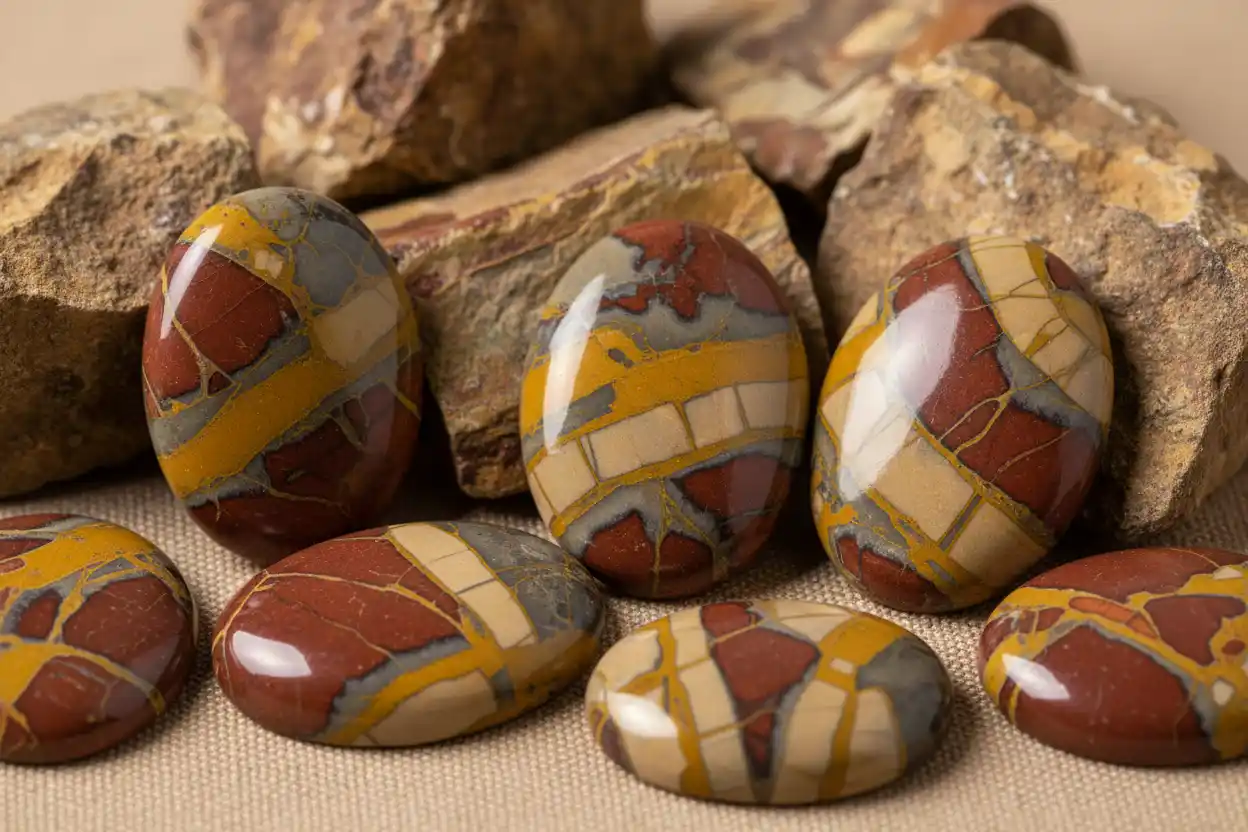
Noreena Jasper is a vividly patterned ornamental rock from Noreena Downs Station in the East Pilbara region of Western Australia. Its red, mustard-yellow, cream, gray, brown, and burgundy areas commonly form angular networks resembling cracked earth, mosaic tiles, abstract maps, or aerial landscapes.
Despite its commercial name, Noreena Jasper is not one mineral species and does not have a single chemical formula or crystal system. Geological descriptions identify it more precisely as a colorful silicified pelite, or silica-hardened mudstone, rather than a conventional single-phase jasper.
Noreena Jasper at a Glance
| Property | Noreena Jasper |
|---|---|
| Material type | Silicified sedimentary rock and locality-based trade material |
| More precise geological description | Silicified pelite or mudstone |
| Main composition | Variable fine-grained silica with iron-rich minerals and remnants of the original sedimentary material |
| Common colors | Brick red, burgundy, mustard yellow, cream, gray, tan, brown, orange, and black |
| Crystal system | No single crystal system applies to the whole rock |
| Typical texture | Fine-grained, massive, fractured, veined, mosaic-like, and locally brecciated |
| Luster | Dull when rough; waxy to vitreous after polishing |
| Transparency | Usually opaque; some thin silica-rich edges may be slightly translucent |
| Mohs hardness | Variable; dense silica-rich areas commonly approach 6.5–7, while altered seams may be softer |
| Cleavage | No single cleavage for the whole rock |
| Tenacity | Brittle, with possible weakness along veins and fractures |
| Common uses | Cabochons, beads, pendants, spheres, slabs, knife handles, carvings, inlay, and display stones |
| Main care concern | Edge chipping, unstable fractures, undercut seams, undisclosed resin, and silica-rich cutting dust |
A Pilbara Trade Stone, Not a Mineral Species
The name Noreena Jasper identifies material from a specific deposit rather than an approved mineral. Its correct classification begins with the distinction between minerals and rocks explained in the broader types of gemstones guide.
A mineral possesses a defined internal structure and a reasonably consistent chemical composition. Noreena Jasper instead contains several microscopic mineral components inherited from mudstone, silicification, iron enrichment, weathering, and fracture filling.
The commercial word jasper remains understandable because the material is opaque, silica-rich, strongly colored, and capable of taking a high polish. Nevertheless, the parent jasper guide should own the general explanation of jasper as an ornamental silica material.
Noreena Jasper’s unique search intent lies in its Pilbara locality, silicified-mudstone identity, fracture-controlled patterns, lapidary behavior, and differentiation from other Australian decorative stones.
The family overview in types of jasper places it among named commercial varieties without requiring every stone called jasper to share exactly the same geological origin.
Geological Origin
The Noreena deposit lies on Noreena Downs Station in Western Australia’s East Pilbara Shire. Specialist locality records associate the material with ancient sedimentary rocks of the Pilbara region.
Noreena Jasper is described as silicified pelite. Pelite is a fine-grained sedimentary rock derived from clay- and silt-rich mud.
The original sediment accumulated in an ancient basin before compaction and lithification transformed it into mudstone. Later silica-rich fluids moved through the rock and replaced or cemented parts of its fine-grained structure.
Silicification increased hardness and allowed the material to accept a durable polish. However, the process did not affect every band or fracture equally.
Subsequent cracking created pathways for additional fluids. Iron-bearing compounds concentrated along many of these discontinuities, producing the branching red, yellow, brown, and gray patterns visible in polished slabs.
The material has also been linked to the Late Archean Jeerinah Formation of the Fortescue Group. Therefore, the host geology is extraordinarily old, although a precise numerical age should describe the formation rather than imply that every visible vein formed at exactly the same moment.
Why Noreena Jasper Looks Like a Mosaic
The characteristic pattern develops from the interaction of fine sedimentary layers, fractures, silica replacement, and iron-rich mineral deposition.
Dark red and burgundy areas commonly owe their color to hematite and related oxidized iron phases. Mustard-yellow and ochre zones frequently reflect goethite or other hydrated iron compounds.
Cream and pale gray areas contain less visible iron or differ in silica content, grain size, weathering, and original sediment composition.
Many pieces contain narrow intersecting veins that divide broader color fields into angular blocks. This geometry produces the brickwork or cracked-earth appearance associated with the best-known material.
Some fractures healed completely with silica and remain structurally sound. Others contain softer or poorly bonded material that may undercut during polishing or reopen after impact.
A visually dramatic line is therefore not automatically a defect, but buyers should distinguish a stable mineral-filled vein from an open crack.
Color Range
Red, burgundy, and rusty orange dominate much commercial Noreena Jasper. However, the material also occurs with mustard yellow, cream, gray, tan, brown, charcoal, and nearly black sections.
Pieces containing both red and yellow can resemble separate red jasper and yellow jasper varieties placed together. Nevertheless, Noreena Jasper should be identified by its deposit, rock type, and combined pattern rather than by isolating each color.
The jasper color guide discusses the wider palette of silica-rich ornamental materials. Noreena’s color story remains more specific because the strongest hues follow ancient sedimentary zones and fracture networks.
Gray portions can provide important contrast rather than indicating low quality. In fact, balanced gray, cream, red, and yellow areas may produce a more detailed composition than a stone dominated by one uniform hue.
Photographs can distort these relationships. Warm lighting intensifies orange and yellow, while aggressive saturation can turn muted burgundy into bright red or gray into blue.
Noreena Jasper and Mookaite
Noreena Jasper and Mookaite both come from Western Australia and commonly contain red, yellow, cream, brown, and purple-toned areas. Their geographic and visual similarities create frequent confusion.
Mookaite is associated with silicified porcelanite and the Windalia Radiolarite in the Carnarvon Basin. Its patterns often form broad flowing zones, patches, breccias, and transitions between saturated colors.
Noreena Jasper is more specifically described as silicified mudstone from the Pilbara. Its signature appearance commonly emphasizes thin angular veins and block-like sections.
Not every piece follows this visual distinction. Mookaite can be brecciated, while Noreena can contain broad color fields. Consequently, source documentation remains more dependable than pattern alone.
Retailers should not use the two names interchangeably merely because both are Australian lapidary materials.
Comparisons with Other Patterned Jaspers
Picture Jasper commonly shows layered, scenic, or landscape-like patterns created by sedimentary structures, mineral staining, and banding. Noreena’s geometry is usually more angular and fracture controlled.
Orbicular Jasper contains rounded or spherical structures rather than dominant crack networks. Those orbs form through radial mineral growth or spherulitic processes.
Ocean Jasper is a Madagascar locality material associated with orbicular or spherulitic silica-rich volcanic rock. It differs in source, geology, and characteristic pattern.
These names describe separate commercial identities. A seller should not relabel ordinary patterned jasper according to whichever name currently commands the greatest attention.
How to Identify Noreena Jasper
The strongest identification combines locality, fine-grained texture, appropriate colors, and an internal mosaic pattern.
A polished surface should show color continuing into the stone rather than a printed or painted design resting on top. Examine the edges, back, drill holes, and any small chips for pattern continuity.
Magnification can reveal fine silica texture, iron-rich veins, natural pits, polishing marks, resin-filled fractures, and concentrated dye.
Dense silica-rich areas generally resist scratching by steel and approach quartz on the Mohs scale. However, local seams may be softer, so a single test cannot describe the entire rock.
Scratch testing should not be performed on a finished cabochon. Instead, the methods in how to identify crystals can help buyers combine luster, texture, density, fracture, and magnification without unnecessary damage.
Advanced analysis may include Raman spectroscopy, X-ray diffraction, microscopy, and elemental testing. A laboratory may report the constituent silica and iron minerals rather than simply certifying the commercial name.
Natural Features and Structural Weaknesses
Small pits can remain where softer grains or altered material undercut during polishing. A few shallow pits may reflect natural texture rather than poor workmanship.
Open cracks deserve greater concern. A fracture extending from the front to the back can break during setting, drilling, or ordinary wear.
Brecciated zones contain fragments separated by later veins or cement. Stable natural breccia can be attractive, but loose or resin-dependent fragments require disclosure.
Cabochon edges should feel solid. Chalky areas, crumbling seams, or glossy pools of filler suggest a weaker piece.
Drilled beads deserve especially close inspection. Radial cracks around a hole can enlarge when cord tension, knots, or metal wire press against the stone.
Jewelry Suitability
Dense Noreena Jasper performs well in pendants, earrings, brooches, cufflinks, beads, bracelets, and protected rings.
Its silica-rich areas provide good scratch resistance for an ornamental rock. Nevertheless, the material remains brittle and can chip at thin edges or along weak veins.
A bezel setting protects the girdle more effectively than widely spaced prongs. Rounded cabochons also distribute stress better than sharp geometric corners.
Rings face more impact than pendants. A low-profile setting is therefore preferable for frequent wear.
Beaded bracelets can be durable when the beads are sound and well drilled. Knots or softer spacers reduce repeated collisions between large stones and metal components.
The comparative gemstone hardness chart explains surface wear, while gemstone toughness versus hardness clarifies why a hard silica-rich stone can still break at a fracture.
Treatments and Imitations
Good Noreena Jasper may require only cutting and polishing. However, resin stabilization can reinforce cracks, fill pits, and bind weaker sections.
Transparent resin may be difficult to see without magnification. Look for glossy material inside fractures, flattened bubbles, or a different luster along filled seams.
Dye can intensify red, yellow, brown, or black. Color concentrated around cracks and drill holes is more suspicious than natural variation across broad internal zones.
Oil or wax may deepen the colors temporarily. Clear coatings can increase gloss but may scratch, peel, or yellow.
Reconstituted material can combine fragments or powder with resin. It may contain genuine Noreena Jasper while no longer being a solid natural piece.
Ceramic, glass, printed resin, and unrelated jasper can imitate its appearance. Repeated patterns, mold seams, round bubbles, low weight, or color that stops at the surface warrant closer inspection.
The broader warning signs appear in how to spot fake crystals, while treatment processes are explained in gemstone treatments.
Current Noreena Jasper Asking Prices
Noreena Jasper remains relatively affordable in common commercial sizes. Exceptional patterning, large stable rough, precise provenance, and designer cutting can raise the price.
| Noreena Jasper product | Broad retail asking range |
|---|---|
| Small tumbled stone | About $3–$10 |
| Standard commercial cabochon | About $4–$20 |
| Large or artist-cut cabochon | About $15–$60 |
| Matched cabochon pair | About $15–$75 |
| Bead strand | About $10–$40 |
| Simple pendant or earrings | About $25–$120 |
| Palm stone or polished freeform | About $15–$60 |
| Small sphere or carving | About $40–$150 |
| Large polished slab, sphere, or display piece | About $100–$500 or more |
| Exceptional old-stock rough or lapidary artwork | Individually priced |
These figures represent broad current retail asking prices rather than formal appraisals or expected resale values.
Very low marketplace prices often reflect mass cutting, heavy discounting, inconsistent origin claims, or stones selected for quantity rather than pattern. A high asking price likewise does not prove authentic provenance.
What Gives Noreena Jasper Value?
Pattern is the principal visual factor. Strong angular networks, balanced color fields, and a design that remains coherent across the cabochon generally attract more interest.
Contrast matters as much as saturation. Cream or gray lines can make red and yellow areas appear more vivid.
Cutting orientation determines whether the design looks intentional. A skilled cutter places the strongest fracture network within the face of the stone rather than cutting through it randomly.
Polish should remain even across differently colored zones. Undercutting, flat spots, deep scratches, and resin pools reduce quality.
Structural stability matters more than sheer size. A large slab crossed by unstable open cracks may be less useful than a smaller sound cabochon.
Verified Noreena Downs or Pilbara provenance adds confidence, particularly for rough and collector slabs. However, a locality story should not override visible workmanship and condition.
Buying Noreena Jasper
Ask whether the seller identifies the stone specifically as Noreena Jasper from Western Australia or merely as an Australian patterned jasper.
Request photographs in neutral light from the front, back, and sides. The best pattern should not depend entirely on one saturated product image.
Examine fracture lines closely. Stable healed veins are acceptable, while open seams, loose fragments, and soft fillings affect wearability.
Ask about resin stabilization, surface filling, dye, coating, wax, and repair. “Natural stone” does not necessarily mean untreated.
Terms such as premium, AAA, museum grade, and rare have no universal grading standard. Pattern, condition, source, polish, and treatment provide more useful comparisons.
General seller checks belong on the jasper buying guide.
Noreena Jasper appears in both the crystals beginning with N directory and the gemstones beginning with N directory, although its correct classification remains a locality-based ornamental rock.
Cleaning and Storage
Clean a sound untreated piece with lukewarm water, mild soap, and a soft cloth or brush. Rinse briefly and dry it completely.
Avoid prolonged soaking when the material contains open fractures, resin, dye, glue, or a porous seam. Water may enter structural weaknesses even when the dense silica remains stable.
The broader guide to crystals in water explains why treatment and construction matter alongside the dominant mineral.
Do not use bleach, strong acids, abrasive powders, or household descaling products. These may damage fillers, polish, metal settings, and weaker iron-rich zones.
Ultrasonic and steam cleaning are unnecessary, particularly for fractured or stabilized pieces.
Store Noreena Jasper away from diamond, sapphire, topaz, and other harder gems that can scratch its polish. A padded compartment also protects thin cabochon edges.
Noreena Jasper Meaning and Symbolism
Modern crystal traditions commonly associate Noreena Jasper with steady action, practical creativity, resilience, and finding order within complicated circumstances.
Its intersecting lines inspire symbolism involving routes, networks, decisions, and the way several experiences can form one larger pattern.
Red and burgundy areas are often linked with vitality and determination, while mustard and cream areas receive associations with optimism, perspective, and grounded thinking.
Because Noreena Jasper is a modern commercial name tied to one Australian deposit, unsupported claims of a universal ancient spiritual tradition should be treated cautiously.
These meanings remain artistic, personal, cultural, or spiritual interpretations. Scientific evidence does not show that Noreena Jasper treats illness, changes luck, or produces guaranteed emotional outcomes.
Frequently Asked Questions
Is Noreena Jasper a true mineral?
No. It is a silicified sedimentary rock rather than one approved mineral species.
Is Noreena Jasper technically jasper?
The lapidary trade uses the jasper name because the material is opaque, silica-rich, and polishable. Geologically, it is more specifically described as silicified pelite or mudstone.
Where does genuine Noreena Jasper come from?
The recognized deposit is at Noreena Downs Station in the East Pilbara region of Western Australia.
What causes its red and yellow colors?
Hematite and related iron oxides contribute red and burgundy, while goethite and other hydrated iron compounds commonly produce yellow and ochre.
Why does Noreena Jasper have a cracked-earth pattern?
Ancient fractures created pathways for silica and iron-bearing fluids. Later mineral filling and staining emphasized the angular network.
How is Noreena Jasper different from Mookaite?
Noreena is a Pilbara silicified mudstone with common fracture-controlled patterns. Mookaite is associated with silicified porcelanite and radiolarite farther south in Western Australia.
Is every line in Noreena Jasper a crack?
No. Many lines are stable, completely mineral-filled veins. Open fractures can still occur and should be checked before purchase.
How hard is Noreena Jasper?
Dense silica-rich sections commonly approach 6.5–7 on the Mohs scale. Softer or altered seams can lower the practical durability of an individual piece.
Is Noreena Jasper usually treated?
Much material is sold after ordinary cutting and polishing, but resin stabilization, filling, wax, oil, coating, and dye can occur.
Can Noreena Jasper be worn in a ring?
Yes, particularly in a low protective bezel. Avoid stones with open fractures or thin unsupported corners.
Can Noreena Jasper go in water?
Brief washing is usually acceptable for intact untreated material. Prolonged soaking is unsuitable when fractures, resin, dye, glue, or coatings are present.
What makes one Noreena Jasper cabochon more valuable?
Strong pattern, balanced contrast, cutting orientation, polish, stable veins, size, treatment disclosure, and verified Western Australian origin all matter.
Noreena Jasper’s angular designs become most effective when the cutter follows the rock’s natural fracture network rather than forcing it into a generic outline. Similar decisions about pattern orientation are explored in the guide to gemstones for carving and cabochons.
Cutting, drilling, grinding, or sanding Noreena Jasper can release respirable silica-rich dust. Use wet lapidary methods, effective local extraction, eye protection, and suitable respiratory protection rather than dry processing.