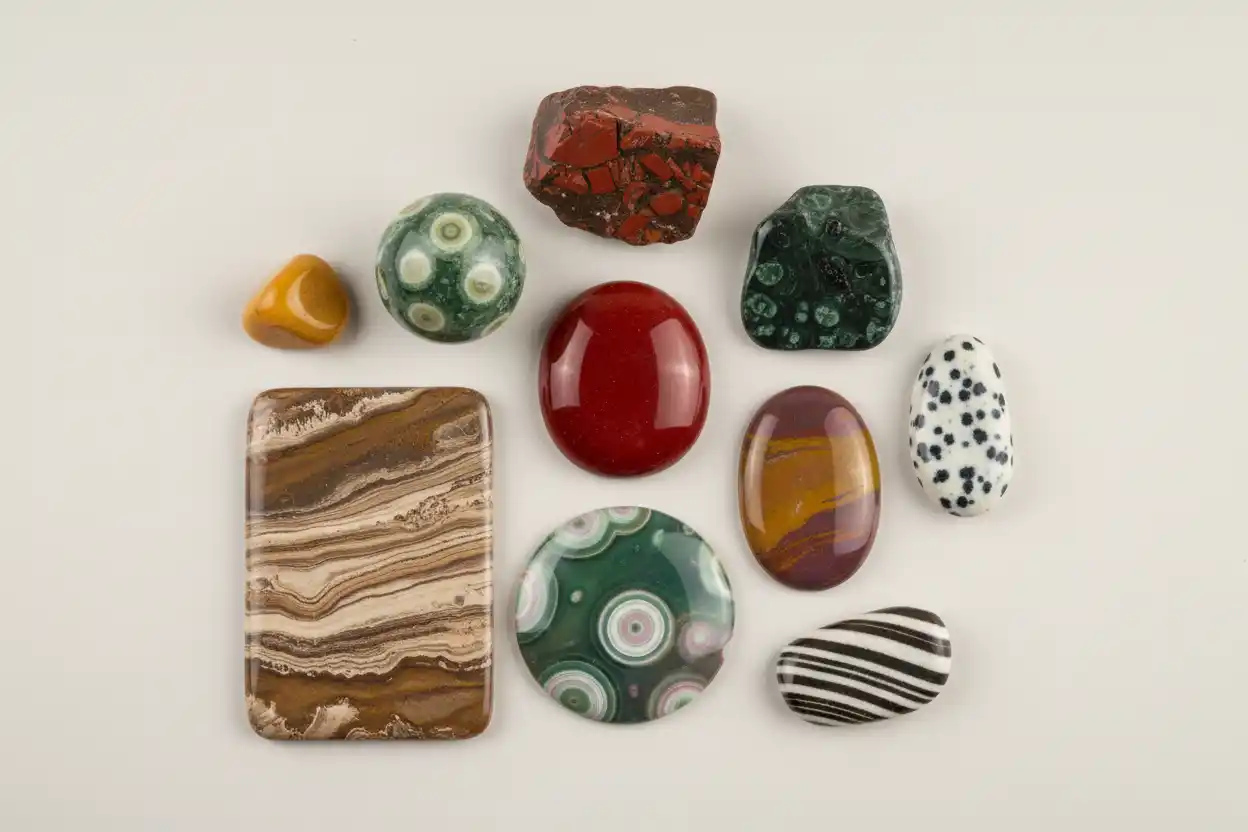
Types of Jasper: Colors and Varieties Explained
Jasper is an opaque, fine-grained silica-rich material colored and patterned by iron oxides, clay, manganese compounds, volcanic fragments, organic structures, and other mineral inclusions. It can appear as solid red stone, desert-like picture patterns, circular orbs, broken-and-cemented breccias, spotted trade materials, or multicolored sedimentary bands.
Its classification is complicated because geologists, mineralogists, lapidaries, and retailers do not always use the word jasper in the same way. Some varieties are genuine microcrystalline quartz or chalcedony, while other popular “jaspers” are rhyolite, silicified sediment, breccia, radiolarite, limestone, or another ornamental rock. The parent jasper meaning and properties guide covers the broad material, while this guide separates its principal varieties and trade categories.
Jasper at a Glance
| Property | Jasper |
|---|---|
| Composition | Mainly microcrystalline quartz and chalcedony, SiO₂, with variable iron oxides, clay, manganese minerals, feldspar, volcanic fragments, and other inclusions |
| Mineral group | Quartz–chalcedony family or silica-rich ornamental rock, depending on the material |
| Main colors | Red, brown, yellow, orange, green, gray, cream, white, black, pink, blue-gray, and multicolored |
| Crystal system or texture | Aggregate of microscopic quartz and chalcedony grains; some trade materials are fine-grained rocks |
| Typical habit | Massive, nodular, bedded, brecciated, orbicular, vein-filled, replacement, and water-worn |
| Luster | Dull to waxy when rough; vitreous to glossy after polishing |
| Transparency | Opaque; occasionally slightly translucent at thin edges |
| Mohs hardness | Usually approximately 6.5–7, but trade-name materials may vary |
| Cleavage | None in true jasper; fracture is typically conchoidal to uneven |
| Tenacity | Brittle, though compact material performs well in carvings and cabochons |
| Common uses | Cabochons, beads, rings, pendants, carvings, boxes, spheres, knife handles, inlay, and mineral specimens |
| Main care concern | Hidden fractures, variable composition, dye or resin, inaccurate trade names, thermal shock, and respirable silica dust during cutting |
What Counts as Jasper?
Strictly defined jasper is opaque microcrystalline silica colored by abundant inclusions.
However, the lapidary trade uses jasper more broadly for attractive opaque rocks that cut and polish well. A material can therefore carry “jasper” in its commercial name even when it is rhyolite, silicified mudstone, radiolarite, altered volcanic rock, breccia, or another mixed composition.
That does not automatically make the name fraudulent. Many trade names have long histories and help buyers recognize a pattern. Nevertheless, sellers should avoid unsupported claims about composition, fossils, locality, or rarity.
Jasper overlaps with chalcedony and quartz, but it is normally more opaque because it contains a larger proportion of fine mineral matter. The broader types of chalcedony guide explains the boundary between plain chalcedony, agate, and jasper.
Red Jasper
Red is the classic jasper color.
Finely dispersed hematite and other iron oxides produce brick red, rust, crimson, brown-red, and orange-red shades. The color may be uniform or broken by white quartz veins, dark mineral lines, yellow patches, and brecciated textures.
Fine red jasper has strong even color, compact texture, and a smooth polish. Material containing open fractures, crumbly areas, or excessive clay may undercut during polishing.
Red jasper occurs worldwide and has been used for beads, seals, carved objects, inlay, and tools for thousands of years.
The dedicated red jasper guide owns its broader material and symbolism intent. The focused carnelian versus red jasper guide explains why carnelian is normally translucent while red jasper is opaque.
Yellow Jasper
Yellow jasper ranges from pale ocher and mustard to golden yellow, tan, and yellow-brown.
Iron hydroxides such as goethite commonly contribute to its color. Heating or natural dehydration can convert yellow-brown iron compounds toward red hematite-rich tones.
Most yellow jasper is opaque and massive. Bands, spots, veins, and brown matrix may create landscape-like patterns.
The planned yellow jasper guide retains the color-specific symbolism, while this article places the material within the wider jasper family.
Brown and Tan Jasper
Brown jasper may appear chocolate, coffee, beige, caramel, rust-brown, or gray-brown.
Iron oxides, clay, organic matter, manganese compounds, and sedimentary particles contribute to the color. Many picture and landscape jaspers use brown as their dominant ground.
Uniform brown material generally has modest commercial value, while exceptional natural scenes, banding, brecciation, or locality provenance can make individual cabochons highly collectible.
Green Jasper
Green jasper can be pale sage, olive, forest green, gray-green, or nearly black green.
Chlorite, amphiboles, epidote, iron-rich minerals, and other inclusions may produce the color. Consequently, not every green trade jasper has the same mineral composition.
Some green jaspers are true opaque chalcedony. Others are silicified volcanic or sedimentary rocks.
Bloodstone and Kambaba material occupy related but distinct trade categories rather than representing every green jasper.
Black, Gray, and White Jasper
Black and gray jasper may contain manganese oxides, carbonaceous material, magnetite, hematite, or dark volcanic components.
White jasper is less common because most opaque silica-rich material contains enough impurities to appear cream, gray, yellow, or brown.
Black-and-white patterns commonly receive zebra, Picasso, spiderweb, or Dalmatian trade labels. Composition varies substantially among those materials.
A polished black stone should not be called jasper solely because it is opaque. Onyx, obsidian, basalt, limestone, glass, and several other materials can appear similar.
Picture Jasper
Picture jasper shows bands, plumes, layers, and color boundaries that resemble deserts, mountains, coastlines, forests, or abstract landscapes.
The scenes form through sedimentary layering, mineral staining, silicification, brecciation, veining, or combinations of those processes. They are natural geological patterns rather than painted images.
Cut orientation determines whether a slab reveals a compelling landscape. A skilled lapidary may study a rough piece for hours before choosing a cut line.
Oregon and other western United States localities are strongly associated with picture jasper, although landscape-patterned silica occurs worldwide.
The most valuable cabochons have clear composition, depth, contrast, strong polish, and minimal fractures.
Landscape Jasper
Landscape jasper is closely related to picture jasper and is sometimes used as a synonym.
Some dealers reserve “landscape” for patterns that clearly resemble a horizon or scenic view, while picture jasper covers a broader range of representational patterns.
Neither term identifies one chemical variety or single locality. The actual geology can include sedimentary jasper, silicified mudstone, volcanic ash, brecciated rock, or mixed chalcedony.
Brecciated Jasper
Brecciated jasper consists of broken jasper fragments cemented by later silica, hematite, chalcedony, quartz, or other minerals.
The fragments may be angular, creating a mosaic-like appearance. Red pieces with white, gray, black, or clear veins are especially common.
Brecciation records physical breakage caused by fault movement, collapse, volcanic activity, sedimentary disruption, or hydrothermal fracturing. Later fluids filled the open spaces and bound the fragments together.
Fine material should have stable cement and closed fractures. Open cracks may trap polishing compound or weaken thin cabochons.
Orbicular Jasper
Orbicular jasper contains round, eye-like, spherical, or concentric structures.
Orbs can form through radial crystal growth, spherulitic volcanic textures, replacement, repeated silica deposition, or mineral aggregates within a fine-grained host.
The trade name covers several geological materials rather than one formation process. Orb size, contrast, color, density, and arrangement vary by deposit.
A well-composed orbicular slab can be more valuable than an evenly colored jasper because every cut produces a different pattern.
Ocean Jasper
Ocean jasper is a trademark-associated orbicular lapidary material from coastal northwestern Madagascar.
Its patterns may include circles, eyes, flowers, waves, bands, druzy cavities, and contrasting patches in green, cream, pink, yellow, red, brown, and gray.
Material came from several deposits and production periods, resulting in substantial variation. Some pieces contain clear or translucent chalcedony, while others are more opaque and rock-like.
Because the name has strong commercial recognition, unrelated orbicular stones are sometimes mislabeled as ocean jasper. Provenance and dealer knowledge matter.
The dedicated ocean jasper buying guide retains detailed authenticity and seller checks.
Kambaba Jasper
Kambaba jasper is a dark green and black orbicular trade material associated with Madagascar and nearby regional supply chains.
It often shows green circular, swirling, or eye-like structures in a nearly black matrix. The polished pattern can resemble algae, forests, or fossil colonies.
Commercial descriptions frequently call it stromatolite or fossilized algae. However, not every marketed specimen has been demonstrated to contain biological fossils, and the material’s precise geological interpretation has been debated.
It is safer to describe Kambaba as a green-black orbicular ornamental rock sold under a jasper trade name unless analytical evidence supports a more specific claim.
The Kambaba jasper buying guide owns treatment and seller considerations.
Mookaite
Mookaite is an Australian lapidary material from the Mooka Creek area of Western Australia.
It commonly displays mustard yellow, cream, white, burgundy, red, purple-red, brown, and pink. Flowing boundaries and broad color fields make it well suited to cabochons and carvings.
Geologically, Mookaite is commonly described as silicified radiolarite, chert, or sedimentary silica derived in part from microscopic marine organisms. It is more specific than a generic color variety of jasper.
The alias “Mookaite jasper” should route to the canonical Mookaite page rather than creating a competing article.
Noreena Jasper
Noreena jasper comes from Western Australia.
It commonly shows red, mustard, cream, tan, and brown fragments separated by darker lines or networks. Patterns may appear geometric, cellular, brecciated, or web-like.
The material is generally described as silicified sedimentary or volcanic-derived rock rather than a single pure mineral variety.
Fine Noreena cabochons have crisp pattern boundaries, warm color contrast, stable structure, and a high polish.
Dalmatian Jasper
Dalmatian jasper is a cream, beige, or pale gray trade material marked with black or dark brown spots.
Despite the name, it is commonly identified as a felsic igneous rock or microgranular material containing feldspar, quartz, and dark amphibole or other minerals rather than strict jasper.
The spots create its commercial appeal. Material is often tumbled, beaded, carved, and cut into cabochons.
Dyed Dalmatian stone also appears in vivid blue, green, pink, or purple. Such colors should be disclosed as treatment rather than presented as rare natural varieties.
The dedicated Dalmatian jasper buying guide handles dyed material and imitation warnings.
Dragon Blood Jasper
Dragon blood jasper is a green-and-red trade material often sold as jasper.
Many examples consist largely of green epidote with red piemontite or other manganese-rich minerals rather than microcrystalline quartz jasper.
The dramatic color contrast explains the name, but sellers should not convert a trade label into an unsupported composition claim.
Material varies by source. Some stones contain more silica, while others are dominated by metamorphic minerals.
Picasso Jasper
Picasso jasper typically shows black, gray, white, cream, and brown lines crossing a pale background.
It is often described as metamorphosed limestone, marble, or another carbonate-rich ornamental rock rather than strict silica jasper.
The intersecting lines may come from fractures, mineral veins, stylolitic features, or metamorphic structures.
Acid sensitivity and hardness can therefore differ from true quartz-rich jasper. Buyers should not assume every Picasso jasper will tolerate the same care as red jasper.
Zebra Jasper
Zebra jasper is a broad trade name for striped, banded, or patchy material in contrasting colors.
Red and cream, brown and white, black and white, green and cream, and yellow-brown combinations all enter the market.
Some material is true jasper or chalcedony. Other zebra stones are calcite, marble, serpentine, rhyolite, or mixed sedimentary rock.
The name should therefore be followed by a reliable composition description whenever possible.
Ocean, Orbicular, and Poppy Patterns
Poppy jasper generally describes red, yellow, brown, or cream orbicular material whose circles resemble flower heads.
Morgan Hill poppy jasper from California is historically important, but the trade also applies the name to unrelated orbicular material.
Ocean jasper, poppy jasper, and generic orbicular jasper overlap visually. Locality and geological context separate the names more reliably than color alone.
Leopard Skin Jasper
Leopard skin jasper is a trade name for spotted or orbicular material with red, brown, tan, cream, black, pink, or green markings.
Much material sold under the name is rhyolite rather than true jasper. “Leopard skin rhyolite” may therefore be a more accurate description.
The name remains useful for pattern recognition, but it should not be presented as a formally defined silica variety.
Polychrome Jasper
Polychrome jasper displays broad flowing areas of red, brown, cream, blue-gray, green, orange, and yellow.
Madagascar is a major commercial source. The material often appears as rounded nodules or masses suitable for freeforms, spheres, and substantial carvings.
Its colors are commonly less sharply banded than agate. Instead, they form sweeping fields, circular patches, and abstract landscape patterns.
Fine pieces balance several colors without excessive cracks or dull porous areas.
Imperial Jasper
Imperial jasper is a trade name associated with fine patterned jasper from Mexico.
Material may display soft pink, green, cream, brown, red, and gray in orbicular, banded, or flowing patterns.
The word imperial describes perceived quality and market identity rather than a mineralogical grade comparable across all sellers.
Dyed and imitation material exists, so unusually vivid colors and low prices deserve scrutiny.
Porcelain Jasper
Porcelain jasper usually describes very fine-grained, smooth, dense material capable of taking a porcelain-like polish.
It may occur in cream, gray, pink, red, brown, green, or multicolored patterns. Some trade materials called porcelain jasper are rhyolitic or volcanic rocks.
Quality depends on polish, color, pattern, structural integrity, and origin rather than a fixed chemical composition.
Bloodstone
Bloodstone is traditionally dark green chalcedony or jasper marked with red, orange-red, or brown iron-oxide spots.
The classic visual contrast led to its historic heliotrope name. Some material is slightly translucent at thin edges, while other pieces are fully opaque.
Bloodstone belongs near the boundary between chalcedony and jasper. Its dedicated article should own its history, meaning, and material-specific buying concerns.
Jasper–Agate and Jasper–Chalcedony Material
Many nodules contain opaque jasper beside translucent chalcedony or banded agate.
Later silica veins may cut through earlier jasper. Alternatively, jasper fragments may become cemented by clear chalcedony.
Such mixed material can be sold as jasper-agate, jasp-agate, brecciated agate, or agate-jasper. The most accurate term depends on which component dominates and how the pattern formed.
The parent agate guide and its dedicated types of agate guide retain the banded translucent side of that overlap.
Jasper Formation and Geology
Jasper forms through several geological pathways rather than one universal process.
Silica-rich fluids can replace limestone, volcanic ash, sediment, wood, shells, and other materials. Iron and manganese compounds remain trapped as the silica hardens, producing color.
Bedded jasper may develop with chert in marine sedimentary environments. Some red jasper is associated with banded iron formations, where iron-rich and silica-rich layers accumulated in ancient oceans.
Hydrothermal activity can silicify volcanic rocks and fill fractures. Faulting or collapse can break earlier jasper into fragments that later become brecciated material.
Rhyolitic and volcanic rocks may develop spherulites, flow bands, or alteration patterns that resemble jasper and enter the lapidary market under jasper trade names.
Mining and Localities
Jasper occurs worldwide because silica-rich fluids and iron-bearing rocks are widespread.
The western United States is famous for picture, landscape, poppy, Morrisonite, Biggs, Owyhee, Bruneau, and other locality-specific jaspers.
Madagascar supplies ocean, polychrome, Kambaba, and numerous commercial patterned stones. Western Australia produces Mookaite, Noreena, and other distinctive lapidary materials.
Mexico supplies imperial, leopard-skin-type, rhyolitic, and multicolored trade jaspers. India, Indonesia, Brazil, Russia, Egypt, South Africa, and many other regions produce commercial rough.
Small deposits may be exhausted quickly because a colorful seam can be narrow or inaccessible. Locality provenance therefore influences collector value even when the material itself is not intrinsically rare.
Inclusions and Pattern Formation
Hematite produces many red and brown colors. Goethite and limonite contribute yellow, ocher, and brown. Manganese oxides create black dendrites, lines, and patches.
Clay can create cream, gray, and muted colors. Chlorite, epidote, amphiboles, and related minerals contribute green.
Brecciation creates angular fragments. Orbicular patterns arise through radial or spherulitic structures, replacement fronts, or repeated growth around nuclei.
Veins may consist of quartz, chalcedony, calcite, hematite, or another mineral. Because some vein minerals are softer than the host, they may undercut during polishing.
How Jasper Is Identified
True jasper is normally opaque, approximately 6.5–7 in hardness, and lacks cleavage. It commonly breaks with conchoidal or uneven fracture.
The gemstone hardness chart helps distinguish quartz-rich jasper from softer calcite, marble, and serpentine trade materials.
Specific gravity, refractive index, microscopic texture, acid reaction, Raman spectroscopy, and X-ray diffraction can establish composition when a trade name is ambiguous.
Home scratch and acid tests can damage polished objects. A lapidary or gemologist should examine valuable or composition-sensitive material.
Common Lookalikes and Mislabels
Dyed howlite, magnesite, marble, calcite, rhyolite, serpentine, quartzite, glass, and resin may be sold as jasper.
Some labels are accepted trade conventions rather than deliberate deception. Dalmatian, Picasso, dragon blood, leopard skin, and zebra jasper can describe visual patterns even when the underlying rock is not strict jasper.
Problems arise when sellers claim false fossils, rare minerals, healing chemistry, or prestigious locality without evidence.
A trustworthy description should separate the trade name from the tested or probable composition.
Treatments and Imitations
Dyeing is the most common jasper treatment. Porous or fractured material can absorb strong blue, green, purple, pink, red, or black dye.
Color may concentrate in cracks, pits, drill holes, and softer matrix areas. Unnaturally uniform vivid color can also indicate treatment.
Wax, oil, resin, and polymer may improve polish or stabilize fractured material. Reconstituted jasper can combine fragments or powder with resin and pigment.
Heat may deepen iron-related colors, though it is not disclosed consistently in low-cost lapidary material.
The broader gemstone treatments guide explains disclosure terminology.
Cutting Behavior
Compact jasper is one of the most versatile lapidary materials.
It can be sawn into slabs, trimmed, domed, drilled, carved, tumbled, engraved, and polished. Most jasper becomes cabochons because faceting provides little benefit to opaque material.
Pattern orientation is critical. Picture jasper must preserve the horizon, orbicular material should center attractive circles, and brecciated pieces need stable cement between fragments.
Mixed compositions can undercut. A soft calcite vein may polish lower than the surrounding quartz, while porous areas may remain dull.
Hidden fractures can open during sawing or drilling. Skilled cutters stabilize fragile slabs only when necessary and disclose resin treatment.
Durability and Jewelry Suitability
True jasper’s hardness near 6.5–7 and lack of cleavage make it suitable for rings, bracelets, pendants, earrings, beads, and carvings.
However, hardness varies when a trade-name stone contains feldspar, calcite, amphibole, or other minerals. The gemstone toughness versus hardness guide explains why compact texture and fracture condition matter as much as a single Mohs number.
Thin cabochons, sharp corners, open breccias, and drilled beads can chip or snap. A protective bezel helps valuable picture, ocean, or orbicular cabochons.
Jasper Prices in 2026
Most jasper remains affordable because it occurs in substantial quantities and is usually sold by piece rather than carat.
Small tumbled stones and ordinary rough commonly sell for $1–$10. Palm stones, towers, small spheres, and commercial carvings often range from $10–$75.
Mass-produced cabochons commonly cost approximately $5–$25 each. Hand-cut picture, ocean, Noreena, Mookaite, imperial, and orbicular cabochons frequently range from $15–$75.
Exceptional scenic or designer cabochons can sell for $75–$300 or more. Rare old-stock locality material, large matched slabs, important lapidary art, or museum-quality polished objects may command several hundred or several thousand dollars.
Ordinary rough often sells by pound, slab, or kilogram. Pattern yield matters more than raw weight because much of a nodule may lack attractive color or remain too fractured to cut.
The dedicated jasper buying guide should retain future seller comparisons and detailed transaction guidance.
Buying Guidance
Start with the pattern and actual composition rather than the prestige of a trade name.
Ask for the country or mine when known, treatment disclosure, stabilization history, dimensions, and photographs of both sides. A thin cabochon may look vivid over a black background but appear pale in a setting.
Inspect pits, fractures, dull zones, undercut veins, dye concentrations, and resin-filled cavities.
For ocean, Kambaba, Dalmatian, dragon blood, Picasso, zebra, and similar trade materials, request an honest description of what the stone probably is rather than demanding an unsupported “pure jasper” claim.
The dedicated buying pages for picture jasper, red jasper, and Dalmatian jasper retain their narrower transaction intent.
Cleaning Jasper
Solid untreated jasper can usually be cleaned with lukewarm water, mild soap, and a soft brush.
Rinse briefly and dry it thoroughly. Avoid abrupt temperature changes because hidden fractures or mixed mineral veins can respond unevenly.
Strong acids, bleach, solvents, abrasive powder, and metal-polishing compounds may damage polish, dye, resin, or softer components.
Ultrasonic cleaning may be acceptable for sound untreated true jasper, but it is inappropriate for fractured, resin-filled, glued, dyed, brecciated, mixed-composition, or unknown material. Conservative hand cleaning is safer.
Storage and Sunlight
Store polished jasper separately from diamond, sapphire, topaz, and other harder stones that can scratch it.
Most natural iron-oxide colors remain stable under ordinary light. However, dyes, resin, and some coatings can fade or discolor under prolonged heat and direct sunlight.
The broader crystals that fade in sunlight guide provides conservative display practices.
Large spheres and carvings require stable stands because a fall can chip edges or damage flooring despite the material’s reasonable durability.
Meaning and Symbolism
Jasper has acquired a wide range of symbolic associations because cultures have used red, yellow, green, brown, patterned, and carved forms for thousands of years.
Modern spiritual traditions often associate red jasper with steadiness, yellow jasper with confidence, picture jasper with connection to landscape, ocean jasper with adaptability, and orbicular patterns with cycles or continuity.
The detailed comparison among colors belongs in the jasper color meaning guide.
Trade-name symbolism should remain separate from geology. A stone marketed as dragon blood or Dalmatian jasper does not gain scientifically demonstrated emotional or medical properties from its commercial name.
Frequently Asked Questions
1. How many types of jasper are there?
There is no fixed number. Jasper is classified by color, pattern, texture, locality, geological origin, and trade name, with new commercial names appearing regularly.
2. Is jasper a type of quartz?
True jasper consists mainly of microcrystalline quartz and chalcedony with abundant inclusions. Some trade-name jaspers are other ornamental rocks.
3. What is the most common jasper color?
Red, brown, and yellow are especially common because iron oxides and hydroxides are widespread color-producing inclusions.
4. What is the difference between jasper and agate?
Jasper is normally opaque and inclusion-rich, while agate is generally translucent and banded. Mixed jasper-agate materials contain both textures.
5. Is ocean jasper a true jasper?
Ocean jasper is an orbicular chalcedony-rich lapidary material from Madagascar sold under an established trade name. Its exact mineral proportions vary.
6. Is Kambaba jasper fossilized algae?
It is frequently marketed as stromatolitic or fossil material, but not every specimen has been scientifically demonstrated to contain biological fossils. A cautious description is green-black orbicular ornamental rock.
7. Is Dalmatian jasper really jasper?
Most Dalmatian jasper is better described as a light-colored felsic igneous rock with dark mineral spots rather than strict microcrystalline jasper.
8. What creates picture jasper landscapes?
Natural layering, mineral staining, silicification, brecciation, and veining create patterns that resemble landscapes when cut in a favorable orientation.
9. Is dragon blood jasper quartz?
Many examples are dominated by green epidote and red piemontite or related minerals, so the trade name does not guarantee quartz-rich jasper.
10. Can jasper be dyed?
Yes. Porous or fractured jasper can absorb strong dye, often visible in cracks, pits, drill holes, and softer areas.
11. Is jasper suitable for everyday rings?
Sound untreated quartz-rich jasper generally performs well in protected rings. Mixed-composition, brecciated, filled, or heavily fractured material needs more caution.
12. Which type of jasper is most valuable?
One-of-a-kind scenic picture jasper, fine ocean or orbicular material, rare old-stock localities, and exceptional lapidary art can command the strongest premiums.
Jasper is best understood as both a silica-rich gem category and a broad lapidary naming tradition. Red hematite-rich jasper, Australian Mookaite, scenic picture stone, Madagascar ocean jasper, brecciated mosaics, and spotted Dalmatian trade rock may share a retail shelf, yet their geology and composition can differ substantially. Careful naming preserves the visual appeal of each material without turning trade terminology into false mineral science. Related entries appear in the crystals that start with J directory and the gemstones that start with J guide.
Safety disclaimer: Cutting, grinding, drilling, or polishing jasper and other silica-rich lapidary materials can release respirable crystalline silica dust, which can cause permanent lung disease. Use wet-cutting methods, effective local extraction, eye protection, and correctly rated respiratory protection; never dry-grind jasper in an unventilated space.