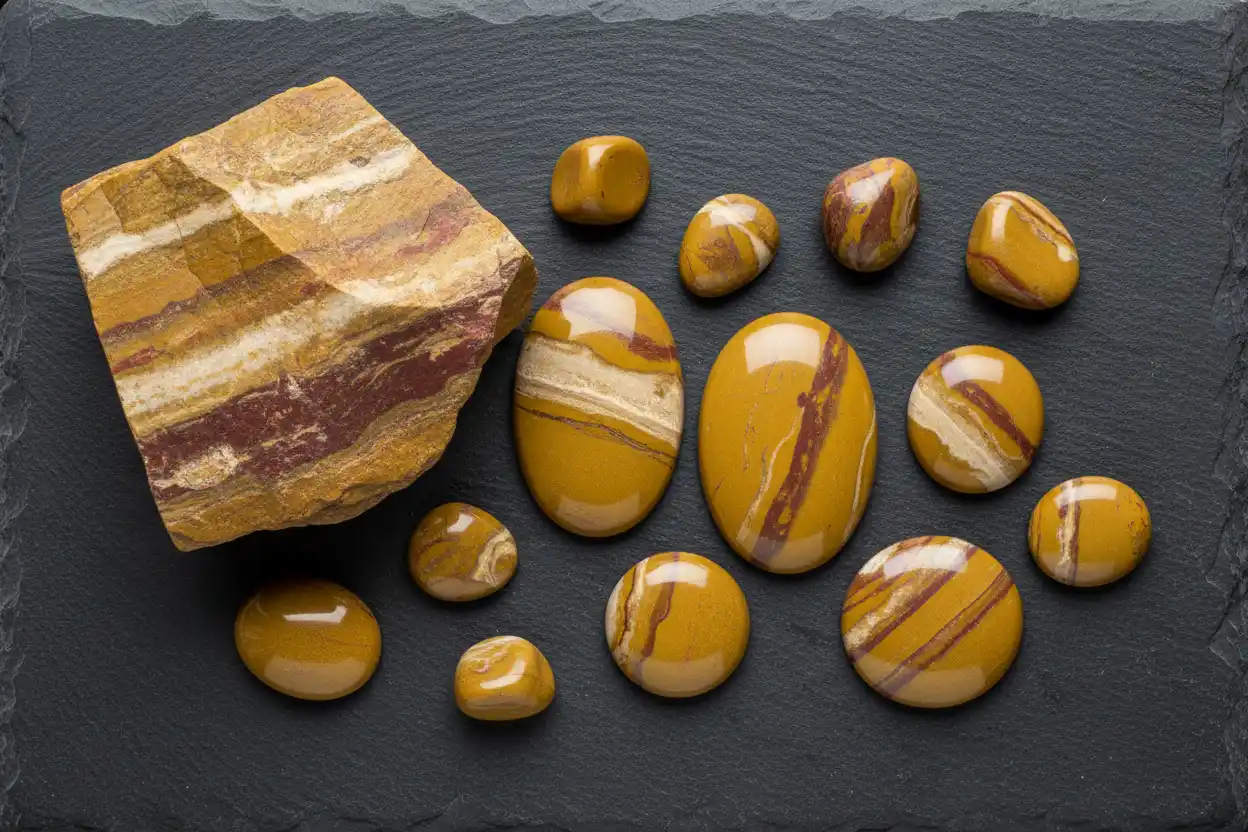
Yellow Jasper: Meaning, Properties & Symbolism
Yellow jasper is an opaque, silica-rich lapidary material whose colors range from pale ochre and mustard to golden yellow, yellow-brown and cream. Iron oxides and hydroxides commonly produce its warm coloration, while clay, manganese compounds and other impurities create spots, veins and contrasting patterns.
The name identifies a color category within the wider jasper family, not a separate mineral species. Because jasper trade names are applied inconsistently, buyers should confirm that a product is dense quartz-rich jasper rather than calcite, marble, rhyolite, serpentine or another yellow ornamental rock.
Yellow Jasper at a Glance
| Property | Yellow Jasper |
|---|---|
| Material type | Opaque microcrystalline quartz or chalcedony-rich rock |
| Main composition | Primarily SiO₂ with iron oxides, clay and other mineral impurities |
| Mineral family | Quartz and chalcedony |
| Typical colors | Pale yellow, mustard, ochre, golden yellow, cream, tan, yellow-brown and yellow with red or black patterns |
| Common coloring materials | Goethite, limonite-group iron hydroxides, hematite and other iron-rich inclusions |
| Crystal structure | Aggregate of microscopic quartz and chalcedony grains |
| Luster | Dull to waxy when rough; waxy to vitreous after polishing |
| Transparency | Opaque, occasionally translucent along very thin edges |
| Refractive index | Spot reading commonly near 1.53–1.54 |
| Specific gravity | Commonly approximately 2.5–2.9 |
| Mohs hardness | Approximately 6.5–7 |
| Cleavage | None |
| Tenacity | Generally tough for a brittle siliceous material |
| Common cuts | Cabochons, beads, tumbles, carvings, slabs and inlay |
| Main care concern | Misidentification, dye, resin stabilization and silica dust during cutting |
What Is Yellow Jasper?
Jasper is a broad lapidary term for dense, opaque material composed largely of microcrystalline quartz or chalcedony.
Its microscopic silica grains are mixed with enough impurities to prevent ordinary transparency. Those impurities also produce the wide range of colors and patterns associated with jasper.
Yellow jasper contains a dominant yellow, mustard, ochre or golden-brown appearance. Some pieces are nearly uniform, while others contain cream bands, red patches, brown veins or black manganese markings.
The material is chemically related to chalcedony and crystalline quartz, but its fine aggregate texture and abundant inclusions give it different visual and cutting characteristics.
The wider classification remains with Types of Jasper, while this page owns yellow jasper’s specific appearance, treatment, identification and care intent.
Is Yellow Jasper a Formal Mineral Variety?
Yellow jasper is a legitimate commercial and lapidary name, but it is not one formally defined mineral species.
The term describes opaque quartz-rich material with a dominant yellow color. It does not require one fixed deposit, pattern or trace-element concentration.
Consequently, two products sold as yellow jasper may contain different proportions of quartz, chalcedony, iron oxides, clay and other minerals.
Some commercial material may not meet a strict quartz-rich definition at all. Sellers occasionally apply jasper to attractive opaque rocks because the name is familiar and marketable.
For this reason, yellow jasper should be treated as a descriptive gem-rock category rather than a chemically uniform mineral variety.
What Makes Jasper Yellow?
Iron is the principal source of most natural yellow jasper coloration.
Goethite and related hydrated iron oxides commonly produce yellow, mustard and ochre tones.
Limonite is an older field and trade term applied to mixtures of hydrated iron oxides and iron-rich alteration products. It can create yellow-brown, ochre and rusty areas.
Hematite produces stronger red or reddish-brown zones. A yellow specimen with red patches may therefore contain both hydrated and less-hydrated iron compounds.
Fine clay particles can soften the color toward cream, tan or beige.
Manganese oxides may form black spots, veins and dendritic markings.
The exact mineral responsible for one yellow area cannot always be identified visually. Raman spectroscopy, X-ray diffraction or chemical analysis may be required when detailed composition matters.
Yellow Jasper Colors and Patterns
Pale Yellow Jasper
Pale material ranges from cream-yellow to light straw.
It may contain fewer iron oxides or more pale silica and clay than strongly colored stone.
A weak color does not automatically indicate bleaching. Natural deposits can produce broad pale areas.
Mustard Jasper
Mustard-yellow is one of the most familiar commercial appearances.
The color is usually muted and earthy rather than bright lemon yellow.
Mustard material works well in beads, carvings and tumbled stones because minor scratches remain less obvious than on highly polished dark stone.
Golden Yellow Jasper
Golden material displays warmer and more saturated yellow-brown coloration.
Sellers may describe it as gold jasper, honey jasper or golden jasper, though these names lack standardized boundaries.
Metallic sparkle should not occur unless the material contains reflective mica, pyrite or another included mineral.
Yellow and Red Jasper
Yellow jasper commonly contains red hematite-rich patches or bands.
When red dominates, the material belongs more naturally with red jasper.
When yellow remains the primary face-up color, red areas can add contrast without changing the commercial classification.
Yellow Picture Jasper
Yellow and brown layers sometimes create scenes resembling dunes, mountains or landscapes.
When scenic patterns dominate, the stone overlaps picture jasper.
The picture-jasper page should retain landscape-pattern intent, while this article covers yellow coloration and broader identification.
Yellow Orbicular Jasper
Rounded circles and spots can occur in yellow, cream and brown jasper.
Orbicular patterning belongs structurally with orbicular jasper and, where locality permits, ocean jasper.
A yellow orbicular stone should not be called Ocean Jasper without Madagascar provenance and the appropriate deposit history.
Yellow Zebra Jasper
Yellow-and-cream or yellow-and-black stripes can be sold as Zebra Jasper.
The striped trade-name issues remain with Zebra Jasper.
Yellow Mookaite
Mookaite commonly includes yellow, cream, red, burgundy and purple areas.
It is a locality-linked Australian material rather than a generic name for every multicolored yellow jasper.
How Yellow Jasper Forms
Jasper can form through several geological processes, which helps explain its inconsistent composition.
Silica-rich fluids may replace sediment, volcanic ash, carbonate rock or earlier minerals while preserving some original texture.
Fine silica can precipitate directly in fractures, cavities and sedimentary environments.
Hydrothermal fluids may deposit chalcedony and quartz while introducing iron compounds.
Iron-rich mud, clay and volcanic material can become silicified during burial or metamorphism.
Weathering converts iron-bearing minerals into hematite, goethite and related oxides or hydroxides, creating red, yellow and brown zones.
Repeated silicification can bind the rock into a dense mass capable of taking a strong polish.
Unlike agate, jasper normally lacks translucent concentric banding. However, natural material can grade continuously between agate, chalcedony and opaque jasper.
Important Sources
Yellow jasper occurs in many countries because silica and iron are widespread.
India is a major commercial supplier of yellow jasper rough, beads and carvings.
South Africa produces yellow, red, brown and patterned jasper from several deposits.
Australia contains extensive yellow and multicolored jasper, including the Mooka Creek material sold as Mookaite.
Madagascar supplies yellow, cream, brown and orbicular jasper used for carvings and polished objects.
Brazil produces jasper, agate and silicified rock in a broad range of colors.
The United States contains yellow jasper in Oregon, Idaho, California, Arizona and several additional western states.
Mexico, Indonesia, Russia and parts of Europe also provide commercial material.
Broad country origin rarely creates a major premium. Mine-level provenance, unusual pattern and lapidary quality matter more.
Internal Features and Mineral Inclusions
Yellow jasper’s opaque structure hides many conventional transparent-gem inclusions.
Instead, collectors examine grain texture, mineral spots, veins, fractures and color boundaries.
Goethite and iron hydroxides produce yellow or brown clouds and patches.
Hematite creates red areas and may form microscopic platelets.
Manganese oxides can produce black dendrites, spots and irregular veins.
Clay minerals may create pale soft-looking bands.
Quartz veins can cross the opaque jasper as white, gray or translucent lines.
Small cavities may contain druzy quartz crystals.
Brecciated pieces contain angular fragments cemented by later silica or iron-rich material.
Yellow Jasper Versus Yellow Chalcedony
Both materials consist largely of microcrystalline quartz.
Yellow chalcedony is normally translucent enough to transmit noticeable light, particularly around its edges.
Yellow jasper is opaque because it contains more inclusions or a coarser, less uniformly transmitting structure.
The boundary is not always sharp. One stone can contain translucent chalcedony seams within opaque yellow jasper.
Commercial names often emphasize appearance rather than strict microscopic composition.
Yellow Jasper Versus Yellow Calcite
Yellow Calcite is much softer, measuring only 3 on the Mohs scale.
Calcite has perfect rhombohedral cleavage and reacts rapidly with dilute acid.
Yellow jasper approaches quartz hardness, lacks cleavage and does not effervesce in ordinary acid testing.
Calcite carvings often show a softer, waxier or slightly translucent appearance, while jasper takes a harder, more glass-like polish.
Acid and scratch testing should be restricted to expendable rough because both methods permanently damage the sample.
Yellow Jasper Versus Yellow Opal
Yellow opal is hydrated silica rather than microcrystalline quartz.
It generally has lower hardness and may appear more waxy, porous or translucent.
Precious yellow opal can display play-of-color, which jasper does not.
Common yellow opal and yellow jasper can overlap visually. Refractive index, density, microscopic texture and spectroscopy provide stronger separation.
Yellow Jasper Versus Yellow Quartzite
Quartzite is a metamorphic rock composed largely of interlocking quartz grains.
Its texture may appear sugary or granular under magnification.
Jasper is much finer-grained and normally shows an opaque, compact structure.
Commercial sellers sometimes use yellow quartzite, jasper and yellow quartz interchangeably, especially for beads and carvings.
A precise description should identify the rock texture rather than relying only on color.
Yellow Jasper Versus Bumblebee Stone
Material commonly sold as Bumblebee Jasper is generally not true jasper.
It is associated with volcanic fumarolic deposits and may contain calcite, sulfur-bearing minerals, arsenic-bearing phases and other components.
Its vivid yellow, orange and black bands differ from the more muted iron-related colors of ordinary yellow jasper.
Bumblebee material also requires stricter safety consideration and should not be grouped automatically with quartz-family jasper.
Identifying Real Yellow Jasper
A genuine quartz-rich jasper should resist scratching by ordinary steel.
Its hardness generally approaches 6.5–7, though mixed areas can be slightly softer.
A spot refractive-index reading near 1.53–1.54 supports chalcedony or microcrystalline quartz.
Specific gravity usually lies near 2.6, although heavy iron minerals can increase it.
Magnification may show a dense granular texture, iron-rich patches, quartz veins and natural fractures.
The material should not contain rounded gas bubbles, mold seams or a plastic-rich surface.
Raman spectroscopy and X-ray diffraction can determine whether quartz, calcite, feldspar or another phase dominates.
The broader testing approach appears in How to Identify Crystals.
Treatments, Dye and Stabilization
Most dense yellow jasper is naturally colored.
Dye can intensify pale yellow, red, black, blue or green areas, especially in porous or fractured material.
Artificial color often concentrates in drill holes, cracks and lighter bands.
Resin stabilization can strengthen weak, brecciated or porous rough.
Wax and oil may deepen color or hide fine scratches temporarily.
Clear coatings can create a glossy surface over material that does not polish well naturally.
Reconstituted stone combines jasper fragments or powder with resin.
Ceramic, glass and molded resin imitate yellow jasper patterns.
The complete disclosure categories appear in Gemstone Treatments Explained and the practical color checks in How to Spot Dyed Crystals.
Cutting and Polishing
Yellow jasper is a practical lapidary material because its dense microcrystalline structure normally accepts a strong polish.
Cabochons display color patches, veins and scenic patterns without requiring transparency.
Free-form cuts allow the cutter to preserve the strongest yellow and red composition.
Beads are widely produced because jasper tolerates drilling better than many cleavable minerals.
Slabs can be bookmatched to create mirrored patterns.
Carvers use yellow jasper for animals, seals, bowls and decorative forms.
Mixed material can undercut where clay-rich or fractured zones are softer than the surrounding quartz.
The material suits the methods discussed in Best Gemstones for Carving and Cabochons.
Tumbling Yellow Jasper
Dense yellow jasper works well in a rock tumbler.
Pieces should be placed with stones of similar hardness to prevent bruising and uneven grinding.
Fractured rough may break into smaller pieces during coarse grit.
Porous areas can trap slurry and polishing compound.
The process described in Rock Tumbling for Beginners should include a careful inspection between stages.
Finished yellow jasper is common among tumbled stones because its opaque color hides minor internal flaws while the surface develops a durable shine.
Hardness, Toughness and Jewelry Suitability
Yellow jasper generally measures 6.5–7 on the gemstone hardness chart.
It resists ordinary scratches better than calcite, fluorite, opal and feldspar.
The stone has no cleavage, which reduces the chance of a clean split along one structural plane.
Nevertheless, jasper remains brittle and can chip when struck against concrete, tile or metal.
The difference between scratch resistance and breakage resistance appears in Gemstone Toughness vs Hardness.
Cabochons work well in rings, pendants, earrings and bracelets.
Thin points, sharp carving details and fractured slabs require more protection than thick rounded stones.
Yellow Jasper Prices in 2026
Yellow jasper is abundant and normally inexpensive.
Small tumbled stones commonly retail for approximately $1–$6 each.
Commercial cabochons usually range from $3–$20, depending on size, pattern and polish.
Current rough listings commonly begin around $8–$15 for small parcels or selected pieces.
Bulk tumbling and cutting rough often sells for approximately $5–$20 per pound.
Better designer cabochons with strong picture patterns, contrasting red zones or excellent polish commonly range from $20–$75.
Large matched pairs, specialty carvings and unusually scenic slabs may sell for $75–$250 or more.
Most premiums come from cutting, artistic pattern and finished workmanship rather than mineral rarity.
What Determines Value?
Color should appear natural and attractive rather than muddy or artificially neon.
Strong contrast between yellow, cream, red and brown can create a more desirable design.
Pattern placement matters. A small cabochon with a complete landscape-like scene can outperform a larger randomly patterned stone.
The polish should be smooth and reflective without pits, orange-peel texture or resin buildup.
Fractures reduce durability, particularly when they cross a ring stone or drill hole.
Treatment disclosure affects collector confidence.
Documented locality can add value when the deposit produces a recognizable and sought-after pattern.
Buying Guidance
Use Where to Buy Real Jasper for the broader seller checklist.
Request photographs under neutral lighting because warm bulbs can exaggerate golden tones.
Inspect the reverse side and drill holes for concentrated dye.
Ask whether the material is quartz-rich jasper, calcite, serpentine, rhyolite or another ornamental rock.
Do not pay a major premium for unsupported labels such as AAA, healing grade or rare golden jasper.
Check for resin, coating, wax and filled fractures.
For rings and bracelets, choose thick cabochons with no cracks reaching the edge.
Cleaning, Water and Sunlight
Clean untreated yellow jasper with lukewarm water, mild soap and a soft brush.
Rinse and dry it thoroughly.
Brief water contact is normally safe for solid untreated material. Avoid prolonged soaking when dye, resin, glue or porous sections may be present.
The general guidance in Which Crystals Can and Cannot Go in Water should be adapted to treatment and setting materials.
Avoid acids, bleach and abrasive household powders.
Ultrasonic cleaning may damage fractured, stabilized or composite stones.
Natural iron-related yellow coloration is normally stable under ordinary indoor light. Dyes and resin may fade or yellow during prolonged heat or sunlight.
The wider display guidance appears in Crystals That Fade in Sunlight.
Meaning and Symbolism
Modern crystal traditions associate yellow jasper with steady confidence, patience, practical optimism and completing tasks through consistent effort.
Its earthy yellow color encourages symbolism involving warmth and motivation without the intensity sometimes assigned to bright transparent yellow gems.
Red and brown patches can add interpretations involving endurance and connection with the physical world.
Some people use yellow jasper as a reminder to make realistic progress rather than wait for perfect conditions.
These meanings are cultural, spiritual or personal rather than scientifically demonstrated effects.
The broader color symbolism appears in Jasper Color Meaning and Symbolism.
Yellow jasper also appears in modern collections of yellow crystals and yellow gemstones.
Frequently Asked Questions
1. Is yellow jasper a real natural stone?
Yes. Natural opaque quartz-rich material containing yellow iron oxides and other impurities is widely available.
2. Is yellow jasper a separate mineral?
No. It is a color category within jasper, which is primarily an opaque microcrystalline quartz or chalcedony material.
3. What makes yellow jasper yellow?
Goethite, hydrated iron oxides and other iron-rich inclusions commonly produce yellow, ochre and mustard colors.
4. Is yellow jasper the same as yellow chalcedony?
They share microcrystalline quartz composition, but yellow chalcedony is usually more translucent while jasper is opaque.
5. How is yellow jasper different from yellow calcite?
Jasper is much harder, lacks cleavage and does not react rapidly with dilute acid.
6. Is Bumblebee Jasper a type of yellow jasper?
Generally no. Bumblebee material is a volcanic, carbonate- and sulfur-bearing ornamental rock rather than conventional quartz-rich jasper.
7. Is yellow jasper dyed?
Much material is naturally colored, although dye, resin, wax and coatings can occur.
8. Can yellow jasper be tumbled?
Yes. Dense material generally tumbles well when placed with stones of similar hardness.
9. Is yellow jasper suitable for rings?
Yes. Thick, unfractured cabochons are durable enough for regular jewelry use.
10. Can yellow jasper go in water?
Brief washing is normally safe for untreated solid jasper. Avoid long soaking when treatment or porosity is uncertain.
11. How much is yellow jasper worth?
Tumbled stones and ordinary cabochons usually cost only a few dollars, while fine designer cuts and carvings can sell for tens or hundreds of dollars.
12. Does yellow jasper have scientifically proven healing properties?
No. Its symbolism may have personal value, but scientific evidence does not establish healing effects.
Yellow jasper is most convincing when its price and description reflect what it actually is: durable, iron-colored, opaque silica whose appeal comes from pattern and workmanship rather than artificial rarity. A carefully framed mustard, cream and red design can be far more distinctive than a uniformly bright stone given an unsupported premium label.
Yellow jasper appears in Crystals That Start With Y and Gemstones That Start With Y.
Safety disclaimer: Cutting, grinding or polishing yellow jasper can release respirable crystalline-silica dust. Use wet lapidary methods, local dust extraction, eye protection and appropriate respiratory protection.