Moonstone Bracelets: How to Choose and Wear
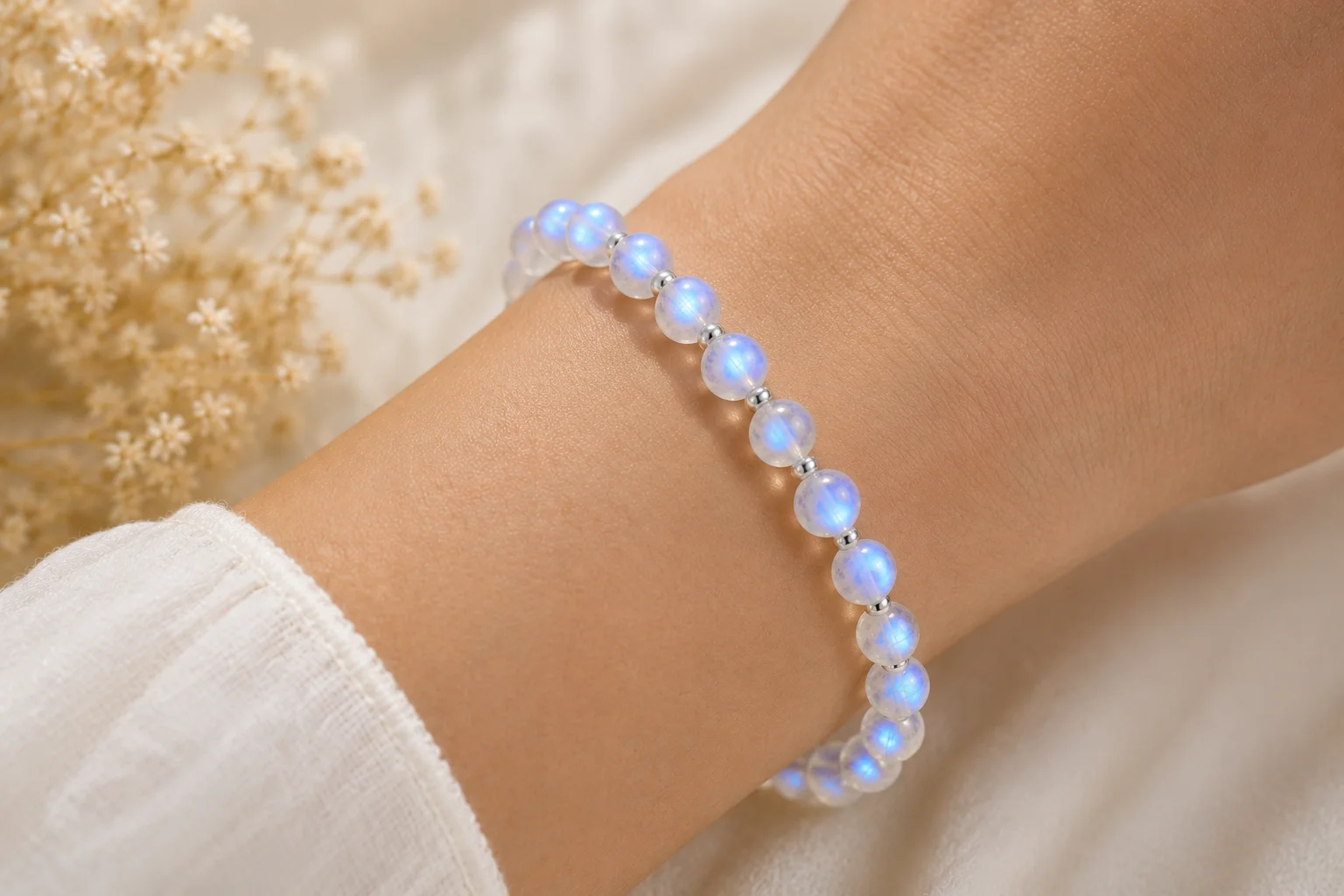
Moonstone bracelets place the gem’s floating internal glow in constant motion. As the wrist turns, a well-oriented cabochon can show a mobile white or blue sheen that appears to billow beneath the surface rather than sit on top of it.
The wrist is also a demanding position for Moonstone. The feldspar ranks 6–6.5 on the Mohs scale, has poor toughness and possesses two cleavage directions. It can scratch, chip or split when struck against desks, doors, metal bracelets or harder gemstones.
A good bracelet therefore requires more than attractive adularescence. Stone orientation, dome shape, drill holes, bezels, link articulation, clasp security and fit determine whether the piece displays its optical effect without asking a cleavage-prone gem to tolerate unrestricted wear.
The wider Moonstone gemstone guide owns its mineral identity, formation, history and symbolism. This article focuses specifically on bracelet styles, quality, construction, comfort, buying and maintenance.
Moonstone Bracelets at a Glance
| Feature | What to evaluate |
|---|---|
| Gem family | Feldspar |
| Defining phenomenon | Adularescence |
| Typical bodycolors | Colorless, white, gray, peach, brown, green and black |
| Mohs hardness | 6–6.5 |
| Toughness | Poor |
| Structural concern | Two cleavage directions |
| Common bracelet forms | Beads, bezel links, stations, cuffs, bangles and charms |
| Most protective construction | Low bezel links |
| Main quality factor | Strong mobile sheen centered on the visible face |
| Main bead concern | Drill-hole chips and poorly oriented glow |
| Main cleaning rule | Warm soapy water only |
| Main wear concern | Desk impact, stacking and clasp failure |
What Creates Moonstone’s Glow?
Moonstone belongs to the Feldspar family.
During cooling, microscopic layers of feldspar components separate within the material. Light enters the stone, scatters between those layers and returns as a floating glow called adularescence.
The effect can appear white, silver or blue. Fine material shows a mobile sheen that travels across much of the cabochon as the viewing angle changes.
Adularescence is not the same as surface reflection. A polished glass imitation may show glare that remains fixed on the surface, while genuine Moonstone’s phenomenon appears within the gem.
The effect also differs from Opal play-of-color. The direct Moonstone vs Opal guide owns that comparison.
Why Bracelets Are Challenging for Moonstone
Bracelets receive more impact than earrings and necklaces.
The wrist repeatedly meets desks, countertops, bags and doorframes. A loose bracelet moves even farther and can strike surfaces with additional momentum.
Moonstone’s hardness provides moderate scratch resistance, but it remains below Quartz, Topaz, Sapphire and Diamond on the Gemstone Hardness Chart.
Cleavage creates a separate weakness. A concentrated blow can split the feldspar even when the polished surface has resisted minor abrasion.
For this reason, a Moonstone bracelet should be considered careful-wear jewelry. Someone who wants a piece that remains on during exercise, cleaning and manual work should choose a tougher material.
Main Moonstone Bracelet Styles
| Bracelet style | Optical advantage | Main concern |
|---|---|---|
| Round bead bracelet | Shows color and sheen around the complete strand | Drill holes and bead-to-bead abrasion |
| Knotted bead strand | Reduces direct contact between beads | Cord moisture and knot wear |
| Bezel-link bracelet | Keeps cabochons oriented face-up | Numerous links and clasp maintenance |
| Prong-link bracelet | Exposes more of each stone | Unprotected edges and pressure points |
| Station bracelet | Lightweight and modern | Flipping settings and delicate chain |
| Cuff bracelet | Supports one large cabochon | Correct wrist fit and impact |
| Bangle | Structured circular design | Hinge, flexing and stone height |
| Charm bracelet | Small moving Moonstone accents | Charm collision |
| Mixed-Moonstone bracelet | Combines bodycolors and varieties | Matching different optical effects |
| Mixed-gem bracelet | Adds contrast | Harder gems may scratch Moonstone |
Moonstone Bead Bracelets
Moonstone beads may be round, oval, barrel-shaped, disk-shaped or irregular.
Unlike a fixed cabochon, each bead rotates independently. This means the strongest sheen may appear only when a particular area faces the light.
A good strand uses beads with enough adularescence to remain interesting through rotation. A bracelet made from poorly oriented material may show one bright flash in photographs but appear mostly milky during wear.
Examine the complete strand rather than one selected bead. Bodycolor, transparency, inclusions, sheen and polish should create a deliberate sequence.
The related Crystal Bracelets guide covers general bracelet symbolism and wear, but it does not replace Moonstone-specific durability guidance.
Stretch Moonstone Bracelets
Elastic bracelets are convenient but introduce predictable maintenance.
Elastic deteriorates through repeated stretching, heat, perspiration, sunscreen and age. Once the strand begins hanging loosely or shows separated fibers, it should be restrung.
Roll the bracelet over the hand rather than pulling it outward into a long line. Excessive stretching places pressure on the elastic and the bead holes.
The knot should remain protected without being forced into a narrow opening. A sharp chipped drill hole can cut the elastic gradually.
Stretch construction is best suited to modestly sized beads. Heavy large beads place more strain on the cord and strike one another with greater force.
Knotted Bead Bracelets
Knots between beads reduce abrasion and limit loss if the cord breaks.
They are particularly useful for finer Moonstone because adjacent feldspar surfaces do not rub continuously.
The knots should remain even and close to the bead openings. Large gaps suggest stretching, while fuzzy or darkened cord indicates wear.
Cord can absorb water, cosmetics and perspiration. A knotted bracelet should therefore be removed before showering, swimming and applying skincare products.
Bezel-Link Moonstone Bracelets
Bezel links provide one of the strongest constructions for Moonstone.
Each cabochon sits inside a metal surround that protects much of its perimeter. The links also keep the stones oriented so their adularescence remains visible from above.
The bracelet should bend smoothly through its entire length. A stiff link can transfer pressure into neighboring settings and cause the line to twist.
The bezel should meet the cabochon evenly without gaps, glue seepage or crushed edges.
Closed backs may support thin stones, but they can also conceal backing, filler or composite construction. A seller should identify whether the visible material is solid Moonstone throughout its depth.
Prong-Set Link Bracelets
Prongs expose more of the Moonstone and allow light to enter through the sides.
However, they leave the girdle more vulnerable and concentrate pressure at a small number of points.
One prong should not press over a visible fracture, cleavage-related line or corner. The cabochon should rest in a supportive basket rather than hang only between prong tips.
Prong-set bracelets suit controlled wear better than rough everyday use.
A low basket is safer than a tall open setting because it catches less and reduces leverage during impact.
Station Bracelets
Station bracelets place small Moonstone cabochons or beads at intervals along a chain.
Two-point connections help flat stations remain face-up. One-point settings turn more freely and may display their backs for much of the day.
The chain must be strong enough for the station weight. Extremely fine chains can stretch or break even though the stones remain intact.
Enough spacing should remain between stations to prevent collision when the bracelet curves around the wrist.
An adjustable slider can improve fit, but it should hold firmly rather than loosen gradually during movement.
Moonstone Cuffs and Bangles
A cuff may feature one central cabochon, several stones or a broad inlay panel.
The center should sit low and receive support beneath the complete base. A high cabochon on a narrow cuff becomes a lever when it catches clothing.
An adjustable cuff should not be bent repeatedly around the stone. Frequent opening and closing weakens metal and can transfer force into the setting.
Hinged bangles should close without flexing the stone-set section. The clasp and hinge should carry the mechanical movement.
A fitted bangle that slides over the hand can protect the setting better than a very loose design that rotates continuously.
Choosing Adularescence
Adularescence is the most important visual quality factor.
Fine Moonstone shows a strong, mobile glow that travels across a broad portion of the cabochon. Blue sheen against a colorless, transparent or nearly transparent body is especially prized.
White or silver sheen can also be attractive, particularly in beads and larger casual pieces.
A stationary bright patch may indicate poor orientation. The cutter must position the feldspar layers correctly so the phenomenon faces upward.
Request video under diffused moving light. One still photograph cannot show mobility or reveal whether the sheen disappears immediately outside a narrow angle.
The complete evaluation belongs to the Moonstone Buying Guide, while current cost belongs to the Moonstone Price Guide.
Cabochon Shape and Dome
Moonstone is usually cut as a cabochon because a smooth dome displays adularescence effectively.
A dome that is too flat may weaken the visual movement. One that is excessively high adds weight and impact exposure.
The base should remain sufficiently flat for secure setting. An uneven underside can make the cabochon rock within a bezel.
Ovals, rounds and cushions work well in bracelet links because they avoid sharp points. Pears and rectangles require additional corner protection.
Rose cuts and faceted Moonstones exist, but their optical behavior differs from classic domed cabochons.
Clarity and Inclusions
Fine transparent Moonstone can contain small inclusions without losing its appeal.
Characteristic tension cracks may form centipede-like patterns. They can help support identity but may also affect durability when they reach the surface or occur near a drill hole.
Cloudiness, fractures and dense internal features reduce transparency and can weaken blue sheen.
A bracelet stone should be evaluated for both beauty and structure. A dramatic flash does not compensate for a major crack crossing the setting.
Side lighting is useful for revealing pits, chips and surface-reaching fissures hidden by frontal photographs.
Types and Colors of Moonstone
The Types of Moonstone guide owns the full variety framework.
Traditional Moonstone may have colorless, white, gray, peach, brown, green or darker bodycolor.
White Moonstone provides the classic pale appearance, while Peach Moonstone ranges from cream to warm orange-pink.
Black Moonstone usually describes dark gray, brown or black feldspar with internal sheen and pale markings.
Mixed-color bracelets can be attractive when the transition appears intentional. However, varieties should not be represented as equal quality merely because they share the Moonstone name.
Rainbow Moonstone
Rainbow Moonstone is a trade name for transparent Labradorite that shows blue or multicolored labradorescence.
It is feldspar and is closely related to traditional Moonstone, but it is not the same orthoclase material.
A rainbow-Moonstone bracelet may show blue, green, yellow or violet flashes, often against a clear to milky body.
The direct Labradorite vs Moonstone guide explains the distinction.
A seller should identify the trade name and underlying feldspar honestly. Rainbow Moonstone should not be used to imply that ordinary Moonstone displays Opal-like rainbow play-of-color.
Treatments and Imitations
Moonstone is not as routinely treated as many colored gems, but coating, backing, dye, fracture filling, resin, glue and assembled construction may occur.
A dark backing can strengthen apparent blue sheen. Coatings may add an artificial flash or improve surface luster.
Common imitations include milky glass, Opalite glass, synthetic materials, white Chalcedony and other feldspars.
The complete diagnostic workflow belongs to Real vs Fake Moonstone.
Avoid scratch, flame, hot-needle and acid tests. Moonstone is cleavage-prone, and destructive testing rarely provides a reliable answer.
Matching Several Moonstones
A multi-stone bracelet should be compared for bodycolor, transparency, sheen color, brightness, mobility, dimensions, dome height and structural condition.
Exact natural matching is difficult because adularescence depends on internal-layer orientation.
One stone should not remain dull while every neighboring cabochon shows bright blue movement unless the difference is deliberate.
In a gradient bracelet, stronger center stones can be balanced by slightly smaller or softer side stones. The progression should look planned rather than assembled from unrelated material.
Continuous video of the complete bracelet is more useful than separate photographs of individual links.
Fit and Wearable Length
A Moonstone bracelet should fit close enough to limit impact but not so tightly that it stresses links or drill holes.
Large beads occupy space inside the bracelet, so wearable circumference differs from the laid-flat length.
A very loose bracelet can rotate under the wrist and hit desks repeatedly. A tight strand places continuous force on elastic, cord and clasp connections.
Measure the wrist with a flexible tape and compare the seller’s stated wearable length.
Link bracelets should articulate without pinching skin. A safety chain can reduce loss risk when it remains short enough not to strike the stones.
Clasps and Metal
A small spring-ring clasp may suit a lightweight station bracelet, while heavier link designs need a substantial lobster or box clasp.
The connection rings should be fully closed and thick enough for the bracelet’s weight.
Sterling silver creates a cool appearance and is common in Moonstone jewelry. White gold and platinum offer similar visual tones, while yellow or rose gold strengthens the contrast with white and peach bodycolors.
Skin compatibility depends on alloy, solder, plating and clasp material rather than Moonstone. These concerns are covered in Best Gemstones and Metals for Sensitive Skin.
Wearing and Stacking
Moonstone bracelets work best when worn alone or beside smooth, non-abrasive metal jewelry.
Do not stack them directly against Diamond, Sapphire, Topaz or rough-edged bracelets. Harder surfaces can scratch the feldspar.
The companion Moonstone Earrings guide offers a lower-impact alternative. A Moonstone Necklace can support a larger cabochon safely, while a Moonstone Ring requires even stricter impact protection.
The June Birthstone guide places Moonstone beside Pearl and Alexandrite within its month-based tradition.
Remove the bracelet before exercise, cleaning, gardening, cooking, swimming, showering and sleep.
Cleaning and Storage
Follow How to Clean Moonstone Jewelry Safely.
Use lukewarm water, mild soap and a soft brush or cloth. Keep cleaning brief when the bracelet contains cord, elastic, glue, backing or unknown treatment.
Never use steam or ultrasonic cleaning. Heat and vibration can exploit cleavage and fractures.
Dry carefully around drill holes, links and clasps.
Store the bracelet flat in a separate padded compartment. Do not hang a heavy bead strand permanently from its clasp.
Belief-based energetic care belongs to How to Cleanse and Charge Moonstone and should avoid salt, high heat and prolonged soaking.
Frequently Asked Questions
1. Is Moonstone durable enough for a bracelet?
It can be worn carefully, but hardness of 6–6.5, poor toughness and cleavage make it vulnerable to impact and scratching.
2. What is the safest Moonstone bracelet style?
A low bezel-link bracelet provides the strongest combination of edge protection and face-up orientation.
3. Are Moonstone bead bracelets fragile?
They can be, especially around drill holes and when beads rub together. Knotted construction offers additional protection.
4. What makes Moonstone glow?
Light scatters between microscopic feldspar layers, creating the internal phenomenon called adularescence.
5. Is blue sheen better than white sheen?
Blue sheen against a transparent colorless body usually commands the strongest market demand, although attractive white sheen remains desirable.
6. Is rainbow Moonstone genuine Moonstone?
It is transparent Labradorite sold under an accepted trade name, not traditional orthoclase Moonstone.
7. Can Moonstone bracelets be treated?
Yes. Coating, backing, filling, dye, resin and assembled construction can occur, though treatment is less standardized than in many gems.
8. How should a Moonstone bracelet fit?
It should move comfortably without rotating excessively or placing continuous pressure on the stones and links.
9. Can Moonstone be stacked with Diamond bracelets?
Direct stacking is not advisable because Diamond and its settings can scratch or chip Moonstone.
10. Can Moonstone bracelets go in water?
Brief gentle cleaning is acceptable for stable stones, but soaking can affect cord, elastic, glue, backing and metal.
11. Can Moonstone be cleaned ultrasonically?
No. Ultrasonic vibration can cause cleavage-related cracks or worsen existing fractures.
12. When should a Moonstone bracelet be restrung?
Restring it when elastic loosens, cord frays, knots separate or cracks develop around bead holes.
A Moonstone bracelet is successful when movement reveals the glow without creating uncontrolled impact. Well-oriented cabochons, protected edges, smooth articulation and a close comfortable fit allow the feldspar layers to do the visual work while the jewelry structure manages the material’s weakness.