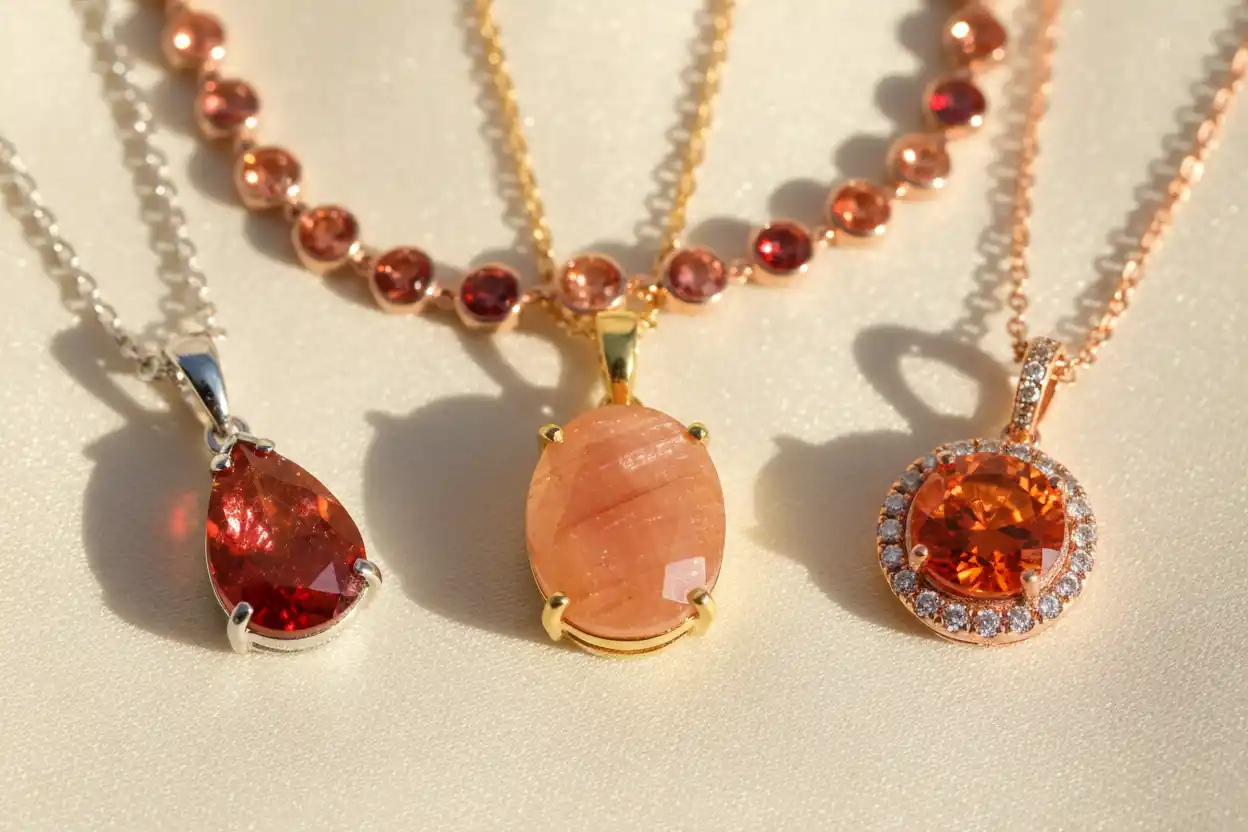
Sunstone Necklaces and Pendants Guide
A Sunstone necklace places the gem’s warm peach, orange, red and coppery flashes where they can catch light without facing the repeated impacts experienced by rings and bracelets. Designs range from simple cabochon pendants to transparent Oregon Sunstone solitaires and elaborate necklaces made from matched faceted gems.
The gemstone is only one part of a successful necklace. Chain strength, bail construction, setting protection, pendant balance and length all affect how comfortably the jewelry sits and how safely it can be worn.
Sunstone Necklaces at a Glance
| Feature | What to Consider |
|---|---|
| Gem family | Feldspar |
| Typical colors | Peach, apricot, orange, gold, red, pink, brown, colorless and green |
| Optical effect | Aventurescence or metallic schiller |
| Mohs hardness | Approximately 6–6.5 |
| Cleavage | Two prominent directions |
| Most versatile design | Solitaire pendant on an adjustable chain |
| Most protective setting | Full or partial bezel |
| Popular cuts | Cabochon, oval, round, cushion and pear |
| Premium material | Transparent copper-bearing Oregon Sunstone |
| Main durability concern | Scratching, cleavage and impact |
| Safest cleaning | Lukewarm water, mild soap and a soft brush |
| Important buying factor | Color and schiller that remain visible in normal light |
What Is a Sunstone Necklace?
A Sunstone necklace may contain one suspended pendant, several gem stations, a line of faceted stones or a complete strand of polished beads.
Sunstone belongs to the broader feldspar family. The commercial name can apply to more than one feldspar composition, including orthoclase, oligoclase and labradorite varieties.
The gemstone’s warm color and reflective inclusions distinguish it from most other feldspars. However, its physical structure still includes prominent cleavage, so a necklace should protect the stone from hard blows and unnecessary pressure.
The broad Sunstone meaning guide covers geology, symbolism and general uses. This page concentrates on pendant styles, necklace construction, fit and practical buying decisions.
Why Sunstone Works Well in Necklaces
Necklaces place the gem away from the hands, reducing contact with desks, tools, doorframes and household surfaces. This makes the format safer than a ring or bracelet for material with moderate hardness and cleavage.
The necklace position also lets the optical effect move naturally with the wearer. Reflective platelets may appear quiet from one direction and flash strongly when the pendant turns.
A larger cabochon or faceted gem can be used without the weight and impact concerns that would affect an equally large ring. Nevertheless, long pendants can strike sinks, tables and seat belts, so chain length and setting height still matter.
Solitaire Sunstone Pendants
A solitaire pendant places one gemstone at the center of the design. It is the most adaptable choice because it can be understated, colorful or highly collectible according to the stone.
Oval and cushion cuts provide balanced proportions. Round stones produce symmetry, while pear shapes create a natural vertical drop.
A transparent gem may be faceted to increase brilliance. More included or opaque material usually performs better as a cabochon, where a broad curved surface can display aventurescence.
The setting should remain proportional to the stone. A heavy frame around a small pale gem can overwhelm the color, while an undersized mounting may not provide enough protection.
Bezel-Set Sunstone Pendants
A bezel surrounds most or all of the gemstone’s girdle with metal. It is one of the safest pendant settings for feldspar.
The metal rim protects vulnerable edges and reduces snagging. A full bezel creates a clean, modern outline, whereas a partial bezel leaves more of the gem visible.
The jeweler must form the metal carefully. Excessive pressure can chip the Sunstone or extend an existing cleavage fracture.
A bezel may make the gemstone appear slightly smaller, but the metal border can also intensify its color. Yellow gold warms peach and orange material, while white metal creates stronger contrast.
Prong-Set Pendants
Prong settings expose more of the gemstone and allow easy access for cleaning. They can work well for transparent Sunstone with sound structure.
Four-prong baskets create an open appearance but leave more of the girdle exposed. Six-prong arrangements provide greater redundancy for round and oval stones.
Each prong should contact the gem evenly without resting directly over a visible fracture. Pointed cuts need protection at their tips.
A high basket may admit more light, yet it also creates more movement and impact risk. For frequent wear, a compact setting usually performs better.
Halo Pendants
A halo places smaller accent gems around the Sunstone. Diamonds, white Sapphires and colorless Zircon can brighten a peach, orange or red center.
The surround increases apparent size without requiring an unusually large Sunstone. It can also provide some protection around the center gem’s edge.
However, every accent introduces additional prongs and cleaning spaces. Lotion, perfume and skin oils can collect beneath a halo and reduce sparkle.
Hard accent stones should not touch the softer feldspar directly. Their girdles can abrade the Sunstone if the setting allows repeated contact.
Sunstone Station Necklaces
Station necklaces place several Sunstones at intervals along a chain. They use fewer gems than a continuous line necklace and create a lighter, more flexible design.
Bezel-set stations remain smooth against the skin and protect the edges. Prong-set stations can look more delicate but may flip if the settings are poorly balanced.
Each gemstone should face forward when the necklace rests naturally. A design that looks attractive on a flat display may behave differently around the neck.
Multicolor station necklaces can use peach, orange, red and colorless Sunstone in a deliberate progression. The colors should appear coordinated rather than randomly assembled.
Graduated Sunstone Necklaces
A graduated necklace places larger gems near the center and progressively smaller stones toward the clasp.
Matching involves more than size. The gemstones should coordinate in body color, transparency, inclusion density and the direction of their reflective effect.
One brown, poorly cut or weakly oriented gem can interrupt the sequence. View the necklace both laid flat and worn around the neck.
Fine graduated Oregon Sunstone suites can be difficult to assemble. A custom jeweler may retain one or two extra matched stones for possible future repairs.
Sunstone Lariat Necklaces
A lariat creates a long vertical line and may use one or two Sunstone drops.
Pear shapes work naturally at the ends, while beads or small cabochons may be integrated into the chain.
The slider or adjustment mechanism must hold securely. A weak mechanism can allow the necklace to loosen during wear.
Because the gemstones move more freely than a short pendant, they can strike each other or nearby surfaces. Designs with two drops should prevent direct gem-to-gem contact.
Sunstone Bead Necklaces
Peach and orange Sunstone beads are widely available in round, barrel, faceted and freeform shapes.
A good strand should show clean drilling, even polish and enough consistency to look intentional. Natural differences in color and inclusion pattern are expected.
Inspect drill holes for chips and radiating fractures. These areas receive repeated pressure from stringing material and neighboring beads.
Knots between valuable beads reduce impact and limit loss if the strand breaks. Heavy necklaces require professional stringing material rather than thin elastic.
Transparent gem-quality Oregon Sunstone is less commonly drilled because fine rough may be more valuable when faceted.
Oregon Sunstone Pendants
Oregon Sunstone is a copper-bearing labradorite feldspar found in the United States.
Its colors include colorless, yellow, pink, salmon, orange, red, green and multicolored combinations. Copper may create both body color and visible schiller.
Fine transparent gems are often faceted. Copper platelets may appear as isolated sparks, parallel reflective planes or a concentrated glowing cloud.
A pendant is an excellent format for valuable Oregon material because the setting can display a relatively large stone with less impact exposure than a ring.
When origin contributes significantly to price, request credible documentation rather than relying on color alone.
Choosing Sunstone Color
Commercial Sunstone commonly appears peach, apricot, orange or reddish brown. These warm colors suit yellow and rose gold particularly well.
Pale gems can look soft and luminous. Deeper orange and red stones produce stronger contrast, although very dark material may appear brown in ordinary indoor light.
Green and red-green Oregon Sunstone is less common. Multicolored gems may display zoning that changes across the stone or appears more strongly from certain directions.
Evaluate color over both light and dark clothing. A transparent pendant that looks vivid against white paper may appear subdued over black fabric.
The orange gemstones guide places Sunstone beside Spessartite Garnet, Fire Opal and other warm gems. Redder material can be compared through the red gemstones guide.
Evaluating Aventurescence
Aventurescence should be visible from the position in which the pendant will normally hang.
The effect may appear as fine glitter, broad metallic flash or a dense coppery glow. More inclusions do not automatically mean a better gem because dense platelets can reduce transparency.
Directional schiller can be spectacular when the stone is held at one angle but nearly invisible when worn. Rotate the pendant through a range of positions before purchase.
For a cabochon, the cutter should orient the inclusion plane toward the front. In a faceted gem, the best orientation balances schiller, body color and brilliance.
The guide to types of Sunstone explains the major visual and mineral varieties.
Cabochon Versus Faceted Sunstone
Cabochons suit opaque, translucent and heavily aventurescent rough. The curved surface presents color and glitter without fragile facet junctions.
A high dome can intensify color, while a lower dome may reveal a broader inclusion pattern. The base should remain flat enough for secure setting.
Faceted Sunstone generally requires greater transparency. Ovals, cushions, rounds and specialty cuts can produce attractive brilliance around the reflective inclusions.
A shallow faceted stone may show a transparent central window. Excessive depth can preserve weight while making the gem appear smaller and darker.
The best cutting style follows the rough rather than a fixed hierarchy.
Clarity and Structural Condition
Sunstone can contain reflective platelets, mineral crystals, internal veils, cleavage fractures and color zoning.
Desirable inclusions create aventurescence. Large open fractures are more concerning, particularly when they reach the girdle or bail area.
Inspect the pendant from the side and back. A setting can conceal fractures that are not visible face-up.
Filled cavities, resin impregnation or surface coatings should be disclosed. Such treatments may improve appearance but can change care requirements.
Sunstone Versus Similar Materials
Goldstone is manufactured glass containing metallic crystals. Its glitter often appears denser and more evenly distributed than natural Sunstone’s directional inclusions.
Aventurine is generally Quartz containing reflective minerals. It is harder and lacks feldspar’s prominent cleavage.
Moonstone belongs to the same broad mineral family but displays adularescence, a floating internal glow rather than metallic glitter.
Labradorite is known for labradorescence, a broad spectral flash created by internal feldspar structures. Oregon Sunstone has a labradorite composition, but its copper-related appearance is distinct.
Necklace Length
A short necklace places the gem near the collarbone. An 18-inch chain is versatile for many wearers, although body proportions and pendant size affect the final position.
Longer chains work with high necklines and layering. They also let the pendant swing farther, increasing impact risk.
An adjustable chain provides flexibility when the recipient’s preferred length is uncertain.
Measure a necklace the wearer already uses rather than relying entirely on labels such as choker, princess or matinee.
A large pendant may need a slightly longer chain so that it lies flat rather than crowding the neckline.
Choosing the Chain
Cable chains provide a simple, dependable foundation. Box and wheat chains offer greater visual weight for substantial pendants.
Snake chains create a smooth line but can kink when stored improperly. Rope chains add texture that may compete with a highly patterned gemstone.
The chain must support the complete weight of the pendant. A fine chain may look elegant but become the weakest point in an expensive piece.
Confirm whether the pendant is sold with a chain. Many fine gemstone pendants are priced separately.
Bail Design
The bail connects the pendant to the chain and carries its full weight.
A fixed bail controls orientation but limits chain compatibility. A hinged bail allows movement and can help the gem settle flat.
Hidden bails create a seamless appearance. Enhancer bails open so the pendant can attach to pearls or thicker chains, although their hinges and locks require careful inspection.
The chain should pass through freely without excessive space. A narrow bail restricts movement, while an oversized one can look disconnected from the design.
Clasp Security
A lobster clasp is appropriate for many lightweight and moderate necklaces. Spring-ring clasps are smaller but can be harder to operate.
Line and graduated necklaces benefit from a box clasp with a secondary safety mechanism.
Magnetic clasps offer convenience but may release unexpectedly. They are rarely ideal for valuable Sunstone jewelry.
Open and close the clasp several times before purchase. It should engage positively without sharp edges or visible gaps.
Metal Choices
Yellow gold emphasizes peach, orange, red and coppery Sunstone. The warm metal creates a cohesive appearance.
Rose gold complements salmon and pink material but may reduce contrast when the gem is pale.
White gold, platinum and silver create a cooler border that can make red, green and strongly aventurescent stones appear brighter.
Sterling silver works well with commercial cabochons, though thin silver settings may be inadequate for valuable transparent gems.
Metal allergies and maintenance requirements should be considered alongside appearance.
Styling and Layering
Small Sunstone pendants pair easily with simple gold chains and neutral clothing.
A larger copper-schiller stone works best with enough space around it to remain the visual focus.
When layering, separate chain lengths so the pendants do not strike each other. Harder gemstones can scratch Sunstone during repeated contact.
Wear a long pendant outside seat belts and remove it before leaning over hard counters or sinks.
The companion guides to Sunstone earrings, Sunstone bracelets and Sunstone rings compare the practical advantages of other formats.
Buying Priorities
Begin with color and optical effect under ordinary lighting. A gem that requires one exact spotlight angle may disappoint during normal wear.
Next, inspect the cutting and structural condition. Look for secure edges, balanced proportions and no major fractures near setting points.
Confirm whether the stone is natural Sunstone, copper-bearing Oregon material, treated feldspar or an imitation. The dedicated Sunstone buying guide provides a fuller authentication and quality process.
Price should reflect color, transparency, aventurescence, size, origin and craftsmanship. Current market factors belong in the Sunstone price guide.
Cleaning and Care
Clean the necklace with lukewarm water, mild soap and a soft brush.
Support the pendant while cleaning so it cannot swing against a hard sink. Work gently around the bail, gallery and chain links where cosmetics collect.
Rinse briefly and dry thoroughly. Avoid prolonged soaking, steam and ultrasonic cleaning.
The complete guide to cleaning Sunstone jewelry covers settings and treatment-sensitive care.
Apply perfume, hairspray and cosmetics before wearing the necklace. Remove it before bathing, exercise and sleeping.
For belief-based maintenance, the guide to cleansing and charging Sunstone explains gentle methods that do not replace physical cleaning.
Storage
Fasten the clasp before storage to reduce tangling. Lay long chains flat or hang them from a suitable organizer.
Keep the gemstone away from Quartz, Spinel, Topaz, Sapphire and Diamond. The gemstone hardness chart shows why these harder materials can scratch feldspar.
A padded compartment or soft pouch protects both the gem and metal.
Sunstone appears in the crystals beginning with S and gemstones beginning with S directories.
Frequently Asked Questions
1. Is Sunstone suitable for necklaces?
Yes. Necklaces expose Sunstone to less impact than rings and bracelets, making them one of the safer formats for the cleavage-prone feldspar.
2. What pendant setting protects Sunstone best?
A full or partial bezel provides the strongest edge protection. Secure low prongs can also work for structurally sound gems.
3. What makes Sunstone sparkle?
Flat reflective inclusions create aventurescence. Copper causes the schiller in Oregon Sunstone, while many other sources contain iron-bearing platelets.
4. Is Oregon Sunstone better for a pendant?
It can provide exceptional transparency, color and copper schiller, but common peach Sunstone can also make an attractive pendant at a lower price.
5. Should a Sunstone pendant be faceted or cut as a cabochon?
Transparent material may benefit from faceting, while heavily included or opaque material usually displays its aventurescence better as a cabochon.
6. Which chain length works best?
An adjustable collarbone-length chain is versatile, though the ideal length depends on the pendant size, wearer and neckline.
7. Which metal looks best with Sunstone?
Yellow gold emphasizes warm colors, white metal creates contrast and rose gold complements salmon or pink material.
8. Can a Sunstone necklace be worn every day?
Careful regular wear is possible. Remove it before exercise, bathing, sleeping and activities where the pendant could strike hard surfaces.
9. How can Sunstone be distinguished from Goldstone?
Sunstone is natural feldspar with directional mineral inclusions. Goldstone is manufactured glass with more uniformly distributed metallic glitter.
10. Does Sunstone need a laboratory report?
Most commercial pendants do not. Reports become more useful for expensive transparent stones, unusual colors or documented Oregon-origin claims.
11. Can a Sunstone necklace go in water?
Brief cleaning with lukewarm water is normally acceptable for sound untreated material. Avoid soaking pieces containing fractures, resin, glue or sensitive metal components.
12. How should a Sunstone necklace be stored?
Fasten the chain and place it in a padded compartment away from harder gemstones. Prevent the pendant from striking other jewelry.