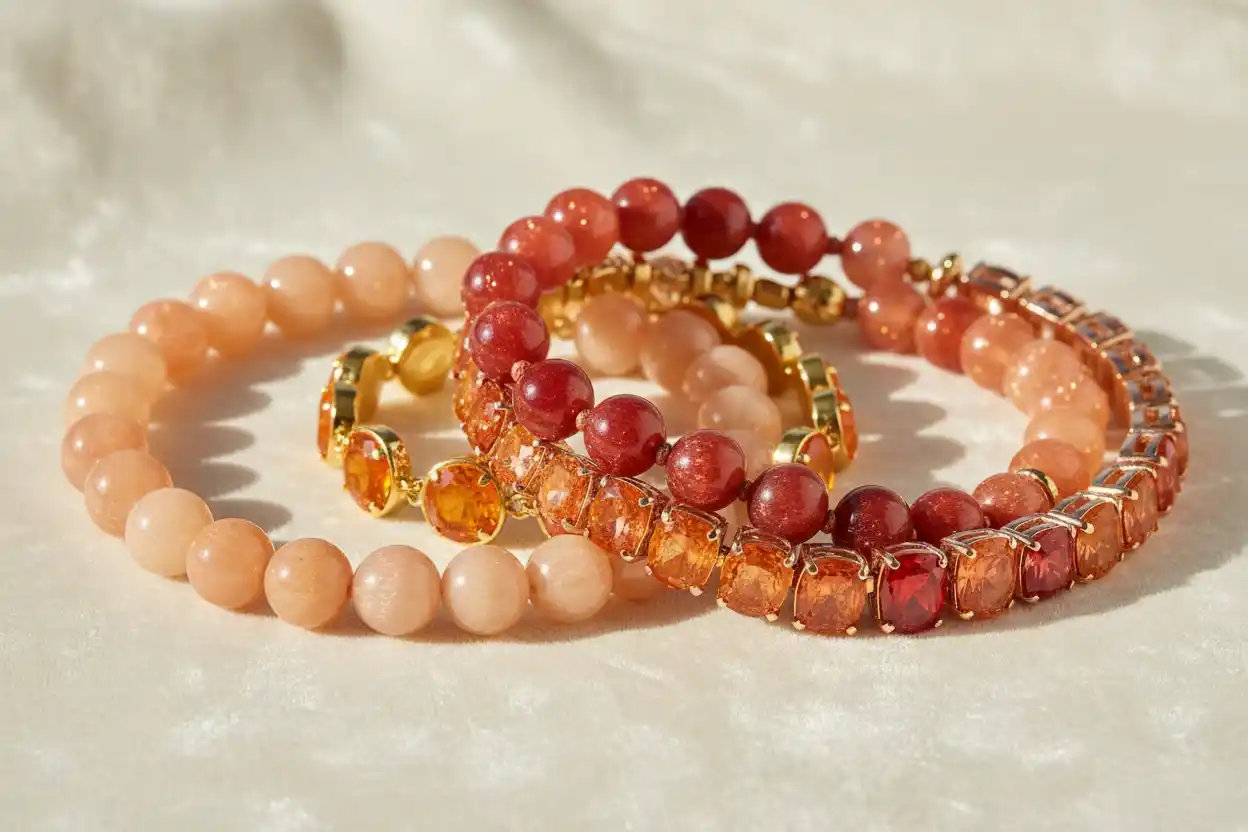
Sunstone Bracelets: How to Choose and Wear
Sunstone bracelets bring warm peach, orange, gold, red and occasionally green tones to one of the most visible jewelry formats. Some stones display a soft internal glow, while others contain reflective platelets that produce a glittering effect known as aventurescence.
Because Sunstone belongs to the feldspar family, it needs more protection than Quartz, Sapphire or Spinel. The strongest bracelet combines attractive color and sparkle with secure stringing, smooth settings, appropriate wrist fit and realistic expectations about daily wear.
Sunstone Bracelets at a Glance
| Feature | What to Consider |
|---|---|
| Gem family | Feldspar |
| Common colors | Peach, orange, gold, brown, red, pink, colorless and green |
| Optical effect | Aventurescence or metallic schiller |
| Mohs hardness | Approximately 6–6.5 |
| Cleavage | Two prominent directions |
| Popular bracelet styles | Beaded, station, tennis, chain, charm, cuff and bangle |
| Best everyday format | Low-profile bezel stations or smooth beads |
| Main quality factor | Appealing color and visible optical effect |
| Main durability concern | Scratching, cleavage and chipping |
| Safest cleaning | Lukewarm water, mild soap and a soft brush |
| Treatment concern | Dyed, coated, filled or misrepresented material |
| Related premium variety | Copper-bearing Oregon Sunstone |
What Is a Sunstone Bracelet?
A Sunstone bracelet may contain rounded beads, faceted beads, cabochons, individually set transparent gems or a single Sunstone charm.
The material belongs to the wider feldspar family, but the name Sunstone can describe more than one feldspar composition. Common material may be orthoclase or plagioclase feldspar, including oligoclase and labradorite.
Most commercial bead bracelets use peach, orange or tan material with visible reflective inclusions. Fine transparent gems, especially copper-bearing Oregon Sunstone, are more likely to appear in faceted station, tennis or designer bracelets.
The broad Sunstone meaning guide covers mineral identity, formation and spiritual traditions. This page concentrates on bracelet construction, selection and wear.
Why Sunstone Sparkles
Sunstone’s sparkle comes from thin reflective inclusions inside the feldspar. Light strikes these platelets and returns as flashes, glitter or a broad metallic glow.
In many Sunstones, the inclusions are associated with hematite, goethite or related iron-bearing material. Oregon Sunstone is different because native copper platelets create its characteristic schiller.
The effect depends strongly on orientation. A bead may look vivid from one angle and quiet from another because the reflective inclusions lie along particular planes.
A bracelet should therefore be examined while it moves around the wrist. A row of gems that looks impressive when laid flat may show weaker sparkle once the stones rotate independently.
The guide to types of Sunstone explains the major feldspar varieties, colors and inclusion-related effects.
Beaded Sunstone Bracelets
Beaded bracelets are the most widely available style. They commonly use round beads between approximately 4 and 12 millimeters, although larger statement beads also exist.
A good strand should show reasonably consistent drilling, polish and color. Natural variation is expected, especially in stones with white feldspar areas, orange zoning or dark inclusions.
Inspect the drill holes carefully. Cleavage-related fractures may begin near a hole and expand as the beads move against the string or neighboring stones.
Elastic bracelets are convenient but should not be stretched farther than necessary. Rolling the bracelet over the hand places less stress on the cord than pulling it open sharply.
Professional restringing may be needed after regular wear. Elastic eventually loses tension even when the stones remain in good condition.
Faceted Bead Bracelets
Faceted Sunstone beads reflect light from both their polished surfaces and internal inclusions. This can create stronger sparkle than smooth round beads.
However, facet edges are more vulnerable to abrasion. Adjacent beads strike one another whenever the wrist moves, gradually softening crisp edges.
Knotted construction can reduce direct impact. Small spacer beads may also help, provided they are not made from harder gemstones or rough metal that will scratch the Sunstone.
Faceted strands should feel smooth against the skin. Sharp drill holes, chipped corners and poorly polished facets indicate weak finishing.
Sunstone Station Bracelets
A station bracelet places individual Sunstones at intervals along a chain. This format uses fewer gems and usually feels lighter than a full bead strand.
Bezel-set stations offer the strongest edge protection. They also reduce snagging and help each stone remain secure when the bracelet contacts clothing or a desk.
Prong-set stations may admit more light, especially around transparent Oregon Sunstone. Each prong should touch the stone evenly without pressing against a visible fracture.
The stations must remain balanced. A poorly designed setting may flip continuously, leaving the gemstone face against the wrist.
Sunstone Tennis Bracelets
A Sunstone tennis bracelet uses a continuous line of individually set gems. Fine examples may contain transparent peach, pink, red or green Oregon Sunstones.
Matching is difficult because Sunstone varies naturally in color, clarity, inclusion density and schiller orientation. A successful row should appear harmonious even if every gem is not identical.
Check articulation between settings. The bracelet should curve smoothly around the wrist without twisting, forming sharp angles or exposing uncomfortable metal.
A box clasp with at least one secondary safety latch is preferable for a valuable line bracelet. Replacement stones can be difficult to match, so some custom jewelers retain one or two spare gems.
The separate Sunstone buying guide explains loose-gem quality factors, while the Sunstone price guide addresses value and rarity.
Sunstone Charm Bracelets
A charm bracelet may use one cabochon, carved Sunstone or small faceted drop. This provides the warm color without requiring a full matched suite.
The charm should connect through a soldered or securely closed ring. Open jump rings can pull apart as the charm catches on clothing.
A protective metal rim is helpful because charms swing freely and may strike neighboring metal components. Long pointed drops need more protection than rounded cabochons.
When several charms share one bracelet, separate the Sunstone from Diamond, Sapphire and other harder gems that could scratch it.
Sunstone Cuffs and Bangles
Rigid bangles may feature a central Sunstone, a row of small gems or inlaid cabochons. Their stable shape can keep the stone oriented correctly and reduce bead-to-bead impact.
Hinged bangles need a reliable clasp and well-aligned hinge. Side-to-side movement around the hinge can eventually strain the setting.
Open cuffs should not be bent repeatedly during wear. Constant reshaping weakens the metal and can transfer pressure to the gemstone.
A low bezel or flush-mounted cabochon provides greater durability than a high projecting cluster.
Choosing Color
Commercial Sunstone appears most often in peach, apricot, orange, tan and reddish brown. Pale material can look soft and luminous, while deeper orange and red produce stronger contrast.
Copper-bearing Oregon Sunstone expands the range to colorless, pink, salmon, red, green and multicolored gems. Some stones show red-green zoning or directional color differences.
A dark stone is not automatically better. If the body color absorbs too much light, the bracelet may look brown or opaque indoors.
Evaluate the piece in neutral daylight, ordinary indoor lighting and lower evening light. Highly concentrated display illumination can exaggerate sparkle.
Related warm-colored choices appear in the orange gemstones guide and red gemstones guide.
Evaluating Aventurescence
Aventurescence should contribute to the design rather than appear as random surface glitter.
In beads, look for flashes distributed across several stones. A strand in which only one bead shows strong sparkle may feel unbalanced unless that contrast is intentional.
In transparent gems, fine copper schiller may appear as a concentrated glowing cloud, parallel reflective platelets or broad metallic flashes. Dense inclusions can make the gem more opaque.
Orientation matters as much as quantity. A cutter may sacrifice weight to position the inclusion planes so that they face the viewer.
Sunstone should not be confused with Goldstone, a manufactured glass containing metallic crystals. It also differs from Aventurine, a Quartz-based material whose sparkling inclusions produce a related visual effect.
Clarity and Matrix
Transparent Sunstone may contain copper platelets, hematite, internal veils, cleavage fractures and mineral inclusions.
Commercial bead material frequently includes pale feldspar areas, dark specks and color zoning. These are not automatically defects.
Large open fractures, however, can weaken a bead or cabochon. Examine the material from the side and around drill holes rather than judging only the polished face.
Filled cavities, resin and surface coatings should be disclosed. A glossy finish that looks thicker than the natural polish may deserve closer examination.
The general crystal identification guide explains how luster, hardness, inclusions and structure work together.
Sunstone Hardness and Bracelet Durability
Sunstone usually ranks around 6–6.5 on the Mohs scale. It resists some ordinary scratches but remains softer than Quartz-rich dust.
The gemstone hardness chart places feldspar below Quartz, Topaz, Corundum and Diamond. Those harder materials can scratch Sunstone during storage or layered wear.
Cleavage creates a separate concern. A bead or faceted gem can chip or split after a sharp impact even when its surface has not been heavily scratched.
Bracelets are therefore more demanding than earrings or necklaces. A person who works at a desk, handles tools or wears several hard bracelets together should expect greater maintenance.
Comparing Sunstone Bracelet Materials
Not every Sunstone bracelet uses the same quality or feldspar variety.
Opaque Indian material commonly shows warm body color and metallic inclusions. It works well for beads and carvings.
Transparent Oregon Sunstone is more likely to be faceted and individually set. Copper-related color and schiller can raise its value considerably.
Pale feldspar marketed as Sunstone may contain little visible aventurescence. It can still be natural, but the seller should not imply an intense optical effect that the bracelet does not show.
Moonstone and Labradorite belong to the same broad mineral family but produce different optical effects. Moonstone displays adularescence, while Labradorite is known for labradorescence.
Choosing the Bracelet Size
Measure the wrist at the point where the bracelet will sit. Then add enough ease for comfortable movement.
A close bead bracelet should roll over the hand without pinching. Larger beads need more length because their diameter reduces the internal circumference.
A tennis bracelet commonly allows approximately one finger of space. Excessive looseness increases snagging and impact, while a very tight bracelet strains links and clasps.
Adjustable chain bracelets are practical gifts when the recipient’s exact wrist size is unknown.
Clasps and Stringing
Elastic construction suits casual bead bracelets but requires periodic replacement. Double-threaded or professionally knotted elastic usually lasts longer than a thin single cord.
Jewelry wire provides greater structure and works well with a clasp. The wire should be flexible enough to curve naturally without creating sharp kinks.
Lobster clasps suit lightweight station bracelets. Box clasps with safety catches are preferable for fine tennis designs.
Magnetic clasps offer convenience but may release unexpectedly. They are rarely the best choice for valuable Oregon Sunstone.
Choosing the Metal
Yellow gold emphasizes peach, orange and red Sunstone. It creates a warm, unified appearance.
Rose gold complements salmon, pink and coppery material, although some stones may blend into the metal rather than contrast with it.
White gold, platinum and silver create a cooler frame. This can make red, green and strongly aventurescent Sunstone appear brighter.
Sterling silver suits commercial beads and cabochons, but thin silver settings may not provide sufficient protection for a valuable transparent gem.
Styling Sunstone Bracelets
Warm Sunstone colors pair naturally with cream, navy, olive, brown, charcoal and denim.
A bead bracelet can be worn alone or beside smooth metal bangles. Avoid stacking it directly against Diamond pavé, Sapphire beads or rough-textured metal.
A fine station bracelet works well with a watch when the two pieces do not strike each other. Wear them on opposite wrists when constant contact is unavoidable.
Transparent red or green Oregon Sunstone can serve as a statement piece, while pale peach beads create a quieter everyday look.
Symbolism and Wearing Traditions
Modern crystal traditions connect Sunstone with optimism, confidence, independence and joyful action.
Some wearers place the bracelet on the dominant wrist to symbolize outward action. Others choose the nondominant wrist for reflection or receiving support.
These customs vary and have no mineralogical requirement. Comfort and safety matter more than a fixed wrist rule.
The dedicated guide to cleansing and charging Sunstone covers spiritual maintenance without replacing physical jewelry care.
Comparing Other Sunstone Jewelry
Sunstone earrings face less impact and are often safer for highly included or delicate gems.
A Sunstone necklace can display a larger cabochon or transparent center stone with limited abrasion.
A Sunstone ring provides maximum visibility but requires a protective setting and more careful wear.
Bracelets remain attractive because the wearer can see the color and sparkle throughout the day, but they also require the strongest clasp and impact precautions.
Cleaning and Care
Clean a Sunstone bracelet with lukewarm water, mild soap and a soft brush. Support the bracelet over a bowl or closed drain.
Work gently around drill holes, prongs and links. Rinse briefly and dry completely before storage.
Avoid steam and ultrasonic cleaning. Heat, vibration, cleavage and hidden fractures can damage the feldspar or loosen a filled area.
The complete guide to cleaning Sunstone jewelry covers settings, beads and treatment-sensitive care.
Remove the bracelet before exercise, bathing, household cleaning and manual work. Perfume and lotion should dry before the jewelry is worn.
Storage
Store the bracelet in a lined compartment or fabric pouch. Do not place it beneath harder jewelry.
Fasten chain bracelets before storage to reduce tangling. Lay tennis bracelets flat rather than folding them sharply.
Elastic strands should not remain stretched around a display stand for long periods. Constant tension shortens the life of the cord.
Sunstone appears among the crystals beginning with S and gemstones beginning with S.
Final Perspective
A Sunstone bracelet succeeds when its warm color and aventurescence remain visible without sacrificing comfort or security. Strong sparkle alone cannot compensate for cracked drill holes, weak elastic, exposed girdles or an unreliable clasp.
Choose the bracelet according to how it will be worn. Smooth beads or low bezel stations suit regular use, while fine matched Oregon Sunstones deserve a secure setting and more deliberate care.
Frequently Asked Questions
1. Is Sunstone durable enough for a bracelet?
It can be worn in bracelets, but its hardness of about 6–6.5 and prominent cleavage make it more vulnerable than Quartz, Spinel or Sapphire.
2. Are Sunstone bead bracelets genuine?
Many are natural feldspar, although quality varies. Dyed material, coated beads, glass and incorrectly named feldspar can also appear in the market.
3. What makes a Sunstone bracelet sparkle?
Thin reflective inclusions create aventurescence. Iron-bearing platelets occur in many Sunstones, while Oregon material may contain native copper.
4. Is Oregon Sunstone better for bracelets?
It can offer exceptional transparency, color and copper schiller, but those qualities also raise the price. Protective settings are advisable.
5. How should a Sunstone bracelet fit?
It should move comfortably without sliding over the hand or striking surrounding objects excessively. Larger beads require additional length.
6. Can Sunstone bracelets be worn every day?
Careful regular wear is possible, but remove the bracelet during exercise, cleaning, gardening and work involving hard surfaces.
7. Can a Sunstone bracelet go in water?
Brief cleaning with lukewarm water is normally acceptable for sound untreated material. Avoid prolonged soaking, especially with elastic, glue, filling or porous matrix.
8. Which wrist should a Sunstone bracelet be worn on?
There is no mineralogical rule. Spiritual traditions assign different meanings to each wrist, but comfort and activity should guide the choice.
9. How can Sunstone be distinguished from Goldstone?
Sunstone is natural feldspar with mineral inclusions. Goldstone is manufactured glass containing evenly distributed metallic crystals.
10. Does Sunstone scratch easily?
It can be scratched by Quartz-rich dust and harder gemstones. Store it separately and avoid abrasive surfaces.
11. How often should an elastic Sunstone bracelet be restrung?
Restring it when the elastic becomes loose, flattened, frayed or discolored. Frequently worn strands may require replacement periodically.
12. What is the safest way to clean a Sunstone bracelet?
Use lukewarm water, mild soap and a soft brush. Avoid steam, ultrasonic machines, abrasive cleaners and sudden temperature changes.
Sunstone’s confidence, abundance and emotional-healing associations belong to spiritual traditions and are not scientifically established medical effects. Feldspar can scratch, cleave and chip, so use gentle cleaning and remove bracelets during high-impact activity.