Picasso Jasper: Meaning, Properties & Symbolism
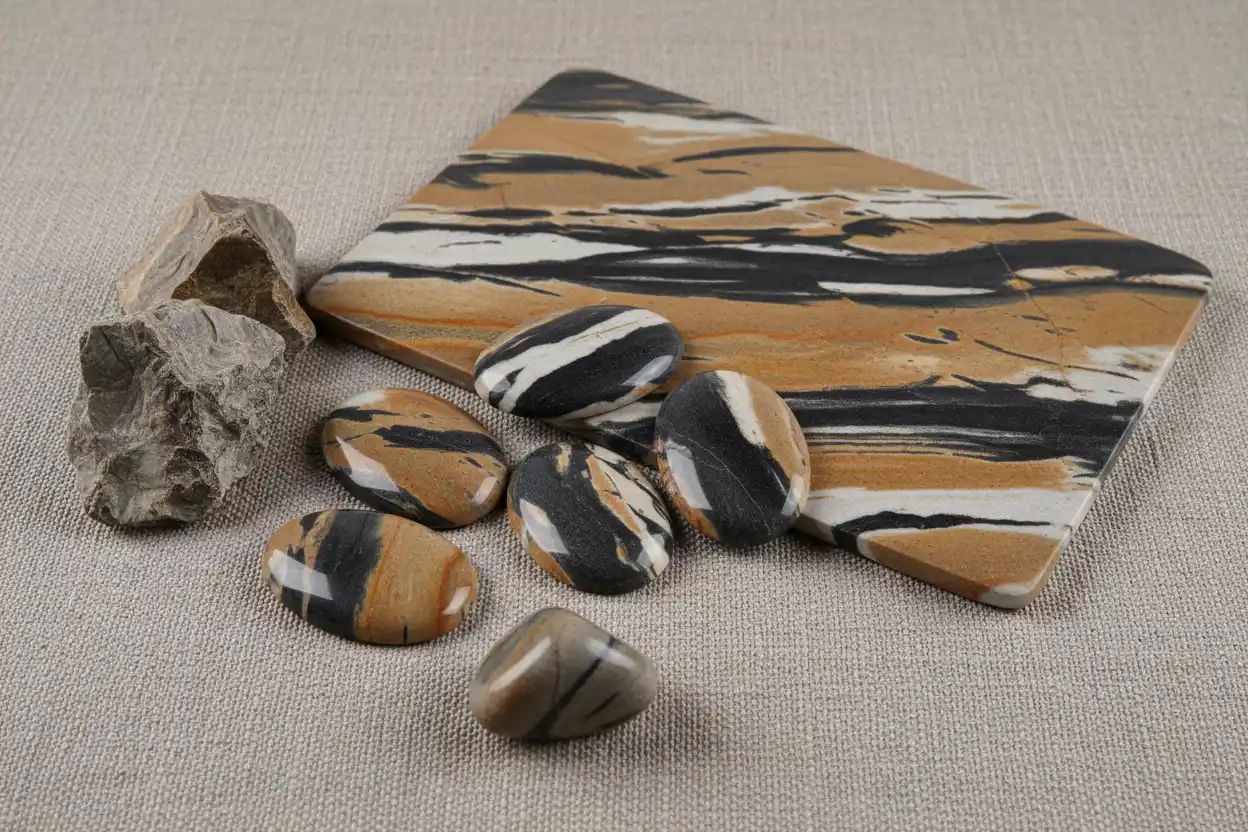
Picasso Jasper is the crystal-trade name commonly applied to a dramatically patterned ornamental rock from Utah that is more accurately called Picasso Marble or Picasso Stone. Classic material displays branching black, gray, brown, cream, tan, and greenish lines resembling abstract brushwork or winter landscapes.
Despite the jasper label, the Utah stone is not conventional silica jasper. It is a carbonate-rich metamorphic and metasomatically altered rock—commonly described as marble, dolomitic marble, limestone onyx, or a related calc-silicate material—whose exact mineral balance varies across the deposit.
Picasso Jasper at a Glance
| Property | Picasso Jasper / Picasso Stone |
|---|---|
| Material type | Patterned metamorphic and altered carbonate rock sold under a trade name |
| More accurate name | Picasso Marble or Picasso Stone |
| Typical composition | Variable calcite, dolomite, diopside and other calc-silicate minerals, with iron- and manganese-bearing vein material |
| Common colors | Cream, white, tan, beige, brown, gray, black, pale green, yellow, rust, and occasional reddish tones |
| Crystal system | No single system applies to the entire rock |
| Typical texture | Fine-grained, veined, fractured, brecciated, mottled, marble-like, and locally calc-silicate-rich |
| Luster | Dull when rough; waxy to vitreous after polishing |
| Transparency | Opaque, with rare thin translucent carbonate zones |
| Mohs hardness | Variable, commonly about 3–4 in carbonate-rich areas and higher in diopside- or silica-rich zones |
| Cleavage | Variable; calcite and dolomite components have strong rhombohedral cleavage |
| Tenacity | Brittle |
| Common uses | Cabochons, beads, pendants, bolo ties, belt buckles, spheres, carvings, sculpture, slabs, and decorative facings |
| Main care concern | Acid etching, scratches, cleavage, uneven hardness, open fractures, fillers, and misleading jasper claims |
Picasso Jasper Is Not True Jasper
Strict mineralogical jasper consists predominantly of opaque microcrystalline silica.
The parent Jasper guide explains that family’s chalcedony- and quartz-rich composition.
Classic Utah Picasso Stone instead belongs to the carbonate and marble side of ornamental geology. Calcite, dolomite, calc-silicate minerals, and dark oxide-bearing lines contribute to its appearance.
Therefore, it does not have quartz’s hardness of approximately 7 across the entire piece. Carbonate-rich areas can scratch much more readily and react with acid.
The workbook places the article within the chalcedony-and-jasper cluster because Picasso Jasper is its dominant search name. The page must still correct that terminology rather than repeat it as a scientific classification.
The broader types of jasper guide distinguishes true silica-rich varieties from commercial stones whose names include jasper for visual or historical reasons.
Picasso Marble, Picasso Stone, and Picasso Jasper
All three names commonly refer to the same patterned Utah lapidary material.
Picasso Marble is the most geologically useful familiar name because the rock began as carbonate sediment and underwent metamorphic or metasomatic alteration.
Picasso Stone is a neutral commercial term that avoids promising one exact composition.
Picasso Jasper is the most common crystal-retail keyword, but it can lead buyers to assume quartz-like hardness and water or acid resistance.
“Picasso onyx” and “limestone onyx” occasionally appear in the stone trade. These are banded-carbonate trade names rather than true chalcedony onyx.
A responsible description can use Picasso Jasper for recognition while immediately explaining that the material is patterned Utah marble or altered carbonate rock.
Geological Origin in Utah
The best-known material comes from the Mineral Mountains and Beaver County region of southwestern Utah.
Utah geological records describe fine-grained gray, black, red, and yellow marble or limestone mined under the Picasso Stone name for sculpture and polished architectural facing.
The precursor rock formed as marine carbonate sediment, including limestone and dolomitic material.
Later igneous activity in the Mineral Mountains heated and altered the carbonate beds. Hot fluids moved through fractures and introduced or redistributed silica, magnesium, iron, manganese, aluminum, and other components.
Metamorphism recrystallized parts of the original limestone or dolostone into marble.
Metasomatic reactions created calc-silicate minerals in some zones. Pale green-gray areas can be rich in diopside or related minerals rather than remaining pure carbonate.
The finished rock is therefore more complex than one formula or one simple marble label suggests.
Marble, Hornfels, or Skarn?
Geological descriptions vary because different portions of the occurrence underwent different degrees of alteration.
A carbonate-rich area may fit the term marble or dolomitic marble.
Where heat recrystallized the rock without major chemical addition, hornfels-like textures can develop.
Where hot fluids reacted extensively with limestone or dolostone and produced minerals such as diopside, the material approaches calc-silicate hornfels or skarn.
Commercial slabs can cross boundaries among these zones. One section may be relatively soft calcite-rich marble, while another contains harder pyroxene-rich material.
For reader-facing accuracy, Picasso Stone is best described as a patterned metamorphic and metasomatically altered carbonate rock whose composition can vary.
The parent Marble guide explains the general transformation of limestone without taking over Picasso Stone’s locality and pattern intent.
Calcite, Dolomite, and Diopside
Calcite is calcium carbonate, CaCO₃, and has a Mohs hardness of 3.
Dolomite is calcium magnesium carbonate, CaMg(CO₃)₂, and generally has a hardness around 3.5–4.
Diopside is a calcium magnesium silicate pyroxene with a hardness around 5.5–6.5.
These minerals respond differently during cutting. A wheel that grinds calcite quickly may remove diopside-rich areas more slowly.
They also respond differently to acid. Calcite fizzes readily in dilute acid, while dolomite often reacts more slowly unless powdered or warmed. Diopside does not behave like a carbonate.
Consequently, one Picasso Stone may undercut during polishing or show uneven wear across its patterned zones.
What Creates the Abstract Lines?
Fractures formed as the rock experienced heating, intrusion, deformation, cooling, uplift, and later stress.
Mineral-bearing fluids moved through those openings. Iron- and manganese-bearing compounds created many black, brown, gray, rust, and yellow lines.
Later calcite, dolomite, silica, and calc-silicate minerals filled or altered additional fractures.
Some dark lines branch like tree limbs. Others form angular networks, wispy brushstrokes, parallel bands, or landscape-like horizons.
The name references this abstract appearance rather than any connection with the artist Pablo Picasso or his materials.
A striking line can be a stable mineral-filled vein. However, an open fracture following the same pattern may reduce durability.
Color and Pattern
Cream and white commonly reflect carbonate-rich areas or pale recrystallized minerals.
Gray and tan may arise from fine inclusions, mixed carbonate composition, weathering, or calc-silicate minerals.
Black lines frequently contain manganese- or iron-rich compounds, although their exact mineral identity varies.
Brown, yellow, and rust tones commonly reflect oxidized iron.
Pale green-gray zones may contain diopside, tremolite-actinolite, chlorite, or other alteration products.
A polished slab can resemble leafless trees, mountain ridges, calligraphy, smoke, maps, or abstract paintings.
Pattern interpretation is subjective. The visible scene does not identify the rock scientifically, but it strongly influences lapidary value.
The broader symbolism assigned to red, gray, black, cream, and green ornamental stones is discussed in jasper color meaning, although Picasso Stone is not silica jasper.
Picasso Jasper and Chalcedony
Chalcedony is microcrystalline silica with hardness near 7 and no mineral cleavage.
Picasso Stone is generally carbonate- or calc-silicate-rich and may contain strong cleavage-bearing minerals.
A quartz-rich jasper usually resists a steel point and weak household acids. Carbonate-rich Picasso Stone scratches more readily and can be etched by vinegar or lemon juice.
Both can take a high polish and display attractive natural patterns, which helps explain the misleading trade name.
A laboratory may find some silica in Picasso Stone, especially in metasomatized or veined zones, but that does not automatically make the whole rock jasper.
Picasso Jasper and Picture Jasper
Picture Jasper is a silica-rich ornamental material known for scenic bands and landscape-like patterns.
Its imagery often comes from sedimentary layering, iron staining, mineral distribution, and brecciation.
Picasso Stone more often displays high-contrast branching or angular lines across a cream, gray, tan, or greenish carbonate host.
Picture Jasper is generally harder and less acid sensitive.
Because both are selected for scenic patterns, sellers sometimes use their names interchangeably. The distinction should follow composition and source rather than whichever scene a buyer sees.
Picasso Jasper and Noreena Jasper
Noreena Jasper is a silicified mudstone from Western Australia.
It commonly shows red, mustard-yellow, cream, and gray angular fracture networks.
Picasso Stone comes from Utah and belongs to a carbonate or calc-silicate metamorphic setting.
Both can resemble abstract paintings, but they differ in geology, hardness, chemical behavior, source, and typical palette.
Noreena generally approaches quartz hardness in dense areas, while Picasso Stone may be scratched by ordinary metal objects.
Picasso Jasper and Zebra Jasper
Zebra Jasper is another broad trade name applied to contrasting striped or banded rocks.
Black-and-white Picasso Stone may resemble zebra material when the veining becomes parallel.
However, zebra names can refer to silica-rich jasper, marble, calcite-rich rock, or another striped ornamental material.
Neither name proves composition without testing.
A product should state whether it is Utah Picasso Stone, silica jasper, marble, or another identifiable rock.
How to Identify Picasso Stone
Begin with pattern and provenance. Classic material should show natural branching, angular, or landscape-like linework consistent with Utah Picasso Stone.
Examine the sides and back. The design should continue through the rock rather than exist only as paint or print on the polished face.
Magnification may reveal crystalline carbonate grains, dark mineral-filled fractures, diopside-rich zones, pits, resin, dye, and polishing drag.
Hardness can vary across one object. Carbonate-rich areas may scratch near Mohs 3–4, while diopside-rich zones resist more strongly.
Acid produces a useful laboratory clue because calcite-rich material effervesces. However, vinegar, hydrochloric acid, and similar tests permanently etch polished stone and should not be used on finished jewelry.
Raman spectroscopy, X-ray diffraction, petrographic microscopy, and chemical analysis can establish the principal minerals.
The framework in how to identify crystals helps distinguish a commercial pattern name from a rock identification.
Lapidary Behavior
Picasso Stone can accept an attractive polish, especially when the grain is fine and the material is structurally sound.
Its variable hardness makes polishing more difficult than a uniform quartz-rich jasper.
Soft carbonate areas may undercut beside diopside, quartz, or other harder minerals. The result can be a wavy surface even when every mineral appears glossy.
Natural fractures may open during sawing or grinding. Stabilization can preserve slabs that would otherwise separate.
Cabochons are commonly cut as freeforms because the cutter can follow the best linework and avoid weak sections.
Spheres reveal the pattern from every direction, although natural fractures and mixed hardness complicate production.
The material is also suited to sculpture because carbonate-rich zones carve more easily than quartz. Its use can be compared with other ornamental rocks in the best gemstones for carving.
Durability and Jewelry Suitability
Picasso Stone is softer than true jasper in most carbonate-rich areas.
Its variable position is best understood through the gemstone hardness chart rather than assigning every piece one exact number.
Calcite and dolomite scratch easily, while diopside-rich areas offer better abrasion resistance.
The rock remains brittle, and mineral-filled fracture networks can become structural weaknesses.
The difference between scratching, cleavage, and breakage is explained in gemstone toughness versus hardness.
Pendants, brooches, earrings, bolo ties, belt buckles, and protected cabochons are practical uses.
An occasional-wear ring should have a low bezel and avoid open fractures near the edge.
Bracelets receive frequent impact and may lose polish quickly.
Treatments and Repairs
Natural Picasso Stone usually requires only cutting and polishing when the rough is solid.
Resin stabilization can strengthen cracks, hold brecciated sections together, and improve polish.
Clear filler may appear inside fractures as glossy, bubble-bearing, or unusually level material.
Dye can darken black lines or add red, green, blue, and purple colors. Concentrated pigment around cracks and drill holes provides a warning sign.
Oil and wax deepen bodycolor temporarily. Surface coatings can create a stronger gloss but may scratch or peel.
Backing may reinforce a thin cabochon or belt-buckle slab. An assembled product should be described clearly.
The processes are explained more broadly in gemstone treatments.
Current Picasso Jasper Asking Prices
Picasso Stone is attractive but not a rare transparent gemstone. Pattern, Utah provenance, cutting, size, and craftsmanship drive most of its value.
| Picasso Stone product | Broad July 2026 retail asking range |
|---|---|
| Small tumbled stone | About $3–$10 |
| Palm stone | About $10–$35 |
| Standard cabochon | About $15–$45 |
| Large or strongly scenic designer cabochon | About $30–$100 |
| Bead strand | About $15–$60 |
| Simple pendant, bolo component, or earrings | About $30–$150 |
| Sterling-silver artisan jewelry | About $75–$350 |
| Small sphere or carving | About $40–$175 |
| Large sphere, sculpture, or display piece | About $150–$1,000 or more |
| Architectural slab or custom artwork | Individually priced |
These figures represent broad asking prices rather than appraisals or resale guarantees.
Current Utah cabochon listings commonly fall around $16–$40, with larger hand-cut pieces reaching approximately $65 or more.
Finished price can rise substantially when an artisan designs the metalwork around a particularly scenic pattern.
What Gives Picasso Stone Value?
Pattern composition matters most. Balanced black, gray, cream, tan, and green lines usually attract more attention than muddy or crowded material.
Scenic patterns can add value when they appear naturally framed within the cabochon.
Cutting orientation determines whether a line resembles a landscape, tree, mountain, or abstract brushstroke.
Polish should remain even despite varying mineral hardness. Undercutting, flat spots, scratches, resin pools, and dull carbonate zones reduce quality.
Structural stability is essential. A beautiful slab crossed by open cracks may be unsuitable for jewelry.
Utah provenance adds confidence because Picasso Stone is a locality-based commercial material.
Treatment and repair should be disclosed. Stabilization may be practical, but it affects how the stone should be cleaned and valued.
Craftsmanship can exceed the raw stone’s value, particularly in bolo ties, belt buckles, sculpture, and custom silverwork.
Buying Picasso Jasper
Ask whether the seller means Utah Picasso Marble or a different patterned stone using the Picasso name.
The description should disclose that classic material is not silica jasper.
Request front, back, edge, and transmitted-light photographs. These views can reveal repairs, backing, open fractures, and pattern continuity.
Ask whether the piece contains resin, dye, wax, coating, glue, or assembled sections.
Check the source. Utah or Beaver County provenance is more meaningful than a generic American stone description.
Do not pay a quartz-jasper durability premium. The material’s carbonate-rich sections require gentler wear.
Generic jasper seller checks remain available in where to buy real Jasper, but this material requires additional verification because its trade name contradicts its composition.
Picasso Jasper appears in the crystals beginning with P directory and the gemstones beginning with P directory.
Cleaning and Storage
Wipe Picasso Stone with a soft dry or slightly damp cloth after wear.
For deeper cleaning, use lukewarm water, mild soap, and a soft brush. Rinse briefly and dry the piece thoroughly.
Avoid vinegar, lemon juice, bathroom descalers, acidic jewelry cleaners, and strong household chemicals. Carbonate-rich areas can etch and become dull.
Do not use ultrasonic or steam cleaning on fractured, filled, backed, glued, or mixed-mineral material.
Prolonged soaking is unnecessary. Water may enter fractures, affect backing, or expose differences among carbonate, filler, and associated minerals. The broader context appears in which crystals can and cannot go in water.
Store the stone separately from quartz, topaz, sapphire, ruby, and diamond. A soft pouch protects its easily scratched polish.
Large spheres and sculptures should rest on stable padded bases so their weight does not concentrate on one fractured edge.
Picasso Jasper Meaning and Symbolism
Picasso Stone’s symbolism is modern and comes primarily from its abstract patterns and trade name.
The intersecting lines are commonly associated with creativity, experimentation, connection, and following an idea beyond its first form.
Landscape-like sections can represent perspective: the same mineral pattern may resemble a tree, mountain, map, or brushstroke depending on orientation.
Its geological transformation from marine carbonate into patterned metamorphic rock inspires themes of adaptation and change under pressure.
Dark lines crossing pale stone can also symbolize boundaries, routes, relationships, or unfinished sketches.
These meanings remain artistic, personal, spiritual, or cultural interpretations. Scientific evidence does not show that Picasso Stone treats illness, forces creativity, repairs relationships, or guarantees emotional stability.
Frequently Asked Questions
Is Picasso Jasper a true jasper?
Classic Utah Picasso Stone is not true silica jasper. It is a patterned metamorphic and altered carbonate rock commonly called Picasso Marble.
Are Picasso Jasper and Picasso Marble the same?
In most crystal and lapidary markets, the names refer to the same Utah ornamental material.
Where does genuine Picasso Stone come from?
The classic material is associated with the Mineral Mountains and Beaver County region of southwestern Utah.
What is Picasso Stone made from?
Its composition varies but commonly includes calcite, dolomite, diopside or other calc-silicate minerals, and iron- or manganese-bearing vein material.
What creates the black abstract lines?
Dark iron- and manganese-bearing minerals entered fractures or formed during metamorphic, hydrothermal, and weathering processes.
How hard is Picasso Jasper?
Carbonate-rich sections commonly fall around Mohs 3–4, while diopside- or silica-rich zones can be harder.
Does Picasso Stone react with acid?
Calcite-rich areas react readily, and dolomite-rich areas may react more slowly. Acid testing permanently damages a polished surface.
Can Picasso Stone go in water?
Brief gentle washing is usually manageable for stable untreated material. Avoid soaking fractured, filled, dyed, glued, backed, or highly porous pieces.
Is Picasso Stone suitable for jewelry?
Yes, particularly pendants, bolo ties, brooches, earrings, and protected cabochons. It is less suitable for exposed everyday rings.
Is Picasso Jasper commonly treated?
Many pieces are untreated, but resin stabilization, filling, dye, wax, coating, backing, and repair can occur.
How can I recognize genuine Picasso Stone?
Look for natural internal linework, variable carbonate or calc-silicate texture, pattern continuity, and credible Utah provenance. Laboratory testing can confirm the mineral assemblage.
What makes Picasso Stone valuable?
Pattern composition, scenic appearance, cutting orientation, polish, stability, Utah provenance, size, treatment disclosure, and craftsmanship determine value.
Picasso Stone is most accurately appreciated as a Utah picture marble rather than a quartz jasper. That correction preserves both its distinctive geology and the artistic linework that made the commercial name popular.
Cutting, drilling, sanding, or grinding Picasso Stone can generate carbonate, calc-silicate, and potentially silica-bearing dust from its variable mineral components. Use wet methods, effective extraction, eye protection, and suitable respiratory protection rather than dry processing.