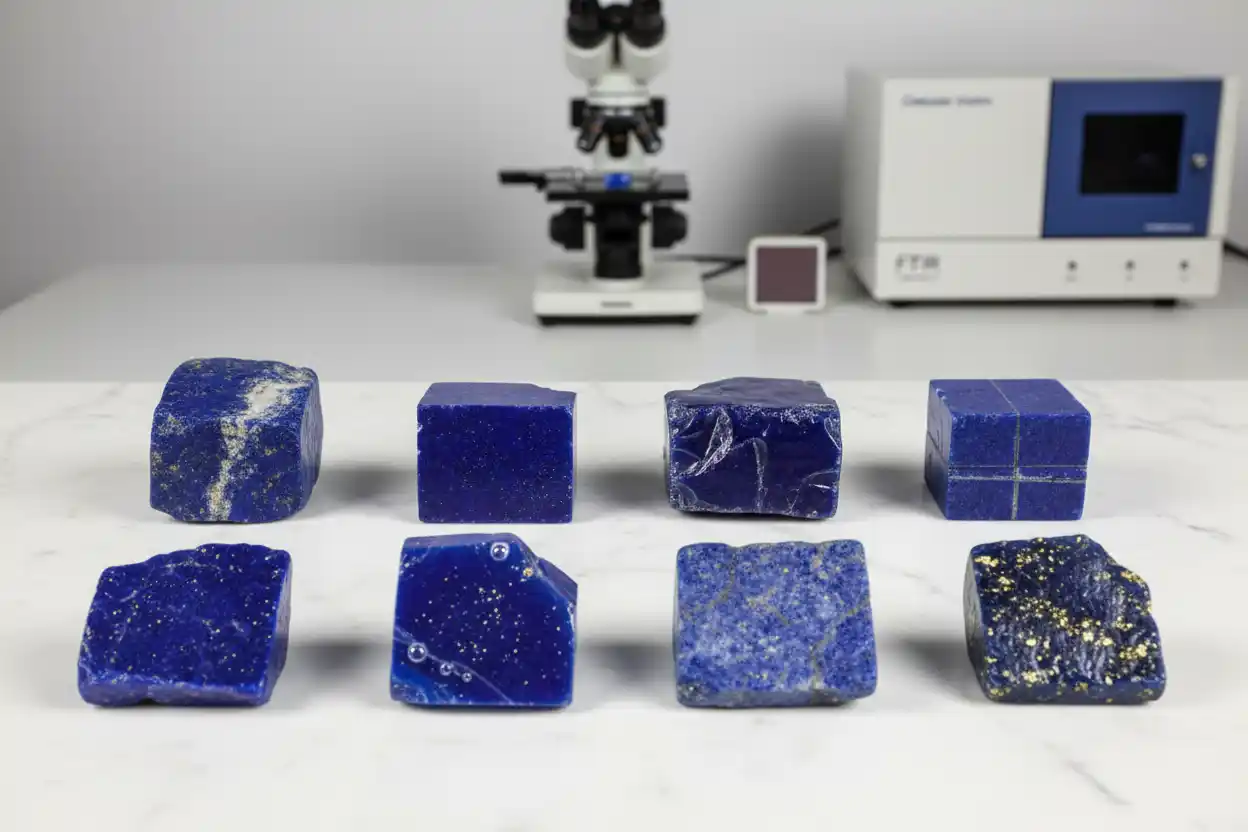
How to Spot Treated or Synthetic Lapis Lazuli
Lapis Lazuli is a blue metamorphic rock composed of several minerals rather than one crystal species with a fixed chemical formula. Lazurite or related sodalite-group minerals create its blue color, while Calcite, Pyrite, diopside, mica, feldspar, and other minerals may form part of the natural aggregate.
Its mixed and sometimes porous texture makes Lapis receptive to dye, wax, oil, polymer impregnation, coating, filling, and repair. Lower-quality pale or Calcite-rich material can be colored to resemble fine royal-blue Lapis, while wax or resin may deepen color and conceal a weak polish.
The term synthetic Lapis Lazuli requires particular care. Because Lapis is a naturally assembled rock rather than one mineral crystal, most manufactured “synthetic Lapis” products do not reproduce its complete geological structure. Gilson Lapis, reconstructed material, glass, plastic, ceramic, and pigment-based composites are more accurately treated as imitations or manufactured substitutes.
A reliable examination first establishes whether the material is natural Lapis Lazuli. It then evaluates dye, impregnation, coating, reconstruction, added metallic particles, and repair as separate issues.
Lapis Lazuli treatment categories at a glance
| Product category | What it contains | Common evidence | Correct description |
|---|---|---|---|
| Natural untreated Lapis | Naturally formed blue metamorphic rock | Natural lazurite-rich grains, Calcite, Pyrite, and mixed texture | Natural Lapis Lazuli |
| Dyed Lapis | Natural Lapis with introduced blue color | Dye in fractures, pores, pale Calcite, and drill holes | Dyed natural Lapis |
| Waxed or oiled Lapis | Natural material with surface or pore treatment | Greasy or waxy luster, residue, temporary color deepening | Surface-treated Lapis |
| Polymer-impregnated Lapis | Porous Lapis permeated with resin or plastic | Polymer in pores, bubbles, fluorescence, FTIR absorption | Impregnated natural Lapis |
| Fracture-filled or repaired Lapis | Cracks and cavities filled with resin or adhesive | Filler bubbles, contrasting luster, repaired joins | Filled or repaired Lapis |
| Coated Lapis | Blue, clear, or protective film over the surface | Peeling, edge wear, surface-only color | Coated material |
| Reconstructed Lapis | Lapis fragments or powder bonded with resin | Granular texture, binder, molded construction | Composite containing Lapis |
| Gilson Lapis imitation | Manufactured blue material designed to resemble Lapis | Different composition, porosity, hardness, and artificial pyrite | Lapis imitation |
| Dyed jasper or other stone | Another natural material dyed blue | Host-rock texture and dye concentrations | Dyed stone imitation |
| Glass, ceramic, resin, or plastic | Manufactured simulant | Bubbles, mold seams, uniform pigment, repeated pattern | Artificial Lapis imitation |
What natural Lapis Lazuli is
Natural Lapis Lazuli is a rock whose appearance depends on the proportions and distribution of several minerals.
The blue component is associated mainly with lazurite and related sodalite-group minerals. White or gray areas commonly consist largely of Calcite, while gold-colored metallic flecks are usually Pyrite.
The complete geological and material profile appears in Lapis Lazuli: Meaning, Healing Properties & Uses. This treatment page does not repeat its symbolism, history, localities, or broad mineral description.
Natural Lapis can be evenly blue, mottled, veined, heavily calcitic, strongly pyritic, or nearly free of visible associated minerals. Consequently, neither white Calcite nor Pyrite is required for authenticity.
The strongest natural material combines credible mineral texture with color distributed through the rock rather than concentrated only in surface-accessible openings.
Why Lapis Lazuli is dyed
Fine royal-blue Lapis commands a stronger price than pale, grayish, greenish, or heavily Calcite-rich material.
Dye can darken the blue body, conceal white Calcite, make separate pieces appear more consistent, and increase the apparent saturation of beads or carvings.
Because the rock contains pores, fractures, grain boundaries, and minerals with different absorption behavior, dye does not always spread evenly. It commonly collects where a liquid could penetrate most easily.
The completed Lapis Lazuli Buying Guide explains how natural color, Calcite, Pyrite, pattern, cut, and treatment affect purchasing decisions. The Lapis Lazuli Price Guide owns the value distinction between fine natural color, commercial treated material, and manufactured imitations.
Where dye appears
Under magnification, introduced blue may concentrate in open fractures, pores, cavities, drill holes, scratches, and grain boundaries.
Calcite-rich areas are particularly important. Dye may turn naturally white or pale Calcite blue, but the resulting shade can look flatter or more concentrated than the surrounding lazurite-rich material.
A bead may show a dark ring around its drill opening. Likewise, a chipped cabochon may reveal a paler interior beneath the saturated surface.
Natural blue can also vary between mineral grains and along fractures. Therefore, one dark line does not prove treatment. The distribution must resemble liquid penetration rather than natural mineral growth.
The broader inspection method appears in How to Spot Dyed Crystals.
Why rubbing tests are unreliable
Some unstable dyes can transfer to cloth, paper, alcohol, or solvent. However, stable dyes may not bleed during ordinary handling.
Wax or polymer may also seal the surface and prevent dye from transferring, even when color was introduced beneath the coating.
A negative rubbing test therefore does not prove natural color. A positive test damages or removes part of the treatment and still does not establish the complete composition of the stone.
Do not apply acetone, alcohol, bleach, or another solvent to jewelry. These substances can remove dye, dissolve wax, cloud polymer, weaken adhesive, and damage the setting.
Professional microscopy and spectroscopy preserve the object while providing stronger evidence.
Waxing
Wax can improve surface luster, deepen color, conceal a poor polish, and reduce dye transfer.
The wax may form a shallow coating or enter pores near the surface. It can create a softer, greasier, or more uniform shine than the underlying rock.
Residue may collect around bead holes, carving recesses, pits, and unpolished edges. Heat from a jeweler’s torch or hot water can soften the wax, while solvents may remove it.
A thin traditional wax application does not replace the mineral body, but it changes care requirements. Heavy wax used to conceal dye or weak construction deserves clearer disclosure.
Oiling
Oil can darken pale or dry-looking Lapis and reduce the visibility of surface-reaching fractures.
Unlike hardened polymer, oil may migrate, evaporate, attract dirt, or require renewal. A stone can gradually become lighter or patchier as oil leaves its pores.
Oil may produce a temporary wet appearance and a slightly greasy surface. However, natural polished Lapis can also have a waxy luster, so touch alone is not conclusive.
FTIR can detect organic substances, while controlled microscopy may reveal oil concentrated in fissures and cavities.
Polymer impregnation
Resin or plastic can be introduced into porous Lapis to improve durability, deepen apparent color, fill small openings, and create a stronger polish.
The treatment may be shallow or extend through much of a bead or cabochon. In heavily impregnated material, the polymer becomes an important structural component.
Possible clues include transparent filler between grains, round bubbles, unusually high surface gloss, polymer bridging cavities, or a difference between the polished face and an existing chip.
Ultraviolet light may reveal contrasting fluorescence from resin, although some polymers are inert and natural minerals may also react.
FTIR provides stronger evidence because organic polymers produce characteristic absorption features that untreated mineral aggregates do not.
Fracture filling and repairs
Open fractures can be filled with clear or blue resin, wax, adhesive, or another substance.
A filled fissure may become less visible because the foreign material reduces the optical contrast between the crack and the surrounding rock. Colored filler can also strengthen the blue appearance.
Under magnification, the examiner may see bubbles, flow structures, smooth material across an irregular cavity, shrinkage gaps, or a different surface luster.
Carvings and beads may also be repaired after breaking. A repaired seam can show glue, misaligned mineral bands, different fluorescence, or a straight boundary inconsistent with natural growth.
Filling and repair do not restore the original rock structure. They should be disclosed when they affect durability or value.
Coated Lapis
A blue coating can make a pale rock, ceramic, glass, resin, or low-grade Lapis resemble a finer natural stone.
Clear coating can also create a high gloss and seal unstable dye.
Inspect raised edges, drill holes, the underside, and existing chips. A coating may peel, scratch, wear from facet junctions, or reveal a lighter material beneath.
Color confined to one external film is fundamentally different from blue generated throughout lazurite-rich grains.
Some coatings are thin enough to escape casual inspection. Raman spectroscopy, FTIR, ultraviolet observation, and surface chemical analysis may be needed.
Reconstructed Lapis Lazuli
Lapis cutting waste, crushed rock, pigment, Pyrite fragments, resin, plastic, and other binders can be combined into slabs, beads, cabochons, carvings, and decorative objects.
The product may contain genuine Lapis powder or chips. Nevertheless, its body was manufactured rather than formed as one natural metamorphic rock.
Under magnification, reconstructed material may show angular blue fragments separated by transparent binder, repeated grain sizes, round resin bubbles, or metallic particles suspended without a credible geological relationship.
The back and drill holes may reveal a granular, cement-like, or plastic-rich interior.
A correct description should use reconstructed, reconstituted, bonded, composite, or Lapis-containing material.
Gilson Lapis is an imitation, not a strict synthetic counterpart
Gilson produced an attractive manufactured material marketed historically through synthetic-Lapis terminology.
However, GIA classifies Gilson Lapis more accurately as an imitation because its ingredients and physical properties differ from natural Lapis Lazuli.
Natural Lapis is a complex rock containing several minerals in variable proportions. A manufactured blue product cannot qualify as a strict synthetic counterpart merely because it resembles its color and includes some similar components.
Gilson-type material may be more porous and softer than natural Lapis. Added Pyrite particles can also appear unusually regular in shape and size or become detached during polishing.
The distinction between synthetic and imitation material is explained in Lab-Grown vs Natural Gemstones and Gemstone Treatments Explained.
Artificial Pyrite and metallic veining
Natural Pyrite in Lapis can appear as tiny scattered flecks, irregular grains, veins, or larger patches.
Manufacturers may add metallic flakes, brass-colored pigment, foil, glitter, or crushed Pyrite to glass, resin, ceramic, or reconstructed Lapis.
Artificial particles may look identical in size, lie at one depth, collect in resin, or follow a decorative pattern unrelated to the surrounding blue material.
Natural Pyrite should appear integrated with the rock’s mineral texture. Its broader properties appear in Pyrite: Meaning, Healing Properties & Uses.
The presence of gold-colored flecks does not prove Lapis, and their absence does not prove imitation.
White Calcite can be hidden or imitated
Natural Lapis commonly contains white or pale Calcite. The associated mineral is described in Calcite: Meaning, Properties & Symbolism.
Dye may conceal Calcite by turning porous white areas blue. Conversely, manufactured imitations may add white pigment or mineral powder to reproduce a natural-looking matrix.
A dyed Calcite area may retain different hardness, luster, and response under magnification from the surrounding blue material.
Raman spectroscopy can map the separate mineral phases and reveal whether the blue color belongs to lazurite-rich grains or an applied substance.
Dyed Sodalite and jasper
Sodalite is a natural blue feldspathoid mineral related structurally to lazurite. It can resemble Lapis, especially when the material contains white Calcite and little visible Pyrite.
The complete mineral comparison belongs to Lapis Lazuli vs Sodalite, while Sodalite: Meaning, Healing Properties & Uses covers the mineral itself.
Pale Sodalite or jasper can be dyed deeper blue and sold as Lapis. Such objects remain natural stones but have the wrong identity and introduced color.
Their mineral structure, spectrum, density, and associated phases differ from natural Lapis.
The broad authenticity workflow appears in Real vs Fake Lapis Lazuli. Treatment-specific Sodalite issues remain with How to Spot Treated or Synthetic Sodalite.
Glass, ceramic, resin, and plastic
Glass can reproduce rich blue color, white clouding, and metallic inclusions. Possible clues include round bubbles, flow lines, mold seams, and a homogeneous glassy texture.
Ceramic can be opaque and stone-like but may show manufactured pores, pigment grains, uniform internal structure, or molded surfaces.
Resin and plastic may display seams, low weight, repeated patterns, bubbles, soft scratches, or metallic glitter suspended in transparent binder.
The broader distinction appears in Glass vs. Crystal.
Sophisticated imitations may combine several substances, requiring Raman, FTIR, X-ray diffraction, and microscopy rather than one visual test.
Heat and chemical sensitivity
Heat is not a routine method for improving natural Lapis color. Instead, heat may damage wax, oil, polymer, dye, adhesive, or the mineral aggregate itself.
Acids can attack Calcite and may release unpleasant sulfur-related odors from some lazurite-bearing material. This is destructive and potentially hazardous, so acid testing should not be used.
Steam and ultrasonic cleaning can disturb filler, coating, fractures, and mixed mineral boundaries.
The safest routine process appears in How to Clean Lapis Lazuli Jewelry Safely.
Professional laboratory testing
Microscopy can reveal dye concentrations, polymer, wax, filler, coating, artificial Pyrite, and reconstructed grain boundaries.
Raman spectroscopy identifies lazurite-group minerals, Calcite, Pyrite, glass, resin, ceramic phases, and many natural substitutes.
FTIR detects wax, oil, plastic, resin, and other organic substances. X-ray diffraction provides a mineralogical fingerprint for the complex aggregate.
X-ray fluorescence or related chemical analysis helps distinguish natural mineral components from pigment-rich manufactured products.
No single spot represents the whole rock. Several blue, white, metallic, and filled areas may need separate analysis.
Reports and buying evidence
A laboratory report is worthwhile for valuable carvings, important archaeological-style objects, prestigious locality claims, unusually clean royal-blue material, or suspected reconstruction.
The completed Gemstone Certification Labs Compared explains report services. How to Read a Gem Lab Report helps match the report’s dimensions, weight, photograph, identification, and treatment comments to the item.
Before buying online, follow How to Buy Gemstones Online Without Getting Scammed. Request photographs of the front, back, sides, drill holes, and any damaged areas rather than relying on a saturated face-up image.
Frequently Asked Questions
1. Is dyed Lapis Lazuli still real Lapis?
The underlying rock may be natural Lapis, but its blue color has been strengthened artificially and should be disclosed.
2. Why is Lapis dyed?
Dye can conceal pale Calcite, darken weak blue material, and make beads or carvings appear more uniform.
3. How can dye appear under magnification?
It may concentrate in fractures, pores, grain boundaries, drill holes, cavities, and formerly pale Calcite-rich areas.
4. Is waxed Lapis fake?
No. Waxed Lapis can be natural rock with a surface treatment, although the wax may conceal dye or a weak polish.
5. Can Lapis be polymer impregnated?
Yes. Resin or plastic may enter pores and fractures to improve durability, color, and polish.
6. What is reconstructed Lapis?
It is a manufactured composite made from Lapis fragments or powder combined with resin, plastic, glass, or another binder.
7. Is Gilson Lapis true synthetic Lapis?
No. It is more accurately classified as an imitation because its ingredients and properties differ from natural Lapis Lazuli.
8. Do gold flecks prove Lapis is genuine?
No. Artificial Pyrite, metallic pigment, foil, and glitter can be added to imitations and composites.
9. Does natural Lapis always contain Pyrite?
No. Genuine material may contain little or no visible Pyrite.
10. Can solvents safely test Lapis dye?
No. Solvents can remove dye, wax, polymer, coating, and adhesive while permanently damaging the object.
11. Can a laboratory detect treatment?
Yes. Microscopy, FTIR, Raman spectroscopy, X-ray diffraction, and chemical analysis can identify many treatments and imitations.
12. When should Lapis receive a laboratory report?
Testing is most useful for valuable carvings, rare-origin claims, suspected reconstruction, major archaeological-style objects, and high-priced natural-color material.
Conclusion
Lapis Lazuli treatment is dominated by dye and surface or pore impregnation. Wax, oil, resin, coating, and filler can deepen color, conceal Calcite, improve polish, and stabilize weak material.
Reconstructed Lapis may contain genuine rock fragments but is not one natural geological piece. Gilson Lapis, glass, ceramic, dyed jasper, plastic, and pigment-rich resin are imitations rather than strict synthetic counterparts.
The strongest examination studies each mineral component, the distribution of color, the presence of organic material, and the continuity of the rock texture. A royal-blue surface or metallic flecks cannot answer those questions alone.