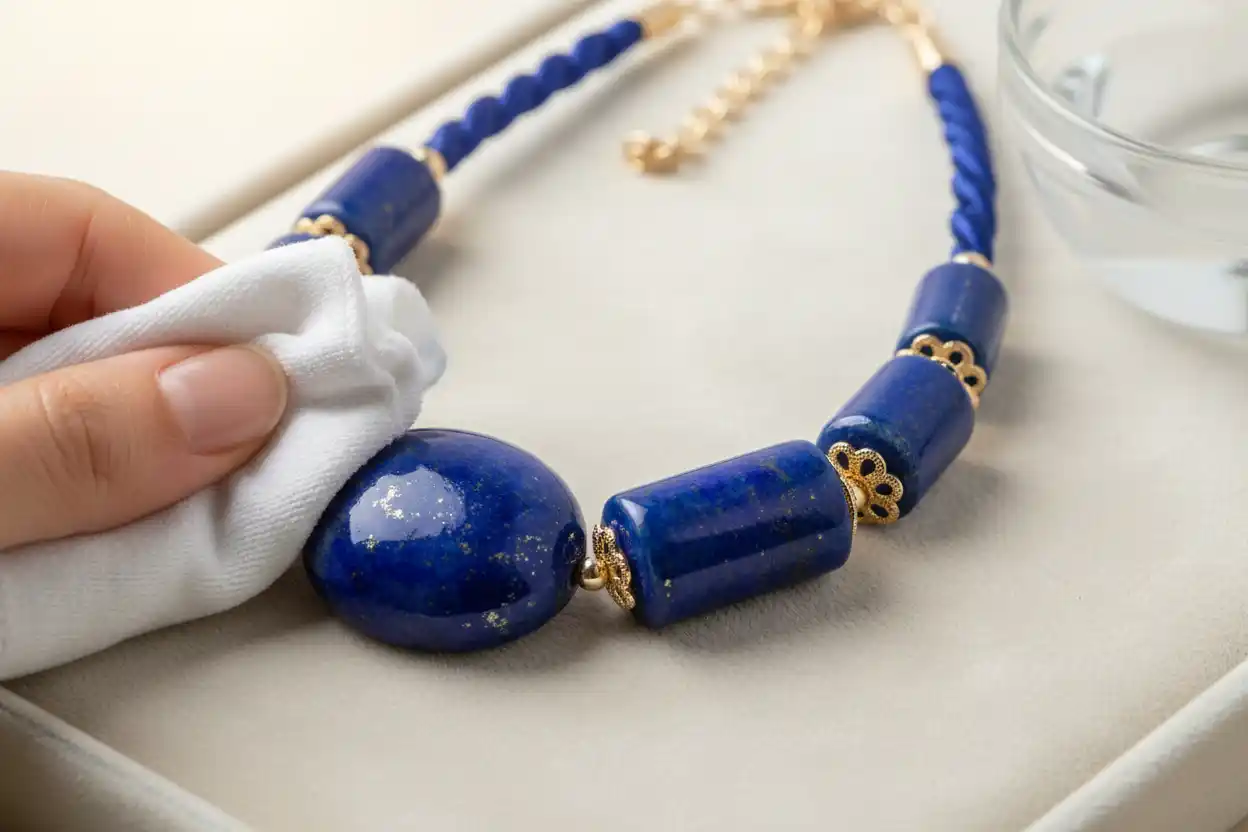
How to Clean Lapis Lazuli Jewelry Safely
Lapis lazuli jewelry should be cleaned carefully with warm water, a small amount of mild soap, and a soft cloth or brush. Test the method on a small inconspicuous area first because some dyed lapis has unstable color.
Never use an ultrasonic cleaner or steam. Prolonged soaking, acids, solvents, abrasives, high heat, and aggressive metal dips may damage the stone, remove dye, alter wax or plastic coatings, or dull its polish.
Why Lapis Lazuli Needs Conservative Care
Lapis lazuli is a rock composed of several minerals rather than one uniform mineral species. Lazurite provides much of its blue color, while calcite, pyrite, sodalite-group minerals, and other components may also be present.
Its history, composition, symbolism, and traditional uses belong to the broader Lapis Lazuli guide.
Because its mineral mixture varies, lapis does not have one perfectly uniform hardness. It commonly falls around 5 to 6 on the Mohs scale.
| Property | Cleaning implication |
|---|---|
| Material type | Polymineralic rock |
| Principal blue component | Lazurite |
| Common associated minerals | Calcite, pyrite and sodalite-group minerals |
| Typical Mohs hardness | Approximately 5 to 6 |
| Surface | Often porous and capable of accepting dye or wax |
| Safest routine method | Brief warm soapy-water cleaning after a hidden-area test |
| Ultrasonic cleaning | Never recommended |
| Steam cleaning | Never recommended |
| Main risks | Dye instability, coating damage, acids, solvents, scratching, heat, and soaking |
The gemstone hardness chart explains why lapis can be scratched by quartz dust and many common jewelry stones.
Its durability depends on the complete rock texture, not only the hardness of one component. The distinction appears in Gemstone Toughness vs Hardness.
Inspect Color, Surface, and Construction
Examine the jewelry under bright, indirect light. Look for cracks, chips, chalky patches, peeling color, lifting coatings, damaged drill holes, loose bezels, frayed string, and cloudy glue.
Pay attention to recesses, edges, and drill holes. Dye may collect in these areas, while wax or resin can create a smooth surface over naturally porous material.
Natural calcite can appear as white patches or veins. Brassy metallic specks are commonly pyrite. Neither feature should be scrubbed away as dirt.
Do not wash a loose, cracked, antique, or visibly unstable piece at home.
Test for Unstable Dye Before Full Cleaning
Some lapis is dyed to intensify blue color or reduce the visibility of pale areas.
Dampen a white cotton swab or a corner of a soft white cloth with clean water. Gently touch an inconspicuous area for a few seconds.
Stop if blue color transfers to the cloth. Use only dry wiping and arrange specialist advice for valuable jewelry.
Do not use acetone or another solvent as a household dye test. Solvents can remove dye, wax, plastic coatings, glue, and surface finishes.
The complete treatment-identification workflow belongs to How to Spot Treated or Synthetic Lapis Lazuli and the broader Gemstone Treatments Explained guide.
Prepare a Gentle Cleaning Solution
Fill a shallow bowl with warm—not hot—water and add a few drops of mild liquid soap.
Use a soft lint-free cloth or a very soft brush. Prepare another cloth dampened with clean water for removing soap.
Place a folded towel beneath the working area. This prevents the lapis from striking a hard sink or countertop.
Avoid soaps containing bleach, ammonia, abrasives, solvents, citrus acids, or aggressive degreasers.
Clean Lapis Briefly
After the hidden-area test, dampen the cloth or brush with the mild solution.
Wipe the polished blue surface gently. Clean around bezel edges, drill holes, bails, settings, and carving recesses without applying heavy pressure.
Do not leave lapis submerged. Its porosity, treatment, mounting, stringing, and mineral mixture make prolonged soaking unnecessary.
Use a second damp cloth to remove soap, then blot the piece dry immediately.
Allow hidden moisture to evaporate naturally at room temperature.
Never Use an Ultrasonic Cleaner
Lapis lazuli should never go into an ultrasonic cleaner.
Vibration may damage a porous or fractured surface, loosen beads, disturb coatings, remove unstable treatment, or weaken the mounting.
Cleaning solution and heat inside the machine create additional risks for dye, wax, resin, and plastic impregnation.
The general equipment boundaries appear in Which Gemstones Can Go in an Ultrasonic Cleaner?.
Never Steam Clean Lapis Lazuli
Steam combines heat, pressure, and rapid temperature change.
Heat can damage wax or plastic coatings, soften glue, affect dye, and create stress within a mineral mixture containing components with different physical properties.
Warm manual cleaning provides sufficient care without those risks.
Avoid Acids Because Lapis May Contain Calcite
Calcite is a common component of lapis lazuli and reacts with acids.
Keep the stone away from vinegar, lemon juice, descaling products, acidic bathroom cleaners, and chemical jewelry dips.
An acid may etch pale calcite areas or create uneven texture even when the blue lazurite remains visible.
Do not attempt to dissolve white patches. Calcite can be part of the natural rock rather than removable contamination.
Preserve Natural Pyrite Flecks
Brassy or golden specks in lapis are commonly pyrite.
These inclusions can contribute visual character, although excessive or poorly distributed pyrite may influence commercial quality.
Do not scrub the metallic areas with a wire brush or metal polish. The surrounding lapis is far softer than most metal-cleaning abrasives.
The broader mineral background belongs to the Pyrite guide.
A lack of pyrite does not prove that lapis is fake, and abundant glitter does not automatically prove authenticity.
Cleaning a Lapis Lazuli Ring
A Lapis Lazuli ring faces frequent contact with soap, sanitizer, hard surfaces, and household chemicals.
Wipe the cabochon and clean around the bezel without soaking the piece. Remove the ring before washing dishes, swimming, showering, gardening, exercise, and cleaning.
Lapis is better suited to protective, low-profile settings than exposed daily-wear designs.
Cleaning Lapis Earrings
Lapis Lazuli earrings usually receive less impact but collect cosmetics and hair products.
Wipe the lapis component separately from the post, hook, back, or hinge.
Keep alcohol-based disinfectant on compatible metal fittings and away from dye, wax, plastic coatings, glue, and the stone.
Cleaning a Lapis Necklace
A Lapis Lazuli necklace may contain beads, knots, silk, cord, wire, metal spacers, or a carved pendant.
Lay bead strands flat and wipe each bead rather than soaking the necklace. Wet thread may stretch, stain, or weaken.
Do not pull beads against one another because trapped grit can scratch their surfaces.
When stringing becomes frayed or permanently soiled, professional restringing is safer than repeated washing.
Cleaning a Lapis Bracelet
A Lapis Lazuli bracelet combines the stone’s moderate hardness with repeated wrist movement and impact.
Inspect every bead, drill hole, elastic section, knot, hinge, and clasp.
Wipe elastic or corded bracelets instead of immersing them. Dry the strand flat rather than hanging it.
Remove the bracelet before desk work or activities that expose it to repeated blows.
Lapis Lazuli Versus Sodalite
Lapis and sodalite can both show rich blue color, but lapis is a rock mixture commonly associated with lazurite, calcite, and pyrite. Sodalite is a mineral species and usually lacks the same characteristic combination.
The full distinction belongs to Lapis Lazuli vs Sodalite, while the individual comparison material is covered in the Sodalite guide.
Cleaning response should not be used as an identification test. Scratching, acids, solvents, and soaking can damage either material.
Waxed, Coated, and Impregnated Lapis
Wax or plastic may be applied to improve polish, reduce porosity, or help stabilize dyed color.
A treated surface may look glossier than untreated stone. Over time, heat, solvents, abrasion, and repeated chemical exposure can dull or remove the layer.
Do not apply household wax, furniture polish, baby oil, cooking oil, or mineral oil. These products attract dirt and may complicate later treatment assessment.
When the surface becomes patchy, professional repolishing or treatment evaluation is safer than home experimentation.
Buying, Value, and Authentication
The Lapis Lazuli buying guide covers blue saturation, calcite, pyrite, texture, treatment, construction, carving, and seller disclosure.
Market factors belong to the Lapis Lazuli price guide.
Glass, plastic, ceramic, dyed stone, reconstructed material, and other imitations may be sold as lapis. The complete authenticity workflow belongs to Real vs Fake Lapis Lazuli.
For valuable pieces, the gemstone certification guide and How to Read a Gem Lab Report explain what laboratories may report about material identity and detectable treatment.
Storage and Preventive Care
Store lapis separately in a soft pouch or padded compartment.
Quartz, topaz, sapphire, ruby, diamond, and many other stones can scratch it. Chains and metal clasps can also create fine wear.
Put the jewelry on after perfume, hairspray, lotion, sunscreen, and makeup have dried. Wipe it after wear to remove perspiration and cosmetics.
Questions about extended water exposure belong to the guide to crystals in water. Brief controlled cleaning should not be confused with soaking.
Physical Cleaning Versus Cleansing
Physical cleaning removes dust, oils, cosmetics, and residue.
Traditional symbolic practices belong to How to Cleanse and Charge Lapis Lazuli. Those methods should still avoid saltwater, acids, prolonged soaking, sunlight, abrasion, and other exposures that may damage lapis.
Frequently Asked Questions
1. What is the safest way to clean lapis lazuli?
Use warm water, a small amount of mild soap, and a soft cloth after testing an inconspicuous area.
2. Can lapis lazuli get wet?
Brief controlled contact may be acceptable, but soaking should be avoided because the stone may be porous, dyed, waxed, coated, glued, or strung.
3. Can lapis go in an ultrasonic cleaner?
No. Vibration, heat, and cleaning solution can damage the stone and its treatments.
4. Can lapis lazuli be steam cleaned?
No. Steam may damage dye, wax, plastic coatings, glue, fractures, and the mixed-mineral structure.
5. Can vinegar clean lapis?
No. Acids can react with calcite present in the rock and may damage the surface.
6. Is dish soap safe for lapis?
A small amount of mild soap may be used after testing a hidden area. Stop if color transfers to the cloth.
7. Can rubbing alcohol clean lapis?
No. Alcohol and other solvents may remove dye, wax, coatings, or adhesive.
8. Can toothpaste polish lapis lazuli?
No. Toothpaste is abrasive and may scratch or dull the stone.
9. Are the golden flecks in lapis dirt?
No. Brassy metallic flecks are commonly natural pyrite inclusions.
10. Why is blue color coming off on my cloth?
The lapis may contain unstable dye. Stop cleaning and avoid further water or solvent exposure.
11. How often should lapis jewelry be cleaned?
Wipe it after wear and use damp cleaning only when visible residue remains.
12. When should lapis receive professional care?
Professional care is appropriate for unstable dye, damaged coatings, cracks, antique pieces, frayed strands, deep scratches, or valuable carvings.
Conclusion
Lapis lazuli is maintained best through minimal, controlled cleaning rather than soaking or powerful equipment. A soft cloth and tested warm-soapy-water method protect its variable mineral mixture, dye, wax, and polish. When blue color transfers or the surface becomes patchy, stop cleaning—the problem is likely treatment stability rather than ordinary dirt.