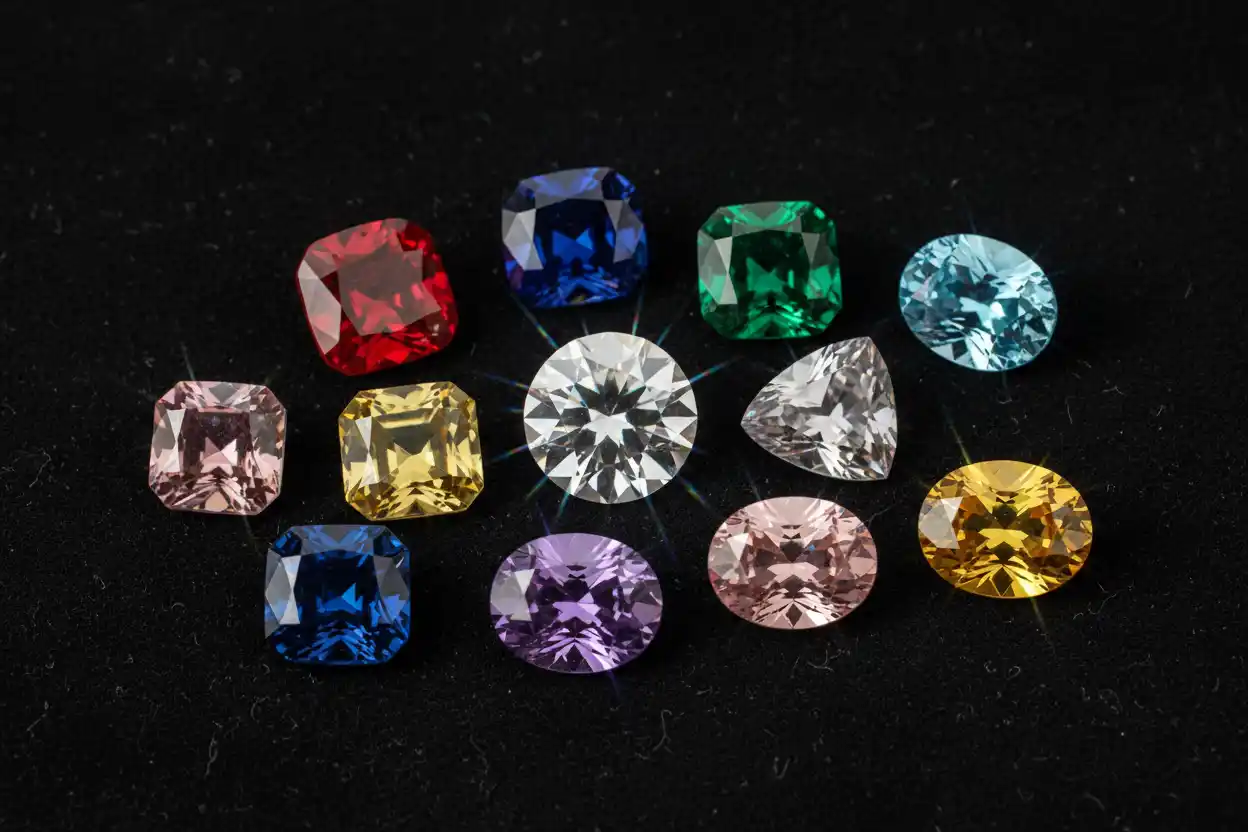
Types of Cubic Zirconia: Colors and Varieties Explained
Cubic zirconia, commonly abbreviated as CZ, is a laboratory-manufactured crystalline material made primarily from zirconium dioxide. It is best known as an affordable diamond simulant, although manufacturers can produce it in nearly every jewelry color.
The different types of cubic zirconia are not natural mineral varieties. Instead, they are distinguished by color-producing dopants, stabilizing compounds, transparency, surface coatings, cutting quality, and commercial grade descriptions. The parent cubic zirconia meaning and properties guide covers the gem material’s broader identity and symbolism.
Cubic Zirconia at a Glance
| Property | Cubic Zirconia |
|---|---|
| Composition | Stabilized zirconium dioxide, ZrO₂, with yttria, calcia, magnesia, or another stabilizer |
| Group | Laboratory-created crystalline oxide; synthetic gem material |
| Colors | Colorless, yellow, orange, red, pink, purple, blue, green, brown, gray, black, and coated rainbow colors |
| Crystal system | Cubic when stabilized |
| Typical habit | Manufactured columnar or irregular crystal rough from skull-melting or related growth processes |
| Luster | Adamantine to vitreous |
| Transparency | Transparent to opaque |
| Mohs hardness | Approximately 8–8.5 |
| Cleavage | None |
| Tenacity | Brittle |
| Common uses | Rings, earrings, pendants, bracelets, fashion jewelry, watch settings, and diamond-simulant jewelry |
| Main care concern | Surface abrasion, chipped facet edges, oil buildup, thermal shock, and wear to applied coatings |
What Makes Cubic Zirconia Cubic?
Pure zirconium dioxide changes crystal structure as temperature changes. At ordinary room temperature, it does not naturally remain in the cubic structure required for gem-quality CZ.
Manufacturers solve that problem by adding a stabilizer such as yttrium oxide, calcium oxide, or magnesium oxide. The stabilizer preserves the cubic crystal arrangement as the molten material cools.
Most gem CZ is grown through a cold-crucible or skull-melting process. Radio-frequency energy melts zirconia powder inside a water-cooled container, while an unmelted outer shell of zirconia acts as its own crucible. This method avoids contaminating the extremely hot melt with an ordinary container.
Once cooled, the synthetic rough is separated, sawn, preformed, and faceted. Its manufactured origin places it within the category explained in lab-grown versus natural gemstones, although CZ is more accurately described as a synthetic material and diamond simulant than as laboratory-grown diamond.
Stabilized Cubic Zirconia Types
The stabilizer is one technical way to distinguish CZ types, although retailers rarely disclose it.
Yttria-Stabilized Cubic Zirconia
Yttria-stabilized zirconia contains yttrium oxide. It is the best-known gem-quality formulation and can produce transparent material with strong brilliance, high dispersion, and good consistency.
The exact percentage affects density, hardness, optical performance, and crystal stability. Too much stabilizer can reduce brilliance or hardness, so manufacturers balance structural stability against gemological performance.
Calcia-Stabilized Cubic Zirconia
Calcium oxide can also stabilize cubic zirconia. Calcia-stabilized formulations appeared in early commercial production and remain technically possible.
Differences between well-made yttria- and calcia-stabilized jewelry CZ are generally less important to consumers than cutting, polishing, color, and structural condition.
Other Stabilized Zirconias
Magnesia and other stabilizing systems are widely used in technical ceramics. However, industrial stabilized zirconia should not automatically be treated as facetable jewelry CZ.
A product description such as “zirconia ceramic” may refer to an opaque engineering material rather than transparent cubic zirconia suitable for gemstones.
Colorless Cubic Zirconia
Colorless CZ is the most familiar type. Its high refractive index and strong dispersion create bright white reflections and pronounced rainbow fire.
Fine colorless material should appear transparent and free from obvious cloudiness, bubbles, polishing lines, chips, or gray areas. Its fire can look stronger than diamond because CZ disperses white light more intensely.
Large colorless stones sometimes reveal their identity through excessive rainbow flashes, relatively low surface relief, or a glassier appearance. Nevertheless, visual impressions alone are not reliable enough to identify every mounted stone.
Colorless CZ is widely used as one of the best diamond alternatives, although its physical properties differ from those of natural diamond and moissanite.
Near-Colorless and Warm White CZ
Not every nominally white CZ is completely colorless. Small amounts of iron or other impurities can produce cream, pale yellow, gray, or warm-white tones.
Warm CZ may be used deliberately in antique-inspired jewelry because it resembles lower-color diamond grades. It can also complement yellow or rose gold more softly than icy white material.
When sold as a diamond simulant, color should be stated clearly. Terms such as “G-color CZ” or “H-color CZ” are commercial comparisons rather than standardized laboratory grades equivalent to diamond color reports.
Yellow Cubic Zirconia
Yellow CZ ranges from pale lemon and canary yellow to golden, amber, champagne, and yellow-brown. Manufacturers achieve these shades by adding controlled dopants during crystal growth.
Strongly saturated yellow material can imitate the visual appearance of fancy yellow diamond, yellow sapphire, citrine, or golden beryl. Its greater dispersion often produces more spectral fire than those natural gems.
Pale yellow stones tend to look bright and open, while deep amber or brownish yellow material may show dark extinction if the pavilion is cut too deeply.
The yellow gemstones guide places yellow CZ beside natural and laboratory-created materials with similar colors without implying equivalent rarity or value.
Orange Cubic Zirconia
Orange CZ includes peach, apricot, tangerine, reddish orange, and deep burnt-orange shades. Cerium-related and other dopant combinations can create much of this range.
Bright orange stones work well in fashion jewelry because they combine saturated color with strong brilliance. Deep reddish orange can resemble spessartine garnet, fire opal, orange sapphire, or imperial topaz from a distance.
However, CZ remains much denser than many of those gems. A loose orange CZ may therefore weigh more than a natural stone with identical dimensions.
Red Cubic Zirconia
Red CZ ranges from bright scarlet to ruby red, cherry red, and dark wine tones. Achieving a commercially attractive transparent red can require careful control of dopant chemistry and concentration.
Deep red material may show lower apparent brilliance because its body color absorbs more light. Therefore, shallower or modified brilliant cuts are often used to prevent the center from becoming too dark.
Red CZ can imitate ruby, red spinel, garnet, and red diamond in inexpensive jewelry. Sellers should describe it as cubic zirconia rather than using an ambiguous label such as “created ruby” unless the stone is actually synthetic corundum.
Pink Cubic Zirconia
Pink CZ is available in blush, rose, bubblegum, hot pink, magenta, and purplish pink. Rare-earth elements such as erbium, europium, and holmium have historically been associated with pink color production.
Pastel pink material can resemble morganite or pale pink sapphire, while strongly saturated stones may imitate pink spinel or fancy pink diamond.
Pink CZ is especially common in earrings, eternity bands, stackable rings, and accent settings. Even coloration and clean polish matter more than nominal carat weight because the synthetic rough is readily available.
Purple and Lilac Cubic Zirconia
Purple CZ may appear lavender, lilac, violet, grape, or reddish purple. Cobalt, manganese, neodymium, and related dopant systems can contribute to this range.
The material’s high dispersion creates colorful flashes that may be more visible than in natural amethyst. Consequently, purple CZ can look unusually lively under spot lighting.
The trade sometimes uses romantic labels such as “amethyst CZ,” but the phrase should mean amethyst-colored cubic zirconia, not synthetic amethyst.
Blue Cubic Zirconia
Blue CZ occurs in pale ice blue, sky blue, aqua, teal, royal blue, and deep sapphire-like tones. Modern production can create colors far stronger and more consistent than early commercial material.
Pale blue CZ may imitate aquamarine or blue diamond, whereas deeper stones can resemble sapphire, spinel, topaz, or synthetic glass.
Color consistency should be assessed through the side as well as the face. Coated blue material may show color concentrated at the surface, particularly along facet edges or areas of abrasion.
Green Cubic Zirconia
Green CZ includes mint, lime, olive, forest green, bluish green, and emerald-like colors. Chromium, vanadium, thulium, and combinations of dopants can produce different green tones.
Transparent emerald-green material provides an inexpensive alternative to highly included emerald, although it lacks emerald’s natural inclusions, geological rarity, and characteristic optical response.
Olive and yellow-green CZ can resemble peridot, chrysoberyl, tourmaline, or green garnet. The color name alone should never be used as an identity.
Brown, Champagne, and Cognac CZ
Brown CZ ranges from light beige and champagne to cinnamon, cognac, chocolate, and near-black brown.
Warm neutral shades are popular in vintage-inspired jewelry and can imitate brown diamond at a much lower cost. Their appeal depends on balance: a stone should retain brilliance instead of looking muddy or overly dark.
Champagne and cognac are marketing color descriptions rather than standardized CZ varieties. One retailer’s champagne may overlap another seller’s pale yellow or light brown.
Black Cubic Zirconia
Black CZ is opaque or nearly opaque and typically receives a high polish. It can be manufactured with strong dark coloration or produced through surface-related processes.
The material offers a highly uniform appearance, unlike many natural black diamonds that owe their color to dense inclusions, fractures, or graphitized zones.
Black CZ is commonly used in men’s rings, pavé accents, earrings, and gothic-inspired designs. Chips are particularly visible because a damaged edge may reveal a lighter interior or interrupt the glossy surface.
Multicolored and Color-Change CZ
Manufacturers can combine dopants, growth zoning, coatings, or optical effects to produce multicolored and color-shifting CZ.
Some specialty stones appear different under daylight and warm incandescent light. However, “color-change CZ” does not have a universally standardized performance threshold. A minor shift in tone should not be marketed as a dramatic alexandrite-like transformation without clear photographic evidence.
Bicolored and gradient stones may be produced through controlled growth or surface treatment. Their value depends mainly on cutting quality, visual design, and brand positioning rather than scarcity of raw material.
Coated and Rainbow Cubic Zirconia
A thin surface coating can give colorless or colored CZ a metallic, iridescent, rainbow, or “mystic” appearance.
These coatings create colors that may not extend through the entire stone. Consequently, abrasion at facet edges, prongs, or the pavilion can expose the underlying CZ.
Coated stones should be cleaned gently and kept away from polishing compounds, strong chemicals, steam, and repeated ultrasonic treatment. Coating disclosure falls within the principles discussed in the gemstone treatments guide.
Crackle Cubic Zirconia
Crackle CZ contains a network of internal fractures created deliberately or developed during manufacturing and cooling.
The fractures reflect light and may accept colored coating or dye, creating a sparkling ice-like pattern. However, they also weaken the stone because each internal crack can propagate under impact or setting pressure.
Crackle material is best suited to protected fashion jewelry rather than rings expected to withstand daily knocks.
Machine-Cut and Precision-Cut CZ
Cut quality creates one of the most meaningful differences between CZ stones.
Mass-produced machine-cut CZ may have uneven facet junctions, thick girdles, shallow pavilions, poor symmetry, or limited polish. It can still look attractive in small pavé settings, where individual cutting precision is difficult to see.
Precision-cut CZ receives closer control of angles, facet alignment, symmetry, and polish. A skilled cutter can use CZ’s strong dispersion to create exceptional brilliance and complex fantasy patterns.
Because the raw material is inexpensive, labor may account for most of a precision-cut stone’s price.
“A,” “AAA,” and “5A” Cubic Zirconia Grades
Retailers frequently advertise A, AAA, 5A, or 6A CZ. These are not universally recognized gemological grades.
One supplier may use 5A to mean clean rough and accurate machine cutting, while another may apply the same label to ordinary commercial stones. There is no independent global scale equivalent to GIA diamond grading.
Consumers should judge actual measurements, cut, polish, transparency, color, warranty, and return policy instead of assuming that more letters guarantee better quality.
Cubic Zirconia Versus Diamond, Moissanite, and Zircon
CZ is not diamond, laboratory-grown diamond, moissanite, or zircon.
Diamond is carbon with Mohs hardness 10. Moissanite is silicon carbide with hardness around 9.25 and strong double refraction. Natural zircon is zirconium silicate and has different optical properties, crystal structure, and brittleness.
The dedicated moissanite versus cubic zirconia guide owns the direct comparison. Broader differences among mined diamond, laboratory-grown diamond, and simulants appear in moissanite versus diamond versus lab diamond.
How Cubic Zirconia Is Identified
CZ has high density, strong dispersion, single refraction, and a refractive index lower than diamond but higher than many common gemstones.
A loose CZ often feels unexpectedly heavy for its dimensions. It may also show stronger rainbow fire and less sharp white brilliance than a well-cut diamond.
Under magnification, commercial CZ may show rounded facet junctions, polishing marks, chips, gas bubbles, or unusual internal particles. High-grade material can be very clean, so absence of inclusions does not establish diamond identity.
Thermal testers designed only to separate diamond from older simulants may identify CZ readily, but combination testers and professional gemological instruments offer better reliability. The principles in gemstone certification become important when a stone is represented as diamond or another valuable gem.
Treatments, Synthetics, and Imitations
Cubic zirconia is already a synthetic material. Therefore, “synthetic CZ” is technically redundant rather than evidence of a fake product.
Its color may be created throughout the crystal with dopants or added afterward through coatings. Fracturing, dyeing, painting, foil backing, and assembled construction can also modify lower-cost jewelry.
CZ itself may imitate diamond, sapphire, ruby, emerald, topaz, spinel, and numerous other gems. Conversely, glass and molded resin can imitate CZ in extremely inexpensive pieces.
The types of gemstones guide explains why synthetic gems, simulants, and imitations are separate categories.
Cutting Behavior
CZ’s lack of cleavage makes it easier to orient than topaz or diamond rough, but its brittle nature still requires controlled pressure.
The material polishes well and accepts almost every conventional shape, including rounds, ovals, cushions, emerald cuts, pears, marquises, hearts, radiants, briolettes, rose cuts, portraits, and fantasy designs.
Its high density means a one-carat CZ is smaller than a one-carat diamond. Retail descriptions sometimes avoid confusion by using “diamond-equivalent weight,” but sellers should state whether a figure represents actual CZ weight or visual size.
Durability and Jewelry Suitability
With hardness around 8–8.5, CZ resists scratches better than quartz, feldspar, apatite, and many natural gems. The gemstone hardness chart places it below sapphire, moissanite, and diamond.
Even so, long-term wear can round facet edges and create fine surface abrasion. That gradual wear contributes to the hazy appearance sometimes seen in older CZ rings.
CZ has no cleavage but remains brittle. The distinction explained in gemstone cleavage and chipping matters because a hard stone can still fracture when struck.
It works well in earrings, necklaces, pendants, bracelets, and occasional-wear rings. Daily-wear rings perform best with protected girdles, secure settings, and realistic expectations about eventual replacement.
Cubic Zirconia Prices in 2026
Cubic zirconia remains one of the least expensive faceted gem materials.
Small commercial loose stones may cost less than $1 to approximately $5 each when purchased in quantity. A well-cut loose stone near one diamond-equivalent carat commonly sells for roughly $3–$30, depending on brand, cutting, coating, and retailer.
Larger precision-cut or specialty-color stones may range from approximately $20 to $100 or more per stone. Custom fantasy cuts, artist-cut pieces, unusual coatings, and limited branded collections can cost substantially more because the price reflects labor rather than rough scarcity.
In finished jewelry, the metal, setting work, design, brand, and warranty usually contribute more value than the CZ itself. A gold CZ ring may therefore cost hundreds or thousands of dollars even though the center stone has modest standalone value.
Detailed market comparisons belong in the cubic zirconia price guide.
Buying Guidance
Begin by choosing color, dimensions, shape, and intended wear rather than focusing on a promotional grade such as 5A.
Request actual millimeter measurements, because carat-equivalent labels can be inconsistent. A round marketed as “one carat equivalent” should usually be close to the visual diameter expected from a one-carat diamond, but its actual CZ weight will be greater.
Inspect facet alignment, girdle thickness, polish, transparency, chips, coating wear, and secure setting. For colored CZ, ask whether the color runs through the crystal or comes from a surface coating.
The dedicated cubic zirconia buying guide covers seller evaluation and setting quality without turning a color-variety page into a transaction checklist.
Cleaning and Storage
Oil, lotion, soap film, and dust reduce CZ brilliance quickly. Clean solid uncoated stones with lukewarm water, mild soap, and a soft brush, paying particular attention to the back of the setting.
Rinse briefly and dry with a lint-free cloth. Avoid abrasive toothpaste, scouring powder, hard brushes, and metal-polishing compounds.
Some secure, untreated CZ jewelry may tolerate ultrasonic cleaning, but coatings, crackle treatment, glue, plated settings, and damaged stones create additional risks. Consult the guide to gemstones in ultrasonic cleaners before using equipment.
Store CZ separately from diamond, sapphire, and moissanite, which can scratch it. The complete step-by-step process belongs in how to clean cubic zirconia jewelry.
Meaning and Symbolism
Cubic zirconia is a modern material, so its symbolism comes primarily from contemporary jewelry culture rather than ancient mineral traditions.
Colorless CZ is often associated with clarity, celebration, accessibility, and personal style without financial pressure. Colored stones may carry the same color symbolism commonly assigned to natural gems: pink with affection, blue with calm communication, green with growth, and yellow with optimism.
Some wearers value CZ because it allows experimentation with large stones, unusual cuts, and vivid colors. These meanings are personal or cultural interpretations, not scientifically measurable effects of stabilized zirconium dioxide.
Frequently Asked Questions
1. How many types of cubic zirconia are there?
There is no fixed number. CZ can be classified by stabilizer, color, transparency, coating, fracture treatment, cutting quality, and commercial finish.
2. Is colorless cubic zirconia the same as lab-grown diamond?
No. CZ is stabilized zirconium dioxide, while laboratory-grown diamond is crystalline carbon with the same fundamental structure as natural diamond.
3. What is the highest-quality type of CZ?
A transparent, precisely cut, accurately polished stone without chips, haze, uneven color, or weak facet alignment represents high quality. Labels such as 5A are not standardized.
4. Does colored CZ have color throughout the stone?
Many colored CZs receive color-producing dopants during growth, so the color extends through the crystal. Coated varieties carry part or all of their color on the surface.
5. Can cubic zirconia change color?
Specialty color-change and color-shifting CZ exists, although performance varies. Buyers should request images under clearly identified lighting conditions.
6. Is black cubic zirconia natural?
No gem-quality black CZ is mined. It is a manufactured form of stabilized zirconium dioxide produced with dark coloration or surface modification.
7. What is rainbow or mystic CZ?
It is generally CZ with an iridescent surface coating. The coating creates the rainbow effect and can wear at exposed edges.
8. Is CZ softer than moissanite?
Yes. CZ is approximately 8–8.5 on the Mohs scale, while moissanite is around 9.25 and generally maintains its polish longer.
9. Why does old cubic zirconia become cloudy?
Fine scratches, rounded facet edges, soap film, lotion, dust, coating wear, or damage beneath the setting can reduce brilliance. CZ itself does not normally turn into an opaque substance without wear or contamination.
10. Can cubic zirconia be worn every day?
It can, but an exposed daily-wear ring will usually show abrasion sooner than diamond or moissanite. Protected settings and regular cleaning extend its useful life.
11. Is precision-cut CZ worth more?
Yes. Precision cutting requires more labor and can produce sharper facet junctions, stronger light return, and more distinctive designs than mass-produced commercial cutting.
12. Does cubic zirconia have resale value?
Loose CZ usually has limited resale value because new material is inexpensive and abundant. Finished jewelry may retain value through its precious metal, craftsmanship, brand, or design.
Cubic zirconia’s real variety lies in manufacturing choices rather than natural geology. Stabilizer chemistry creates the cubic structure, dopants create nearly unlimited colors, and cutting determines whether the finished stone looks ordinary or exceptionally lively. Related entries appear in the crystals that start with C directory and the gemstones that start with C guide.