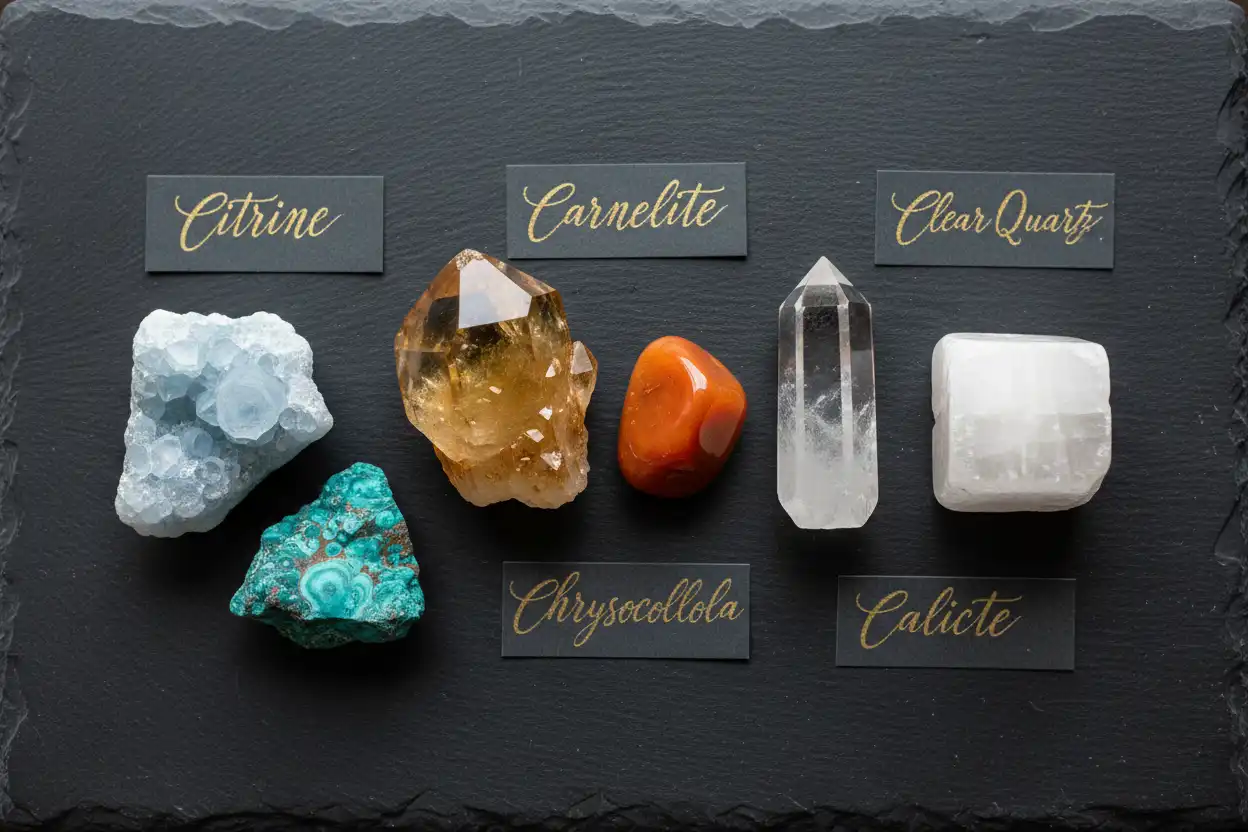
Crystals That Start With C: Names and Meanings
Crystals that start with C include calcite, carnelian, cavansite, celestite, chalcedony, charoite, chrysocolla, chrysoprase, citrine, clear quartz and many rarer minerals.
Some entries, such as coral and cubic zirconia, are not natural mineral crystals. They are included because they are commonly found in crystal, jewelry and gemstone collections.
Crystal meanings are traditional and spiritual associations rather than scientifically proven medical effects.
Explore the previous alphabetical collection in Crystals That Start With B.
C Crystals at a Glance
| Crystal or material | Typical appearance | Common symbolic meaning |
|---|---|---|
| Cacoxenite | Golden-brown needle-like inclusions | Growth and perspective |
| Calcite | White, orange, blue, green or pink | Clarity and renewal |
| Candle Quartz | White layered quartz formations | Inner reflection |
| Carnelian | Orange to reddish chalcedony | Motivation and confidence |
| Cavansite | Vivid blue crystal clusters | Insight and communication |
| Celestite | Pale sky-blue crystals | Calm and reflection |
| Cerussite | Clear, white or gray crystals | Adaptability |
| Chalcedony | Translucent fine-grained quartz | Balance and communication |
| Chalcopyrite | Brassy yellow metallic mineral | Opportunity and confidence |
| Charoite | Swirling purple material | Transformation and resilience |
| Chevron Amethyst | Purple-and-white banded quartz | Focus and reflection |
| Chiastolite | Brown stone with a cross-shaped pattern | Stability and protection |
| Chrome Diopside | Rich green transparent crystal | Renewal and growth |
| Chrysanthemum Stone | Dark rock with flower-like patterns | Patience and development |
| Chrysoberyl | Yellow, green or brown crystal | Discipline and resilience |
| Chrysocolla | Blue-green copper-rich material | Communication and calm |
| Chrysoprase | Apple-green chalcedony | Hope and renewal |
| Cinnabar | Bright red mercury sulfide | Transformation and ambition |
| Citrine | Yellow to orange quartz | Optimism and purposeful action |
| Clear Quartz | Transparent or milky quartz | Clarity and intention |
| Clinochlore | Green, brown or violet mineral | Balance and self-awareness |
| Cobaltocalcite | Pink to purple calcite | Compassion and openness |
| Copper | Reddish metallic native element | Energy and connection |
| Coral | Red, pink, white or black organic material | Protection and vitality |
| Covellite | Indigo-blue metallic mineral | Insight and change |
| Crazy Lace Agate | Intricately banded chalcedony | Joy and adaptability |
| Creedite | Clear, white, orange or violet clusters | Direction and clarity |
| Crocoite | Bright orange-red crystals | Creativity and confidence |
| Cryolite | White or colorless soft mineral | Simplicity and release |
| Cubic Zirconia | Colorless or colored synthetic crystal | Clarity and self-expression |
| Cuprite | Deep red or dark metallic crystals | Vitality and determination |
Cacoxenite
Cacoxenite is a golden, brown or reddish iron phosphate mineral that often appears as needle-like inclusions within quartz or amethyst.
It is traditionally associated with:
- Personal growth.
- Wider perspective.
- Learning from change.
- Reconsidering old assumptions.
Similar-looking inclusions may be sold under the same name, so identification can require more than appearance alone.
Calcite
Calcite is a common carbonate mineral that occurs in many colors and crystal forms.
Popular varieties include:
- Orange calcite.
- Blue calcite.
- Green calcite.
- Honey calcite.
- Mangano calcite.
- Optical calcite.
Calcite is commonly associated with clarity, renewal and fresh thinking.
Because it is soft and acid-sensitive, keep it away from harsh cleaners and harder stones that may scratch it. The calcite color guide explains how its traditional symbolism changes across different colors.
Candle Quartz
Candle quartz is a trade name for quartz formations with layered or crusted surfaces resembling melted candle wax.
It is commonly linked with:
- Inner reflection.
- Patience.
- Gradual development.
- Recognizing quiet progress.
Candle quartz is a quartz formation rather than a separate mineral species.
Carnelian
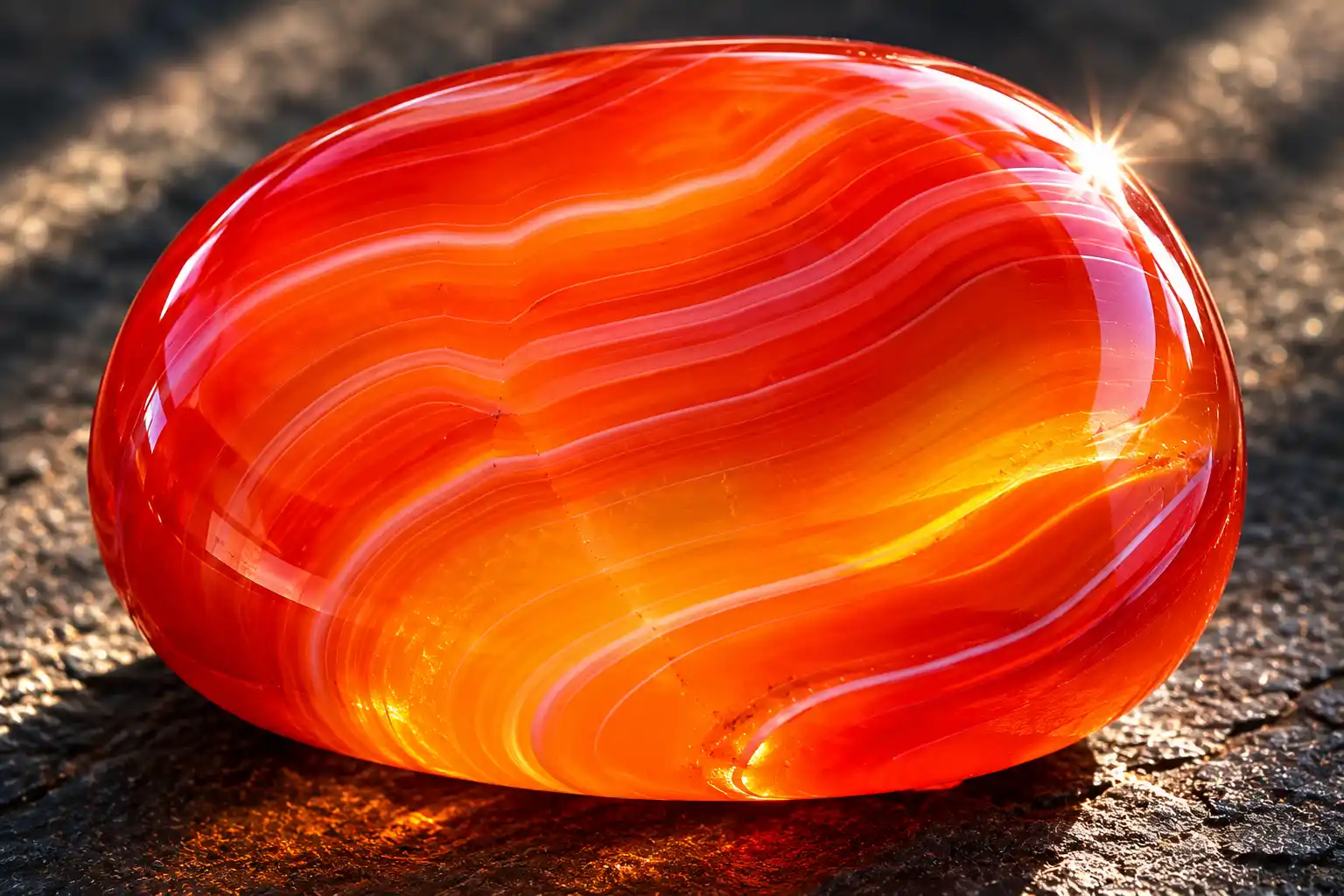
Carnelian is an orange, reddish-orange or brownish-red form of chalcedony.
Its traditional meanings include:
- Motivation.
- Confidence.
- Creativity.
- Courage.
- Practical action.
Some carnelian is heated or dyed to improve its color. Natural variations and treatment disclosure are important when authenticity matters.
Cavansite
Cavansite is a vivid blue mineral that commonly forms small radiating clusters on a pale matrix.
It is associated with:
- Clear communication.
- Learning.
- Insight.
- Expressing complex ideas.
Cavansite crystals can be delicate and are generally safer in a protected display than in a pocket or bag.
Celestite
Celestite, also called celestine, is best known for its pale sky-blue crystals.
It is traditionally associated with:
- Calm.
- Peace.
- Reflection.
- Gentle communication.
Celestite is relatively soft and fragile. Avoid soaking it and protect natural clusters from impact.
Cerussite
Cerussite is a lead carbonate mineral that may appear clear, white, gray or pale brown.
Its symbolism often includes:
- Adaptability.
- Flexibility.
- Reorganizing priorities.
- Changing direction thoughtfully.
Cerussite contains lead. Wash your hands after handling raw specimens, keep them away from children and pets, and never place them in drinking water.
Chalcedony
Chalcedony is a fine-grained form of silica that includes many familiar stones:
- Agate.
- Carnelian.
- Chrysoprase.
- Onyx.
- Bloodstone.
- Sardonyx.
Chalcedony is commonly associated with balance, thoughtful communication and emotional steadiness.
Its colors can also carry different traditional associations, described in the chalcedony color meaning guide.
Chalcopyrite
Chalcopyrite is a brassy yellow copper-iron sulfide mineral that is sometimes confused with pyrite.
Treated specimens may develop blue, purple or rainbow surfaces and are often sold as peacock ore.
Its common symbolic meanings include:
- Confidence.
- Opportunity.
- Resourcefulness.
- Positive outlook.
Avoid soaking chalcopyrite or placing it in water intended for drinking.
Charoite
Charoite is a distinctive purple material with swirling patterns in violet, lavender, white and black.
It is traditionally associated with:
- Transformation.
- Resilience.
- Accepting change.
- Moving beyond fear.
Because imitations and look-alike materials exist, pattern, texture and seller disclosure are important when buying.
Chevron Amethyst
Chevron amethyst contains visible V-shaped bands of purple amethyst and white quartz.
It is also sold as dream amethyst.
Its symbolism includes:
- Focus.
- Reflection.
- Recognizing patterns.
- Balancing intuition with practical judgment.
Chiastolite
Chiastolite is a variety of andalusite containing dark inclusions that form a natural cross-shaped pattern.
It is commonly associated with:
- Stability.
- Protection.
- Transition.
- Perspective during change.
The cross pattern is created by mineral inclusions rather than carving or engraving.
Chrome Diopside
Chrome diopside is a vivid green variety of diopside colored by chromium.
Its traditional meanings include:
- Renewal.
- Emotional openness.
- Appreciation of nature.
- Practical growth.
It may resemble emerald but is a different mineral and generally requires more protection from impact.
Chrysanthemum Stone
Chrysanthemum stone is a decorative rock containing pale mineral patterns that resemble flower petals.
It is traditionally associated with:
- Patience.
- Natural development.
- Individuality.
- Finding opportunity within existing circumstances.
Some pieces may have painted or enhanced patterns, so treatment disclosure matters.
Chrysoberyl
Chrysoberyl is a durable mineral that includes alexandrite and cat’s-eye chrysoberyl.
It commonly appears yellow, green or brown and is associated with:
- Discipline.
- Resilience.
- Clear decisions.
- Consistent effort.
Despite its name, chrysoberyl is not part of the beryl mineral family.
Chrysocolla
Chrysocolla is a blue-green copper-rich material commonly found with quartz, malachite or azurite.
It is traditionally linked with:
- Communication.
- Calm expression.
- Listening.
- Emotional balance.
Its composition and durability vary, especially when it forms alongside other minerals.
Chrysoprase
Chrysoprase is an apple-green variety of chalcedony colored by nickel.
Its symbolic meanings include:
- Hope.
- Emotional renewal.
- Optimism.
- Forgiveness.
- New beginnings.
Some material may lose intensity after prolonged exposure to heat or strong sunlight.
Cinnabar
Cinnabar is a bright red mercury sulfide mineral historically used as a source of mercury and as a pigment.
It is traditionally associated with:
- Ambition.
- Transformation.
- Confidence.
- Material goals.
Cinnabar contains mercury. Do not grind, heat, lick, soak or place it in drinking water.
Citrine
Citrine is yellow to orange quartz.
Natural citrine is relatively uncommon, while much of the deep orange material sold commercially is heat-treated amethyst.
Its traditional meanings include:
- Optimism.
- Confidence.
- Purposeful action.
- Generosity.
- Creative momentum.
Treatment does not automatically reduce a stone’s usefulness or beauty, but it should be disclosed.
Clear Quartz
Clear quartz is transparent to translucent colorless quartz.
It is commonly associated with:
- Clarity.
- Intention.
- Focus.
- Versatility.
Large polished spheres can concentrate sunlight, so keep them away from windows where focused light could create excess heat.
Clinochlore
Clinochlore is a member of the chlorite mineral group and may appear green, brown, gray or violet.
It is traditionally linked with:
- Balance.
- Self-awareness.
- Personal development.
- Releasing unnecessary habits.
Clinochlore is relatively soft and should be protected from scratching.
Cobaltocalcite
Cobaltocalcite is cobalt-bearing calcite with pink, magenta or purple coloring.
It is associated with:
- Compassion.
- Kindness.
- Emotional openness.
- Supportive communication.
Like other forms of calcite, it is soft and sensitive to acids.
Copper
Copper is a naturally occurring metallic element that may form masses, wires, dendrites or crystals.
Its traditional meanings include:
- Energy.
- Connection.
- Creativity.
- Resourcefulness.
- Movement of ideas.
Natural copper can oxidize and leave residue, so wash your hands after handling raw pieces.
Coral
Coral is an organic material produced by marine organisms rather than a mineral crystal.
It may appear red, pink, orange, white or black.
Coral is traditionally associated with:
- Protection.
- Vitality.
- Emotional strength.
- Connection with the sea.
It is soft and sensitive to chemicals. Legal and sustainability restrictions may also apply to its collection and trade.
Covellite
Covellite is an indigo-blue to metallic-purple copper sulfide mineral.
Its symbolism commonly includes:
- Insight.
- Transformation.
- Independent thinking.
- Recognizing hidden patterns.
Covellite is soft and may tarnish or flake. Keep it dry and away from consumable liquids.
Crazy Lace Agate
Crazy lace agate is a patterned chalcedony with swirling bands in white, cream, brown, yellow, red or gray.
It is commonly associated with:
- Joy.
- Adaptability.
- Humor.
- Flexibility during change.
Its detailed patterns make it popular for cabochons, carvings and tumbled stones.
Creedite
Creedite forms clear, white, orange or violet prismatic crystals, often in radiating clusters.
It is traditionally linked with:
- Direction.
- Mental clarity.
- Organizing priorities.
- Acting on decisions.
Natural clusters are fragile and require stable display.
Crocoite
Crocoite is recognized by vivid orange to red prismatic crystals.
It is commonly associated with:
- Creativity.
- Confidence.
- Enthusiasm.
- Expressive action.
Crocoite contains lead and chromium. Avoid producing dust and keep it away from children, pets and drinking water.
Cryolite
Cryolite is a soft mineral that is usually white or colorless.
Its traditional associations include:
- Simplicity.
- Mental release.
- Fresh perspective.
- Reducing unnecessary complexity.
Cryolite is uncommon in beginner collections and is mainly kept as a mineral specimen.
Cubic Zirconia
Cubic zirconia is a laboratory-grown crystalline material commonly used as a diamond alternative.
It can be colorless or produced in many colors.
It is associated with:
- Clarity.
- Confidence.
- Accessible beauty.
- Personal expression.
Cubic zirconia is manufactured and should not be confused with natural zircon.
Cuprite
Cuprite is a copper oxide mineral that may form deep red, reddish-brown or nearly black crystals.
It is traditionally linked with:
- Vitality.
- Determination.
- Grounding.
- Completing demanding tasks.
Cuprite can be soft and sensitive. Avoid soaking it or placing it in direct crystal elixirs.
C Crystals by Color
Blue C Crystals
Blue examples include:
- Cavansite.
- Celestite.
- Chrysocolla.
- Covellite.
Green C Crystals
Green examples include:
- Chrome diopside.
- Chrysoprase.
- Some chrysoberyl.
- Clinochlore.
Orange and Yellow C Crystals
Examples include:
- Carnelian.
- Citrine.
- Orange calcite.
- Creedite.
- Crocoite.
Purple C Crystals
Examples include:
- Charoite.
- Chevron amethyst.
- Cobaltocalcite.
- Violet creedite.
Care and Safety
C crystals vary considerably in durability and chemical composition.
Important precautions include:
- Cinnabar contains mercury.
- Cerussite and crocoite contain lead.
- Copper, covellite, cuprite and chalcopyrite are copper-bearing materials.
- Calcite and cobaltocalcite are soft and acid-sensitive.
- Cavansite, celestite and creedite clusters may break easily.
- Coral is organic and sensitive to chemicals.
Before cleaning an unfamiliar specimen, review How to Identify Crystals, Which Crystals Can and Cannot Go in Water and Which Crystals Fade in Sunlight.
Frequently Asked Questions
What is the most popular crystal that starts with C?
Citrine, clear quartz, carnelian, calcite, celestite and chrysocolla are among the best-known examples.
Which blue crystals start with C?
Cavansite, celestite, chrysocolla and covellite are notable blue C crystals.
Which green crystals start with C?
Chrome diopside, chrysoprase, chrysoberyl and clinochlore may appear green.
Which purple crystals start with C?
Charoite, chevron amethyst, cobaltocalcite and some creedite specimens may appear purple or violet.
Is coral a crystal?
No. Coral is an organic material, but it is often included in gemstone and crystal collections.
Is cubic zirconia natural?
No. Cubic zirconia is generally manufactured in laboratories.
Which C crystals require the most careful handling?
Cinnabar, cerussite and crocoite require strict safety precautions because of their composition. Cavansite, celestite and creedite also require protection from impact.
Continue Exploring Crystals and Gemstones
Explore jewelry materials, durability and value in Gemstones That Start With C.
Continue alphabetically with Crystals That Start With D, or browse the complete Crystals 101 collection.