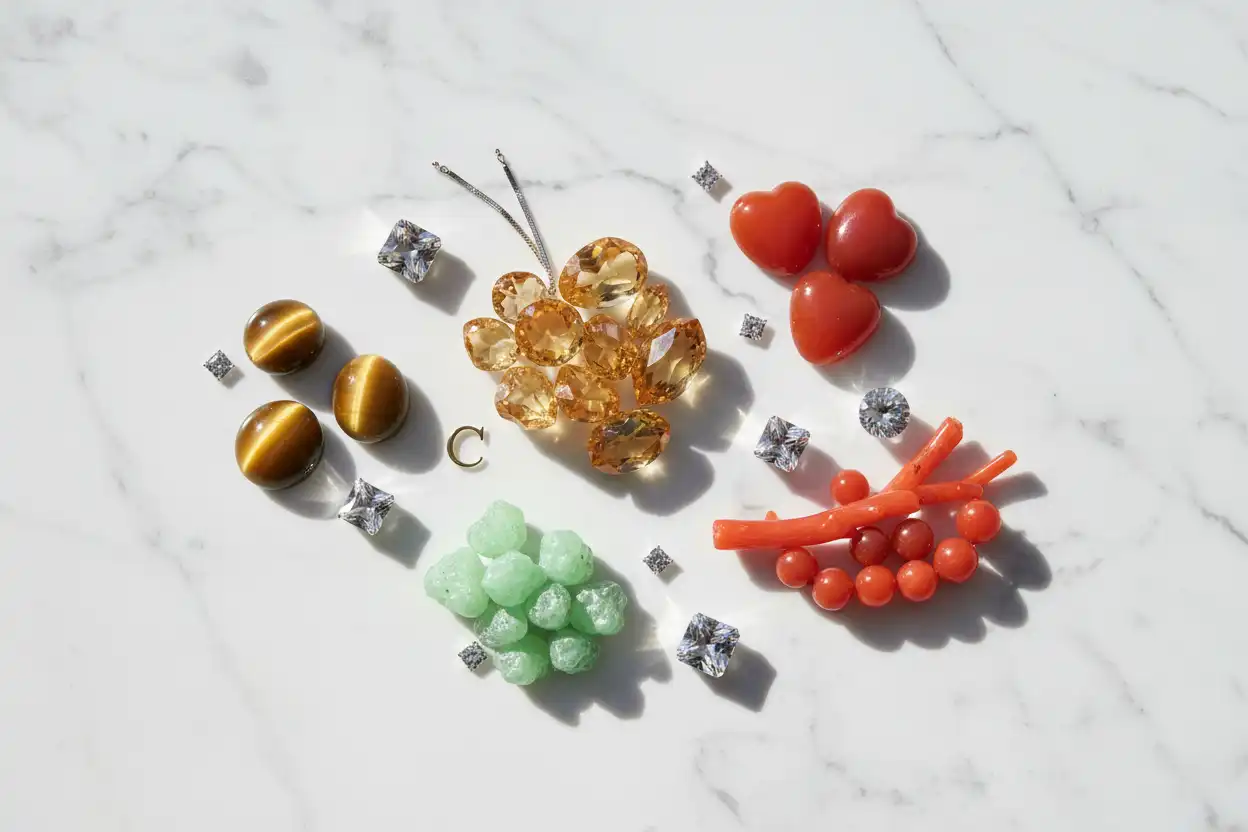
Gemstones That Start With C: A–Z Guide
Gemstones and gem materials that start with C include calcite, carnelian, celestite, cerussite, chalcedony, charoite, chiastolite, chrome diopside, chrysanthemum stone, chrysoberyl, chrysocolla, chrysoprase, citrine, clear quartz, cobaltocalcite, coral, crazy lace agate, crocoite, cubic zirconia and cuprite.
The C list includes durable quartz-family gems, soft carbonates, organic jewelry materials, rare collector stones and a widely used laboratory-manufactured diamond alternative.
The symbolic meanings mentioned below come from gemstone traditions rather than scientifically established medical effects.
Continue from Gemstones That Start With B. For specimen-focused minerals and additional C materials, explore Crystals That Start With C.
C Gemstones at a Glance
| Gemstone or material | Typical colors | Material type | Common use |
|---|---|---|---|
| Calcite | Clear, white, orange, pink, green or blue | Carbonate mineral | Cabochons, carvings and display pieces |
| Carnelian | Orange, red-orange or brownish red | Chalcedony | Rings, beads and seals |
| Celestite | Pale blue, white or colorless | Sulfate mineral | Collector stones and protected pendants |
| Cerussite | Colorless, white, gray or pale yellow | Lead carbonate mineral | Rare faceted collector gems |
| Chalcedony | White, gray, blue or numerous colors | Microcrystalline quartz | Beads, carvings and cabochons |
| Charoite | Purple with white, black or lilac patterns | Silicate lapidary material | Cabochons and statement jewelry |
| Chiastolite | Brown with a dark cross pattern | Andalusite variety | Cabochons and pendants |
| Chrome Diopside | Vivid green to deep forest green | Pyroxene gemstone | Faceted earrings and rings |
| Chrysanthemum Stone | Dark rock with pale flower-like patterns | Decorative rock | Carvings and cabochons |
| Chrysoberyl | Yellow, green or brown | Oxide gemstone | Durable fine jewelry |
| Chrysocolla | Blue, green or turquoise | Copper-bearing material | Cabochons and inlay |
| Chrysoprase | Apple green to deep green | Chalcedony | Rings, beads and cabochons |
| Citrine | Pale yellow to orange-brown | Quartz | Faceted jewelry |
| Clear Quartz | Colorless and transparent | Quartz | Faceted stones and carvings |
| Cobaltocalcite | Pink, rose or magenta | Cobalt-bearing calcite | Collector cabochons and specimens |
| Coral | Red, pink, orange, white or black | Organic gem material | Beads and carved jewelry |
| Crazy Lace Agate | Cream, red, yellow, brown and gray bands | Chalcedony | Cabochons and beads |
| Crocoite | Orange-red to scarlet | Lead chromate mineral | Collector specimens |
| Cubic Zirconia | Colorless or nearly any manufactured color | Laboratory-grown zirconium dioxide | Affordable faceted jewelry |
| Cuprite | Deep red, brown-red or nearly black | Copper oxide mineral | Rare collector gems |
Calcite
Calcite is a calcium carbonate mineral found in a wide range of colors and crystal forms.
Common gem and decorative varieties include:
- Clear optical calcite.
- Orange calcite.
- Green calcite.
- Pink calcite.
- Honey calcite.
- Banded material used for carvings.
Calcite is traditionally associated with clarity, motivation and recognizing areas that need improvement.
With a Mohs hardness of about 3 and perfect cleavage, it scratches and breaks more easily than most everyday jewelry stones. It is better suited to pendants, earrings, carvings and occasional-wear pieces than exposed rings.
Carnelian
Carnelian is an orange to reddish-brown variety of chalcedony colored mainly by iron oxides.
Its shades include:
- Pale orange.
- Vivid orange-red.
- Rust red.
- Brownish red.
- Yellow-orange.
Carnelian is traditionally associated with confidence, courage, creativity and purposeful action.
Its quartz-family durability makes it suitable for beads, rings, seals and cabochons. Heat treatment has been used for centuries to improve or deepen the color of some material.
Natural carnelian often shows uneven color, clouding or subtle translucency rather than a perfectly uniform appearance.
Celestite
Celestite, also called celestine, is a strontium sulfate mineral best known for pale sky-blue crystals.
It may also occur in:
- Colorless.
- White.
- Gray.
- Pale yellow.
- Pinkish tones.
Celestite is traditionally linked with calm, thoughtful communication and reflection.
Its softness, cleavage and brittle crystals make it primarily a display mineral. Small polished pieces may be used in protected pendants, but exposed rings and bracelets are not practical.
Crystal clusters should be stored where the points cannot rub against other stones.
Cerussite
Cerussite is a lead carbonate mineral known for high density, strong brilliance and complex crystal forms.
Gem-quality material may appear:
- Colorless.
- White.
- Gray.
- Pale yellow.
- Brown.
- Smoky.
Cerussite is traditionally associated with responsibility, awareness and careful decision-making.
Although transparent material can be faceted, cerussite is soft, brittle and highly sensitive to heat. Faceted stones are collector gems rather than practical jewelry.
Cerussite contains lead. Avoid grinding, cutting, licking, soaking or creating dust, and wash your hands after handling rough specimens.
Chalcedony
Chalcedony is a microcrystalline form of quartz that includes many familiar gem varieties.
Members of the chalcedony family include:
- Agate.
- Carnelian.
- Chrysoprase.
- Onyx.
- Bloodstone.
- Jasper-related materials.
Chalcedony is traditionally associated with stability, communication and emotional composure.
Its toughness and good scratch resistance make it suitable for rings, bracelets, beads, carvings and engraved gems.
Dyeing is common, especially in brightly colored commercial agate and uniformly colored chalcedony.
Charoite
Charoite is a purple silicate mineral and lapidary material recognized by flowing, fibrous and swirling patterns.
Its colors may include:
- Deep violet.
- Lavender.
- Lilac.
- White.
- Black.
- Brownish or translucent areas.
Charoite is traditionally associated with transformation, resilience and accepting necessary change.
It is usually cut into cabochons, beads, carvings and statement pendants. Its variable texture and natural fractures make protective settings preferable for rings.
Dyed stone, purple resin and composite material may imitate its appearance.
Chiastolite
Chiastolite is a variety of andalusite containing dark carbonaceous inclusions arranged in a cross-like pattern.
It is usually:
- Brown.
- Tan.
- Gray-brown.
- Reddish brown.
- Marked with a dark central cross.
Chiastolite is traditionally associated with balance, protection and maintaining direction during change.
The cross pattern is most visible when the crystal is cut across its length. Cabochons and polished slices are more common than transparent faceted stones.
Natural inclusions can create weak areas, so thin slices should be protected from impact.
Chrome Diopside
Chrome diopside is a vivid green variety of diopside colored by chromium.
Its colors range from:
- Bright grass green.
- Emerald green.
- Bluish green.
- Deep forest green.
Chrome diopside is traditionally linked with growth, confidence and appreciation of nature.
Its strong green color can resemble emerald or tsavorite, but chrome diopside is softer and has cleavage. It is better suited to earrings, pendants and occasional-wear rings with protective settings.
Large stones may become very dark because the material absorbs color strongly.
Chrysanthemum Stone
Chrysanthemum stone is a decorative rock known for pale flower-like patterns against a darker background.
The contrasting formations may appear:
- White.
- Cream.
- Gray.
- Pale yellow.
- Against black, brown or gray matrix.
It is traditionally associated with patience, individuality and gradual development.
The floral patterns are natural mineral formations rather than fossilized flowers or painted decorations.
Because the trade name can cover material with different compositions, cleaning should be based on the specific matrix and flower-forming minerals.
Chrysoberyl
Chrysoberyl is a durable gemstone mineral that occurs in yellow, green, brown and color-changing varieties.
Its most famous forms include:
- Alexandrite.
- Cat’s-eye chrysoberyl.
- Transparent yellow or green chrysoberyl.
Chrysoberyl is traditionally associated with confidence, adaptability and clear judgment.
With a Mohs hardness of 8.5 and good toughness, it is one of the strongest C gemstones for everyday jewelry.
Fine cat’s-eye stones display a sharp, mobile band of light, while alexandrite changes color under different lighting conditions.
Chrysocolla
Chrysocolla is a blue to green copper-bearing material frequently found with quartz, chalcedony, malachite or other copper minerals.
It may appear:
- Turquoise blue.
- Blue-green.
- Deep green.
- Brown or black matrix.
- Mottled or veined.
Chrysocolla is traditionally associated with communication, calm and honest self-expression.
Pure material can be soft and fragile. Quartz-rich chrysocolla and stabilized cabochons are more suitable for jewelry.
Avoid acids, harsh chemicals and prolonged soaking, especially when the exact composition or treatment is unknown.
Chrysoprase
Chrysoprase is an apple-green to deep green variety of chalcedony colored by nickel-bearing compounds.
It may range from:
- Pale mint.
- Apple green.
- Yellow-green.
- Rich saturated green.
Chrysoprase is traditionally associated with optimism, renewal and emotional confidence.
Its toughness makes it suitable for rings, beads, earrings and cabochons. However, prolonged exposure to strong heat or sunlight may affect the color of some material.
Dyed chalcedony and green glass can imitate fine chrysoprase.
Citrine
Citrine is yellow to orange-brown quartz.
Its shades include:
- Pale lemon.
- Golden yellow.
- Honey.
- Orange.
- Madeira-like reddish brown.
Citrine is traditionally associated with confidence, abundance, motivation and productive thinking.
Natural citrine is less common than heated amethyst sold as citrine. Heat-treated material remains real quartz, but its enhancement should be described accurately.
Citrine’s quartz hardness makes it suitable for most jewelry styles, although sharp impacts can still chip exposed corners.
Clear Quartz
Clear quartz is transparent or nearly transparent colorless quartz.
Natural stones may contain:
- Veils.
- Internal fractures.
- Fluid inclusions.
- Mineral needles.
- Growth zoning.
- Cloudy areas.
Clear quartz is traditionally associated with clarity, focus and amplifying intentions.
It is commonly faceted, carved, polished into spheres or used as natural crystal points.
Glass can imitate clear quartz, particularly when pieces contain round bubbles, molded shapes or unusually perfect clarity at a very low price.
Cobaltocalcite
Cobaltocalcite is cobalt-bearing calcite known for pink, rose and vivid magenta colors.
It commonly occurs as:
- Crystal coatings.
- Rounded botryoidal surfaces.
- Small rhombohedral crystals.
- Pink areas on dark matrix.
Cobaltocalcite is traditionally associated with compassion, emotional openness and supportive communication.
Like ordinary calcite, it is soft and acid-sensitive. Collector specimens should not be scrubbed, soaked or stored beside harder minerals.
Its intense color is attractive, but its durability makes it better suited to display than everyday jewelry.
Coral
Gem coral is an organic material formed from the calcium carbonate skeletons of marine organisms.
Jewelry colors include:
- Red.
- Pink.
- Salmon.
- Orange.
- White.
- Black or golden organic materials sold within the wider coral trade.
Coral is traditionally associated with protection, vitality and connection with the sea.
It is soft and sensitive to acids, perfume, cosmetics, heat and ultrasonic cleaning.
Environmental impact and species protection are important buying considerations. The guide to coral ethics in jewelry explains why provenance and responsible sourcing matter.
Crazy Lace Agate
Crazy lace agate is a highly patterned chalcedony known for looping, swirling and irregular bands.
Typical colors include:
- Cream.
- Red.
- Yellow.
- Brown.
- Gray.
- White.
It is traditionally associated with joy, adaptability and appreciating complexity.
Its durability makes it practical for beads, cabochons and statement rings. Pattern quality and polish are usually more important than transparency.
Some commercial material may be dyed to intensify red, pink or purple tones.
Crocoite
Crocoite is a lead chromate mineral famous for vivid orange-red and scarlet crystals.
It commonly forms:
- Long prismatic crystals.
- Needle-like clusters.
- Bright coatings.
- Crystals on contrasting matrix.
Crocoite is traditionally associated with motivation, creativity and disciplined action.
Its crystals are soft, brittle and unsuitable for normal jewelry. The material also contains lead and hexavalent chromium compounds.
Avoid dust, grinding, ingestion and prolonged handling. Store specimens securely away from children, pets and food.
Cubic Zirconia
Cubic zirconia is laboratory-manufactured crystalline zirconium dioxide.
It is available in:
- Colorless.
- Pink.
- Yellow.
- Blue.
- Green.
- Red.
- Purple.
- Black.
Cubic zirconia is traditionally associated with clarity, modern creativity and accessible luxury.
It offers strong brilliance and good scratch resistance at a much lower cost than diamond. However, it is denser and may show more rainbow fire than many diamonds.
Pricing, size and quality differences are covered in the cubic zirconia price guide.
Cuprite
Cuprite is a copper oxide mineral known for deep red, brown-red and nearly black crystals.
Transparent material may display intense ruby-red color under strong light.
Cuprite is traditionally associated with vitality, determination and practical confidence.
Although rare transparent pieces can be faceted, cuprite is soft, brittle and vulnerable to scratching. Most examples remain collector gems or protected cabochons.
Because it contains copper, rough material should not be ground or placed in drinking water.
Which C Gemstones Are Best for Everyday Jewelry?
Stronger choices include:
- Chrysoberyl.
- Chalcedony.
- Carnelian.
- Chrysoprase.
- Citrine.
- Clear quartz.
- Crazy lace agate.
- Cubic zirconia.
Materials needing protected or occasional-wear settings include:
- Charoite.
- Chiastolite.
- Chrome diopside.
- Chrysocolla.
- Coral.
- Calcite.
Celestite, cerussite, crocoite, cobaltocalcite and most cuprite specimens are better suited to collecting than regular wear.
Treatments, Imitations and Trade Names
Important buying considerations include:
- Heated carnelian.
- Dyed chalcedony and agate.
- Stabilized chrysocolla.
- Heated amethyst sold as citrine.
- Glass sold as clear quartz.
- Treated or protected coral.
- Laboratory-manufactured cubic zirconia.
- Variable rock compositions sold under decorative trade names.
Treatments are not automatically undesirable, but they should be disclosed when they affect durability, value or identity. The major processes are explained in Gemstone Treatments Explained.
Care Guide for C Gemstones
- Keep calcite, celestite and cobaltocalcite away from harder stones.
- Avoid acids on carbonates and copper-bearing materials.
- Store cerussite and crocoite as hazardous collector minerals.
- Protect chrome diopside and chiastolite from sharp impacts.
- Keep coral away from perfume, hairspray and heat.
- Avoid ultrasonic cleaning for porous, assembled, fractured or stabilized material.
- Use mild soap and brief water contact only when the gemstone and treatment permit it.
- Keep individual stones in separate compartments to reduce scratching.
Frequently Asked Questions
What is the most valuable gemstone that starts with C?
Fine chrysoberyl varieties, particularly alexandrite and high-quality cat’s-eye chrysoberyl, can be extremely valuable.
Which green gemstones start with C?
Chrome diopside, chrysoprase, chrysocolla and some chalcedony or calcite varieties are notable examples.
Which orange gemstones start with C?
Carnelian, citrine and orange calcite are the best-known choices.
Is cubic zirconia a natural gemstone?
No. It is a laboratory-manufactured crystalline material.
Is coral a crystal?
No. Coral is an organic gem material formed from marine skeletal structures.
Is clear quartz suitable for everyday jewelry?
Generally, yes. It has good scratch resistance, although exposed points and internal fractures can still chip.
Is crocoite safe for jewelry?
No. Its softness, brittleness and lead-chromate composition make it unsuitable for ordinary jewelry.
Is chrysocolla always soft?
Pure chrysocolla can be soft, but quartz-rich or stabilized material may be considerably more durable.
Continue the Gemstone Alphabet
Continue with Gemstones That Start With D, or browse all alphabetical directories in the Crystals 101 collection.