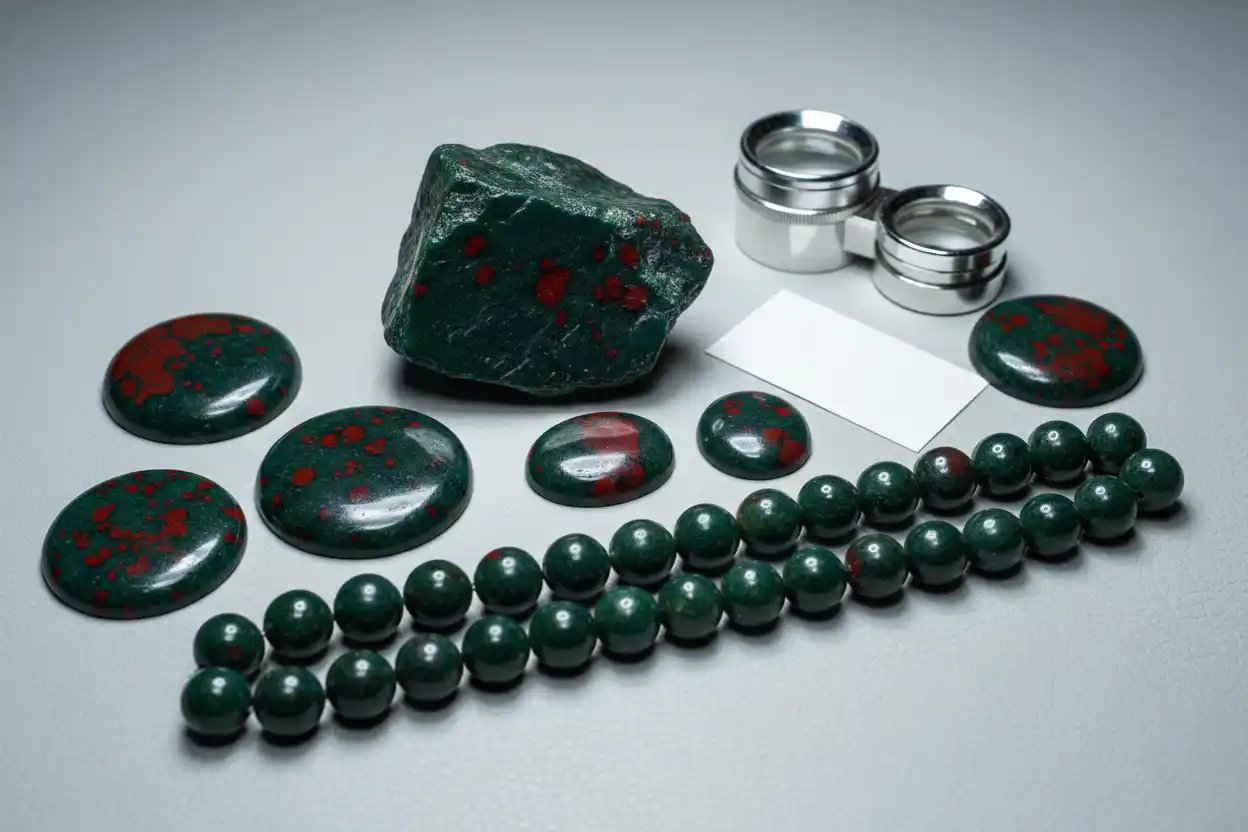
Where to Buy Real Bloodstone and Avoid Dyed Imitations
Real bloodstone is a dark green chalcedony or jasper-like material marked by red iron-oxide inclusions. Its historical name is heliotrope, but both names refer to the same canonical material rather than separate gemstones.
Most genuine bloodstone is affordable. Consequently, buyers are more likely to encounter dyed green chalcedony, painted red spots, unrelated red-and-green rock, resin composites and loose trade-name usage than a sophisticated synthetic equivalent.
Quality also varies widely. Some stones have a rich dark green body and sharply contrasting red spots, while others contain gray, white, yellow or brown areas. A pattern can be natural without meeting the appearance that most buyers expect from traditional bloodstone.
The planned bloodstone meaning guide owns the material’s identity, history and symbolism. The planned bloodstone healing-properties guide will keep traditional wellness beliefs separate from this buyer-focused discussion.
Bloodstone and Heliotrope Are the Same Material
The tracker’s alias boundary follows standard gemological usage: heliotrope is another name for bloodstone. Sellers should not imply that heliotrope is a rarer, stronger or more valuable mineral simply because the name sounds historic.
Bloodstone belongs within the broad chalcedony family. It consists mainly of cryptocrystalline silica, commonly described as dark green chalcedony or jasper with red spots or inclusions of iron oxide, particularly hematite.
Definitions vary slightly in the market. Some authorities emphasize semi-translucent green chalcedony, while retailers may use bloodstone for opaque green jasper-like material with red, yellow or pale markings. Therefore, a seller should show the exact pattern rather than relying on the name.
The chalcedony guide explains the parent material, while the jasper guide covers the opaque microcrystalline quartz varieties often discussed alongside bloodstone.
Choose the Right Product Form
| Product | Best source | Main concern |
|---|---|---|
| Natural rough | Lapidary supplier or mineral dealer | Weak red pattern, dye, fractures and misleading wet photographs |
| Slab | Lapidary supplier | Surface-only pattern, hidden cracks and low cutting yield |
| Cabochon | Gem dealer or lapidary artist | Painted spots, filler, poor pattern placement and flat polish |
| Beads | Established bead supplier | Dyed stone, composites and fractures around drill holes |
| Carving or seal | Skilled carver or antique specialist | Repair, artificial coloring and unsupported age claims |
| Tumbled stone | Reputable crystal retailer | Generic green jasper substituted for bloodstone |
| Jewelry | Jeweler with treatment disclosure | Glue, backing, metal quality and exaggerated rarity |
| Antique intaglio or cameo | Specialist dealer with provenance | Misidentified stone, restoration and illicit antiquity concerns |
For jewelry, judge the cut and setting. For rough, evaluate usable pattern. Antique buyers must also examine provenance and legality.
Where to Buy Genuine Bloodstone
Lapidary suppliers
Lapidary suppliers are often the best source for rough and slabs because they understand how the red pattern continues through the material. Request photographs of both slab faces and the edges.
A red patch visible only on the weathered surface may disappear during cutting. Conversely, irregular internal spots visible along the edge suggest that the pattern continues into the stone.
Ask for dry photographs. Water and oil can intensify the green body, hide scratches and make low-grade rough look more attractive than it will after drying.
Gemstone dealers
A gemstone dealer is appropriate for calibrated cabochons and high-quality loose stones. Listings should state dimensions, transparency, treatment and country of origin.
The seller should photograph each cabochon under neutral light. Strong color editing can make olive or gray-green material appear nearly black and can turn brown iron staining into vivid red.
Gem and mineral shows
At shows, compare bloodstone with red jasper, dragon blood jasper, moss agate, green chalcedony and dyed quartz. Use a loupe to inspect the relationship between the red markings and the green silica body.
Natural red areas generally have irregular boundaries and sit within the stone. Painted spots can remain on the surface, collect in pits or end abruptly at the girdle.
Reputable online shops
Online sellers should show the exact item or explain batch variation clearly. Because bloodstone pattern is highly individual, a generic photograph cannot guarantee that the delivered piece will have similar red coverage.
The online gemstone buying guide explains seller verification and return rights. For bloodstone, ask whether the listing’s contrast and saturation were digitally adjusted.
Jewelry retailers
A jeweler should identify the stone as bloodstone or heliotrope and disclose dye, impregnation, backing or assembly. Metal content and setting quality often contribute more to the price than the stone itself.
For antique-style signet rings, determine whether the carving is modern or genuinely old. A traditional motif does not prove antique age.
What Genuine Bloodstone Looks Like
Traditional bloodstone has a dark green body with irregular red spots, flecks, streaks or patches. The red markings commonly come from iron oxides, especially hematite.
Green may range from medium forest green to nearly black. Some material includes yellow, cream, gray or white areas. Those secondary colors do not automatically make the stone fake, although they may reduce desirability for buyers seeking the classic pattern.
Translucency varies. Thin edges or some green zones may transmit light, while dense material appears opaque. A granular or fibrous microcrystalline texture can become visible under magnification.
Red markings should look geologically integrated. Their shapes are rarely identical or perfectly circular. Nevertheless, nature can create concentrated patches, so irregularity supports authenticity but does not prove it.
How Much Red Should Bloodstone Have?
No universal percentage defines bloodstone. Some high-quality stones contain only a few well-positioned red spots, while others show abundant red patterning.
For a cabochon, placement often matters more than total quantity. A small bright-red patch near the center can create a stronger visual effect than many muddy brown flecks around the edge.
Too much pale matrix can dilute the classic appearance. Similarly, a nearly solid red-and-green breccia may be attractive but could belong to a different trade material.
Buy the exact pattern you prefer rather than paying for an arbitrary grade such as “AAA bloodstone.”
Bloodstone Versus Dragon Blood Jasper
Dragon blood jasper is a commercial name commonly applied to a green-and-red decorative rock that is not traditional bloodstone. Its pattern often includes larger red areas, opaque green matrix and a different mineral composition.
The dragon blood jasper guide owns that material’s identity. A seller should not use “dragon bloodstone,” “dragon blood jasper” and “heliotrope” interchangeably.
Both stones can be natural, but they have different definitions and markets.
Bloodstone Versus Red Jasper in Green Matrix
Some red-and-green jaspers resemble bloodstone but lack the traditional chalcedony structure or characteristic small red iron-oxide pattern. The distinction can become subjective in opaque massive material.
The red jasper guide and types of jasper overview provide wider context. If a seller cannot explain why a stone is bloodstone rather than generic jasper, the price should not depend on the premium name.
Bloodstone Versus Moss Agate
Moss agate commonly shows green dendritic, filamentous or moss-like inclusions within translucent chalcedony. Bloodstone usually has a denser green body with distinct red iron-oxide spots.
Some commercial stones combine mossy green features with red inclusions and receive overlapping labels. Clear photography and a cautious description are more useful than forcing an uncertain piece into one category.
Common Imitations and Misrepresentation
Dyed green chalcedony
Pale chalcedony may be dyed dark green and then marked or combined with red color. Dye can concentrate in cracks, pits, porous zones and drill holes.
Painted red spots
Ordinary green stone can be dotted with red pigment. Under magnification, paint may sit over scratches, fill surface depressions or show brush-like boundaries.
Dyed jasper
Natural jasper can be dyed or stained to improve contrast. The underlying material may be genuine silica rock, but it is not naturally colored bloodstone.
Resin and composite material
Crushed stone particles can be mixed with polymer and molded into beads or carvings. Bubbles, resin-rich seams, repeated patterns and unusually uniform color support composite construction.
Glass
Green glass may contain painted red dots, colored fragments or metallic inclusions. Round bubbles, flow lines and mold seams can reveal manufacture, although laboratory testing may be needed for convincing products.
Unrelated red-and-green rock
Unakite, dragon blood jasper, epidote-rich rock and mixed jasper may receive a bloodstone label because of color resemblance. Mislabeling can be accidental when wholesalers use broad commercial names.
The fake-crystal guide offers a broader method for assessing dye, glass, resin and unsupported labels.
Treatments and Enhancement
Bloodstone may be dyed, waxed, oiled, resin-impregnated, fracture-filled or coated. Ordinary natural material often reaches the market untreated, but sellers should not use that generalization as a substitute for disclosure.
Wax or oil can deepen green color and improve luster. Polymer impregnation can strengthen fractured rough or help a porous carving accept polish.
Colored filler may disguise pits or extend a red patch. Inspect under magnification for color differences between the host stone and filled areas.
The gemstone treatments guide explains how treatment changes value and care.
Evaluating Rough and Slabs
Look for a strong green body with red markings that continue beyond the outer rind. Ask for a freshly sawn face or edge view when possible.
Fractures reduce cutting yield. A large rough piece with many cracks may produce fewer usable cabochons than a smaller solid slab.
The green body should not shed color when wiped with a plain damp cloth. However, do not apply solvents or chemicals, since they may damage legitimate treatments and do not provide a reliable complete test.
For slabs, compare both sides. If red markings appear on one polished face but not along any edge, ask whether the surface has been stained.
Evaluating Cabochons
A good bloodstone cabochon uses its pattern intentionally. The red areas should be visible face-up, while the dome should produce an even reflection without flat spots.
Check the girdle for chips and the back for dye, backing or filler. An opaque black backing may deepen the apparent body color and should be disclosed.
Minor surface pits can occur in mixed microcrystalline material, but the polish should not look heavily coated. A thick resin layer can create an unnaturally glassy finish.
The types of chalcedony guide helps place bloodstone among related cryptocrystalline quartz materials.
Buying Beads
Each bead should show a natural variation in green and red pattern. A perfectly repeated design across an entire strand can indicate molded or printed material.
Inspect drill holes for concentrated dye and radial fractures. Rough hole edges can cut stringing cord or collect skin products.
A seller should state the bead diameter, hole size, strand length and whether the photographs show the exact strand. Since pattern drives desirability, random selection should be clearly disclosed.
Buying Rings and Signets
Bloodstone has a long association with engraved seals and signet rings. Modern bloodstone rings can be durable enough for regular wear, but the stone can still chip after a hard blow.
A bezel or flush setting protects the perimeter better than high prongs. Check whether the stone is glued into the setting and whether the back is open for inspection.
The gemstone hardness chart places chalcedony around 6.5 to 7. The toughness-versus-hardness guide explains why edge thickness, fractures and setting design still matter.
Buying Pendants, Earrings and Bracelets
Pendants allow larger patterns to remain visible with relatively low impact risk. Earrings should be matched for overall color and contrast rather than identical red spots.
Bracelet beads face repeated contact with desks and harder jewelry. Choose sound beads with clean drill holes and avoid combining them directly with diamonds or corundum spacers.
The planned March birthstone jewelry guide provides gift and setting context, while this guide remains focused on material authenticity.
Antique and Carved Bloodstone
Historic bloodstone was used for intaglios, seals and decorative carvings. Genuine age can add value, but age claims also create the greatest provenance risk.
Inspect old pieces for repolishing, replaced settings, filled chips and recut engravings. A modern carving in an antique-style mount should not be sold as ancient or Renaissance work.
Request invoices, collection history and independent appraisal for expensive antiques. Avoid objects with stories suggesting undocumented removal from an archaeological site.
Localities and Origin Claims
India is the best-known commercial source of bloodstone, while material also comes from Brazil, Australia, China, the United States and other regions.
Color pattern rarely proves a particular country. “Indian bloodstone” should be treated as a supply-chain statement rather than a visual diagnosis.
A precise mine claim needs stronger documentation than a country label. For ordinary cabochons, country-level origin may be all the seller can reasonably provide.
Price and Value
Bloodstone is generally affordable, although fine cabochons, large clean pieces, detailed carvings and verified antiques can command higher prices.
Value rises with attractive green color, distinct natural red pattern, good polish, structural integrity and skillful pattern placement. Muddy color, excessive fractures, weak contrast and obvious filler reduce desirability.
Carving labor can exceed the raw stone’s value. Likewise, a precious-metal signet ring may cost far more than an equivalent loose cabochon.
The gemstone pricing guide explains why cut, treatment, craftsmanship and documentation influence retail price.
Seller Questions
Ask whether the material is natural bloodstone or heliotrope and whether either name is being used only as a trade label. Confirm the stated country of origin and how that information was obtained.
Request disclosure of dye, wax, oil, resin, filler, backing and repair. For rough, ask whether photographs show the material dry. For cabochons, request front, back, side and transmitted-light views when useful.
If buying an antique, ask for ownership history and restoration information. Finally, confirm that the return period permits ordinary visual and gemological inspection.
Professional Identification
A gemologist can examine bloodstone’s cryptocrystalline quartz texture, refractive properties, specific gravity and inclusions. Raman spectroscopy can confirm quartz and help characterize iron-oxide components.
Microscopy may reveal dye concentration, surface paint, polymer-filled fractures and glass bubbles. Advanced infrared analysis can support detection of some polymer treatments.
Testing is most worthwhile for expensive carvings, alleged antiques, high-value jewelry and disputed dyed material. A retailer’s printed card without methods does not provide equivalent assurance.
Ethical Sourcing
Bloodstone supply chains can involve small-scale mining, regional cutting and international bead production. Complete mine-level traceability may be difficult for inexpensive stones.
The ethical crystal sourcing guide explains how to assess sourcing language. Ask sellers to distinguish verified information from wholesaler assumptions.
Antique legality and archaeological provenance are equally important. An old-looking bloodstone seal should not be purchased when its ownership history appears suspicious.
Cleaning and Storage
Clean an untreated sound bloodstone with lukewarm water, mild soap and a soft brush or cloth. Rinse briefly and dry completely.
Avoid harsh chemicals and high heat. Ultrasonic cleaning may be inappropriate for filled, heavily fractured or antique pieces, while steam can stress treatments and settings.
Store bloodstone separately from harder gems. Wrap engraved surfaces so they do not rub against metal.
The planned where-to-buy-chalcedony guide and where-to-buy-jasper guide will cover those broader markets without absorbing bloodstone’s specific pattern and alias issues.
Frequently Asked Questions
1. Are bloodstone and heliotrope the same stone?
Yes. Heliotrope is an established alternate name for bloodstone, not a separate premium mineral.
2. What causes the red spots in bloodstone?
The red markings commonly come from iron oxides, especially hematite, distributed within the green cryptocrystalline quartz material.
3. Does real bloodstone have to be dark green?
Traditional material is generally dark green, but shade and secondary colors vary. Olive, gray-green, yellow and pale areas can occur naturally.
4. How many red spots should genuine bloodstone have?
There is no required number. Authentic pieces can have a few distinct spots or abundant red patterning.
5. Is dragon blood jasper the same as bloodstone?
No. Dragon blood jasper is a separate commercial material with a different appearance and mineral composition, despite its red-and-green colors.
6. Can bloodstone be dyed?
Yes. Pale chalcedony, jasper and other stones may be dyed green or enhanced with red pigment. Treatment should be disclosed.
7. How can I detect painted red spots?
Use magnification to see whether pigment sits on the surface, fills scratches or ends at the girdle. Do not scrape the stone or apply solvents.
8. Is bloodstone suitable for daily rings?
It is reasonably wearable, but it can chip after impact. A protective bezel and removal during heavy work reduce risk.
9. Is Indian bloodstone always the best?
India is an important source, but country alone does not determine quality. Pattern, color, condition, cut and treatment matter more.
10. Are yellow spots a sign of fake bloodstone?
Not necessarily. Natural material can contain yellow, brown, white or pale areas along with red markings.
11. Do inexpensive bloodstones need certificates?
Usually not. Clear seller disclosure and return rights are sufficient for ordinary tumbles or cabochons. Testing is more useful for costly antiques or disputed treatment.
12. What is the biggest red flag in a bloodstone listing?
Be cautious when a stone has perfectly uniform green color and identical bright-red dots, while the seller provides no close-ups, treatment statement or return policy.
Let the Pattern Prove the Name
Bloodstone does not need perfect color or abundant red spots to be genuine. However, its green body and iron-rich markings should look integrated, natural and consistent with the seller’s description.
The March birthstone guide, B crystal directory, B gemstone directory and gemstone types guide provide wider context. Choose the stone whose pattern, treatment and origin are shown clearly rather than the one supported by the most dramatic historical claim.