
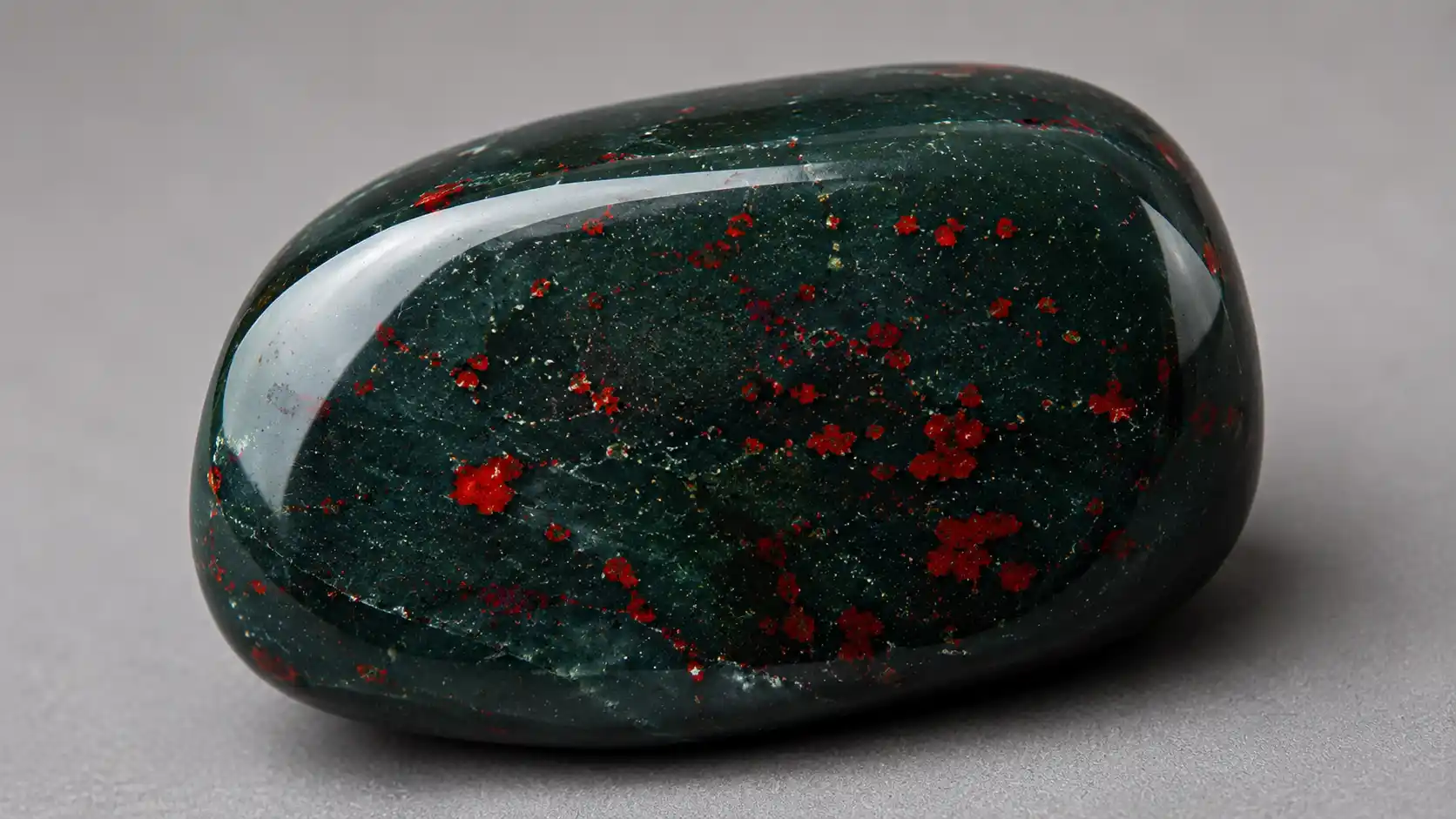

Bloodstone is a striking dark-green stone scattered with red flecks like drops of blood, treasured in crystal tradition as a stone of courage, vitality, and grounding. Also known as heliotrope, it has one of the richest histories of any gemstone — carried by Roman warriors, woven into medieval Christian legend, and prized for thousands of years as a stone of strength and life-force. Bold, energizing, and deeply rooted, bloodstone is the crystal many people reach for when they need courage and stamina.
At Gems Lore, we love bloodstone for its dramatic look and its long heritage of strength. Here’s everything worth knowing about this powerful stone.
Bloodstone at a Glance
- What it is: A dark green variety of chalcedony (quartz family) with red iron-oxide spots
- Best known for: Courage, vitality, strength, and grounding
- Chakra: Root and heart
- Hardness: 6.5–7 on the Mohs scale — durable, water-safe, and easy to care for
- Also called: Heliotrope
- Birthstone: A traditional March birthstone
What Is Bloodstone?
Bloodstone is a variety of chalcedony — a microcrystalline form of quartz, in the same family as agate and jasper. It’s deep green (often classed as a green jasper or jasper-chalcedony), marked by distinctive red to reddish-brown spots and streaks, which are inclusions of iron oxide (hematite). Those red flecks against the green base give the stone its name and its dramatic look.
Quick facts:
- Mineral: Chalcedony / jasper (quartz family), green with red iron-oxide spots
- Color: Dark green base with red, orange, or brown flecks
- Hardness: 6.5–7 on the Mohs scale — durable and water-safe (see our gemstone hardness chart)
- Main sources: India (the major source), Brazil, and Australia
- Good to know: part of the chalcedony family — see our agate meaning guide for its relatives
Bloodstone has two traditional names. “Bloodstone” comes from those blood-red spots, while “heliotrope” comes from the Greek helios (sun) and trepein (to turn) — from an ancient belief that the stone could turn or redden the reflection of the sun in water. To compare it with another red chalcedony, see our red jasper meaning guide.
The Legends of Bloodstone
Few stones carry such powerful stories. The most famous is a medieval Christian legend: it was said that during the Crucifixion, drops of Christ’s blood fell from the cross onto the green jasper at its base, staining it forever with red — and so bloodstone was born. This gave it the name “martyr’s stone” and made it a prized material for carving religious scenes during the Renaissance.
Long before that, the stone was carried by warriors and athletes in the ancient world. Roman soldiers carried bloodstone as an amulet of courage and endurance, and it was widely believed to staunch bleeding when placed on a wound — a belief rooted in sympathetic magic, since the red spots resembled blood. The Babylonians and Egyptians valued it too, and in some lore heliotrope could even render its bearer invisible. Whatever you make of the legends, they all point the same way: bloodstone has always been a stone of courage, vitality, and protection.
Bloodstone Meaning and Symbolism
In crystal tradition, bloodstone is above all the stone of courage and vitality. Its energizing, grounding nature is associated with strength, stamina, and the life-force itself — a stone to call on when you need to be brave, resilient, and full of energy.
Its core themes are courage and strength, vitality and life-force, grounding and endurance, and protection and purification. Bloodstone is seen as both energizing and steadying — revitalizing you when you’re depleted while keeping you grounded and centered. If a single phrase captures the bloodstone meaning, it’s grounded courage: strong, vital, and resilient.
Bloodstone Healing Properties
Folklore and crystal practice assign bloodstone a range of emotional, spiritual, and physical associations. These reflect tradition and belief rather than medical fact.
Emotional. Bloodstone is most associated with courage in adversity, motivation, and resilience — helping you find strength under pressure and push through challenges. It’s a traditional favorite for determination and confidence (see our crystals for confidence guide).
Spiritual. Traditionally, it’s used as a grounding, protective, and purifying stone — revitalizing energy, banishing negativity, and anchoring you firmly. It’s long been carried as a protective amulet (see our crystals for protection guide).
Physical (traditional associations). Because of its red spots, bloodstone has a long folk association with blood, circulation, and vitality. These are traditional beliefs, not medical claims — bloodstone is not a treatment for any blood or health condition.
Bloodstone for Courage and Vitality
Bloodstone’s signature role is supporting courage and vitality, so it’s worth a closer look. People carry bloodstone when they need bravery or stamina — before a challenge, a competition, or a demanding day; hold it for motivation and resilience when energy or morale is low; or keep it close for grounding and protection. Its long history with warriors and athletes makes it a natural choice for anyone facing a test of strength or nerve.
The honest, human-first view: a crystal can’t make you brave or give you energy. But bloodstone makes a grounding, motivating touchstone — a reminder of your own strength and resilience — that supports the real sources of courage and vitality: preparation, rest, determination, and self-belief. For its steadying side, see our crystals for grounding guide.
Bloodstone and the Chakras
Bloodstone bridges two energy centers. Its red flecks and grounding, vitalizing nature connect it to the root chakra (survival, stability, and life-force), while its green base links it to the heart chakra (love and emotional balance). This pairing reflects bloodstone’s blend of physical strength and steadying, heart-centered courage. Our crystals for chakras guide shows how it fits, and you’ll find more grounding options in our root chakra crystals guide.
Bloodstone Birthstone and Zodiac
Bloodstone is a traditional March birthstone, valued long before aquamarine became the modern choice — see our March birthstone guide for both. In astrology it’s most often associated with Aries (courage), Pisces, and Libra. Anyone seeking strength, vitality, or grounding is drawn to it, whatever their sign.
How to Use Bloodstone
Bloodstone is an energizing, grounding stone, easy to put to work. A few popular ways:
- Carry it before a challenge — a competition, interview, or demanding task — for courage and stamina.
- Hold it for motivation when your energy or morale is low.
- Keep it close for grounding and protection at home or at work.
- Wear it — durable and tough, bloodstone makes excellent everyday jewelry, including signet rings.
- Use it in grounding meditation to feel strong, rooted, and revitalized.
Care, Cleansing, and Charging
Bloodstone is durable and easy to care for. At 6.5–7 on the Mohs scale it’s water-safe, tough, and stands up well to everyday wear, so a gentle wash with mild soap and water and a soft cloth keeps it looking great, and its color doesn’t fade. Just avoid harsh chemicals and hard knocks. You can cleanse it by almost any method — water, moonlight, smoke, or sound. For the full routine, see our how to cleanse crystals guide.
Real vs. Fake Bloodstone, and Its Varieties
Genuine bloodstone is opaque dark-green chalcedony with naturally embedded, irregular red iron-oxide spots, and a durable 6.5–7 hardness. Watch out for imitations: dyed or painted green stones with artificial-looking red, glass (which may show bubbles), and dyed jasper. The tells of a fake are red marks that look painted on or sit only on the surface, overly uniform color, and a too-cheap price for a large, vividly marked stone. Genuine red spots are embedded within the stone and irregular. For general identification, see our how to spot fake crystals guide.
Popular variations include:
- Classic bloodstone — dark green with red flecks
- Plasma — green chalcedony with few or no red spots
- Bloodstone with yellow — green base with both red and yellow markings
Bloodstone is most often seen as cabochons, tumbled stones, and carved pieces rather than faceted gems, since it’s opaque — its beauty lies in its color and pattern rather than sparkle, which is why it has long been favored for signet rings and intaglios.
Crystal Pairings for Bloodstone
Bloodstone pairs naturally with stones that share its grounding, courageous energy. For an extra boost of bravery and willpower, combine it with tiger’s eye, a classic stone of courage and confidence (see our tigers eye meaning guide) — together they make a strong “face the challenge” duo. For deeper grounding, pair bloodstone with a root-anchoring stone like hematite or black tourmaline, balancing its vital, energizing side with steadiness. And for sustained physical stamina, many people like bloodstone alongside red jasper, doubling down on endurance and strength. A small set of bloodstone, a confidence stone, and a grounding stone covers courage, stamina, and stability — a practical trio for demanding days, competitions, or any test of nerve.
Choosing Bloodstone
If you’re shopping for bloodstone, look for a rich, deep green base with well-distributed red or orange flecks — the contrast between green and red is what gives a piece its character and appeal. Some stones are heavily spotted, others show just a few dramatic red marks; both are lovely, so it comes down to taste. Check that the red is embedded within the stone rather than painted on the surface, and that the polish is smooth and even. Bloodstone is affordable, durable, and widely available as tumbled stones, worry stones, cabochons, beads, and carvings, so a quality piece needn’t cost much. As always, buy from a seller who describes the material honestly, and favor natural stones over suspiciously vivid dyed imitations.
Frequently Asked Questions
What is bloodstone good for?
Bloodstone is traditionally used for courage, vitality, strength, grounding, and protection. People carry it before challenges, hold it for motivation, and keep it close for grounding. These are traditional uses, not medical treatments.
Why is it called bloodstone?
It’s named for the red iron-oxide spots scattered across its dark green surface, which look like drops of blood. Its other name, heliotrope, comes from a Greek belief that the stone could turn the sun’s reflection red in water.
What chakra is bloodstone?
Bloodstone is associated with the root chakra (grounding, vitality, and life-force) thanks to its red flecks, and the heart chakra (love and balance) thanks to its green base.
Is bloodstone a birthstone?
Yes — bloodstone is a traditional March birthstone, used long before aquamarine became the modern March stone. Many lists still recognize both.
Can bloodstone go in water?
Yes — at 6.5–7 on the Mohs scale, bloodstone is durable and water-safe, so a brief rinse or gentle wash is fine. Just avoid harsh chemicals and hard knocks.
Does bloodstone help with blood or circulation?
Bloodstone has a long folkloric association with blood and vitality because of its red spots, but these are traditional beliefs, not medical facts. Bloodstone is not a treatment for any blood or health condition.
Where to Go From Here
Bloodstone is the collection’s warrior — bold, vital, and grounding. Carry it when you need courage and stamina, hold it for motivation and resilience, and let its green-and-red depths remind you of the strength you already carry. Durable and rich with history, it’s a wonderful everyday stone for anyone facing a challenge.
If bloodstone’s courageous, vitalizing energy resonates with you, you’ll likely be drawn to its fiery chalcedony cousin — explore the bold, motivating warmth in our carnelian meaning guide. And to see how bloodstone compares with other stones at a glance, browse our crystal meanings chart.
Does bloodstone give you courage? Tell us in the comments.