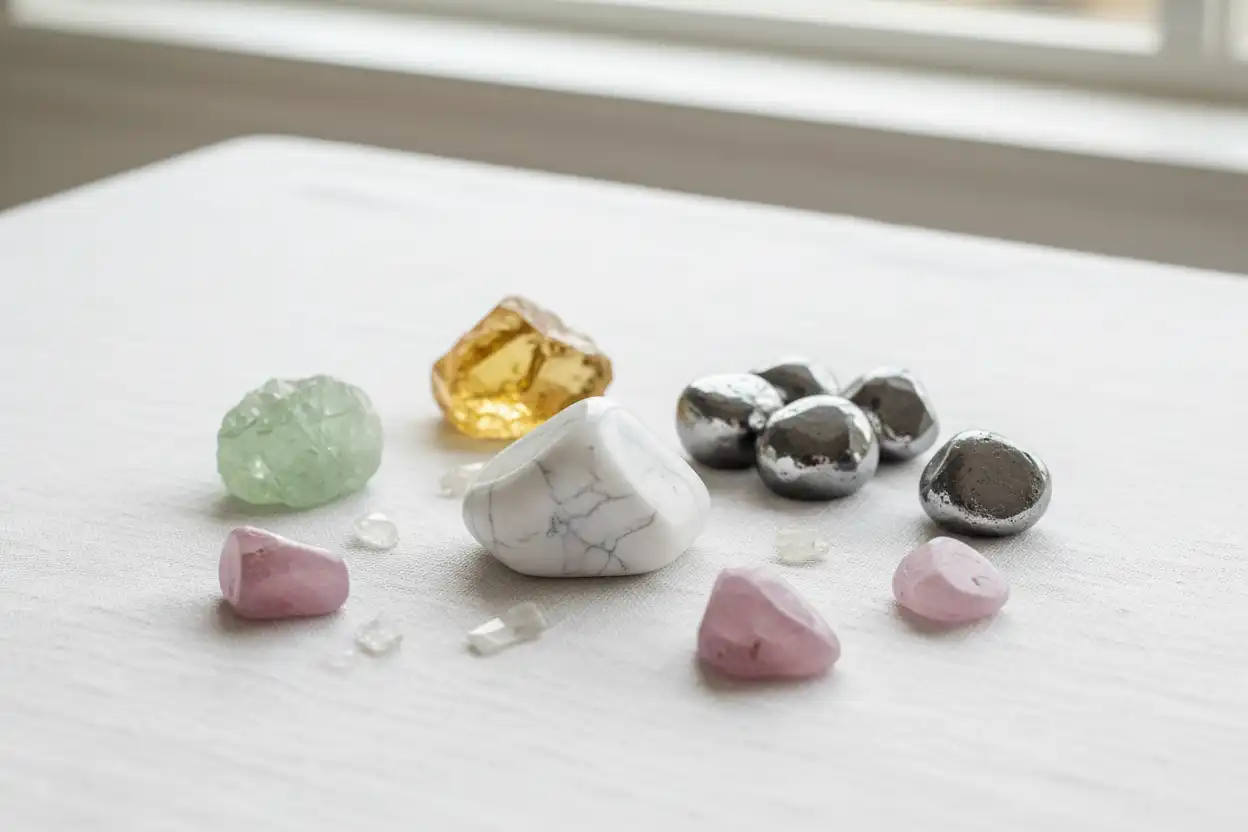
Crystals That Start With H: Names and Meanings
Crystals that start with H include hackmanite, halite, harlequin quartz, heliodor, hematite, Herkimer diamond, hessonite garnet, heulandite, hiddenite, hollandite quartz, honey calcite, howlite, hyalite opal and hypersthene.
This group ranges from water-soluble salt crystals and soft zeolites to durable quartz varieties, metallic iron minerals and valuable jewelry gemstones.
Crystal meanings are traditional and spiritual associations rather than scientifically proven medical effects.
Continue from the previous alphabetical collection with Crystals That Start With G.
H Crystals at a Glance
| Crystal or material | Typical appearance | Common symbolic meaning |
|---|---|---|
| Hackmanite | White, pink, lavender or violet | Change and self-discovery |
| Halite | Clear, white, pink or blue cubic crystals | Purification and simplicity |
| Harlequin Quartz | Clear quartz with red or dark inclusions | Focus and balanced action |
| Heliodor | Yellow to greenish-yellow beryl | Confidence and clear direction |
| Hematite | Metallic gray, black or reddish brown | Grounding and determination |
| Herkimer Diamond | Clear, double-terminated quartz | Clarity and personal awareness |
| Hessonite Garnet | Honey-orange to reddish-brown garnet | Confidence and steady progress |
| Heulandite | White, peach, pink or red zeolite | Reflection and emotional openness |
| Hiddenite | Pale to vivid green spodumene | Growth and emotional renewal |
| Hollandite Quartz | Clear quartz with dark star-like inclusions | Perspective and inner organization |
| Honey Calcite | Golden-yellow to amber calcite | Motivation and practical confidence |
| Howlite | White stone with gray or black veining | Patience and calm communication |
| Hyalite Opal | Clear, white or pale glassy opal | Openness and creativity |
| Hypersthene | Dark gray, brown or black with silvery sheen | Self-control and thoughtful action |
Hackmanite
Hackmanite is a variety of sodalite known for tenebrescence, a reversible color change caused by exposure to ultraviolet light.
Depending on its origin and condition, it may appear:
- White.
- Pale gray.
- Pink.
- Lavender.
- Violet.
- Deep purple after ultraviolet exposure.
The intensified color may gradually fade when the stone is removed from ultraviolet light.
Hackmanite is traditionally associated with:
- Personal change.
- Self-discovery.
- Adaptability.
- Revealing overlooked qualities.
- Responding constructively to new information.
Its relationship with the wider sodalite family helps explain its color, composition and appearance.
Halite
Halite is natural sodium chloride—the mineral form of salt.
It commonly forms cubic crystals in:
- Clear.
- White.
- Pink.
- Orange.
- Blue.
- Purple.
- Gray.
Halite is traditionally associated with:
- Purification.
- Simplicity.
- Clear boundaries.
- Releasing clutter.
- Creating an orderly environment.
Halite dissolves readily in water and can absorb moisture from humid air. It should be kept dry in a stable display container.
Do not rinse halite, place it in an aquarium or use decorative specimens as edible salt.
Harlequin Quartz
Harlequin quartz is clear or translucent quartz containing red, orange, brown or dark mineral inclusions.
The inclusions may consist of:
- Hematite.
- Lepidocrocite.
- Goethite.
- Other iron-rich minerals.
Its traditional meanings include:
- Focus.
- Balanced action.
- Motivation.
- Emotional awareness.
- Combining reflection with practical effort.
Some sellers use “harlequin quartz” and “fire quartz” interchangeably, while others reserve the name for material containing both red and darker inclusions.
Learn about its host mineral in the quartz family guide.
Heliodor
Heliodor is a yellow to greenish-yellow variety of beryl.
Its color commonly ranges from:
- Pale lemon yellow.
- Golden yellow.
- Yellow-green.
- Warm honey tones.
Heliodor is traditionally associated with:
- Confidence.
- Clear direction.
- Optimism.
- Independent decision-making.
- Following through on plans.
It belongs to the same mineral family as emerald, aquamarine, morganite and goshenite. Explore these relationships in the beryl guide.
Yellow heliodor may resemble citrine, but the two have different crystal structures and physical properties. The guide to heliodor vs. citrine explains the main identification differences.
Color, clarity, size and treatment can influence cost, as covered in the heliodor price guide.
Hematite
Hematite is an iron oxide mineral that may appear metallic silver-gray, black, reddish brown or earthy red.
Regardless of its external appearance, natural hematite usually produces a reddish-brown streak when rubbed against an unglazed porcelain surface.
Hematite is traditionally associated with:
- Grounding.
- Determination.
- Practical thinking.
- Stability.
- Completing demanding responsibilities.
Its traditional spiritual uses are explored in more detail in the guide to hematite healing properties.
Some polished hematite sold in jewelry is synthetic or combined with other materials. Use the guide to buying real hematite when comparing natural and manufactured pieces.
For routine care, follow methods suitable for iron-rich material in How to Cleanse and Charge Hematite.
Herkimer Diamond
Herkimer diamonds are naturally double-terminated quartz crystals historically associated with Herkimer County, New York.
Despite the name, they are quartz rather than diamond.
They commonly show:
- Excellent transparency.
- Two naturally pointed ends.
- Internal fractures.
- Carbon inclusions.
- Small fluid or mineral inclusions.
Herkimer diamonds are traditionally associated with:
- Clarity.
- Personal awareness.
- Focus.
- Amplifying intentions.
- Recognizing overlooked details.
The term is sometimes used broadly for double-terminated quartz from other locations. Provenance and seller disclosure matter when locality is important.
The guide to buying a real Herkimer diamond explains what to examine before purchasing.
Hessonite Garnet
Hessonite is an orange, honey-colored, reddish-brown or cinnamon-colored variety of grossular garnet.
It may display a distinctive internal appearance sometimes described as:
- Swirled.
- Treacly.
- Heat-wave-like.
- Slightly roiled.
Hessonite is traditionally associated with:
- Confidence.
- Steady progress.
- Motivation.
- Practical ambition.
- Learning from past experience.
It is used in rings, pendants, earrings and collector stones.
Explore its mineral relatives in the complete garnet guide.
Heulandite
Heulandite is a member of the zeolite mineral group.
It commonly forms tabular or bladed crystals in:
- White.
- Clear.
- Peach.
- Pink.
- Red.
- Pale green.
Heulandite is traditionally associated with:
- Reflection.
- Emotional openness.
- Patience.
- Examining recurring patterns.
- Creating space for change.
Its crystals are relatively soft and have good cleavage, making them vulnerable to scratching and impact.
Heulandite should not be routinely soaked. Its relationship with other porous minerals is explained in the zeolite guide.
Hiddenite
Hiddenite is a green variety of spodumene.
Its color may range from:
- Pale yellow-green.
- Mint green.
- Emerald-like green.
- Medium green with visible color zoning.
Hiddenite is traditionally associated with:
- Emotional renewal.
- Growth.
- Hope.
- Compassion.
- Beginning again after disappointment.
The stone has distinct cleavage and can fracture if struck. Some green material may also fade after prolonged exposure to strong light or heat.
Fine natural hiddenite is uncommon, and some similarly colored stones may be sold under the name incorrectly. The hiddenite price guide explains the factors that affect value.
Hollandite Quartz
Hollandite quartz is clear or translucent quartz containing dark hollandite inclusions.
The inclusions may form:
- Tiny stars.
- Bursts.
- Crosses.
- Radiating clusters.
- Dark suspended dots.
These distinctive patterns make hollandite quartz popular among inclusion-quartz collectors.
It is traditionally associated with:
- Perspective.
- Inner organization.
- Recognizing patterns.
- Mental focus.
- Understanding interconnected ideas.
Natural internal fractures and exposed inclusions can make some specimens more vulnerable than ordinary solid quartz.
Honey Calcite
Honey calcite is a yellow, golden or amber-colored variety of calcite.
It may appear:
- Transparent.
- Translucent.
- Cloudy.
- Banded.
- Waxy when polished.
Honey calcite is traditionally associated with:
- Motivation.
- Practical confidence.
- Decision-making.
- Learning.
- Turning ideas into manageable actions.
Calcite is soft and acid-sensitive. Keep honey calcite away from vinegar, citrus juice, harsh cleaners and harder stones.
Explore related varieties in the calcite guide.
Because dyed or mislabeled stones may resemble honey calcite, review the guide to buying real honey calcite before purchasing.
Howlite
Howlite is usually white or cream with gray, brown or black web-like veining.
It is traditionally associated with:
- Patience.
- Calm communication.
- Self-awareness.
- Slowing impulsive reactions.
- Preparing for rest.
Howlite is porous and commonly dyed blue or green to imitate turquoise and other stones.
Dyed howlite may show:
- Color concentrated inside cracks.
- Very uniform blue coloring.
- White areas beneath scratches.
- Dye transfer after unsuitable cleaning.
Use the guide to buying real howlite to compare natural, dyed and imitation material.
Gentle maintenance methods are covered in How to Cleanse and Charge Howlite.
Hyalite Opal
Hyalite is a transparent, translucent or milky variety of common opal with a glassy appearance.
It often forms:
- Rounded coatings.
- Botryoidal surfaces.
- Clear globules.
- Thin crusts.
- Small glass-like masses.
Some hyalite fluoresces bright green under ultraviolet light because of trace elements within the material.
Hyalite opal is traditionally associated with:
- Openness.
- Creativity.
- Curiosity.
- Fresh perspective.
- Recognizing subtle possibilities.
Natural hyalite can be delicate and may develop cracks when exposed to sudden environmental changes.
Explore its broader mineral family in the opal guide.
Hypersthene
Hypersthene is a dark member of the orthopyroxene mineral group.
It commonly appears:
- Dark gray.
- Brown.
- Greenish brown.
- Nearly black.
- Silvery or bronze under reflected light.
Polished hypersthene may display a soft metallic or silky sheen.
It is traditionally associated with:
- Self-control.
- Thoughtful action.
- Clear priorities.
- Emotional restraint.
- Making decisions without unnecessary pressure.
Hypersthene can be brittle and should be protected from strong impacts, steam and ultrasonic cleaning.
H Crystals by Color
White and Colorless H Crystals
Examples include:
- Halite.
- Herkimer diamond.
- Howlite.
- Hyalite opal.
- Pale heulandite.
Yellow and Golden H Crystals
Notable examples include:
- Heliodor.
- Honey calcite.
- Hessonite garnet.
- Some halite specimens.
Green H Crystals
Green examples include:
- Hiddenite.
- Greenish heliodor.
- Some hackmanite before ultraviolet exposure.
- Pale green heulandite.
Purple and Pink H Crystals
Examples include:
- Hackmanite.
- Pink heulandite.
- Certain halite crystals.
Black, Gray and Metallic H Crystals
Examples include:
- Hematite.
- Hypersthene.
- Hollandite quartz inclusions.
- Dark harlequin quartz inclusions.
Which H Crystals Are Suitable for Jewelry?
Common jewelry choices include:
- Heliodor.
- Hematite.
- Herkimer diamond.
- Hessonite garnet.
- Hiddenite.
- Honey calcite.
- Howlite.
- Hypersthene.
Durability differs considerably.
Hessonite garnet and heliodor are generally better suited to regular jewelry than soft halite, heulandite or honey calcite.
Hiddenite and hypersthene require protection from impact because of cleavage or brittleness. Howlite can scratch, absorb dyes and react to chemicals.
For a jewelry-centered comparison, explore Gemstones That Start With H.
Care and Safety for H Crystals
H crystals require material-specific care:
- Halite: Keep completely dry because it dissolves in water.
- Hackmanite: Protect from prolonged intense light when preserving its current color matters.
- Heliodor: Avoid hard impacts and professional cleaning methods that have not been approved for the stone.
- Hematite: Dry it after cleaning and check whether the piece is natural, coated or manufactured.
- Herkimer diamond: Protect exposed points and internal fractures.
- Heulandite: Avoid soaking, abrasion and rough handling.
- Hiddenite: Limit strong light, heat and sudden impact.
- Honey calcite: Keep away from acids and harder stones.
- Howlite: Avoid dyes, oils and aggressive cleaners that may enter its pores.
- Hyalite opal: Protect from rapid temperature and humidity changes.
- Hypersthene: Avoid ultrasonic cleaners and strong blows.
Store fragile specimens in padded compartments rather than loose bags where harder stones can strike them.
Frequently Asked Questions
What is the most popular crystal that starts with H?
Hematite, howlite, Herkimer diamond and honey calcite are among the most familiar H crystals.
Which green crystals start with H?
Hiddenite is the best-known green H crystal. Some heliodor, hackmanite and heulandite specimens may also show green tones.
Which H crystals are purple?
Hackmanite is the most notable purple example. Some halite and heulandite specimens may appear pink, lavender or violet.
Is a Herkimer diamond a real diamond?
No. Herkimer diamond is a naturally double-terminated form of quartz.
Can halite go in water?
No. Halite is natural salt and dissolves in water.
Is howlite naturally blue?
Natural howlite is usually white or cream with gray or dark veining. Blue howlite is commonly dyed.
Why does hackmanite change color?
Hackmanite can display tenebrescence, a reversible color change triggered by ultraviolet light.
Is hematite magnetic?
Natural hematite is generally weakly magnetic or nonmagnetic. Strongly magnetic polished beads may be manufactured material sold as magnetic hematite.
Does hyalite opal glow under ultraviolet light?
Some hyalite specimens fluoresce bright green under ultraviolet light, although the strength of the reaction varies.
Continue Exploring Crystals
Continue alphabetically with Crystals That Start With I, or browse beginner guides, care information and crystal directories in the Crystals 101 collection.