Gemstones That Start With H: A–Z Guide
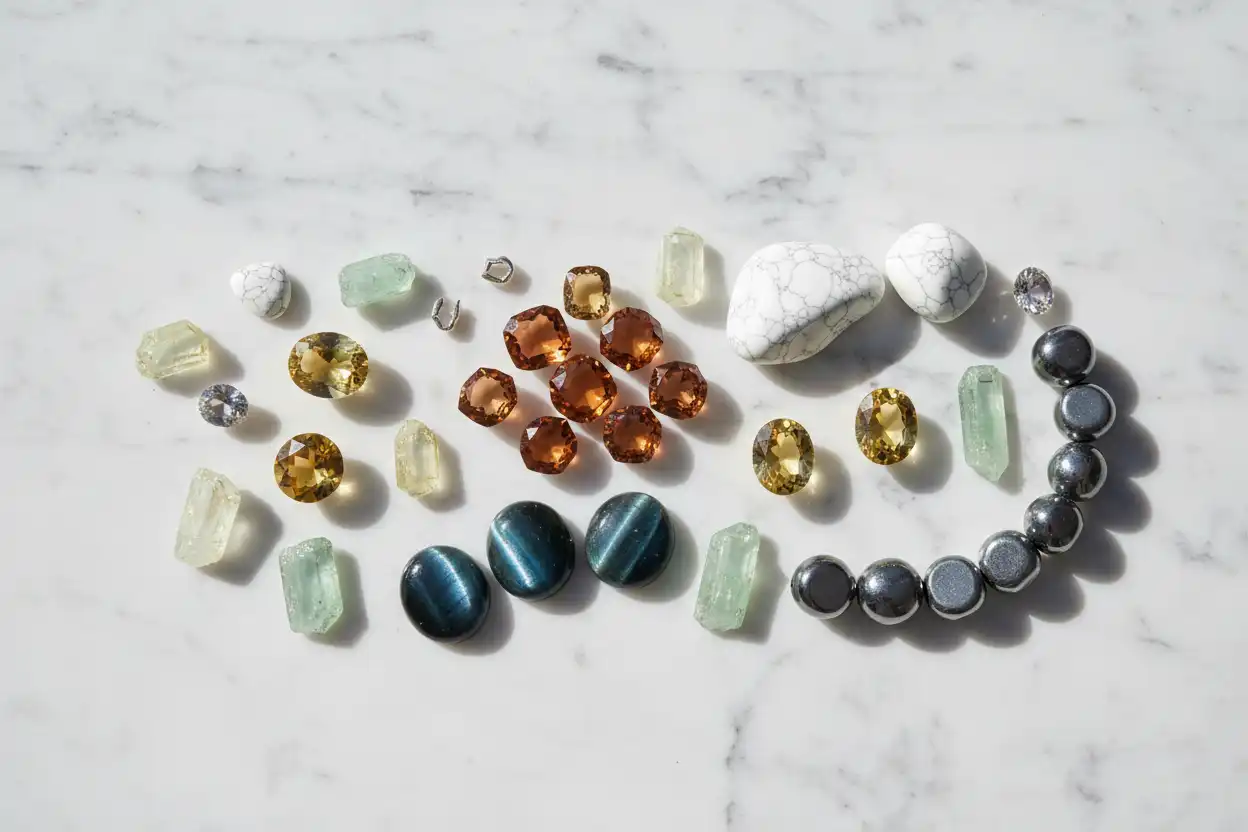
Gemstones and gem materials that start with H include hackmanite, halite, harlequin quartz, heliodor, hematite, Herkimer diamond, hessonite garnet, heulandite, hiddenite, hollandite quartz, honey calcite, howlite, hyalite opal and hypersthene.
The H directory combines valuable faceted gemstones, included quartz, optical minerals, metallic iron material, soft collector crystals and commercial lapidary stones.
Traditional meanings are symbolic associations rather than scientifically proven medical effects.
Continue from Gemstones That Start With G. For additional crystal-focused context, explore Crystals That Start With H.
H Gemstones at a Glance
| Gemstone or material | Typical appearance | Material type | Common use |
|---|---|---|---|
| Hackmanite | White, pink, lavender or violet | Sodalite variety | Cabochons and collector stones |
| Halite | Clear, white, pink or blue cubes | Sodium chloride mineral | Collector specimens |
| Harlequin Quartz | Quartz with red and dark inclusions | Included quartz | Cabochons and polished stones |
| Heliodor | Yellow to greenish-yellow | Beryl gemstone | Faceted jewelry |
| Hematite | Metallic gray, black or reddish brown | Iron oxide mineral | Beads and cabochons |
| Herkimer Diamond | Clear double-terminated quartz | Quartz | Pendants and natural-crystal jewelry |
| Hessonite Garnet | Orange, honey or reddish brown | Grossular garnet | Faceted jewelry |
| Heulandite | White, peach, pink or red | Zeolite mineral | Collector specimens |
| Hiddenite | Pale to vivid green | Spodumene gemstone | Rare faceted jewelry |
| Hollandite Quartz | Quartz with dark star-like inclusions | Included quartz | Cabochons and collector gems |
| Honey Calcite | Golden-yellow to amber | Calcite variety | Carvings and protected jewelry |
| Howlite | White with gray or black veining | Borate mineral | Beads and carvings |
| Hyalite Opal | Clear, white or pale glassy opal | Common opal | Collector gems and cabochons |
| Hypersthene | Dark gray or brown with metallic sheen | Pyroxene-group material | Cabochons and beads |
Hackmanite
Hackmanite is a variety of sodalite known for tenebrescence, a reversible color response triggered by ultraviolet light.
Depending on the specimen, it may appear:
- White.
- Pink.
- Lavender.
- Violet.
- Deep purple after ultraviolet exposure.
Hackmanite is traditionally associated with adaptability, self-discovery and recognizing hidden qualities.
The intensified color may gradually fade after the ultraviolet source is removed.
Hackmanite is generally used for cabochons, beads and collector pieces. It is softer than sapphire or quartz and should be protected from scratches and impact.
Halite
Halite is natural sodium chloride—the mineral form of salt.
It commonly forms cubic crystals in:
- Clear.
- White.
- Pink.
- Orange.
- Blue.
- Purple.
Halite is traditionally associated with simplicity, purification and clear boundaries.
It is water-soluble and can absorb moisture from humid air. Halite should remain in a dry display container and should never be rinsed, soaked or worn in jewelry exposed to perspiration.
Decorative mineral specimens are not intended for eating.
Harlequin Quartz
Harlequin quartz is clear or translucent quartz containing red, orange, brown or dark mineral inclusions.
These inclusions may include hematite, goethite or related iron-rich minerals.
Harlequin quartz is traditionally associated with focus, motivation and balancing reflection with action.
The name is used inconsistently. Some sellers apply it to fire quartz, while others reserve it for material containing several inclusion colors.
Solid polished pieces may be suitable for pendants and cabochons, but internal fractures should be examined carefully.
Heliodor
Heliodor is the yellow to greenish-yellow variety of beryl.
Its colors include:
- Pale lemon.
- Golden yellow.
- Yellow-green.
- Honey.
- Warm golden-brown tones.
Heliodor is traditionally associated with confidence, optimism and clear direction.
Its hardness makes it suitable for rings, earrings and pendants when the stone is not heavily fractured.
Yellow heliodor may resemble citrine. The guide to heliodor versus citrine explains their differences in mineral identity, optical properties and durability.
Value factors are covered in the heliodor price guide.
Hematite
Hematite is an iron oxide mineral that may appear metallic silver-gray, black, reddish brown or earthy red.
Natural hematite typically produces a reddish-brown streak even when its surface looks metallic.
It is traditionally associated with grounding, determination and practical judgment.
Hematite is commonly fashioned into:
- Beads.
- Cabochons.
- Carvings.
- Signet-style pieces.
- Polished ornaments.
Strongly magnetic beads sold as magnetic hematite are often manufactured material rather than natural hematite.
Care methods suitable for iron-rich material are covered in How to Cleanse and Charge Hematite.
Herkimer Diamond
Herkimer diamonds are naturally double-terminated quartz crystals historically associated with Herkimer County, New York.
Despite the name, they are quartz rather than diamond.
Typical features include:
- Two naturally pointed ends.
- High transparency.
- Internal fractures.
- Carbon inclusions.
- Fluid or mineral inclusions.
Herkimer diamonds are traditionally associated with clarity, focus and personal awareness.
They are used in natural-crystal pendants, earrings, rings and wire-wrapped jewelry.
Exposed points and internal fractures can chip, so protective settings are preferable.
Hessonite Garnet
Hessonite is an orange, cinnamon, honey or reddish-brown variety of grossular garnet.
It may display a distinctive internal appearance described as:
- Swirled.
- Roiled.
- Treacly.
- Heat-wave-like.
Hessonite is traditionally associated with confidence, steady progress and practical ambition.
It has good durability for rings, earrings and pendants, although included stones should still be protected from impact.
Its warm color can resemble zircon, citrine or spessartite garnet.
Heulandite
Heulandite is a zeolite mineral occurring in white, clear, peach, pink, red and pale green crystals.
It commonly forms:
- Tabular crystals.
- Bladed crystals.
- Radiating groups.
- Crystals on matrix.
Heulandite is traditionally associated with reflection, openness and gradual change.
It is soft and cleavable, making natural crystal clusters unsuitable for conventional jewelry.
Protected collector pendants may use small pieces, but most specimens should remain in display boxes.
Hiddenite
Hiddenite is the green variety of spodumene.
Its shades range from:
- Pale yellow-green.
- Mint green.
- Medium green.
- Vivid emerald-like green.
Hiddenite is traditionally associated with hope, renewal and emotional growth.
It is strongly pleochroic and may show different color intensity from different directions.
Spodumene has perfect cleavage, making hiddenite vulnerable to sharp blows and pressure during setting.
Color, transparency, origin and certification affect the values discussed in the hiddenite price guide.
Hollandite Quartz
Hollandite quartz is clear or translucent quartz containing dark hollandite inclusions.
The inclusions may resemble:
- Stars.
- Crosses.
- Bursts.
- Radiating clusters.
- Suspended black dots.
Hollandite quartz is traditionally associated with perspective, organization and recognizing patterns.
It is mainly used for collector cabochons and polished stones.
Natural internal fractures or inclusions reaching the surface may reduce durability. The seller should accurately identify the inclusions rather than relying only on visual resemblance.
Honey Calcite
Honey calcite is a yellow, golden or amber-colored variety of calcite.
It may be transparent, translucent, cloudy or banded.
Honey calcite is traditionally associated with motivation, confidence and turning ideas into manageable actions.
It is commonly used for:
- Carvings.
- Cabochons.
- Beads.
- Decorative objects.
Calcite is soft and reacts with acids. Rings and bracelets are generally poor choices unless the setting provides substantial protection.
Buying considerations appear in Where to Buy Real Honey Calcite.
Howlite
Howlite is usually white or cream with gray, brown or black web-like veining.
It is traditionally associated with patience, self-awareness and calm communication.
Howlite is commonly cut into:
- Beads.
- Cabochons.
- Carvings.
- Decorative pendants.
- Tumbled stones.
Its porous structure makes it easy to dye. Blue-dyed howlite is frequently sold as turquoise or under vague names.
The guide to buying real howlite explains how to assess natural, dyed and imitation material.
Hyalite Opal
Hyalite is a transparent, translucent or milky variety of common opal with a glassy appearance.
It may occur as:
- Rounded coatings.
- Clear globules.
- Botryoidal surfaces.
- Thin crusts.
- Small glass-like masses.
Some hyalite fluoresces vivid green under ultraviolet light.
Hyalite opal is traditionally associated with openness, curiosity and creativity.
Gem material may be polished or faceted, but natural formations can be delicate and sensitive to sudden environmental changes.
Hypersthene
Hypersthene is a dark pyroxene-group material known for a silver, bronze or silky reflective effect.
It commonly appears:
- Dark gray.
- Brown.
- Greenish brown.
- Nearly black.
- Metallic under directional light.
Hypersthene is traditionally associated with self-control, thoughtful action and clear priorities.
It is usually cut into cabochons, beads and polished freeforms.
The material can be brittle and should be protected from sharp impacts, steam and ultrasonic cleaning.
Which H Gemstones Are Best for Jewelry?
Stronger or more practical choices include:
- Heliodor.
- Hessonite garnet.
- Hematite.
- Herkimer diamond.
- Howlite.
- Hypersthene.
- Carefully set hiddenite.
Materials better suited to protected or occasional wear include:
- Hackmanite.
- Harlequin quartz.
- Honey calcite.
- Hyalite opal.
- Hollandite quartz.
Halite and heulandite are primarily collector specimens.
Care Guide for H Gemstones
- Keep halite completely dry.
- Protect hiddenite, heliodor and heulandite from cleavage-related impact.
- Store hackmanite away from unnecessary prolonged ultraviolet exposure.
- Inspect included quartz for fractures before setting.
- Avoid acids on honey calcite.
- Keep dyed howlite away from solvents and prolonged soaking.
- Protect hyalite opal from sudden heat and humidity changes.
- Avoid steam and ultrasonic cleaning for hypersthene and fractured specimens.
- Separate soft stones from garnet and beryl jewelry during storage.
The broader guide to crystals that fade in sunlight covers light-sensitive materials and safer display practices.
Frequently Asked Questions
What is the most valuable gemstone that starts with H?
Fine natural hiddenite and high-quality heliodor can be valuable. Size, color, transparency, origin and certification influence price.
Which green gemstones start with H?
Hiddenite is the best-known green H gemstone. Some heliodor and heulandite specimens may also show greenish tones.
Is Herkimer diamond a real diamond?
No. It is naturally double-terminated quartz.
Is hematite suitable for jewelry?
Yes, polished hematite is widely used in beads and cabochons, although it can chip and should be kept dry after cleaning.
Is howlite naturally blue?
No. Natural howlite is usually white or cream. Blue material is generally dyed.
Can halite be worn in jewelry?
It is impractical because perspiration and moisture can dissolve or damage it.
Is hiddenite suitable for everyday rings?
Its cleavage makes it vulnerable to impact. Protected settings and occasional wear are safer.
Does every hyalite opal fluoresce?
No. Fluorescence strength varies between specimens and localities.
Continue the Gemstone Alphabet
Continue with Gemstones That Start With I, or browse all alphabetical guides through the Crystals 101 collection.