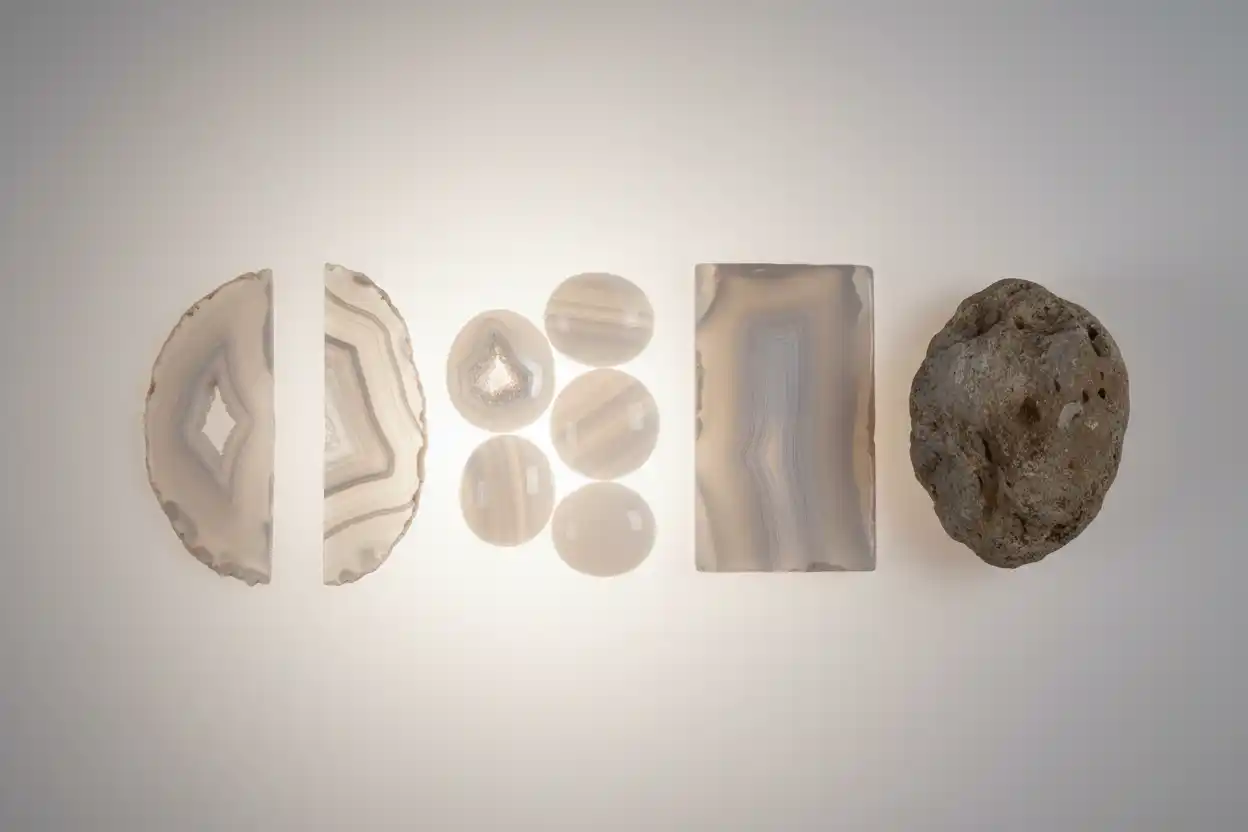
White Agate Meaning, Properties, Value and Identification
White agate is pale to opaque banded chalcedony whose colors range from translucent colorless-white and milk white to cream, gray-white and softly patterned stone. Its appeal comes from subtle layering, cloudlike translucence and the durability of microcrystalline quartz.
The name is often applied too broadly. A genuinely agate-based piece should contain chalcedony and normally show some form of banding, structural layering or agate growth, rather than being any polished white stone.
White Agate at a Glance
| Property | White Agate |
|---|---|
| Material type | White or pale banded chalcedony |
| Mineral family | Quartz |
| Main composition | Microcrystalline SiO₂ |
| Typical colors | Colorless-white, milk white, cream, pale gray and white with brown or black bands |
| Crystal structure | Microscopic intergrowths of quartz and moganite |
| Common habit | Nodules, veins, geodes, layered fillings and rounded masses |
| Luster | Waxy to vitreous after polishing |
| Transparency | Translucent to opaque |
| Refractive index | Spot reading commonly near 1.53–1.54 |
| Specific gravity | Approximately 2.58–2.64 |
| Mohs hardness | About 6.5–7 |
| Cleavage | None |
| Tenacity | Generally tough for a siliceous gem, though still brittle |
| Common cuts | Cabochons, beads, cameos, carvings, slices, tablets and tumbled stones |
| Main care concern | Dye, bleaching, resin and hidden fractures; prolonged heat can affect treatments |
What Is White Agate?
Agate is a patterned form of chalcedony, an aggregate of microscopic quartz-family crystals.
White agate develops when pale or nearly colorless chalcedony fills cavities in rock in repeated layers. Differences in porosity, grain orientation and included material make individual bands visible.
Some specimens are almost uniformly milky and show only faint layering. Others contain sharp white, gray, cream, brown or black stripes.
The parent agate guide owns family-level history and broad symbolism. The types of agate guide classifies named patterns and varieties, while this page focuses specifically on naturally pale material.
Is White Agate a Formal Mineral Variety?
White agate is a descriptive gem-trade name rather than a separate mineral species.
Its essential material is chalcedony, and the term white describes the dominant visual appearance.
Strict geological usage often reserves agate for chalcedony with visible banding. Commercial sellers may apply the name to uniformly white chalcedony even when banding is subtle.
That usage is acceptable when the material genuinely comes from an agate nodule or layered deposit, but a completely unbanded white chalcedony may be described more accurately as white chalcedony.
The distinction between family, color and pattern appears in types of chalcedony.
What Makes Agate White?
White agate does not depend on one strong coloring element.
Tiny crystals, microscopic pores, fluid inclusions and grain boundaries scatter light, creating a milky or cloudy appearance.
Relatively pure silica produces colorless or white layers. Iron and manganese impurities can add cream, gray, tan, brown or black bands.
Some specimens contain opal, quartz, clay or other fine minerals between chalcedony layers.
The degree of translucence depends on grain size, porosity and inclusion density. Thin edges may glow even when the center appears opaque.
White Agate Patterns
Milky White Agate
Milky material shows soft cloudlike layers with low contrast. It is popular for beads, carvings and minimalist cabochons.
A lack of strong pattern does not make it fake, although it can make distinction from ordinary white chalcedony more difficult.
White Banded Agate
Alternating translucent and opaque white bands create a subtle striped appearance.
Fine banding may become visible only when the stone is held against strong transmitted light.
White and Gray Agate
Gray lines provide more contrast and can produce lace, fortification or eye patterns.
Some pieces resemble Botswana agate, though the locality-specific name should not be used without provenance.
White Lace Agate
Commercial white lace agate contains looping, wavy or cloudlike bands. The name may refer to naturally pale lace-patterned agate from several sources.
It should not be confused with blue lace agate, whose identity depends on pale blue chalcedony banding.
White Onyx-Type Agate
Parallel white and gray bands may be cut for cameos and intaglios.
True quartz onyx is straight-banded chalcedony. Retail “white onyx” may instead be calcite or marble, which is softer and acid-sensitive.
White Agate With Dendrites
Black or brown branching inclusions can occur within pale agate.
When dendritic inclusions dominate the pattern, the material belongs more naturally with dendritic agate.
How White Agate Forms
Agate commonly develops inside cavities left by gas bubbles in volcanic rock or within fractures and sedimentary voids.
Silica-rich groundwater enters the opening and deposits microscopic chalcedony along the cavity wall.
Repeated fluid episodes create layers with slightly different structures, porosity and impurities.
The bands may follow the shape of the cavity, producing concentric or fortification patterns.
Later quartz can grow in the central opening, creating a geode with an agate rim and crystalline interior.
Weathering releases durable nodules from their host rock. Rivers can transport and round them before discovery.
Important Sources
Brazil and Uruguay are major commercial sources of agate nodules and geodes. Pale layers frequently occur alongside gray, brown and colorless chalcedony.
India supplies white and patterned agate used for beads, carvings and cabochons.
Botswana is known for fine gray-white and brown banding, though only documented material should receive the locality name.
Mexico, Madagascar, Morocco, Turkey, Germany, China and the United States also contain notable agate deposits.
Oregon, Montana, Arizona, Michigan and several other American states produce white or pale banded chalcedony.
Because agate is widespread, broad country origin rarely determines value by itself.
Internal Features
Agate banding occurs at a microscopic structural level. Individual layers may differ in fiber orientation, pore space and trace minerals.
Fine quartz crystals can line cavities or fractures. These druzy areas add sparkle but create more fragile surface points.
Fluid inclusions and small hollow spaces may remain from the original cavity-filling process.
Iron oxides create yellow, red and brown stains, while manganese oxides can form dark branching patterns.
Natural fractures may cut across several bands. Dye and resin can accumulate in these cracks, making them useful treatment indicators.
White Agate Versus White Chalcedony
All agate is chalcedony, but not all chalcedony is agate.
White agate normally shows banding, layered growth or a nodule structure. White chalcedony may appear more uniform and lack obvious bands.
Their hardness, refractive index and overall chemical composition are similar, so the difference is mainly structural and descriptive.
A seller using the two names interchangeably is not necessarily offering a fake stone, but the pattern description should remain accurate.
White Agate Versus Howlite
Howlite is a soft calcium borosilicate commonly found as white nodules with gray or black veins.
It has a hardness of approximately 3.5, much lower than white agate.
Howlite veins tend to form irregular webbing rather than chalcedony banding.
Dyed howlite is frequently used to imitate turquoise, but untreated pieces may also be sold incorrectly as white agate.
White Agate Versus Magnesite
Magnesite is a magnesium carbonate that may appear white, cream or gray-veined.
It is softer and reacts more readily with acid than quartz-family agate.
Porous magnesite absorbs dye easily. A suspiciously uniform white or bright color may require testing.
White Agate Versus Moonstone and Opal
Moonstone belongs to the feldspar family and shows adularescence, a floating internal glow caused by light interference between microscopic layers.
Agate has a waxier, more stable banded appearance and greater toughness.
White opal is hydrated silica and may display play-of-color. It generally has a lower refractive index, more water-related sensitivity and different internal structure.
White agate does not show precious opal’s moving spectral flashes.
White Agate Versus White Jade
White jade may consist of nephrite or jadeite. Both are denser and have different internal textures from chalcedony.
Nephrite has a fibrous interlocking structure, while jadeite is granular.
White agate commonly shows curved bands and chalcedony translucence rather than jade’s compact texture.
Laboratory testing is important because all three materials are carved and sold under cultural trade names.
Identifying Real White Agate
A polished stone should have hardness close to 7. Destructive scratch testing should not be used on finished jewelry.
A spot refractive-index reading near 1.53–1.54 supports chalcedony.
Magnification may reveal banding, fine pores, iron staining, crystal-lined cavities and natural fractures.
The material should not show gas bubbles or mold seams associated with glass and resin.
Raman spectroscopy can confirm quartz-family silica and distinguish agate from carbonate or feldspar imitations.
The broader method appears in how to identify crystals.
For shopping, the checks in real versus fake agate address dyed, glass and resin products.
Treatments, Bleaching and Dye
Agate is among the gemstones most commonly altered through color treatment.
Dye enters microscopic pores and fractures, producing intense black, blue, green, red and other colors.
White material may be bleached to remove brown or yellow staining and create a more uniform appearance.
Resin impregnation can strengthen porous or fractured rough. Polymer may also improve polish and translucence.
Wax and oil can deepen contrast or temporarily hide a dry surface.
White agate is less likely to be dyed white than colored agate is to be dyed, but bleaching and resin remain relevant.
Color concentrated in drill holes, fractures or porous bands suggests treatment.
The complete treatment workflow belongs to treated agate, while GIA’s treatment guidance confirms that chalcedony accepts a wide variety of dyes.
Cutting and Polishing
White agate is commonly cut as a cabochon because a domed surface highlights curved layers and translucence.
Thin slices reveal banding more clearly than thick opaque cuts.
Cameo cutters use contrasting layers to create a pale raised design above a darker background.
Beads are economical because agate nodules yield many durable calibrated shapes.
Free-form pendants preserve fortification patterns and druzy cavities.
Agate accepts a high polish, but open pores and cavities may retain polishing compound.
Cutters use wet methods because dry grinding quartz-family material creates respirable silica dust.
Durability and Jewelry Suitability
White agate measures approximately 6.5–7 on the gemstone hardness chart.
Its microcrystalline structure generally gives it better practical toughness than large single quartz crystals.
It has no cleavage, though a sharp impact can still chip thin edges or break a stone along a fracture.
Agate works well in rings, pendants, earrings, bracelets and beads.
Large cameos and carvings should be protected from drops because brittle silica cannot bend.
Druzy surfaces are less durable than smooth cabochons because their tiny points catch and chip.
White Agate Prices in 2026
Small tumbled stones commonly retail for approximately $1–$8.
Commercial beads and simple cabochons often cost $2–$20 per piece.
Better banded cabochons with attractive translucence and polish generally range from $20–$75.
Large designer stones, cameos and unusually fine white-gray patterns may sell for $75–$200 or more.
Current retail listings range from only a few dollars for small calibrated cabochons to around $90 for a large 30-carat stone marketed as high grade.
Large carvings, spheres and decorative objects can cost several hundred dollars when workmanship is substantial.
White color alone does not make agate rare. Pattern, cutting, size, provenance and treatment disclosure determine whether a premium is justified.
What Determines Value?
Banding should be visually balanced and continuous.
Translucence adds depth, particularly when alternating opaque and glowing layers are visible.
Clean white color can be attractive, but perfectly uniform chalky material may be less interesting than naturally varied stone.
Natural dendrites, eyes, fortifications or central quartz cavities can increase collector appeal.
Polish should be even, without pits, scratches or waxy residue.
Treatment disclosure matters. Untreated material with documented origin may receive a premium, while ordinary bleached or resin-treated beads should remain affordable.
Buying Guidance
Use where to buy agate for general seller checks.
Ask whether the stone is natural, bleached, dyed, stabilized or backed.
Inspect the drill holes and reverse side. Treatments often become more obvious away from the polished face.
Confirm whether the seller means agate, chalcedony, white onyx, howlite or calcite.
Do not pay a rarity premium solely for the word “AAA,” which has no universal agate grading standard.
Request dry photographs under neutral lighting. Oil and wet surfaces can hide fractures and exaggerate translucence.
Cleaning, Water and Storage
Clean untreated white agate with lukewarm water, mild soap and a soft brush.
Brief soaking usually does not harm solid untreated material, but prolonged immersion is unnecessary.
Avoid harsh acids, bleach and abrasive powders.
Ultrasonic cleaning may be safe for flawless untreated agate but is not recommended when fractures, dye, resin or druzy cavities are present.
Steam can damage treatments and produce thermal shock.
Store white agate away from harder sapphire and diamond jewelry.
Cosmetics and oils can collect in pale porous surfaces, so clean beads periodically rather than allowing residue to build.
Meaning and Symbolism
White agate has been associated in modern crystal traditions with composure, balance, honesty and creating mental space before making decisions.
Its pale layered appearance encourages symbolism involving gradual progress rather than abrupt transformation.
Some people use it as a reminder to communicate calmly or separate facts from emotional reactions.
These interpretations are cultural, spiritual or personal rather than scientifically demonstrated properties.
Its color symbolism overlaps the broader white crystals guide, while the full range of agate symbolism belongs to agate color meaning.
Frequently Asked Questions
1. Is white agate a real natural stone?
Yes. Naturally pale and white-banded agate occurs worldwide, although commercial material may also be bleached or stabilized.
2. Is white agate the same as white chalcedony?
White agate is a form of chalcedony that normally shows banding or layered growth. Uniform white chalcedony may lack the structure expected of agate.
3. What makes white agate white?
Microscopic quartz fibers, pores, fluid inclusions and relatively low concentrations of coloring impurities scatter light and create a milky appearance.
4. Is white agate the same as white onyx?
Quartz onyx is straight-banded chalcedony and can overlap white agate. Retail white onyx may also be calcite, so testing is important.
5. How can white agate be distinguished from howlite?
Agate is much harder and commonly shows curved banding. Howlite is soft and usually has irregular gray webbing.
6. Is white agate dyed?
White material is less often dyed white, but it can be bleached, resin-stabilized or coated. Dark contrasting bands may also be artificially enhanced.
7. Can white agate go in water?
Brief washing is normally safe for untreated solid agate. Avoid long soaking when dye, resin, glue or porous areas are present.
8. Is white agate suitable for rings?
Yes. Its hardness and microcrystalline structure make it practical for rings, especially in protective settings.
9. Does white agate fade in sunlight?
Natural white color is generally stable. Dyes, coatings and resin may yellow or change under prolonged heat and strong light.
10. Where is white agate found?
Commercial sources include Brazil, Uruguay, India, Botswana, Mexico, Madagascar, Turkey and the United States.
11. How much is white agate worth?
Small commercial stones cost only a few dollars, while fine large cabochons, cameos and carvings can range from $50 to several hundred dollars.
12. Does white agate have scientifically proven healing properties?
No. Symbolic interpretations may have personal meaning, but scientific evidence does not establish healing effects.
White agate is not valuable because it is perfectly blank. Its strongest pieces reveal restrained geological detail—soft gray lines, translucent layers, small quartz cavities and changes in texture that record repeated silica deposition inside an ancient opening.
White agate appears in Crystals That Start With W and Gemstones That Start With W.