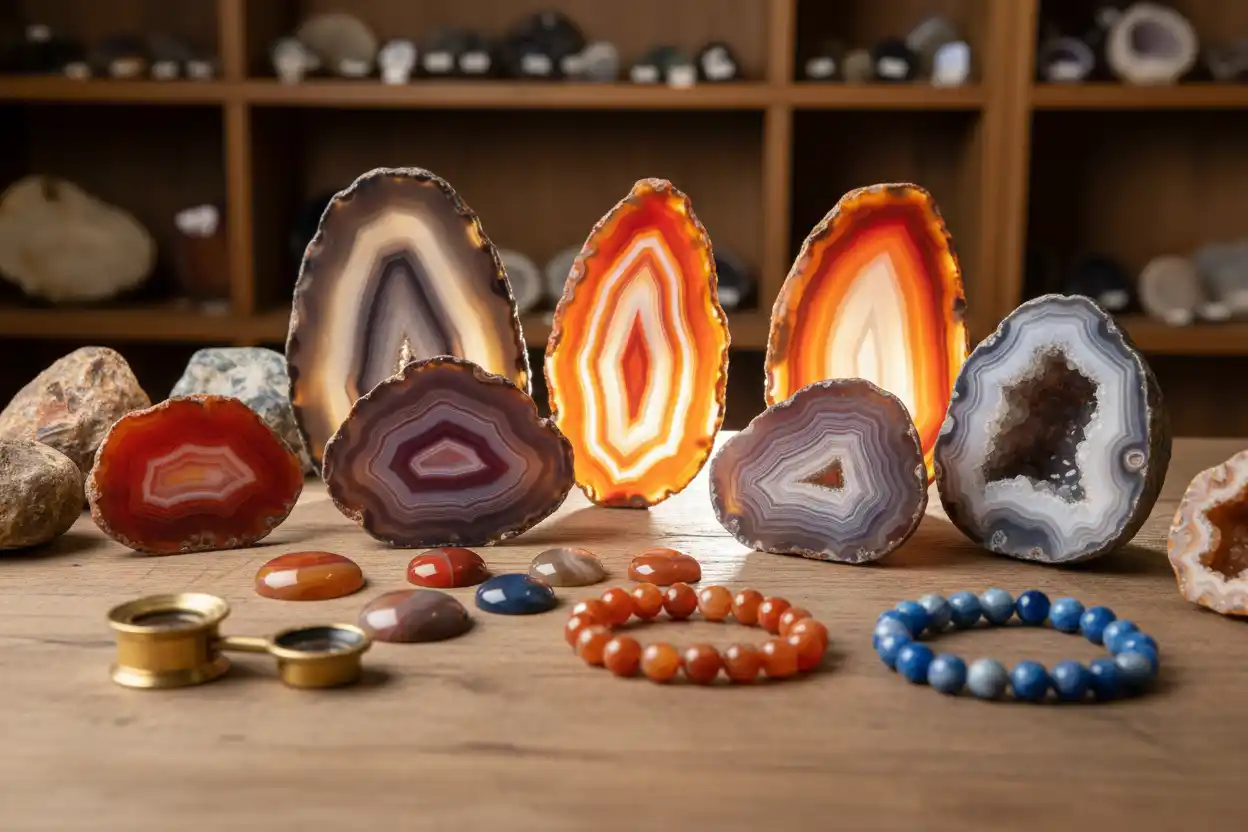
Where to Buy Real Agate (and Avoid Fakes)
Real Agate is widely available through mineral dealers, lapidary suppliers, gem shows, independent jewelry makers, established rock shops and online marketplaces. The challenge is not finding a product labeled Agate. It is determining whether the material is natural Chalcedony, dyed Agate, reconstructed material, glass or a different stone carrying an inaccurate trade name.
Agate is relatively abundant, so buyers rarely need to accept vague descriptions, heavily edited photographs or unverifiable rarity claims. A reputable seller should identify the variety, disclose dye or other enhancement, show the exact item when natural pattern matters and offer a practical return policy.
The best place to buy depends on what you need. Mineral collectors benefit from specialist dealers who understand locality and formation. Jewelry buyers need secure settings and clear treatment disclosure. Bead buyers should inspect drill holes, matching and stringing quality, while lapidaries need rough sold with realistic information about fractures, rind and usable yield.
Agate Buying Options at a Glance
| Buying source | Best for | Main caution |
|---|---|---|
| Specialist mineral dealer | Documented specimens, locality and natural formations | Collector-grade pieces may cost more |
| Lapidary supplier | Rough, slabs, cabochons and calibrated material | Rough yield and fracture condition vary |
| Gem and mineral show | Comparing many stones under similar conditions | Temporary sellers may offer limited after-sale support |
| Established rock shop | Beginner purchases and in-person inspection | Staff expertise differs by store |
| Independent jewelry artist | Finished rings, pendants, earrings and bracelets | Confirm whether the maker cut or sourced the stone |
| Bead supplier | Matched strands, drilled shapes and bulk quantities | Dye and treatment may be underdisclosed |
| General online marketplace | Variety and price comparison | Mislabeling, edited images and copied descriptions |
| Estate or antique dealer | Older jewelry and historic carvings | Old terminology may conceal treatment or incorrect identity |
| Direct-from-miner seller | Rough and source-specific specimens | Mine claims still need documentation |
| Social-media seller | One-of-a-kind pieces and live-sale access | Limited policies and impulse buying risks |
What Is Real Agate?
Agate is a variety of Chalcedony, the microcrystalline form of Quartz. It commonly shows bands, layers, fortification patterns, eyes, plumes, moss-like inclusions or other structures created as silica accumulated inside cavities and fractures.
Not every Chalcedony is Agate. Strong banding traditionally separates Agate from more uniformly colored Chalcedony, although commercial terminology is often broader.
The completed Agate meaning guide owns the mineral identity and formation process. Buyers who need to compare major commercial categories can use the completed types of Agate guide.
A genuine Agate can be natural and untreated, naturally mined but dyed, heated, coated or otherwise enhanced. Treatment does not change the host mineral into glass, but it changes the product description and market value.
The Best Place to Buy Collector Agate
Specialist mineral dealers are generally the strongest source for locality-documented specimens, geode halves, natural nodules and unusual formations.
A knowledgeable dealer should explain whether the piece was collected from a named deposit, purchased through an old collection or acquired through a commercial rough supplier. Labels, collection records and previous invoices strengthen provenance.
Collector specimens should show natural surfaces where possible. A polished face may reveal the pattern, while an unpolished rind helps demonstrate that the design belongs to the original nodule.
Locality claims deserve particular care. Similar banding occurs in unrelated deposits, so appearance alone cannot prove that a specimen came from Botswana, Brazil, Mexico, Madagascar or the United States.
Buying Agate at Gem and Mineral Shows
Shows allow buyers to compare many sellers, patterns and price levels in one place.
Natural color differences become easier to judge when several slices sit under the same lighting. You can also inspect edges, backs, drill holes and unpolished areas rather than relying on one front-facing photograph.
Ask the seller whether the item is dyed, stabilized, coated, backed or assembled. A confident answer is more useful than a vague statement that the stone is “100% genuine.”
Keep the receipt and photograph the seller’s label before leaving. Temporary booths may be difficult to contact after the event.
Buying Agate From a Rock Shop
An established local rock shop can be suitable for a first Agate purchase.
The main advantage is physical inspection. You can compare weight, polish, banding, translucency and surface condition without shipping risk.
Ask whether the shop separates natural-color Agate from dyed material. Bright pink, electric blue, intense purple and neon green slices are commonly enhanced, although natural Agate can also show vivid colors.
The staff should be willing to distinguish a geological name from a marketing name. “Ocean,” “flower,” “dragon,” “vein” and similar terms do not all have standardized mineralogical meanings.
Buying Agate Rough
Lapidary suppliers sell nodules, seam Agate, slabs, preforms and partially polished rough.
Rough should be priced with uncertainty in mind. An attractive exterior does not guarantee strong internal banding, and a promising nodule may contain fractures, hollow areas or plain Chalcedony.
Ask whether the rough has been cut from a larger verified parcel and whether representative sample faces are available.
Wet photographs can exaggerate color and hide scratches. Request at least one dry image.
Shipping cost also matters because rough may be heavy and contain a large proportion of rind or unusable host rock.
Buying Agate Slabs
A slab reveals more information than an unopened nodule.
Inspect whether the pattern extends through the material, whether fractures cross the intended cutting area and whether the thickness supports the planned cabochon or carving.
A slab should be photographed dry and against neutral backgrounds. Strong backlighting can make ordinary pale material look much more saturated.
Check for saw marks, uneven thickness and hidden cracks near the edge.
Dyed slabs may show concentrated color inside fractures or along porous bands. The completed treated Agate guide explains these clues in depth.
Buying Agate Cabochons
Cabochons should be judged by pattern placement, outline, polish, dome and structural condition.
The strongest design usually centers or intentionally frames the most attractive banding. A high dome may deepen color, while a low dome can display a broad pattern.
Inspect the back. A flat, well-finished base supports setting and reveals whether dye concentrates near cracks.
The girdle should remain smooth and free from chips.
Ask for millimeter dimensions, thickness and weight. A photograph without scale can make a small cabochon appear much larger.
Buying Agate Beads
Bead strands require different checks from specimens and cabochons.
Inspect color consistency, drill-hole quality, bead diameter and polish. Natural Agate can vary, but a strand should still look intentionally sorted.
Dye often concentrates around drill holes and fractures. Blue or red residue on the cord can indicate unstable coloring.
Look for chips radiating from the openings, particularly in faceted or thin disk beads.
A strand described as natural should state whether that refers to the base material or the color. Naturally mined dyed Agate is still natural stone, but its color is treated.
Buying Agate Jewelry
Finished jewelry adds setting, metal, construction and maker skill to the stone’s value.
A bezel should follow the cabochon evenly. Prongs should hold sound edges rather than cross fractures.
For rings and bracelets, choose compact material without open cracks. Earrings and necklaces can accommodate larger or more delicate pieces.
Ask whether the metal is solid, plated or filled. The value of a well-made setting may exceed the Agate itself.
Independent artists should be able to explain where the cabochon came from and whether they cut it personally or sourced it from another lapidary.
Buying Agate Online
Online buying works best when the listing shows the exact item.
Natural patterns vary too much for a generic photograph to represent every slice, geode or cabochon accurately.
A complete listing should include front, back, edge and scale images. Video under neutral moving light can reveal polish and translucency.
Read the full description rather than relying on the title. A seller may place “natural Agate” in the headline but disclose dye or stabilization in smaller text.
Save screenshots of the description and treatment claim before purchasing.
Marketplace Warning Signs
Copied photographs, repeated descriptions and extreme rarity claims deserve caution.
A seller who offers hundreds of visually identical “one-of-a-kind natural” slices may be using stock images or heavily processed material.
Be careful with listings that describe every color as rare, healing grade, museum grade or investment grade. These terms are not standardized Agate grades.
An unusually low price does not always prove a fake because Agate is abundant. However, a low price combined with a famous locality, perfect pattern and unsupported untreated claim is less credible.
What a Good Agate Listing Should Include
A reliable listing should identify the object as rough, slab, cabochon, bead, carving, geode or finished jewelry.
It should state the dimensions and weight, disclose dye or other treatment and distinguish the exact item from a representative example.
For locality-specific material, the seller should explain the source of the claim.
Photographs should use realistic color and show any fractures, repairs, cavities or backing.
The return policy should permit inspection unless the product was altered, custom cut or clearly sold as final sale.
Natural Color Versus Dyed Agate
Dyed Agate is common and can be attractive.
The problem arises when artificial color is presented as rare natural material.
Strong color concentrated in porous bands, cracks, pits and drill holes can indicate dye. Some treated slices show colors that are extremely uncommon or absent in natural Agate.
A natural-color statement should be explicit. “Natural stone” does not necessarily mean natural color.
The completed real-versus-fake Agate guide owns the full authentication workflow.
Heat-Treated Agate
Heating can strengthen red, orange or brown colors by altering iron-bearing compounds.
Carnelian and related Chalcedony have a long history of heat treatment.
Heating may be stable and widely accepted, but it should not be represented as proof of an exceptionally rare natural color.
A seller may not always know the treatment history of older or commercial rough. In that case, “treatment unknown” is more accurate than an unsupported untreated guarantee.
Coated and Metallic Agate
Some Agate receives metallic or iridescent coatings.
These products may be sold under names involving aura, titanium or rainbow effects.
The coating exists near the surface and can scratch, wear or react to polishing.
Coated Agate remains based on natural Chalcedony if the underlying stone is genuine, but the visible effect is manufactured.
The listing should identify the coating clearly rather than implying that metallic rainbow color formed inside the stone.
Glass and Resin Imitations
Glass can imitate transparent banded Agate through colored layers, swirls and molds.
Possible clues include round bubbles, flow lines, mold seams and repeated patterns.
Resin may contain pigments, glitter, embedded fragments or printed designs. It can feel light, although subjective weight is not a reliable identification test.
Some manufactured pieces contain crushed Agate in resin. These are composites rather than one natural stone.
Do not use hot-needle or destructive scratch tests. The how-to-identify-crystals guide provides safer principles.
Reconstructed and Assembled Agate
Fragments or thin slices can be joined with adhesive.
A doublet may use an attractive Agate face over a dark backing to strengthen color. A broken geode may be repaired or mounted to a base.
Assembly is not automatically unacceptable when disclosed.
Look for straight joining planes, adhesive bubbles, mismatched polish and color limited to one thin layer.
The price should reflect the amount of natural material and the quality of construction.
Buying Specific Agate Varieties
Different Agate varieties deserve different expectations.
Blue Lace Agate should show delicate blue and white banding rather than intense uniform electric blue.
Botswana Agate is valued for fine gray, pink, brown and white bands, but locality should not be assigned by appearance alone.
Crazy Lace Agate shows complex lace-like Mexican patterns, while Fire Agate displays iridescent layers and requires skilled cutting.
Dedicated buying pages exist or are planned for several of these varieties, so the general Agate page should not replace their locality-specific and pattern-specific checks.
Moss, Dendritic and Tree Agate
Moss Agate contains moss-like mineral inclusions but usually lacks conventional banding.
Dendritic Agate contains branching mineral patterns, while Tree Agate commonly appears white with green dendritic markings.
These names are often used loosely across retail listings.
Buyers should inspect whether the material is translucent Chalcedony, opaque rock, dyed substitute or resin.
Natural inclusions should appear integrated within the material rather than printed on the surface.
Flower, Grape and Iris Agate
Flower Agate is a commercial name for Chalcedony containing plume-like or floral patterns.
Grape Agate is a misleading trade name for botryoidal purple Chalcedony from Indonesia rather than banded Agate in the strict sense.
Iris Agate displays spectral colors through diffraction in extremely fine bands when sliced thinly and viewed correctly.
A seller should explain what creates the appearance instead of relying solely on a memorable trade name.
White Agate
White Agate can be translucent, milky or banded.
Uniform white material may overlap commercially with white Chalcedony, dyed stone, Howlite, Magnesite, glass and other substances.
Inspect translucency, banding and mineral properties rather than assuming that every polished white bead is Agate.
A bright white strand can also be bleached or coated.
Agate Price Claims
Agate prices vary according to pattern, locality, rarity, size, cutting, treatment, provenance and artistry.
Common dyed slices and commercial beads should not carry the same value as fine natural Fire Agate, documented collector nodules or exceptional Iris Agate.
Large size alone does not create value. Plain, fractured or heavily treated material remains common even when physically large.
Avoid sellers promising investment returns. Agate can be collectible, but most retail products do not have a liquid resale market.
Seller Questions to Ask
Ask what the material is, whether its color is natural, what treatments were used and whether the photographed item is the exact piece.
For locality material, ask how the source was documented.
For jewelry, ask about backing, repairs, adhesives and metal composition.
For beads, ask whether color transfer has been tested and whether the strand was matched from one parcel.
A seller who does not know should say so rather than inventing certainty.
Return Policies and Documentation
A return period allows the buyer to inspect color, dimensions and condition under ordinary light.
Custom-cut stones, altered jewelry and opened bead strands may have different policies, so review the terms before ordering.
Keep invoices describing the variety and treatment.
High-value collector material should retain labels and provenance records. Separating a specimen from its documentation can reduce its collector usefulness.
Caring for a New Agate Purchase
Agate is comparatively durable and ranks near 7 on the Mohs scale.
Warm water, mild soap and a soft brush are suitable for many untreated pieces. Dyed, coated, glued and composite products require greater caution.
Avoid solvents because they may affect dye or adhesive.
The gemstone hardness chart provides durability context, while which crystals can go in water explains why treatment and construction matter alongside mineral identity.
Final Buying Perspective
Agate is abundant enough that buyers can insist on honest disclosure.
Choose specialist mineral dealers for documented specimens, lapidary suppliers for rough and cabochons, established bead suppliers for strands and transparent artists for finished jewelry.
The strongest purchase is not necessarily untreated. It is accurately described, fairly priced and suitable for its intended use.
Agate also appears in the crystals beginning with A and gemstones beginning with A directories.
Frequently Asked Questions
1. Where is the best place to buy real Agate?
Specialist mineral dealers, established rock shops, lapidary suppliers and reputable gem shows provide the strongest opportunities for inspection and disclosure.
2. Is Agate sold online usually real?
Much online Agate is genuine Chalcedony, but its color may be dyed and its locality or variety name may be inaccurate.
3. Is dyed Agate fake?
No. It is treated natural material when the host stone is genuine, but the dye must be disclosed.
4. How can I spot dyed Agate in a listing?
Look for intense color concentrated in cracks, pores, bands or drill holes and for shades that appear unnaturally uniform or neon.
5. Should Agate always have bands?
Traditional Agate is banded Chalcedony, but retail usage also includes plume, moss, dendritic and other patterned Chalcedonies.
6. Is cheap Agate necessarily fake?
No. Agate is abundant, so genuine commercial material can be inexpensive.
7. Are Agate trade names reliable?
Some identify established patterns or localities, while others are informal marketing names. The seller should explain the material behind the label.
8. What photos should an online seller provide?
Front, back, edge, scale and dry-light photographs are ideal, with video for valuable cabochons or specimens.
9. Is natural-color Agate more valuable?
It can be, especially when the color, pattern and locality are desirable, but workmanship and condition also matter.
10. Can glass imitate Agate?
Yes. Layered or swirled glass can imitate bands, and resin can reproduce almost any pattern.
11. Do I need a laboratory report for Agate?
Usually not. Testing becomes more useful when an unusual natural-color, rare variety or high-value locality claim materially affects price.
12. What should an Agate invoice say?
It should identify the object or variety and disclose known dye, heat, coating, backing, reconstruction or other treatment.