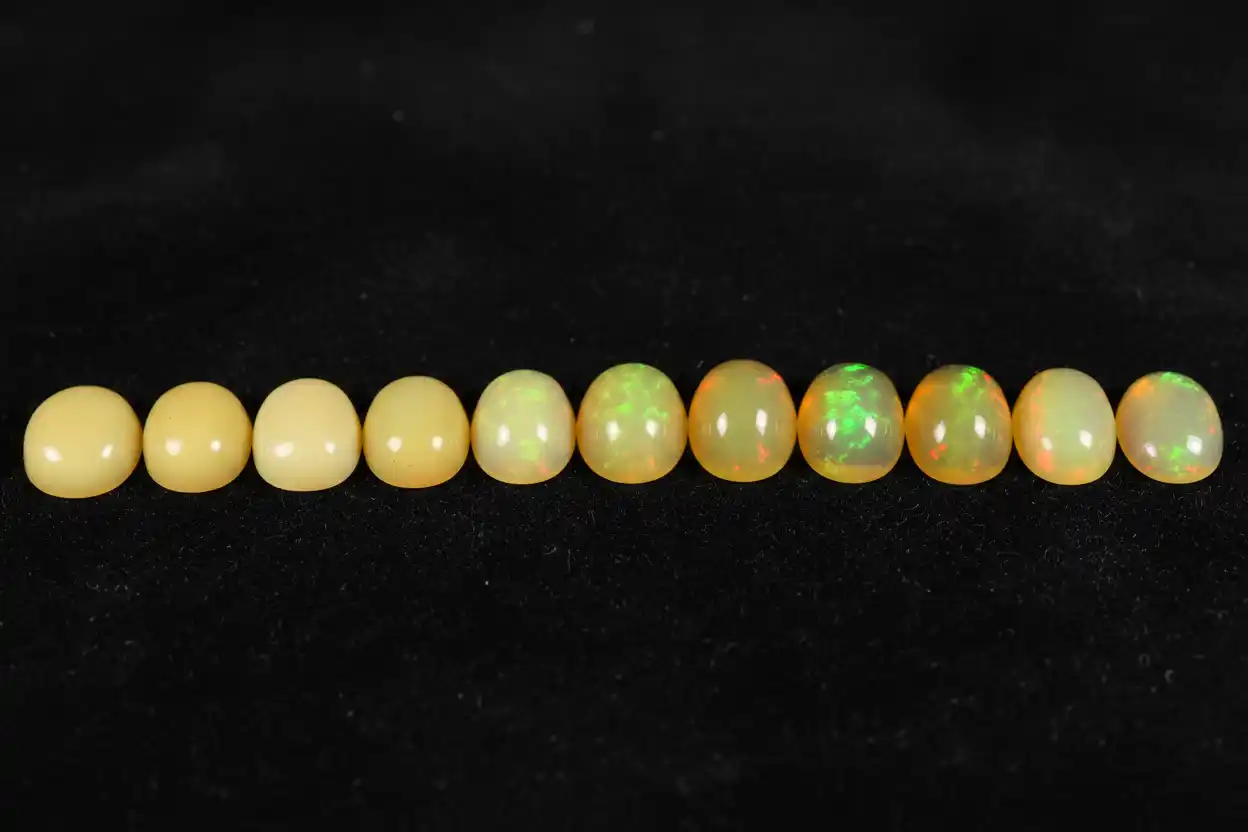
Yellow Opal Meaning, Properties, Value and Identification
Yellow opal is opal whose dominant body color ranges from pale lemon and butter yellow to honey, golden yellow, mustard and yellow-brown. It can occur as common opal without spectral flashes or as precious opal displaying moving play-of-color.
The term overlaps with fire opal at the orange-yellow boundary, yet not every yellow opal qualifies as fire opal. This page focuses on yellow body color, common-versus-precious classification, hydrophane behavior, treatment and care without duplicating the wider opal family guide.
Yellow Opal at a Glance
| Property | Yellow Opal |
|---|---|
| Material type | Yellow-bodied common or precious opal |
| Composition | Hydrated silica, SiO₂·nH₂O |
| Mineral classification | Amorphous mineraloid |
| Typical colors | Pale lemon, butter yellow, golden yellow, honey, mustard, yellow-orange and yellow-brown |
| Optical effects | None in common opal; play-of-color in precious opal; chatoyancy in rare fibrous material |
| Luster | Waxy to vitreous |
| Transparency | Transparent to opaque |
| Refractive index | Approximately 1.37–1.47 |
| Specific gravity | Commonly approximately 1.98–2.25 |
| Mohs hardness | Approximately 5–6.5 |
| Cleavage | None |
| Tenacity | Brittle |
| Water behavior | Variable; some material is strongly hydrophane |
| Common cuts | Cabochons, beads, carvings, free forms and occasional faceted transparent stones |
| Main care concern | Crazing, scratching, liquid absorption, dye, resin and sudden temperature change |
What Is Yellow Opal?
Yellow opal is a color-based commercial category within the opal family.
The stone’s essential material is hydrated amorphous silica rather than crystalline quartz.
A yellow body can occur in common opal, precious opal, hydrophane opal and certain chatoyant varieties.
The body color describes the underlying appearance when play-of-color is not dominating the view.
A pale yellow stone with bright red and green flashes is precious yellow opal. An opaque buttery stone without flashes is common yellow opal.
The full family-level classification appears in Types of Opal, while color symbolism across the family remains with Opal Color Meaning and Symbolism.
Common Yellow Opal
Common yellow opal lacks visible play-of-color.
Its appearance may be translucent and waxy or completely opaque.
Color can be uniform, clouded, mottled or crossed by brown and white veins.
Common material is fashioned into cabochons, beads, carvings, spheres and tumbled stones.
Some yellow common opal is sold under descriptive names such as honey opal, butter opal, lemon opal or golden opal.
These labels are not standardized and can overlap with yellow chalcedony, calcite or glass.
Common yellow opal is normally valued for body color, translucence, pattern and polish rather than spectral effects.
Precious Yellow Opal
Precious yellow opal contains ordered silica structures capable of diffracting visible light.
The play-of-color may include green, blue, yellow, orange, red and violet.
A yellow background can strengthen warm flashes while reducing contrast for weak yellow and orange color.
Red and green normally create the strongest value premium.
Pattern and brightness matter more than the mere presence of spectral color.
A stone with vivid broad flashes can be valuable even when much of the body remains yellow or cream.
The family-wide optical phenomenon is discussed in Precious Opal.
What Makes Opal Yellow?
Yellow body color can result from several factors.
Iron oxides and hydroxides are common contributors, particularly in opal formed within iron-rich volcanic or sedimentary host rocks.
Microscopic clay, organic matter and other mineral particles can create cream, ochre and yellow-brown tones.
Light scattering through pores and silica structures may soften the color toward butter yellow.
Some body color results from treatment. Hydrophane white or pale opal can absorb yellow dye, oil or other coloring material.
Surface staining can also make a pale interior appear yellow.
Because the mechanism varies, a laboratory should avoid assigning one coloring agent based only on visual appearance.
Yellow Opal Color Range
Lemon Yellow Opal
Lemon material ranges from pale greenish yellow to clean light yellow.
Transparent pieces can resemble lemon quartz, yellow fluorite or pale fire opal.
A vivid artificial-looking lemon color should prompt treatment testing, particularly in porous hydrophane material.
Butter Yellow Opal
Butter opal is an informal name for creamy opaque or translucent yellow common opal.
The best material shows an even warm color without chalky pits or distracting brown fractures.
Honey Opal
Honey opal ranges from translucent golden yellow to yellow-brown.
Some material displays play-of-color, while other stones are valued only for body color.
The name can also be applied to calcite, chalcedony and resin products, so the seller should state opal explicitly.
Golden Opal
Golden opal is a descriptive term for saturated yellow or yellow-orange material.
It has no formal boundary separating it from honey opal or pale fire opal.
Mustard and Ochre Opal
Opaque mustard and ochre colors usually indicate stronger iron-rich inclusions or fine sediment.
Such material commonly serves the carving and bead market rather than transparent jewelry.
Yellow-Brown Opal
Yellow-brown stones can resemble caramel, amber or light chocolate.
Some Ethiopian hydrophane opal changes toward yellow or brown after absorbing oil, skin products or contaminated liquid.
A changed body color should not automatically be assumed natural or permanent.
Yellow Opal Versus Fire Opal
Fire Opal is defined primarily by a yellow, orange or red body color rather than by play-of-color.
Transparent-to-translucent yellow-orange opal may be sold as fire opal, particularly when its appearance and locality match the established market.
Yellow opal is the broader descriptive phrase and includes opaque common opal that would not normally be called fire opal.
The categories overlap at pale yellow and yellow-orange boundaries.
A seller should describe body color, transparency, play-of-color and origin rather than using fire opal merely as a premium label.
Yellow Opal Versus White Opal
White Opal has a white, cream or light gray body.
Yellow opal shows a dominant lemon, butter, honey or golden tone.
Warm cream stones can fall between the categories.
The boundary is descriptive rather than chemical. Both remain hydrated silica and can occur as common or precious opal.
Yellow staining or absorbed oil can shift a previously white hydrophane opal toward yellow, making treatment and care history important.
Yellow Opal Versus Ethiopian Opal
Ethiopian Opal is a geographic category rather than a color variety.
Ethiopian material can be white, colorless, yellow, orange, brown, black or multicolored.
Much Wollo opal is hydrophane, meaning it absorbs water and other liquids through microscopic pores.
Some Ethiopian yellow opal is naturally colored. Other stones may turn yellowish after absorbing oils, cosmetics or contaminated liquid.
A yellow stone cannot be assigned Ethiopian origin from appearance alone.
Yellow Opal Versus Yellow Jasper
Yellow jasper is an opaque microcrystalline quartz material with greater hardness.
It normally shows a more granular, earthy or iron-rich appearance.
Opal has lower density, lower hardness and a more waxy luster.
Precious opal may show play-of-color, which jasper does not.
Common opal and jasper can intergrow or grade into silicified rock, so spectroscopy may be needed for mixed material.
Yellow Opal Versus Yellow Calcite
Yellow calcite has hardness 3, perfect rhombohedral cleavage and a rapid acid reaction.
Opal lacks cleavage and does not effervesce like calcium carbonate.
Calcite commonly shows very strong double refraction in transparent material.
Opal’s luster is generally waxier, and its refractive index is lower.
Destructive testing should be avoided on finished stones.
Yellow Opal Versus Yellow Chalcedony
Chalcedony is crystalline microfibrous silica, while opal is amorphous hydrated silica.
Yellow chalcedony is normally harder, denser and less water-sensitive.
Both can have waxy luster and similar translucence.
Raman spectroscopy, refractive index and microscopic texture provide dependable identification.
Hydrophane Yellow Opal
Hydrophane opal absorbs water into connected microscopic pores.
When immersed, it may become clearer, temporarily lose play-of-color or change body tone.
The stone gains weight while wet and may take hours or days to return to its dry appearance.
Hydrophane pores can also absorb skin oils, perfume, dye and household chemicals.
Oil contamination can create persistent yellow or brown discoloration.
A hydrophane stone should not be tested repeatedly by soaking it at home. Every immersion creates another opportunity for contamination and stress.
The broader water behavior remains an important section of the Ethiopian Opal Buying Guide.
Chatoyant Yellow Opal
Some yellow common opal contains parallel fibrous or needle-like structures that produce a cat’s-eye effect.
A sharp light band should move across the cabochon as the light source changes position.
The stone is normally cut with a high dome and correct orientation.
A weak broad sheen should not be marketed as a premium cat’s eye.
Yellow cat’s-eye opal is usually valued by eye sharpness, centering, body color and condition rather than play-of-color.
How Yellow Opal Forms
Opal forms when silica-bearing water moves through fractures, cavities and porous rock.
As water evaporates or chemical conditions change, silica particles accumulate as a gel.
The gel gradually loses some water and hardens.
Regularly arranged silica spheres produce precious opal, while irregular arrangements form common opal.
Iron-rich host rocks and groundwater introduce yellow, orange and brown color.
Volcanic deposits commonly produce hydrophane opal because their pore structure remains open and absorbent.
Sedimentary deposits can produce seams, nodules, fossil replacements and more compact opal.
Important Sources
Ethiopia
Wollo and other Ethiopian regions produce yellow, cream, orange, white and brown hydrophane opal.
Material ranges from opaque common opal to transparent stones with strong play-of-color.
Treatment and liquid absorption require careful disclosure.
Mexico
Mexico is a classic source of yellow, orange and red fire opal.
Pale yellow Mexican material can overlap the yellow-opal category.
Transparent stones may be faceted, while included or opaque material is cut as cabochons.
Australia
Australian fields produce light, cream, yellowish and precious opal in sedimentary deposits.
Yellow body tones may occur within white, crystal, boulder and matrix opal.
Australian material is generally less hydrophane than typical Wollo opal, though individual stones vary.
Peru
Peru is better known for blue and pink common opal but also produces pale yellow, cream and mixed-color material.
United States
Oregon, Nevada and Idaho contain yellow, golden and transparent-to-translucent opal.
Some American deposits produce unstable high-water material requiring specialist drying and storage.
Additional Sources
Brazil, Madagascar, Tanzania, Indonesia, Honduras and Slovakia contain yellow or yellow-brown opal.
Origin should be documented rather than inferred from color.
Inclusions and Internal Features
Yellow opal can contain clay, iron oxides, sand, host-rock fragments, fluid-filled pores and organic material.
Brown or black dendritic inclusions may create scenic patterns.
Potch areas lack play-of-color and may appear white, yellow or gray.
Fine fractures can reflect light strongly.
Crazing forms a network of cracks caused by internal stress, drying or instability.
Surface pits are common in porous hydrophane material.
Dye, resin and oil can concentrate around pits and scratches, providing treatment clues.
Identifying Real Yellow Opal
Natural opal commonly has a refractive index between approximately 1.37 and 1.47.
Specific gravity is usually lower than quartz and chalcedony.
Precious play-of-color should shift irregularly through the stone as it moves.
Natural common opal often contains uneven clouding, host-rock particles and variable transparency.
Synthetic opal may show repeating cellular, columnar or lizard-skin patterns.
Glass can contain rounded bubbles and flow lines.
Plastic or resin imitations feel softer, lighter and may show molding marks.
The complete consumer workflow appears in Real vs Fake Opal and How to Identify Crystals.
Treatments and Enhancement
Hydrophane opal can absorb yellow dye, producing a brighter or more uniform body color.
Dye commonly concentrates in pits, fractures and surface scratches.
Oil and wax may improve apparent transparency temporarily.
Resin impregnation can stabilize fractures and reduce porosity.
Smoke and sugar-and-acid treatments darken opal or its matrix rather than normally creating yellow, though they may be used on material that began yellow or white.
Surface coatings can increase gloss or alter color.
Fracture filling can hide crazing without restoring structural integrity.
A yellow stone may also be a doublet or triplet containing a thin opal layer over backing.
The complete treatment intent remains with Treated Opal and Gemstone Treatments Explained.
Synthetic Yellow Opal
Laboratory-grown opal can be produced in yellow and many other colors.
Synthetic material may show genuine play-of-color from an ordered silica or polymer-based structure.
Some manufactured opal contains a substantial resin component.
Highly regular pattern, repeating color cells and uniform structure can provide clues.
Imitation opal uses glass, plastic, foil or glitter without reproducing natural opal’s structure.
Synthetic and simulated material should be disclosed clearly under the principles in Lab-Grown vs Natural Gemstones.
Cutting and Polishing
Common yellow opal is usually cut into cabochons, beads, carvings and free forms.
Precious material is oriented so the brightest color layer lies near the face.
Transparent fire-opal-like pieces may be faceted when internal clarity permits.
Hydrophane rough can change appearance during wet cutting, so the lapidary must reassess color after complete drying.
Heat must remain controlled because opal can fracture through thermal shock.
Pits and sand grains may tear out during polishing.
Thin opal layers may be backed deliberately as doublets when solid cutting would be impractical.
Hardness, Toughness and Jewelry Suitability
Yellow opal measures approximately 5–6.5 on the gemstone hardness chart.
Quartz dust and harder gems can scratch its surface.
Opal has no cleavage but remains brittle.
Crazing, porosity, thin seams and matrix boundaries reduce toughness.
The difference between scratch resistance and breakage resistance appears in Gemstone Toughness vs Hardness.
Pendants and earrings provide safer regular use than rings and bracelets.
A ring should use a protective bezel, substantial dome and stable stone.
Yellow Opal Prices in 2026
Opaque common yellow opal cabochons commonly retail for approximately $2–$15 per carat, though many are priced by piece.
Small commercial common-opal cabochons and beads often cost $5–$30 each.
Yellow cat’s-eye opal commonly ranges from approximately $8–$25 per carat, depending on eye sharpness and body color.
Current yellow cat’s-eye examples include stones around $13–$15 per carat.
Transparent yellow fire-opal-like material commonly ranges from approximately $20–$75 per carat.
One current 15.79-carat transparent yellow fire opal is offered at approximately $24 per carat, illustrating the affordability of commercial material.
Precious yellow opal with strong multicolored play-of-color commonly ranges from approximately $30–$150 per carat.
Fine red-dominant, broad-flash or unusually stable material can exceed $150–$500 per carat.
Exceptional stones with superior brightness, pattern and provenance may sell for more.
The broader valuation factors remain with the Opal Price Guide.
What Determines Value?
The first distinction is common versus precious opal.
In common material, body color, translucence, uniformity and polish dominate value.
In precious material, brightness, spectral range, pattern and color coverage are more important than yellow body color alone.
Red and orange play-of-color generally receive stronger premiums than blue-only flashes.
A sharp centered cat’s eye adds value to chatoyant stones.
Stability is essential. Crazing and active cracking can make an attractive stone commercially unsound.
Hydrophane behavior, dye, resin and other treatments affect pricing.
Solid stones normally command more than assembled doublets or triplets with a similar face-up appearance.
Buying Guidance
Use the full Opal Buying Guide for seller and quality checks.
Ask whether the stone is common, precious, fire opal, hydrophane, cat’s eye, solid, treated or assembled.
Request dry photographs and video under neutral lighting.
A wet stone can appear clearer, darker and more saturated than it will after drying.
Ask whether the body color has changed during storage or wear.
Inspect for dye concentration around pits and fractures.
Look for crazing under magnification.
Compare face-up dimensions rather than weight alone, especially when matrix or backing contributes mass.
Use an independent laboratory for expensive stones or unusual color claims.
Cleaning, Water and Storage
Clean stable solid opal with lukewarm water, mild soap and a soft cloth or brush.
The complete procedure appears in How to Clean Opal Jewelry.
Do not use ultrasonic or steam cleaners.
Avoid prolonged soaking, particularly for hydrophane material, doublets, triplets and resin-filled stones.
If hydrophane opal becomes wet, let it dry slowly at room temperature.
Do not accelerate drying with a hair dryer, heater or direct sunlight.
Keep oils, perfumes, hairspray and cosmetics away from porous opal.
The general water safety guide should not be interpreted as permission to soak hydrophane opal.
Store the stone separately from harder gems in a stable indoor environment.
Meaning and Symbolism
Modern crystal traditions associate yellow opal with creativity, optimism, flexible thinking and recognizing opportunities within changing circumstances.
Its combination of warm body color and, in precious material, shifting spectral flashes encourages symbolism involving stable confidence alongside imagination.
Honey-colored common opal is often linked with patience and gradual personal development.
Some people use yellow opal as a reminder that valuable qualities may appear differently under changing conditions.
These meanings are cultural, spiritual or personal rather than scientifically demonstrated effects.
Yellow opal appears in modern collections of yellow crystals and yellow gemstones.
Frequently Asked Questions
1. What is yellow opal?
Yellow opal is common or precious opal with a dominant lemon, butter, honey or golden-yellow body color.
2. Is yellow opal the same as fire opal?
Not always. Transparent yellow-to-orange material may be classified as fire opal, while opaque common yellow opal normally is not.
3. Can yellow opal show play-of-color?
Yes. Precious yellow opal can display blue, green, yellow, orange, red and violet flashes.
4. What makes opal yellow?
Iron-rich inclusions, clay, organic material, light scattering and, in some cases, artificial dye can produce yellow body color.
5. Is yellow Ethiopian opal natural?
Natural yellow Ethiopian opal exists, but porous hydrophane material can also absorb dye, oil and contaminants.
6. Why did my opal turn yellow?
Hydrophane opal can absorb skin oil, cosmetics or contaminated liquid. Heat, aging, resin and other treatments can also alter appearance.
7. Is yellow opal normally treated?
Many stones are untreated, but dye, oil, resin, coatings, smoke treatment and assembled construction can occur.
8. How is yellow opal different from yellow jasper?
Opal is hydrated amorphous silica with lower hardness. Jasper is opaque microcrystalline quartz and is generally more durable.
9. Can yellow opal be faceted?
Transparent fire-opal-like material can be faceted. Opaque and play-of-color stones are usually cut as cabochons.
10. Can yellow opal go in water?
Brief gentle cleaning is generally acceptable for stable solid material. Avoid prolonged soaking, especially with hydrophane or assembled opal.
11. How much is yellow opal worth?
Common material may cost only a few dollars per carat, while fine precious yellow opal with bright red and multicolored play-of-color can reach hundreds of dollars per carat.
12. Does yellow opal have scientifically proven healing properties?
No. Its symbolism may be personally meaningful, but scientific evidence does not establish healing effects.
Yellow opal requires more than a color label. A useful description identifies whether the stone is common or precious, transparent or opaque, hydrophane or compact, naturally colored or treated, and stable enough for its intended jewelry use.
Yellow opal appears in Crystals That Start With Y and Gemstones That Start With Y.