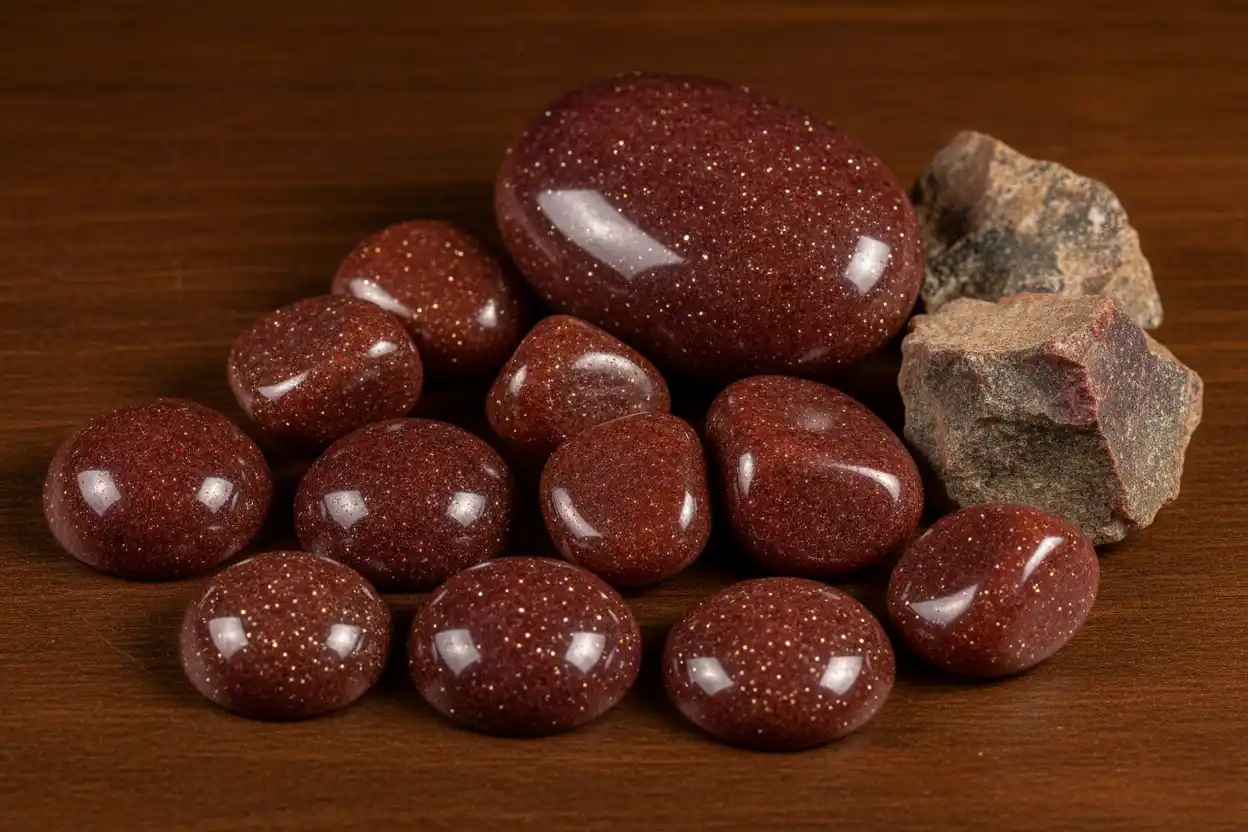
Red Aventurine Meaning, Properties, Identification & Value
Red Aventurine is a quartz-rich ornamental material colored by fine iron-bearing inclusions, commonly hematite, goethite, or hematite-stained mica. Reflective platelets create aventurescence, the subtle glittering effect that distinguishes genuine aventurine from ordinary opaque red quartzite.
Most material appears brick red, orange-red, rust, terracotta, peach-red, or reddish brown rather than transparent ruby red. It is generally a fine-grained quartzite or quartz-rich aggregate, not one homogeneous red Quartz crystal.
Red Aventurine at a Glance
| Property | Red Aventurine |
|---|---|
| Material type | Aventurescent quartzite or quartz-rich metamorphic rock |
| Main composition | Quartz, SiO₂, with hematite, goethite, mica, and other accessory minerals |
| Common colors | Brick red, orange-red, rust, terracotta, peach, pink-red, and reddish brown |
| Optical effect | Aventurescence from reflective platelets |
| Crystal system | No single external system applies to the rock; quartz components are trigonal |
| Typical texture | Massive, granular, foliated, mottled, streaked, or finely sparkling |
| Luster | Vitreous to waxy, with metallic-looking reflections |
| Transparency | Translucent to opaque |
| Mohs hardness | Commonly approximately 6.5–7 |
| Cleavage | None for the quartz-rich aggregate |
| Tenacity | Brittle |
| Fracture | Conchoidal to uneven |
| Common uses | Cabochons, beads, bracelets, pendants, spheres, carvings, palm stones, inlay, and decorative objects |
| Main care concern | Edge chipping, dye, resin, confusion with glass or Sunstone, and respirable silica dust during cutting |
What Red Aventurine Is
Aventurine is a visual and textural variety within the wider Quartz family.
The parent Aventurine guide explains the material’s family-level mineralogy and general aventurescent effect. Red Aventurine owns the iron-rich color, identification, lookalikes, market use, and color-specific symbolism.
Unlike Clear Quartz, it rarely forms transparent six-sided crystals. Most commercial rough consists of tightly interlocking quartz grains containing small reflective mineral platelets.
For that reason, mineralogical references frequently classify Aventurine as quartzite rather than a single macrocrystalline Quartz variety.
The red name describes the dominant bodycolor. It does not establish one exact iron mineral, locality, or degree of aventurescence.
Some pieces sparkle strongly under directional light, while others show only a fine satin shimmer.
How Aventurescence Forms
Aventurescence occurs when numerous flat, reflective inclusions return small flashes of light.
The inclusions must have enough contrast with the quartz host and a suitable orientation to become visible.
In Red Aventurine, hematite platelets commonly supply both red coloration and metallic-looking sparkle. Goethite and iron-stained mica can add orange, gold, brown, or coppery reflections.
Some orangey-red material contains muscovite mica stained by hematite. Meanwhile, other pieces contain layers enriched directly in fine hematite grains.
The optical effect differs from glitter applied to a surface. Natural reflections originate throughout the polished material and shift as the stone turns.
A stone can remain genuine Red Aventurine even when its sparkle is subtle. However, a completely dull red rock may be better described as ferruginous quartzite unless sufficient reflective inclusions are present.
Geological Formation
Many Aventurine deposits began as quartz-rich sediments or silica-rich rocks that underwent metamorphism.
Heat, pressure, deformation, and fluid movement recrystallized the quartz grains into a dense interlocking aggregate.
Meanwhile, mica, hematite, goethite, and other accessory minerals became distributed through layers, fractures, or foliated zones.
Directed pressure can align platy inclusions. Consequently, the strongest sparkle may appear on one cut surface while another orientation looks almost dull.
Iron-bearing fluids can also move through fractures and grain boundaries, producing red staining after the main quartzite formed.
Not every deposit follows the same sequence. Some commercial material represents hydrothermal quartz-rich rock or altered silica material rather than classic metamorphosed sandstone.
Therefore, one universal formation story should not be assigned to every red bead strand.
What Causes the Red Color?
Hematite, Fe₂O₃, is the principal color-producing mineral in many Red Aventurines.
Fine hematite particles create brick-red, crimson-brown, rust, and orange-red tones. Larger platelets can produce visible metallic flashes.
Goethite contributes yellow-brown, orange, bronze, and rusty shades, particularly where hematite has undergone alteration.
Muscovite or other mica can become coated or stained by iron oxides, adding pale coppery sparkle.
The amount, grain size, and distribution of these inclusions control the finished appearance.
A dense concentration produces opaque dark-red material, whereas a lower concentration can leave the quartz partly translucent.
Artificial dye remains another possible color source. Accordingly, a saturated red product should be examined rather than assumed natural.
Red Aventurine and Green Aventurine
Green Aventurine commonly owes its color and sparkle to chromium-bearing fuchsite mica.
Red material relies more strongly on hematite, goethite, and iron-stained mica.
Both are quartz-rich aggregates and normally have similar scratch resistance.
Nevertheless, their porosity, inclusion density, translucency, and structural quality vary by deposit.
A green-and-red stone can contain several mica- and iron-rich zones rather than represent a recognized bicolored variety.
The full commercial color range belongs on types of Aventurine.
Red Aventurine and Blue Aventurine
Blue Aventurine is commonly colored by blue mineral inclusions distributed through quartz-rich material.
Its sparkle may be weaker and more silvery than the copper-red reflections of iron-rich Aventurine.
Both colors can be imitated through dyed quartzite or manufactured glass.
Therefore, the aventurine label should depend on internal reflective inclusions rather than color alone.
Red Aventurine versus Strawberry Quartz
Strawberry Quartz is commonly transparent to translucent macrocrystalline Quartz containing fine red, pink, or orange inclusions.
Those inclusions may include hematite, lepidocrocite-like iron phases, mica, or other minerals.
Red Aventurine is generally more granular, opaque, and rock-like. Its reflective particles create a broader sparkled surface.
Retail boundaries are inconsistent. Some sellers call translucent red aventurescent Quartz Strawberry Quartz, while others apply Red Aventurine to almost every iron-included pink Quartz.
A precise description should state transparency, texture, visible inclusions, and whether a strong aventurescent effect is present.
Red Aventurine versus Sunstone
Sunstone is aventurescent feldspar rather than Quartz.
Its reflective inclusions can include copper, hematite, goethite, or related minerals depending on the variety and locality.
Sunstone commonly has a clearer peach, orange, red, or green feldspar body. Cleavage is also an important identifying feature.
Red Aventurine is generally denser in texture, quartz rich, and lacks feldspar’s two strong cleavage directions.
The distinction matters for both identification and value. Fine transparent Oregon Sunstone occupies a much higher gem market than ordinary Red Aventurine.
Red Aventurine versus Goldstone
Goldstone is manufactured glass containing reflective metallic crystals, commonly copper.
Red-brown Goldstone displays extremely regular, bright sparkle that can resemble high-quality Aventurine.
However, its glass host may show round bubbles, flow features, mold marks, or unusually uniform glitter.
Natural Red Aventurine usually contains irregular mineral grains, uneven color, quartz-rich texture, and variations in reflection.
Goldstone is not a fake when sold under its correct manufactured name. Misrepresentation occurs when it is labeled natural Red Aventurine, Sunstone, or copper-bearing Quartz.
Red Aventurine versus Red Jasper
Red Jasper is an opaque silica-rich material colored primarily by iron oxides.
Both materials may have similar brick-red and brown-red colors.
The central difference is aventurescence. Red Aventurine contains reflective platelets capable of producing visible shimmer, whereas ordinary Red Jasper normally has a more matte, uniformly opaque appearance.
Some natural rocks fall near the commercial boundary. A weakly sparkling iron-rich quartzite may be labeled Jasper by one cutter and Aventurine by another.
The stone’s texture and optical behavior provide more useful information than the name alone.
Important Commercial Sources
India supplies substantial quantities of red, orange, green, and brown Aventurine used for beads, cabochons, carvings, and decorative objects.
Brazil produces numerous quartz-rich lapidary materials, including iron-bearing and aventurescent varieties.
China is an important source and manufacturing center for polished spheres, towers, beads, and carvings.
Russia, Spain, Tanzania, and other quartzite-producing regions have also supplied red or orange aventurescent material.
Finished products often pass through cutting centers far from the mine. Consequently, a country of export does not prove geological origin.
Mine-level provenance is uncommon in inexpensive commercial products. A premium locality claim should therefore include more documentation than a wholesaler’s label.
How to Identify Red Aventurine
Examine the stone beneath one strong directional light.
Genuine aventurescence should arise from numerous internal reflective particles rather than one surface glitter coating.
Rotate the stone slowly. Different platelets should flash at different moments.
Magnification may reveal quartz grains, red hematite particles, mica plates, fractures, resin, dye concentrations, and polishing marks.
Quartz-rich material commonly approaches Mohs 7 and lacks cleavage. However, destructive scratch testing is unsuitable for finished pieces.
Specific gravity normally falls near quartzite values, although abundant iron minerals can raise it slightly.
Raman spectroscopy can identify exposed quartz, hematite, goethite, and mica components. Petrographic microscopy and X-ray diffraction provide stronger rock-level classification.
The practical testing sequence in how to identify crystals helps separate natural mineral sparkle from glass or coating.
Treatments and Imitations
Dye is one of the most common Red Aventurine concerns.
Pale quartzite can be dyed red, orange, pink, or brown. Pigment may collect inside cracks, pores, and drill holes.
Clear resin can stabilize fractured material and improve polish.
Wax and oil deepen color temporarily, while coatings can add artificial gloss or metallic reflection.
Reconstituted products may combine quartz powder, colored stone fragments, and polymer binder.
Goldstone, dyed quartzite, red glass, ceramic, resin, and synthetic decorative products can imitate natural material.
The broader treatment definitions appear in gemstone treatments explained, while general warning signs appear in how to spot fake crystals.
Durability and Jewelry Suitability
Quartz-rich Red Aventurine commonly measures approximately 6.5–7 on the Mohs scale.
Its surface resistance appears in the gemstone hardness chart.
The material has no single mineral cleavage, although it remains brittle as a rock.
Natural fractures, mica-rich layers, and iron-rich seams can create weak points.
The difference between hardness and resistance to impact appears in gemstone toughness versus hardness.
Sound cabochons and beads work well in pendants, earrings, bracelets, necklaces, bolo ties, and protected rings.
A bezel provides better edge support than widely spaced prongs.
Bracelet beads should have smooth drill holes without cracks extending from the cord channel.
Current Red Aventurine Asking Prices
Red Aventurine is generally affordable because commercial rough is available in useful sizes.
| Red Aventurine product | Broad July 2026 retail asking range |
|---|---|
| Small tumbled stone | About $2–$8 |
| Palm stone | About $8–$25 |
| Standard cabochon | About $5–$25 |
| Strongly sparkling designer cabochon | About $20–$75 |
| Bead strand | About $7–$35 |
| Stretch bracelet | About $10–$40 |
| Small sphere or tower | About $15–$60 |
| Large sphere, carving, or freeform | About $50–$250 |
| Sterling-silver jewelry | About $30–$200 |
| Gold or custom jewelry | Determined mainly by the metal and craftsmanship |
These are broad asking ranges rather than appraisals or guaranteed resale values.
Fine natural sparkle, attractive pattern, and honest identification matter more than large size. A heavily dyed carving should not command the same premium as naturally iron-rich material with strong aventurescence.
What Gives Red Aventurine Value?
Visible aventurescence is the principal factor.
Fine material displays many small moving reflections without looking like uniformly glittered glass.
Color should be attractive under neutral light. Brick red, copper red, and orange-red usually receive more interest than muddy brown.
Texture matters. Dense, stable material produces a smoother polish than porous or heavily fractured rough.
Translucency can add depth, although opaque material remains appropriate for carvings and beads.
Cutting orientation determines how strongly aligned platelets reflect face-up.
Treatment disclosure, structural condition, polish, pattern, size, and craftsmanship complete the valuation.
Buying Red Aventurine
Ask whether the material is natural quartz-rich Aventurine, dyed quartzite, Goldstone, or another manufactured product.
Request a rotating video under directional and diffuse light.
The sparkle should vary naturally rather than remain perfectly uniform.
Inspect drill holes, fractures, edges, and the reverse for concentrated dye.
Compare the stone’s texture with Strawberry Quartz, Sunstone, Goldstone, and Red Jasper before relying on the listing title.
Seller, treatment, and return-policy checks belong on where to buy real Aventurine.
Red Aventurine appears in the red-crystal directory and the red-gemstone directory.
It is also indexed through the crystals beginning with R directory and the gemstones beginning with R directory.
Cleaning and Storage
Clean a sound untreated piece with lukewarm water, mild soap, and a soft cloth or brush.
Rinse briefly and dry it thoroughly.
Avoid prolonged soaking when the stone contains dye, resin, glue, wax, mica-rich layers, or open fractures.
Ultrasonic and steam cleaning are unnecessary for mixed or treated material.
Do not use bleach, abrasive powder, or strong household acids.
Store Red Aventurine separately from sapphire, ruby, topaz, and diamond.
Large carvings should rest on padded stable surfaces so an accidental fall does not chip their edges.
Red Aventurine Meaning and Symbolism
Modern crystal traditions associate Red Aventurine with motivation, endurance, creativity, decisiveness, and turning an intention into practical action.
Its numerous reflective particles inspire symbolism involving many small efforts contributing to one visible result.
Iron-rich color connects the stone with warmth, persistence, physical activity, and purposeful momentum.
Meanwhile, its quartz-rich structure can represent consistency and maintaining a plan through changing circumstances.
These meanings remain personal, artistic, cultural, or spiritual interpretations. Scientific evidence does not show that Red Aventurine treats illness, improves circulation, increases fertility, or guarantees motivation.
Frequently Asked Questions
Is Red Aventurine a mineral?
It is generally a quartz-rich rock or quartzite containing reflective iron-rich minerals rather than one homogeneous mineral crystal.
What causes its red color?
Hematite, goethite, and iron-stained mica commonly create red, rust, orange, and brown colors.
What causes the sparkle?
Flat hematite or mica-rich inclusions reflect light from within the quartz-rich host.
Is Red Aventurine the same as Strawberry Quartz?
Not always. Strawberry Quartz is commonly more transparent and macrocrystalline, while Red Aventurine is generally granular, opaque, and strongly aventurescent.
Is Red Aventurine a type of Sunstone?
No. Red Aventurine is quartz rich, while Sunstone is aventurescent feldspar.
Is Red Aventurine the same as Goldstone?
No. Goldstone is manufactured glass containing metallic crystals.
How does Red Aventurine differ from Red Jasper?
Red Aventurine displays reflective shimmer, while ordinary Red Jasper generally has an opaque, non-sparkling surface.
Where is Red Aventurine found?
Commercial material is associated with India, Brazil, China, Russia, Spain, Tanzania, and other quartzite-producing regions.
Is Red Aventurine commonly treated?
Natural material may be untreated, but dye, resin, wax, oil, coating, and reconstructed products occur.
Is Red Aventurine suitable for rings?
Sound material is durable enough for protected regular wear, although natural fractures and brittle edges can still chip.
Can Red Aventurine go in water?
Brief washing is usually suitable for stable untreated material. Avoid soaking dyed, filled, glued, waxed, or fractured pieces.
What makes Red Aventurine valuable?
Natural color, strong aventurescence, dense texture, polish, translucency, cutting orientation, structural condition, treatment disclosure, and craftsmanship determine value.
Red Aventurine is most accurately appreciated through the interaction between its quartz-rich host and reflective iron minerals. That distinction prevents naturally sparkling quartzite from being confused with transparent Strawberry Quartz, feldspar Sunstone, or copper-bearing manufactured glass.
Cutting, drilling, sanding, or grinding Red Aventurine can release respirable crystalline-silica and iron-mineral dust. Use wet lapidary methods, effective local extraction, eye protection, protective clothing, and suitable respiratory protection.