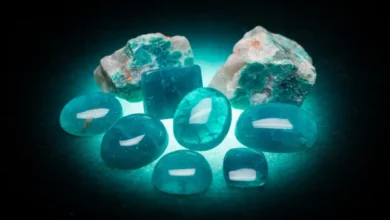

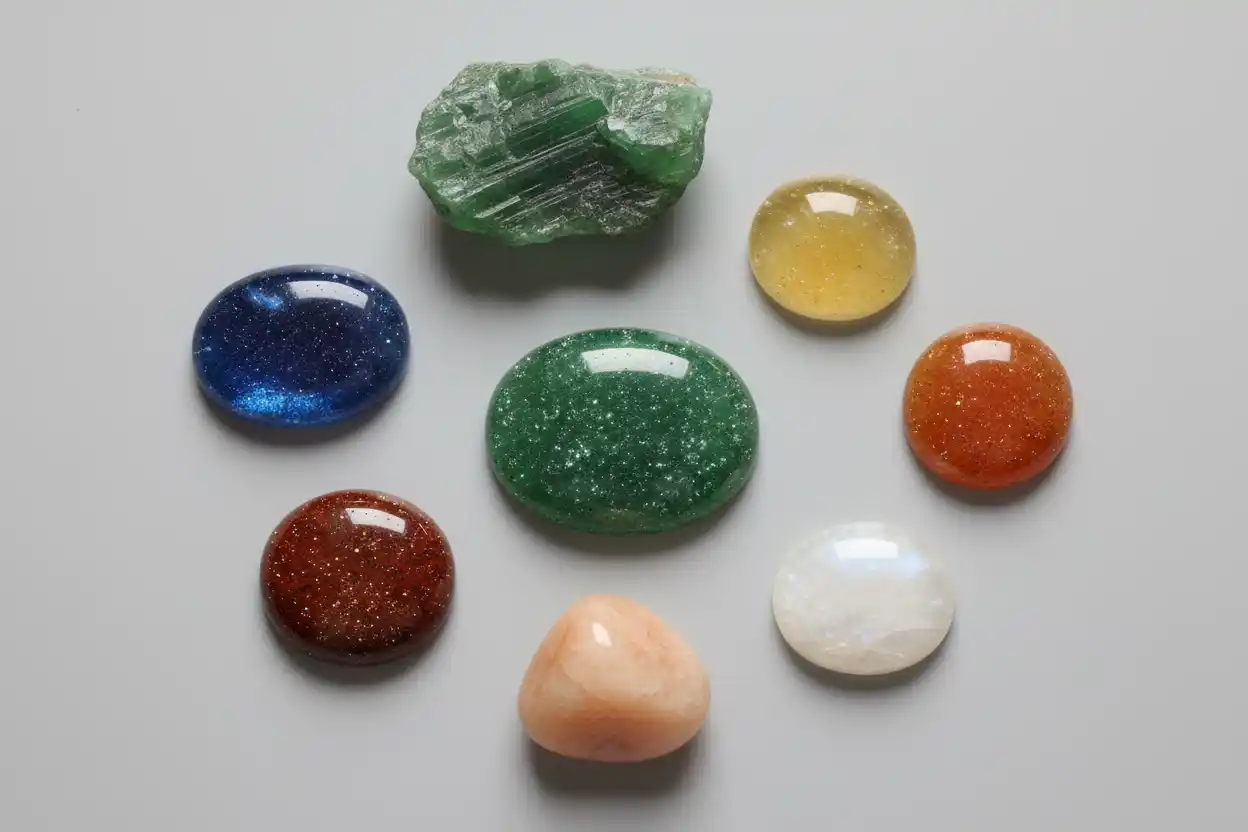

Aventurine is a translucent-to-opaque quartz-rich rock whose reflective mineral platelets create a sparkling optical effect called aventurescence. Green Aventurine containing chromium-rich Fuchsite is the best-known type, while Hematite, Goethite, Muscovite, Dumortierite, and related inclusions can produce red, orange, peach, yellow, brown, blue, white, and grey varieties.
Natural Aventurine Quartz should not be confused with goldstone, an artificial glass containing metallic crystals, or with aventurine feldspar, the gem material more commonly called Sunstone.
Aventurine at a Glance
| Property | Aventurine |
|---|---|
| Main composition | Quartz-rich aggregate or quartzite with reflective mineral inclusions |
| Defining effect | Aventurescence from platy or reflective inclusions |
| Main colors | Green, blue, red, orange, peach, yellow, brown, white, grey |
| Common inclusions | Fuchsite, Muscovite, Hematite, Goethite, Dumortierite, Chlorite, other micas and oxides |
| Structure | Fine-to-coarse-grained Quartz aggregate rather than one flawless crystal |
| Transparency | Translucent to opaque |
| Luster | Vitreous-to-waxy with metallic or silvery flashes |
| Mohs hardness | Commonly around 6.5–7, varying with inclusion content |
| Cleavage | None as a Quartz-rich aggregate |
| Tenacity | Brittle but generally durable when compact |
| Common uses | Cabochons, beads, spheres, carvings, tiles, pendants, bracelets, ornamental objects |
| Main care concern | Dye, resin, mixed hardness, fractures, mislabeling as Jade, and silica dust during cutting |
What Is Aventurine?
Aventurine belongs to the wider Quartz family, but most commercial material is more accurately described as Aventurine Quartzite or a compact Quartz-rich aggregate.
The Aventurine parent guide owns its general properties, formation, symbolism, and uses. This page focuses on color varieties, inclusion minerals, natural versus treated material, and related lookalikes.
The defining feature is aventurescence: numerous reflective particles flash as the stone moves beneath light.
In green Aventurine, the reflecting mineral is commonly Fuchsite, a chromium-bearing variety of Muscovite mica.
Red, orange, and brown varieties frequently contain Hematite, Goethite, or other iron-rich particles.
Some blue material contains Dumortierite, blue mica, amphibole, or other included minerals. However, commercial blue Aventurine is inconsistent, and dyeing is common enough to require scrutiny.
Aventurine belongs within types of gemstones as an ornamental material rather than a transparent faceted gem.
What Causes Aventurescence?
Aventurescence occurs when thin reflective platelets or particles return light from many small internal surfaces.
The inclusions are often preferentially oriented rather than randomly distributed. Consequently, one polished face may show much stronger sparkle than another.
Large bright flakes create obvious flashes, while microscopic particles produce a softer shimmer.
The amount of inclusion material affects transparency. Sparse Fuchsite can create a translucent green stone, while dense mica makes the material opaque.
Cutting orientation is critical. A cabochon or sphere should expose the plane that returns the strongest sparkle toward the viewer.
Aventurescence differs from chatoyancy. Cat’s-eye gems display one narrow band of light, while Aventurine shows many scattered flashes.
Main Types of Aventurine
| Variety | Typical color | Common inclusion or cause | Main trade distinction |
|---|---|---|---|
| Green Aventurine | Mint to dark green | Fuchsite or other chromium-bearing mica | Most recognized and abundant variety |
| Blue Aventurine | Pale to dark blue | Dumortierite, blue mica, amphibole, or dye | Composition varies; often less sparkly |
| Red Aventurine | Brick red to reddish brown | Hematite and iron oxides | Strong warm color and metallic sparkle |
| Orange Aventurine | Orange, rust, copper | Hematite, Goethite, or iron-rich mica | Closely overlaps red and peach material |
| Peach Aventurine | Soft peach, apricot, pink-orange | Fine mica and iron oxides | Decorative pastel trade category |
| Yellow Aventurine | Cream-yellow, gold, mustard | Muscovite, iron oxides, other mica | Often subtle in sparkle |
| Brown Aventurine | Tan, bronze, chocolate, red-brown | Hematite, Goethite, mica | Broad natural earth-tone category |
| White Aventurine | White, cream, off-white | Muscovite and pale mica | Silvery sparkle over pale Quartz |
| Grey Aventurine | Silver-grey, smoke-grey | Mica, Hematite, graphite-like inclusions | Frequently subdued or metallic |
| Aventurine Jade | Usually green | Trade misnomer for Quartzite | Not true Jade |
| Aventurine Feldspar | Orange, red, green | Copper or Hematite in Feldspar | More accurately called Sunstone |
| Goldstone | Brown, blue, green glass | Manufactured metallic crystals | Artificial glass, not natural Aventurine Quartz |
Green Aventurine
Green Aventurine is the most common and commercially important variety.
Its color usually comes from Fuchsite, whose chromium content creates light green, medium green, blue-green, and dark green shades.
Fuchsite platelets also produce the characteristic silvery or greenish sparkle.
Fine material has balanced color, visible aventurescence, and enough translucency to create depth.
Very dense mica can make the stone opaque and grainy. Sparse inclusions may produce a pale nearly transparent Quartzite with only occasional flashes.
India is the leading commercial source. Brazil, Russia, Tanzania, Austria, Spain, and other regions also produce green material.
The dedicated Green Aventurine page owns its symbolism and material-specific use, while where to buy Green Aventurine covers sourcing and authentication.
Green Aventurine appears frequently among green gemstones, but its sparkle and granular structure separate it from Jade, Chrysoprase, and Malachite.
Fuchsite-Rich Aventurine
Not every Fuchsite-bearing Quartz rock should automatically be classified as Aventurine.
Aventurine should display a recognizable sparkle from reflective plates within a Quartz-rich host.
Material with extremely high Fuchsite content may behave more like a mica-rich rock, becoming softer, flaky, and difficult to polish evenly.
Fuchsite veins can undercut around harder Quartz grains.
A seller should distinguish Aventurine Quartzite from a nearly pure Fuchsite specimen or from Ruby in Fuchsite, which contains distinct Corundum crystals.
The strongest green Aventurine value generally comes from a useful balance: enough Fuchsite for color and sparkle without making the stone structurally weak.
Blue Aventurine
Blue Aventurine ranges from pale denim and grey-blue to royal blue and dark navy.
The commercial name covers several possible materials. Blue inclusions may include Dumortierite, blue mica, amphibole, or related silicates.
Some blue Quartz with Dumortierite has a silky or cloudy appearance but little true aventurescence. It may be more accurately called Dumortierite Quartz.
Natural Blue Aventurine should show integrated colour and mineral texture rather than dye concentrated along cracks and drill holes.
Dark uniform royal-blue beads deserve particular scrutiny because dyed Quartzite and glass are common.
The dedicated where to buy Blue Aventurine guide owns seller and treatment checks.
Blue material belongs visually among blue gemstones, although it is more commonly cut as beads and cabochons than transparent faceted gems.
Red Aventurine
Red Aventurine contains Hematite, iron-rich mica, Goethite, or related mineral particles.
Colors range from pale rusty red to brick, terracotta, copper-red, and red-brown.
Flat Hematite plates can create bright metallic red or gold flashes.
Fine red material has visible sparkle without looking like artificial glitter suspended in glass.
Natural zoning and variation are expected. A perfectly uniform bright scarlet stone may have been dyed.
Red Aventurine can resemble Red Jasper, Carnelian, Sunstone, and goldstone. Magnification and structural examination help separate them.
It fits within red gemstones as an opaque ornamental option.
Orange Aventurine
Orange Aventurine overlaps strongly with red, peach, and brown varieties.
Hematite and Goethite commonly create orange, rust, copper, and golden-brown coloration.
Some stones show broad orange color with only subtle shimmer. Others have dense reflective particles.
Commercial names such as orange, sunset, copper, and tangerine Aventurine are not standardized.
Natural color should continue into the stone instead of appearing as a surface stain.
Orange material can be confused with Carnelian, Orange Calcite, dyed Quartzite, and orange goldstone.
It belongs visually among orange gemstones.
Peach Aventurine
Peach Aventurine is a pastel trade category between pale orange, pink-orange, apricot, cream, and light brown.
The color commonly comes from fine iron oxides and mica distributed through a light Quartz host.
Sparkle is often softer than in dark green or red material.
Fine stones have warm even colour, subtle reflective depth, and few dark fractures.
Some peach products are ordinary pale Quartzite enhanced with dye. Drill holes and cracks should be checked for concentrated pink-orange color.
Peach Aventurine is widely used for palm stones, hearts, beads, spheres, and carvings.
Yellow and Golden Aventurine
Yellow Aventurine ranges from cream and lemon to mustard, honey, tan-yellow, and gold.
Muscovite, iron oxides, Goethite, and related mineral particles can create the color and shimmer.
Pale yellow material may be nearly white in weak indoor light.
The term Golden Aventurine can be confusing because brown goldstone glass is also marketed as golden Aventurine.
Natural material has irregular mineral grains and varied flashes, whereas goldstone often contains extremely uniform metallic crystals throughout glass.
Brown Aventurine
Brown Aventurine includes tan, bronze, chestnut, chocolate, red-brown, and smoky earth tones.
Hematite, Goethite, iron-rich mica, and other inclusions commonly produce the color.
Fine brown material can show copper, gold, or silver flashes.
It may resemble Tiger’s Eye, Bronzite, Brown Jasper, and goldstone.
The granular Quartzite texture separates it from Bronzite’s pyroxene cleavage and Tiger’s Eye’s parallel fibrous chatoyancy.
Brown Aventurine belongs within brown gemstones but usually occupies an affordable decorative market.
White Aventurine
White Aventurine has a colorless, milky, cream, or pale grey Quartz host containing reflective Muscovite or other light-colored mica.
The effect can resemble frost, snow, or fine silver glitter.
Dense mica may make the material opaque, while finer inclusions allow weak translucency.
White Aventurine is less commercially recognized than green, red, or blue, so mislabeling is common.
Plain Milky Quartz without visible aventurescence should not receive the Aventurine name.
Grey and Silver Aventurine
Grey Aventurine ranges from pale silver-grey to smoke-grey, charcoal, and metallic grey.
Mica, Hematite, and dark mineral particles create subtle sparkle.
Some material marketed as Silver Aventurine is manufactured glass containing metallic crystals.
Natural grey Quartzite should reveal mineral texture and irregular reflective areas rather than a perfectly uniform glitter field.
Dark grey stones can also be mistaken for Hematite-rich Quartz, graphite-bearing rock, or low-grade Labradorite.
Aventurine Quartzite Versus Single-Crystal Quartz
Commercial Aventurine is usually a rock made of interlocking Quartz grains rather than one continuous Quartz crystal.
This aggregate texture explains why physical properties vary slightly across a piece.
Grain boundaries can trap dye, resin, polishing compound, and dirt.
Some included single-crystal Quartz also shows reflective platelets. It may display aventurescence but differs structurally from classic Quartzite Aventurine.
A precise description such as “Fuchsite-bearing Aventurine Quartzite” is more informative than treating every sparkling Quartz material as one uniform species.
Aventurine Versus Jade
Aventurine has frequently been marketed as Indian Jade, Australian Jade, Aventurine Jade, or Quartz Jade.
These are commercial misnomers. True Jade consists of Jade varieties Jadeite or Nephrite.
Green Aventurine is generally more granular and sparkly. Jade often has a smoother fibrous or granular texture without mica-like flashes.
Jadeite and Nephrite have different density, refractive behaviour, toughness, and mineral composition.
The dedicated Aventurine vs Jade guide owns the detailed comparison.
Aventurine can still be attractive and durable, but it should not receive Jade pricing solely because of a misleading name.
Aventurine Quartz Versus Aventurine Feldspar
Aventurine feldspar is a separate material more commonly known as Sunstone.
Its host is Feldspar rather than Quartz. Reflective inclusions may include copper, Hematite, or other minerals.
Sunstone can be more transparent and may show oriented platelets producing strong schiller.
Orange and red Aventurine Quartzite is usually more granular and opaque.
A listing should state Aventurine Quartz or Sunstone instead of using “Aventurine” without the host mineral.
Aventurine Versus Goldstone
Goldstone is manufactured glass containing reflective copper or other metallic crystals.
Its name comes from a glassmaking process traditionally associated with accidental discovery—a ventura, meaning by chance.
Brown goldstone contains copper-colored sparkle. Blue, green, and purple versions use different metallic or coloring ingredients.
Natural Aventurine has irregular grain boundaries, variable inclusion size, and geological patterning.
Goldstone often has extremely uniform glitter, glassy conchoidal fracture, bubbles, and no natural Quartz grains.
Goldstone is not fake when sold honestly as manufactured glass. It becomes misleading only when represented as natural Aventurine.
Major Aventurine Sources
India is the dominant commercial source of green and blue Aventurine Quartzite.
Brazil supplies green, red, orange, brown, white, and mixed material.
Russia, Spain, Austria, Chile, Tanzania, China, and the United States contain additional deposits.
The inclusion minerals and texture vary by locality. Some Indian green material contains abundant Fuchsite, while Brazilian red and orange varieties may be richer in Hematite.
Cutting centers and geological sources are not always the same. A stone polished in Jaipur does not necessarily come from an Indian mine.
For higher-value rough or specimens, country, district, and supplier documentation provide more confidence than color alone.
Treatments and Enhancement
Dyeing is the most significant Aventurine treatment concern.
Porous Quartzite and grain boundaries absorb blue, green, red, pink, purple, and black dyes readily.
Resin impregnation can strengthen fractured material and improve polish.
Wax and oil deepen color and reduce the visibility of fine scratches.
Coatings can create metallic, rainbow, or high-gloss surfaces.
Reconstructed products can combine crushed Quartz, mica, pigment, and resin.
A strong artificial color does not necessarily mean the host is fake; it may be treated natural Quartzite. However, the treatment should be disclosed.
The broader terminology appears in gemstone treatments explained.
Synthetic Aventurine and Composites
Quartz can be synthesized, but laboratory-grown Aventurine Quartzite is not a significant jewelry category.
The natural material depends on a rock-scale mixture of Quartz grains and reflective mineral inclusions.
Imitations are therefore more likely to be glass, dyed Quartzite, resin, ceramic, or reconstructed composite.
A composite may contain genuine Aventurine chips held together with polymer.
Printed patterns and metallic flakes can be embedded in resin to imitate green or blue sparkle.
A seller should distinguish natural Quartzite, treated Quartzite, reconstructed material, and aventurine glass.
Cutting and Polishing
Aventurine is commonly cut as cabochons, beads, spheres, towers, hearts, carvings, bowls, slabs, and decorative tiles.
The lapidary must orient the rough to expose the strongest reflective platelet direction.
A poorly oriented cabochon can appear dull even when the rough contains abundant mica.
Different inclusions may undercut during polishing. Soft mica flakes can pull out beside harder Quartz grains, leaving pits.
Fractures may follow mica-rich bands or grain boundaries.
Faceting is uncommon because most material is translucent or opaque and has aggregate texture.
Large decorative pieces require inspection for resin, filled cracks, and glued repairs.
Durability and Jewelry Suitability
Aventurine has good basic scratch resistance, commonly around Mohs 6.5–7.
Its durability depends on grain bonding, inclusion concentration, fractures, and treatment.
Compact cabochons work well in pendants, earrings, beads, bracelets, and occasional-wear rings.
Heavily mica-rich material may flake or undercut more easily than dense Quartzite.
A bezel protects edges, while sharp points and thin carved sections remain vulnerable.
The dedicated where to buy Aventurine guide helps evaluate quality, treatment, and construction before jewelry use.
Aventurine Value and July 2026 Asking Prices
Aventurine is abundant enough that most commercial material remains inexpensive.
As of July 2026, small tumbled stones and simple cabochons commonly carry asking prices around $1–$10 each.
Better individual cabochons, palm stones, hearts, and small carvings often range from $8–$30.
Beaded bracelets commonly appear around $10–$45, depending on bead size, color consistency, sparkle, and construction.
Spheres measuring roughly 40–60 millimeters frequently ask $15–$75. Larger high-quality spheres can range from $75–$300, while very large decorative pieces may exceed that level.
Fine natural blue, vivid red, unusually aventurescent, or locality-documented material can carry a premium, but unsupported AAA labels should not justify extreme pricing.
Current commercial green cabochons often sell for only a few dollars, while selected designer cuts may ask $20–$100 per stone based on workmanship.
Buying the Right Aventurine Type
Request photographs under dry neutral light. Wet surfaces and strong directional lighting can exaggerate color and sparkle.
Ask which mineral causes the aventurescence. Green material should not automatically be described as Fuchsite-rich unless that composition is credible.
Blue Aventurine deserves particular caution because Dumortierite Quartz, dyed Quartzite, glass, and resin are frequently confused.
Check drill holes and fractures for concentrated dye.
A natural stone should have irregularly distributed particles rather than perfectly identical glitter.
The seller should disclose dye, resin, wax, coating, backing, repair, and reconstructed construction.
General online purchase safeguards appear in how to buy gemstones online.
Aventurine Meaning by Type
The individual pages for Green Aventurine, Blue Aventurine, and Red Aventurine own detailed color-specific symbolism.
Modern crystal traditions commonly associate green with opportunity and growth, blue with reflection and communication, red with motivation, and peach with warmth or creativity.
These are cultural and personal interpretations rather than scientifically measured properties.
No Aventurine type has been shown to attract money, alter luck, treat heart disease, improve metabolism, or guarantee emotional outcomes.
Frequently Asked Questions
1. Is Aventurine a mineral?
It is generally a Quartz-rich rock or Quartzite variety containing reflective mineral inclusions.
2. What causes the sparkle in Aventurine?
Flat mica, Hematite, Goethite, or other mineral particles reflect light and create aventurescence.
3. What makes Green Aventurine green?
Chromium-bearing Fuchsite mica is the classic coloring and reflective inclusion.
4. What makes Red Aventurine red?
Hematite, Goethite, iron-rich mica, and related oxides commonly create red and reddish-brown color.
5. Is Blue Aventurine always Dumortierite Quartz?
No. Blue commercial material can contain Dumortierite, mica, amphibole, dye, or other components.
6. Is Aventurine the same as Jade?
No. Aventurine is Quartz-rich material, while true Jade is Jadeite or Nephrite.
7. Is Sunstone a type of Aventurine?
Sunstone is sometimes called aventurine feldspar, but its host is Feldspar rather than Quartz.
8. Is goldstone natural Aventurine?
No. Goldstone is manufactured glass containing reflective metallic crystals.
9. Is Peach Aventurine naturally colored?
Natural peach Quartzite exists, but pale material can also be dyed, so fractures and drill holes should be checked.
10. Is Aventurine suitable for daily jewelry?
Compact untreated material is reasonably durable, although hard impact and abrasion can still damage it.
11. Is Aventurine commonly treated?
Dye, resin impregnation, waxing, coating, and reconstruction are all possible.
12. What most affects Aventurine value?
Natural color, inclusion type, strength of aventurescence, compactness, size, polish, treatment, locality, and craftsmanship determine value.
Aventurine types should be defined by both the Quartz-rich host and the particles that create their color and sparkle. Green Fuchsite Aventurine, red Hematite material, blue Dumortierite-rich Quartz, and goldstone glass can look related in a display, yet they are not interchangeable products.
Aventurine is Quartz-rich material. Cutting, drilling, grinding, carving, or dry-polishing can release respirable crystalline silica dust capable of causing serious lung disease. Use wet methods, effective local exhaust ventilation, sealed eye protection, suitable respiratory protection, and controlled cleanup.