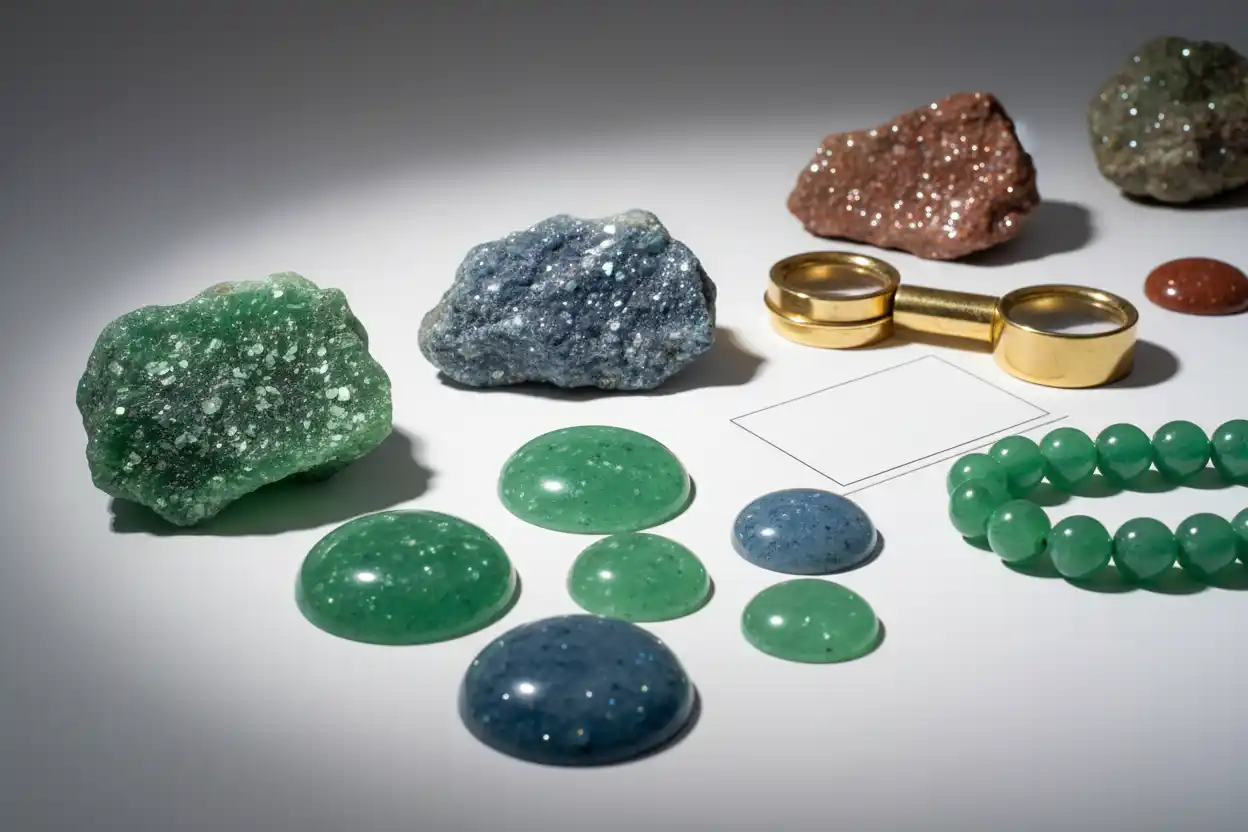
Where to Buy Real Aventurine: Trusted Sellers and Fake-Spotting Tips
Real aventurine is widely available, but the name is used loosely across crystal shops, bead markets and jewelry listings. Genuine aventurine is a quartz-rich material containing reflective mineral inclusions that create aventurescence—a glittering effect that appears within the stone as it moves under light. It should not be confused with “aventurine glass,” goldstone, dyed quartz, green glass or jade sold under an imprecise label.
Because most aventurine is affordable, the main buying risks are misidentification, dye, resin treatment, poor-quality manufacture and exaggerated rarity rather than elaborate laboratory-grown counterfeits. The aventurine meaning and properties guide explains the mineral family and symbolism, while this page focuses on sellers, disclosure, authenticity and purchase quality.
Understand What Aventurine Actually Is
Aventurine is generally described as a quartz or quartzite variety containing platy inclusions. Green material commonly owes its color and sparkle to chromium-bearing mica such as fuchsite. Other colors can involve iron-rich minerals or different inclusions. The reflective plates scatter light unevenly, producing the characteristic internal shimmer.
The material is usually translucent to opaque and is most often cut as cabochons, beads, tumbles, carvings, spheres and decorative objects. Transparent faceted material with strong, evenly distributed aventurescence is unusual. A listing that shows perfectly clear “aventurine” with identical glitter throughout deserves closer examination.
Quartz gives aventurine hardness near 7, making it more scratch resistant than calcite, fluorite and many soft decorative stones. Nevertheless, fractures, mica-rich zones, drill holes and resin treatment can reduce durability. The quartz family guide provides the wider mineral context.
Decide Which Aventurine Product You Want
| Product form | Best source | Main buying concern |
|---|---|---|
| Natural rough | Mineral dealer or lapidary supplier | Correct identification, color treatment and misleading locality claims |
| Tumbled stones | Established crystal retailer with batch photos | Dye, glass substitutes, weak polish and excessive filler |
| Cabochons | Lapidary seller who shows front, back and side | Orientation of sparkle, cracks, backing and resin impregnation |
| Beads | Reputable bead supplier with treatment disclosure | Dyed quartz, glass, drill-hole fractures and inconsistent sizing |
| Carvings or spheres | Lapidary or decor seller | Filled pits, coating, low aventurescence and composite construction |
| Finished jewelry | Jeweler who names stone, metal and treatment | Mislabeling as jade, adhesive settings and poor return terms |
| Collector specimen | Mineral dealer with locality label | Weak provenance and confusion with other quartz-rich rocks |
Your intended use should guide the purchase. A bead strand needs consistent drilling and structural strength, whereas a collector piece benefits from natural texture, provenance and visible inclusion structure.
Where to Buy Real Aventurine
Specialist lapidary suppliers
Lapidary suppliers are often the best source for rough, slabs and cabochons because they understand orientation, fracture patterns and polishing behavior. A good supplier states whether the material is natural, dyed, stabilized or resin-impregnated and shows dry photographs rather than relying on oil-enhanced images.
Ask for the slab thickness, approximate yield, known fractures and country of origin. If you plan to cut the material, request photographs under both diffuse light and a single directional light so you can judge how the aventurescence responds.
Reputable bead and jewelry suppliers
A serious bead seller lists bead diameter, hole size, strand length, color consistency and treatment. It should also clarify whether buyers receive the pictured strand or a comparable batch item. For jewelry, request the metal composition, setting method and whether the stone is solid, backed or glued.
Green aventurine is sometimes sold as “Indian jade,” but that trade name does not make it jade. Sellers should identify the material as aventurine quartz rather than using jade terminology as the primary identity.
Mineral and gem shows
Shows let you compare natural aventurine, glass, goldstone, jade and sunstone side by side. Move each piece under a point light and observe whether the glitter comes from irregular internal plates or a uniformly manufactured distribution. Inspect drilled holes, polished edges and the back of cabochons with a loupe.
Do not conduct scratch tests on merchandise. Instead, use nondestructive observation and ask the seller how the material was identified. The crystal identification guide explains which properties can be assessed safely.
Trusted online shops and marketplaces
Online purchases require exact-item photographs or clear batch disclosure, a realistic video, seller contact information and a written return policy. Listings should avoid saturated filters that turn pale material into intense emerald green.
Use the online gemstone buying guide to check seller history, payment protection and return procedures. On a general marketplace, prioritize shops that answer technical questions rather than those that rely entirely on metaphysical claims.
What Genuine Aventurine Looks Like
Natural aventurine usually shows a granular quartz-rich body with unevenly distributed reflective inclusions. The sparkle may strengthen when the stone is tilted and weaken when viewed from another direction. Individual reflective plates can vary in size, density and orientation.
Green aventurine ranges from pale silvery green to medium or deeper green. Its shimmer may be subtle in cloudy material and stronger in translucent pieces with well-oriented mica. Red, orange, peach, brown and blue materials occur in the trade, but each color deserves its own scrutiny because sellers may apply aventurine labels to different quartz-rich rocks.
The types of aventurine guide separates major color varieties and inclusion patterns. Dedicated profiles for blue aventurine and red aventurine provide material-specific context, while the planned green aventurine guide will focus on the best-known color variety.
Under 10× magnification, look for internal platy reflections, granular texture, natural fractures and color that belongs to the body rather than pooling only in cracks. Surface scratches may occur on poorly handled pieces, but perfectly uniform glitter, round bubbles and flow lines point toward glass.
Real Aventurine Versus Goldstone
Goldstone is a manufactured glass containing abundant reflective crystals. It may be brown, blue, green or other colors, and sellers sometimes call it aventurine glass. Although the historical naming is related, goldstone is not natural aventurine quartz.
Natural aventurine usually has irregular sparkle within a cloudy or granular body. Goldstone tends to show denser, more uniform glitter inside glass. Round bubbles, glassy conchoidal chips and repeated sparkle distribution further support glass identification.
The goldstone guide explains its manufactured origin and decorative appeal. Goldstone can be a legitimate material when labeled honestly; the problem is selling it as natural aventurine.
Aventurine Versus Jade
Green aventurine, jadeite, nephrite, serpentine and other green stones are frequently confused in low-information listings. Aventurine is quartz-rich and often shows visible glitter. Jade usually has a tougher interlocking structure and does not depend on mica sparkle for its identity.
Color alone cannot separate them. Some aventurine contains little visible shimmer, while treated jade or glass can imitate green translucent material. The planned aventurine versus jade comparison will address the distinction directly. For jade-specific buying concerns, use the jade guide, real versus fake jade guide and jade buying guide.
A seller using “Indian jade” should still disclose that the product is aventurine quartz when that is the actual material.
Aventurine Versus Sunstone
Aventurine quartz and sunstone can both show aventurescence, but sunstone is feldspar. Its glitter may come from reflective copper or hematite inclusions, and its body color, cleavage and optical character differ from quartz-rich aventurine.
The sunstone profile and types of sunstone guide explain those feldspar varieties. Be cautious when a listing uses “aventurine sunstone” without naming the mineral species.
Other Common Substitutes and Mislabels
Dyed quartz or quartzite
Low-grade pale quartz can be dyed green, blue or red and sold as aventurine. Dye may gather in fractures, pits and drill holes. If the material has strong color but little or no reflective inclusion structure, ask why it is being called aventurine rather than simply dyed quartz.
Colored glass
Glass may show bubbles, flow lines, rounded internal features and a uniform body. Molded beads can also have seams or identical shapes. However, some glass lacks obvious bubbles, so visual inspection is not always conclusive.
Serpentine and green decorative stone
Soft green rocks are sometimes marketed as aventurine or jade. Their polish, hardness and texture differ, but a home scratch test is not appropriate for finished goods. A gemologist can use refractive index, specific gravity and microscopy.
Coated or glittered resin
Resin pieces may contain metallic glitter or stone chips. Look for mold seams, bubbles, unusually low weight, a plastic-like surface and glitter that does not have natural mineral boundaries.
The broader fake-crystal guide provides additional nondestructive checks for glass, resin, coatings and misleading trade names.
Treatments to Ask About
Aventurine may be dyed, waxed, oiled, coated, fracture-filled or polymer-impregnated. Polymer treatment can strengthen porous or fractured material and improve surface appearance. It may also affect value, care and laboratory reactions.
A seller should answer whether the stone is:
- Naturally colored
- Dyed
- Surface-coated
- Waxed or oiled
- Resin-impregnated
- Fracture-filled
- Backed or assembled
- Reconstituted from chips and binder
Do not accept “100% natural” as a complete treatment statement. A natural stone can still be dyed or impregnated. The gemstone treatment guide explains why disclosure must cover both origin and enhancement.
How to Judge Green Aventurine
Green is the dominant retail variety, so it deserves the most careful comparison. Attractive material balances body color, translucency and aventurescence. Very dark stones can hide sparkle, whereas very pale stones may show weak color. The best choice depends on whether you prefer a soft silvery effect or strong visible plates.
Check color consistency across the object. Natural variation is expected, but concentrated green around drill holes can indicate dye. Rotate the stone under light; internal sparkle should not disappear as if it were only a surface coating.
The planned green aventurine buying guide will cover color-specific sellers, imitations and quality factors without replacing this all-color buying page.
How to Judge Blue Aventurine
Blue aventurine can range from pale gray-blue to deeper navy tones. Some commercial material contains different blue inclusions or is sold under broad trade terminology, so ask what creates the color and whether the identification is mineralogical or commercial.
Overly electric blue color, strong concentration in cracks and no internal reflective structure warrant caution. Compare the material with the dedicated blue aventurine buying guide when evaluating a color-specific purchase.
Buying Rough and Slabs
Rough should be photographed dry because water or oil can temporarily intensify color and hide surface flaws. Ask for a sawn face if the exterior rind conceals the material. A moving-light video helps reveal the direction and density of reflective inclusions.
For slabs, inspect both faces and edges. Open fractures, mica-rich seams and friable zones can reduce cutting yield. If resin stabilization has been used, ask whether the entire slab was impregnated or only surface-filled.
Buying Cabochons
A well-cut cabochon should display the glitter when viewed face-up, not only from an extreme angle. Its dome should be symmetrical unless the design is intentionally freeform, and the girdle should be even enough for secure setting.
Inspect the back for dye concentration, backing, resin or deep fractures. A dark backing may increase apparent saturation and should be disclosed. Surface pits can occur where inclusions or grains undercut during polishing, but heavy coating is not an acceptable substitute for sound lapidary work unless clearly stated.
Buying Beads and Bracelets
Bead quality depends on more than color. Check roundness, polish, hole centering, strand matching and fractures around drill holes. Aventurine beads can chip when holes are drilled too close to a flaw.
Photographs should show the exact strand or a representative group under neutral light. If every bead has identical intense color and glitter distribution, ask whether the material is glass or dyed.
Buying Carvings, Spheres and Towers
Large objects amplify hidden flaws. Rotate the piece and inspect every face for filled cavities, open seams, flat spots and repaired breaks. A sphere should be truly round and should not rely on a stand to hide a major defect unless the defect is disclosed.
Carvings require clean detail without chalky edges or crumbly recesses. Very thin projections can break even though quartz itself is relatively hard because fractures and mica-rich zones interrupt the structure.
Buying Aventurine Jewelry
Aventurine is suitable for many jewelry types, yet design still matters. Bezel-set cabochons protect edges better than exposed prongs. Rings can work for occasional wear, while pendants and earrings face less impact.
The gemstone hardness chart explains scratch resistance, and the guide to gemstone toughness versus hardness explains why internal fractures and inclusions can still cause breakage.
Ask whether the stone is glued, backed or drilled. In plated jewelry, confirm the base metal and plating thickness so the value of the setting is not confused with the value of the stone.
Price and Value Factors
Aventurine is generally available in commercial quantities, so ordinary material should not carry extreme rarity premiums. Value rises with attractive body color, visible and well-distributed aventurescence, translucency, clean polish, large usable size, skillful carving, matched beads and honest treatment disclosure.
For rough, usable yield matters more than total weight. A fractured kilogram with weak sparkle may be less valuable than a smaller clean slab. For cabochons, orientation and polish can outweigh size. For jewelry, metal quality and craftsmanship may contribute more to the price than the aventurine itself.
The gemstone pricing guide explains how material quality, cutting, treatment and seller overhead interact. Be wary of “AAA,” “five-star” and “investment grade” labels that lack measurable criteria.
Seller Questions Before You Buy
Ask the seller:
- Is this natural aventurine quartz, glass or another material?
- What mineral inclusions create the color and sparkle?
- Has it been dyed, coated, waxed, filled or resin-impregnated?
- Is the stated country of origin documented?
- Are the photographs of the exact item or a representative batch?
- Does the stone have cracks, pits, repairs, backing or glue?
- For beads, what are the hole size and strand tolerance?
- For jewelry, is the stone solid, backed, drilled or adhesive-set?
- What lighting and editing were used for the photos?
- What return period applies after inspection?
Written answers matter because they establish what was represented at the time of sale.
Home Inspection Without Damage
Use neutral daylight, a directional lamp and a 10× loupe. Rotate the stone and observe whether reflective plates lie within the body. Examine drill holes and fractures for concentrated dye, then check polished surfaces for coating boundaries or resin-filled pits.
Compare the weight and temperature only as supporting observations, not as proof. Glass, quartz and resin can overlap in hand feel depending on size and construction.
Do not scratch the stone, heat a needle, apply acid, use uncontrolled solvents or strike it to test fracture. Those methods damage property and still may not provide a reliable identification.
When Professional Testing Is Worthwhile
A gemologist can use microscopy, refractive index and specific gravity to distinguish quartz-rich aventurine from many glasses, jades and softer green stones. Quartz typically produces readings near the quartz range, while glass and jade materials differ. Mixed or porous pieces may complicate measurements.
Raman spectroscopy can identify quartz and associated minerals. Fourier-transform infrared spectroscopy can help detect some polymer impregnation, while ultraviolet response may provide supporting evidence for resin but is not definitive by itself.
Professional testing is most useful for expensive jewelry, large carvings sold as premium material, disputed jade-versus-aventurine cases and stones with unusual treatment claims.
Shipping, Returns and Documentation
Cabochons and carvings should be wrapped individually so they do not strike harder objects. Bead strands need padding around clasps and metal spacers. Large spheres and towers require rigid inner packaging, corner support and a second outer box.
A return policy should allow inspection under normal light without destructive testing. Restocking fees, international return costs and exclusions for drilled or mounted stones should be visible before payment.
Ethical Sourcing and Origin Claims
India and Brazil are often associated with commercial aventurine, while other countries also produce quartz-rich material. However, color and sparkle do not prove locality. Ask whether the origin comes from the miner, cutter, wholesaler or merely a traditional trade assumption.
The ethical crystal sourcing guide explains how to assess traceability, labor claims and environmental language. For inexpensive beads, full mine-level documentation may be unavailable, but sellers should still avoid invented “direct from the mine” stories.
Cleaning and Long-Term Care
Untreated aventurine is generally more durable than soft carbonate minerals, but care should account for fractures, dye, polymer and settings. Use lukewarm water, mild soap and a soft cloth for a sound untreated piece, then rinse briefly and dry. Avoid sudden temperature changes and prolonged soaking.
Do not use steam or ultrasonic cleaning on fractured, dyed, filled, glued or resin-impregnated material. The planned water-safety guide and ultrasonic-cleaner guide provide broader material-specific cautions. For symbolic practices, the crystal cleansing guide offers non-destructive options without treating spiritual traditions as scientific effects.
Store polished pieces separately from diamond, corundum and other harder gems. Keep bead strands flat or loosely coiled so the cord and drill holes are not stressed.
Buy the Inclusion Pattern, Not the Marketing Grade
Aventurine is most appealing when its mineral inclusions create a natural, changing relationship with light. That effect should remain visible in neutral photographs, survive inspection from several angles and make sense for the product form.
The A crystal directory, A gemstone directory and visual guide to gemstone types can help you compare aventurine with other quartz varieties and green decorative stones. Choose a seller who can name the material, explain treatment, show the exact piece and accept a return. Those safeguards matter far more than a dramatic grade label.
Frequently Asked Questions
1. Is green aventurine a real natural stone?
Yes. Genuine green aventurine is a quartz-rich natural material whose color and sparkle commonly come from green mica inclusions. However, dyed quartz, glass and other green stones may be sold under the same name.
2. Is aventurine the same as aventurine glass?
No. Natural aventurine is quartz-rich stone with mineral inclusions. Aventurine glass usually refers to manufactured glittering glass such as goldstone.
3. How can I tell aventurine from glass?
Natural aventurine usually has irregular internal plates, granular texture and uneven sparkle. Glass may show round bubbles, flow lines, mold seams and more uniform glitter, although laboratory testing may be needed for high-value items.
4. Is aventurine the same as jade?
No. Aventurine is quartz-rich, whereas jade refers to jadeite or nephrite. Trade names such as “Indian jade” can refer to aventurine, so the seller should state the actual mineral identity.
5. Is all blue aventurine dyed?
No. Natural blue aventurine-type material exists, but the commercial name may cover different inclusion-bearing quartz materials. Strong color in cracks, no internal sparkle and vague disclosure justify caution.
6. Does real aventurine always sparkle strongly?
No. Aventurescence can be subtle, especially in opaque, pale or poorly oriented material. Weak sparkle does not automatically make a stone fake, but a complete absence of reflective inclusions raises a naming question.
7. Can aventurine be resin-treated?
Yes. Polymer impregnation, filling and surface enhancement can occur, particularly in fractured or porous material. Treatment should be disclosed because it affects care and value.
8. Is aventurine suitable for everyday jewelry?
It can work in many jewelry designs because quartz is relatively hard. Still, fractured cabochons, drilled beads and treated stones can chip or fail, so protected settings and sensible care are important.
9. What makes one aventurine piece more valuable than another?
Body color, translucency, intensity and distribution of aventurescence, usable size, structural condition, polish, carving quality, matched color and treatment disclosure all influence value.
10. Do I need a gemological certificate for aventurine?
Usually not for inexpensive tumbles or beads. A report becomes more useful for expensive jewelry, disputed jade identification, unusual treatment claims or large premium carvings.
11. What is the biggest red flag when buying aventurine beads?
Be cautious when beads have identical saturated color and perfectly uniform glitter but the seller will not state whether they are glass, dyed or resin-treated. Missing drill-hole photographs and no return policy add further risk.
12. Where is the safest place to buy real aventurine?
A reputable lapidary supplier, mineral dealer, established bead company or jeweler with exact material identification, treatment disclosure, realistic photos and a written return policy is safer than an anonymous seller relying on vague metaphysical claims.