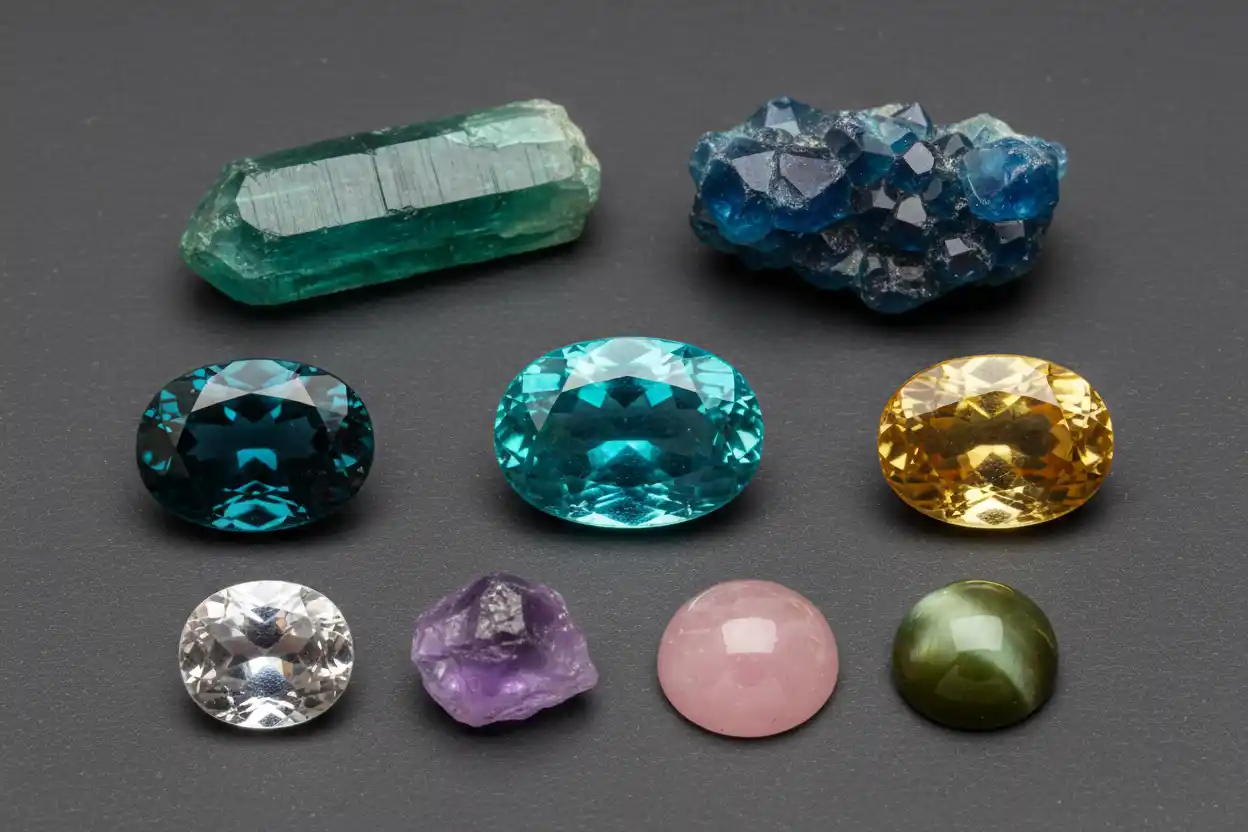
Types of Apatite: Colors and Varieties Explained
Apatite is a mineral group rather than one narrowly defined species. Its principal calcium-phosphate members contain fluorine, hydroxyl, or chlorine, while trace elements and structural substitutions produce blue, green, yellow, violet, pink, brown, and colorless crystals.
Most gem-quality material is fluorapatite. Color names such as neon blue Apatite, asparagus stone, moroxite, and Paraíba-color Apatite describe appearance or historical trade usage rather than separate approved mineral species.
Apatite at a Glance
| Property | Apatite |
|---|---|
| General composition | Ca₅(PO₄)₃(F,OH,Cl), varying by group member |
| Main gem species | Fluorapatite |
| Other principal members | Hydroxylapatite and chlorapatite |
| Crystal system | Hexagonal |
| Main colors | Colorless, blue, green, yellow, violet, purple, pink, orange, brown |
| Transparency | Transparent to opaque |
| Luster | Vitreous to subresinous |
| Mohs hardness | 5 |
| Cleavage | Poor or indistinct, but the mineral remains brittle |
| Optical character | Uniaxial, usually negative |
| Common forms | Faceted gems, cat’s-eye cabochons, beads, carvings, crystals, matrix specimens |
| Main care concern | Scratching, chipping, heat, fractures, and confusion with more durable blue or green gems |
What Is Apatite?
Apatite is the group name for structurally related calcium-phosphate minerals. The interchangeable fluorine, hydroxyl, and chlorine positions produce several endmembers with similar appearance and physical properties.
The broader Apatite guide owns the mineral’s general formation, history, symbolism, and uses. This page focuses on chemical members, gemstone colors, optical effects, trade names, and collector varieties.
Apatite is abundant as microscopic accessory grains in many igneous and metamorphic rocks. However, transparent crystals large and clean enough for cutting are much less common.
Its name comes from a Greek word meaning to deceive because Apatite can resemble Beryl, Tourmaline, Topaz, Peridot, and other minerals. That history remains relevant today: neon blue gems are sometimes confused with Aquamarine or Paraíba Tourmaline, while green stones may resemble Peridot.
Apatite belongs within types of gemstones as a colorful but comparatively soft collector gem. It also appears in crystals that start with A and gemstones that start with A.
How Apatite Types Are Classified
Apatite names fall into three overlapping systems.
Chemical names identify the dominant anion in the crystal structure. Fluorapatite contains fluorine, hydroxylapatite contains hydroxyl, and chlorapatite contains chlorine.
Color and optical names describe appearance, including neon blue, asparagus-green, yellow, violet, pink, and cat’s-eye Apatite.
Historical or commercial names such as moroxite and Paraíba Apatite may describe a particular shade but do not establish chemical composition or geographic origin.
One stone can fit several categories. A faceted Madagascan gem may be fluorapatite, neon blue Apatite, and a strongly pleochroic collector stone at the same time.
Main Types of Apatite
| Type | Typical appearance | Main distinction |
|---|---|---|
| Fluorapatite | Colorless, blue, green, yellow, violet, pink, brown | Most common mineral and gem member |
| Hydroxylapatite | Colorless, white, grey, yellow, greenish | Hydroxyl-dominant endmember; less common as a faceted gem |
| Chlorapatite | Colorless, white, yellow, pale pink, brownish | Chlorine-dominant endmember; uncommon in jewelry |
| Neon blue Apatite | Intense turquoise, cyan, blue-green, or electric blue | Most commercially recognized gem color |
| Green Apatite | Mint, yellow-green, grass green, olive | Broad color range; overlaps with asparagus stone |
| Asparagus stone | Transparent yellowish-green Apatite | Historical trade term |
| Yellow Apatite | Lemon, golden yellow, straw, honey | Frequently transparent and faceted |
| Purple or violet Apatite | Lilac, violet, grape, purple-blue | Scarcer collector color |
| Pink Apatite | Pale pink, rose, raspberry, magenta | Uncommon and often locality-sensitive |
| Colorless Apatite | Clear to near-colorless | Collector material easily confused with other colorless gems |
| Cat’s-eye Apatite | Moving light band over yellow, green, blue, or brown body | Produced by aligned inclusions |
| Massive Apatite | Opaque blue, green, yellow, or mixed material | Used for beads, carvings, and decorative objects |
Fluorapatite
Fluorapatite has the ideal formula Ca₅(PO₄)₃F and is the most common member of the Apatite group.
Most transparent gems sold simply as Apatite are fluorapatite unless laboratory testing proves another species. It occurs in almost every commercially important gem color.
Pure fluorapatite would be colorless. Blue, green, yellow, violet, pink, and brown shades arise from manganese, rare-earth elements, iron, irradiation-related defects, and substitutions within the phosphate structure.
Fluorapatite can fluoresce strongly. Yellow material may show pink or purplish reactions, while blue, green, and violet stones can produce blue, yellow-green, or purple luminescence depending on their chemistry.
The species occurs in pegmatites, skarns, marble, carbonatites, hydrothermal veins, and various igneous rocks. Large crystals may form where slow growth and mineral-rich fluids create enough open space.
Hydroxylapatite
Hydroxylapatite has the ideal formula Ca₅(PO₄)₃OH.
The mineral occurs naturally in rocks and also belongs to the same structural family as the nanoscale carbonate-rich biological apatite found in bones and teeth. However, a polished mineral specimen should not be described as literal fossilized bone simply because both contain apatite-related material.
Natural hydroxylapatite is commonly colorless, white, pale yellow, grey, or yellow-green. Transparent gem-quality crystals are uncommon.
Its optical and physical properties overlap strongly with fluorapatite, so visual separation is unreliable.
Infrared spectroscopy, chemical analysis, or X-ray diffraction may be required to identify the dominant fluorine-versus-hydroxyl component.
Chlorapatite
Chlorapatite has the ideal formula Ca₅(PO₄)₃Cl.
It is less common than fluorapatite and rarely encountered as a named faceted gemstone.
Natural colors include colorless, white, pale yellow, yellow-green, pinkish, and brownish tones. Some crystals occur in metamorphic and igneous environments where chlorine-rich fluids influenced growth.
Because chlorine, fluorine, and hydroxyl can substitute for one another, natural crystals may fall between ideal endmembers.
A seller should not identify a stone as chlorapatite from color alone. Laboratory chemical or structural evidence is necessary.
Neon Blue Apatite
Neon blue is the most popular Apatite color in modern jewelry.
The strongest gems appear electric blue, turquoise, cyan, or blue-green. Some have a brightness reminiscent of copper-bearing Paraíba Tourmaline, which explains trade names such as Paraíba-color Apatite.
Apatite does not become Paraíba Tourmaline because of color. The two have different compositions, crystal structures, hardness, density, refractive properties, and market values.
Fine neon material has vivid saturation without becoming overly dark. Excessive green or grey can lower demand, although some buyers prefer turquoise-blue stones.
Madagascar has supplied important neon blue and blue-green gems. Brazil, Mozambique, Myanmar, and other deposits have also produced blue material.
The color can show strong pleochroism, with blue seen from one direction and yellowish, colorless, or greenish tones from another. Cut orientation therefore affects face-up appearance.
Neon Apatite occupies a distinctive place among blue gemstones, but its hardness makes it less suitable for unrestricted ring wear than Sapphire, Spinel, or Aquamarine.
Paraíba-Color Apatite
“Paraíba Apatite” is an informal commercial expression for turquoise, neon blue, or blue-green Apatite.
The name does not indicate copper-bearing Tourmaline and does not prove the stone came from Paraíba, Brazil.
A responsible listing should use wording such as “Paraíba-color Apatite” rather than implying membership in the Paraíba Tourmaline category.
The dedicated Apatite vs Aquamarine comparison also helps separate bright blue Apatite from Beryl. Apatite is softer, denser, and has different refractive and spectroscopic properties.
Moroxite
Moroxite is an older name applied to blue or blue-green Apatite, especially fluorapatite.
The term appears on historic mineral labels and in older gemstone literature, but it is not a separate approved species.
Modern dealers may use moroxite to make ordinary blue Apatite sound rarer. Unless the label carries genuine historical or locality value, the stone should still be evaluated simply as blue fluorapatite.
Green Apatite
Green is one of Apatite’s broadest natural color families.
Stones range from pale mint and celery green to grass green, yellow-green, olive, and deep forest green. Some crystals show blue-green zoning or yellow cores.
Iron, manganese, rare-earth elements, and structural defects may all influence the color.
Transparent green material is faceted, while included or fibrous rough may be cut as cabochons. Fine green cat’s-eye stones are also known.
A green stone should not be assumed to be Peridot, Tourmaline, or Chrysoberyl from appearance. Apatite’s hardness of 5 is an important distinction, although scratch testing should never be used on a finished gem.
Green varieties naturally belong among green gemstones.
Asparagus Stone
Asparagus stone is a historic trade name for transparent yellowish-green or asparagus-green Apatite.
Classic material has been associated with Spain and several European deposits, although similar color occurs elsewhere.
The name describes color rather than a chemical species. A laboratory would normally identify the stone as fluorapatite or another Apatite-group member.
Fine asparagus stone should have lively yellow-green color, useful transparency, and good cutting. Pale cloudy material has less commercial appeal.
The term is less common in contemporary jewelry than neon blue or golden Apatite, but it remains useful when interpreting old collections.
Yellow and Golden Apatite
Yellow Apatite ranges from pale straw and lemon to canary yellow, golden, honey, and greenish yellow.
Transparent yellow crystals can be remarkably bright because the body color allows strong light return.
Madagascar, Mexico, Brazil, Myanmar, and other countries have produced faceting material.
Yellow Apatite may fluoresce purplish pink under longwave ultraviolet light, although the response is not identical in every stone.
Highly included yellow material can show chatoyancy when cut as a cabochon.
The variety belongs naturally within yellow gemstones, where it should be compared with Citrine, Yellow Beryl, Yellow Sapphire, and Golden Topaz.
Purple and Violet Apatite
Purple Apatite can appear lilac, violet, grape, reddish purple, purple-blue, or greyish violet.
Fine transparent purple crystals are less common than commercial blue and yellow material.
Purple fluorapatite specimens are particularly valued when they form sharp hexagonal crystals on contrasting matrix.
Pleochroism can reveal different violet, blue, yellowish, or nearly colorless directions.
Some purple stones fluoresce yellow-green in longwave ultraviolet light and pale purple under shortwave conditions.
A strong purple color does not establish origin. Portugal, Pakistan, Afghanistan, Brazil, Namibia, and other regions have produced violet material.
These stones overlap visually with purple gemstones, including Amethyst, Iolite, Spinel, and Sapphire.
Pink Apatite
Pink Apatite ranges from pale blush and rose to raspberry, reddish pink, and occasional magenta-like hues.
Manganese commonly contributes to pink and red coloration, although detailed color mechanisms can involve several trace elements and defects.
Pink crystals may occur with Muscovite, Feldspar, Albite, or other pegmatite minerals.
Fine transparent material is rare enough to interest collectors, but it remains soft for daily jewelry.
Opaque pink material can be cut into beads or carvings, though identification is important because Rhodonite, Rhodochrosite, Calcite, dyed stone, and glass can look similar.
The variety fits within pink gemstones but occupies a much smaller market than Morganite, Rose Quartz, or Pink Tourmaline.
Colorless Apatite
Colorless Apatite is uncommon in mainstream jewelry because it lacks the vivid color that normally attracts buyers.
Clean crystals can be faceted into bright collector stones. Their moderate refractive index produces attractive brilliance but not the exceptional fire of Zircon or Sphalerite.
Colorless Apatite may be confused with Quartz, Beryl, Topaz, Feldspar, or glass.
Refractive index, density, birefringence, optic character, spectroscopy, and hardness distinguish it more safely than visual inspection.
Because of its softness, a large colorless Apatite is normally more valuable as a collector gem than as a Diamond substitute.
Cat’s-Eye Apatite
Cat’s-eye Apatite displays one moving band of reflected light across a cabochon.
Parallel needles, tubes, fibers, or aligned inclusions create the effect. The eye becomes sharpest beneath one small point light.
Yellow, green, blue-green, brown, and rare neon blue cat’s-eye stones occur.
A fine cabochon should have a straight, centered, continuous eye that opens and closes as the light moves. A weak diffuse band has less value.
Blue cat’s-eye Apatite is substantially rarer than ordinary yellow-green chatoyant material.
The body must be cut with the inclusion direction perpendicular to the cabochon’s length. Incorrect orientation can weaken or eliminate the eye.
Cat’s-eye Apatite should not be confused with Chrysoberyl Cat’s Eye, which is harder, generally more valuable, and gemologically distinct.
Massive and Opaque Apatite
Not all commercial Apatite is transparent.
Massive material can appear deep blue, turquoise, green, yellow, grey, or mixed. It is fashioned into beads, palm stones, spheres, carvings, and polished freeforms.
Blue massive Apatite commonly contains fractures, grain boundaries, white patches, and darker matrix.
Its color can resemble Turquoise or dyed Howlite. A polished blue surface should therefore be examined for dye concentration and resin.
Opaque material is usually inexpensive compared with fine transparent neon gems. Strong color, low fracture density, good polish, and reliable treatment disclosure improve its value.
Apatite Crystal and Locality Types
Brazil has produced blue, green, yellow, colorless, pink, and cat’s-eye material from pegmatites and metamorphic deposits.
Madagascar is particularly associated with neon blue, yellow, green, and chatoyant gems.
Mexico has yielded yellow, green, and colorless crystals, including large transparent material.
Pakistan and Afghanistan produce sharp purple, green, blue, colorless, and pink crystals on attractive pegmatite matrix.
Myanmar and Sri Lanka have supplied faceting and cat’s-eye material through alluvial deposits.
Canada, Norway, Portugal, Spain, Germany, Morocco, Mozambique, Namibia, Tanzania, and the United States also contain important collector occurrences.
A locality name should be supported by documentation. Color alone cannot separate Madagascan, Brazilian, or Pakistani Apatite reliably.
How Apatite Forms
Apatite crystallizes in many geological environments, which explains its broad color and chemistry.
In igneous rocks, it commonly forms as small accessory crystals during magma cooling. Pegmatites can produce much larger crystals because volatile-rich fluids allow prolonged growth.
Skarns and marble host Apatite where calcium-rich rocks interact with phosphate-bearing fluids.
Carbonatites and alkaline igneous rocks can contain large masses of phosphate minerals and rare-earth-rich Apatite.
Sedimentary phosphorite consists largely of fine-grained apatite-related material, often derived from biological and marine processes.
The broader processes are discussed in how gemstones are formed.
Treatments
Most faceted Apatite is sold without routine treatment, but enhancement is possible.
Heating has been reported for selected material to adjust green, yellow, or blue coloration. The response depends heavily on original chemistry.
Irradiation may create or alter color centers, though it is not as common commercially as treatment in Topaz or Quartz.
Dye can intensify porous, fractured, or massive blue and green material.
Surface coating can create unnaturally saturated blue, green, rainbow, or metallic appearances.
Resin filling may stabilize heavily fractured cabochons and carvings.
The treatment types are explained in gemstone treatments explained. A seller should disclose enhancement rather than relying on the assumption that all Apatite is untreated.
Synthetic Apatite and Imitations
Synthetic apatite compounds are manufactured for scientific, optical, biomedical, and industrial applications.
Laboratory-grown gem Apatite is not a large mainstream jewelry market, but synthetic material can exist.
More common substitutes include glass, synthetic Spinel, Cubic Zirconia, blue Topaz, Aquamarine, Tourmaline, and dyed Quartz.
Neon blue Apatite is also used as a visual substitute for expensive Paraíba Tourmaline, although standard gemological testing separates them.
The distinctions among natural, synthetic, imitation, and assembled materials are covered in lab-grown vs natural gemstones.
Durability and Jewelry Suitability
Apatite defines Mohs hardness 5. Ordinary dust containing Quartz can scratch it.
The mineral is brittle and can chip around facet junctions, girdles, drill holes, and pointed corners.
Pendants, earrings, brooches, and protected occasional-wear pieces are safer than daily rings and bracelets.
A low bezel protects cabochons, though excessive setting pressure can still break the stone.
The gemstone hardness chart explains scratch resistance, while gemstone toughness vs hardness addresses impact and breakage.
Steam and ultrasonic cleaning should be avoided, especially for fractured or filled stones.
Apatite Value and July 2026 Asking Prices
Apatite prices vary by color, transparency, size, optical effect, cutting, treatment, and origin documentation.
As of July 2026, pale, included, or commercial faceted stones commonly carry asking prices around $10–$40 per carat.
Better neon blue or blue-green gems often appear around $40–$150 per carat.
Fine saturated, clean, precision-cut neon stones can ask $150–$300 per carat or more, particularly in useful calibrated sizes.
Yellow and green faceted Apatite commonly falls around $15–$60 per carat, although exceptionally clean or unusually large examples can exceed that range.
Commercial cat’s-eye stones often ask $15–$75 per carat, while sharp neon blue or fine green eyes may reach $75–$200 per carat or more.
Large crystals, rare purple or pink localities, and exceptional matrix specimens can cost hundreds or thousands of dollars independent of their faceting value.
The general pricing mechanics are explained in how gemstone prices work.
Buying the Right Apatite Type
The dedicated where to buy Apatite guide owns detailed seller and authenticity intent.
Ask whether the seller means fluorapatite, another identified group member, or simply an untested Apatite-group gem.
For neon stones, request neutral-light photographs and a video. Excessive saturation editing can make ordinary green-blue material appear electric.
Inspect facet junctions for abrasion. A bright Apatite can still have significant edge wear because of its softness.
Cat’s-eye stones should be shown under one moving point light so the eye’s sharpness and centering remain visible.
Treatment questions should cover heating, irradiation, dye, coating, resin filling, and assembled construction.
General transaction checks appear in how to buy gemstones online.
Apatite Color Meaning and Variety Symbolism
The dedicated Apatite color meaning page owns detailed symbolic interpretations by color.
Modern crystal traditions often associate blue Apatite with communication and creativity, green with growth and adaptability, yellow with motivation, and purple with reflection or imagination.
These associations are cultural and personal rather than mineralogical classifications.
No Apatite type has been shown scientifically to cause weight loss, suppress appetite, rebuild teeth, heal bone, or treat disease.
For nonmedical ritual care, the separate how to cleanse Apatite guide provides lower-risk options that avoid harsh water, salt, and physical abrasion.
Frequently Asked Questions
1. Is Apatite one mineral or a mineral group?
It is a group containing related calcium-phosphate minerals, including fluorapatite, hydroxylapatite, and chlorapatite.
2. Which Apatite type is used most often as a gemstone?
Fluorapatite accounts for most transparent faceted and cat’s-eye material.
3. What is neon blue Apatite?
It is intensely saturated turquoise, cyan, or blue-green gem Apatite, commonly associated with Madagascar and Brazil.
4. Is Paraíba Apatite actually Paraíba Tourmaline?
No. It is an informal color comparison and does not indicate copper-bearing Tourmaline.
5. What is asparagus stone?
It is a historical trade name for transparent yellowish-green Apatite.
6. What is moroxite?
Moroxite is an older name for blue or blue-green Apatite, usually fluorapatite.
7. Is the Apatite in bones the same as gemstone Apatite?
Bones contain nanoscale, carbonate-rich biological apatite related to hydroxylapatite, but they are not equivalent to transparent gem crystals.
8. Which Apatite colors are rarest?
Fine pink, purple, colorless, and sharp neon blue cat’s-eye stones are among the less common commercial varieties.
9. Can Apatite show a cat’s-eye?
Yes. Aligned inclusions can produce chatoyancy in yellow, green, brown, blue-green, and rare neon blue stones.
10. Is Apatite suitable for a daily ring?
No. Its hardness of 5 and brittle nature make lower-impact jewelry safer.
11. Is Apatite commonly treated?
Most is sold untreated, but heating, irradiation, dyeing, coating, and resin filling are possible.
12. What most affects Apatite value?
Color saturation, transparency, size, cutting, chatoyancy, crystal form, locality, condition, treatment, and documentation determine value.
Apatite varieties are easiest to understand when chemistry and trade language remain separate. Fluorapatite, hydroxylapatite, and chlorapatite describe structural composition; neon blue, asparagus, yellow, purple, and cat’s-eye describe the appearance a collector can actually see.