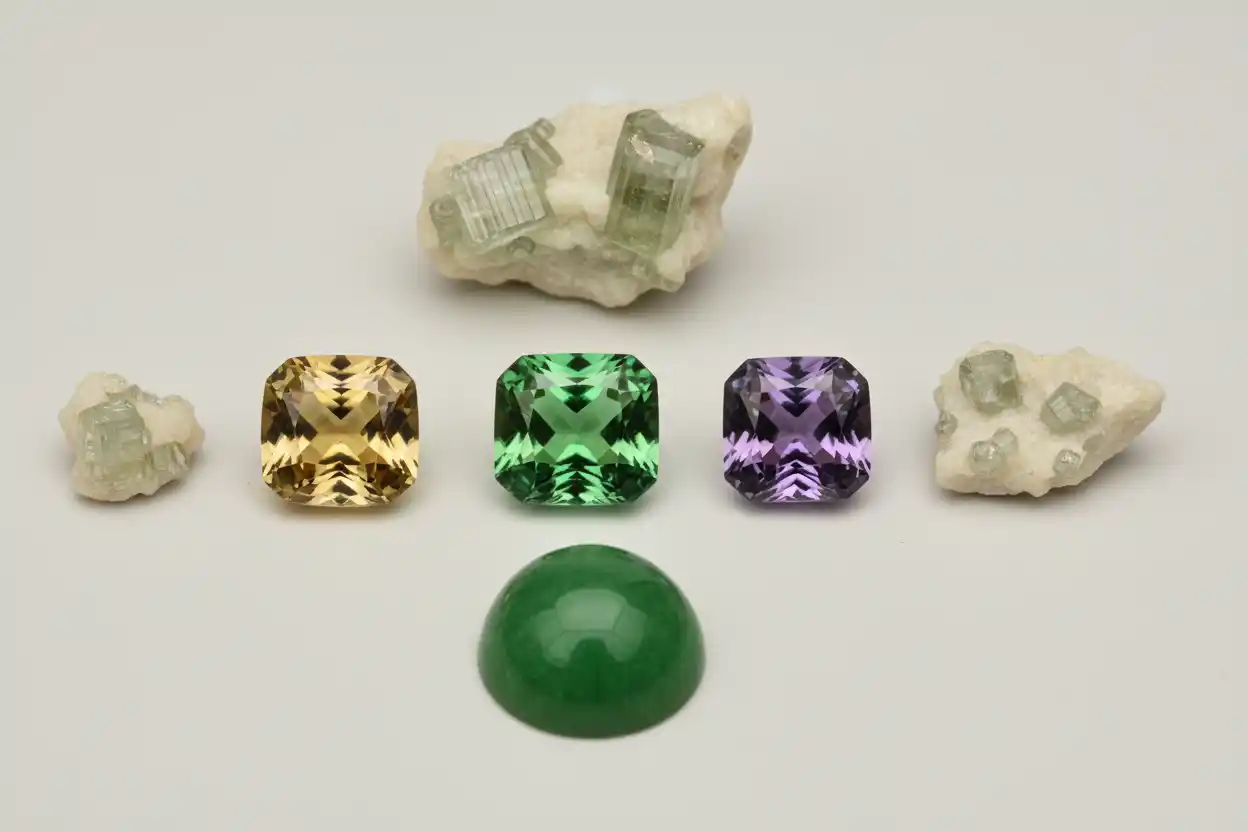
Vesuvianite Meaning, Properties, Varieties and Value
Vesuvianite is a complex calcium-aluminum silicate found chiefly in skarns, metamorphosed limestone and altered ultramafic rocks. It occurs as green, yellow, brown, orange, blue, purple and nearly colorless crystals, as well as opaque jade-like masses used for carvings and cabochons.
The mineral is also known by its historical synonym idocrase. Although transparent vesuvianite can become an attractive faceted gem, much commercial material is translucent or opaque and valued for color, texture and locality rather than brilliance alone.
Vesuvianite at a Glance
| Property | Vesuvianite |
|---|---|
| Mineral group | Vesuvianite group |
| Mineral class | Complex sorosilicate |
| General composition | Calcium-aluminum-magnesium-iron silicate containing hydroxyl and fluorine; composition is variable |
| Common colors | Green, yellow-green, brown, golden, orange, red-brown, blue, violet, purple, pink, white and black |
| Crystal system | Tetragonal |
| Common habit | Short prismatic, long prismatic, pyramidal, columnar, granular and massive |
| Luster | Vitreous to resinous |
| Transparency | Transparent to opaque |
| Refractive index | Commonly approximately 1.70–1.75 |
| Birefringence | Usually low, commonly about 0.004–0.006 |
| Specific gravity | Approximately 3.32–3.43 |
| Optical character | Usually uniaxial, commonly negative; anomalous optical behavior can occur |
| Mohs hardness | Approximately 6–7 |
| Cleavage | Poor to very poor |
| Tenacity | Brittle |
| Common cuts | Ovals, cushions, emerald cuts, cabochons, beads, carvings and tablets |
| Main care concern | Brittle fractures, uneven massive material and possible resin or dye in jade-like products |
What Is Vesuvianite?
Vesuvianite is a mineral species with an unusually complex crystal structure capable of accommodating calcium, aluminum, magnesium, iron, titanium, boron, fluorine and other elements.
Its chemical formula varies across references because natural specimens contain extensive substitutions. This complexity can produce a wide range of colors and optical behavior.
Transparent crystals can be faceted, while massive green material becomes cabochons, beads and carvings. Some massive vesuvianite closely resembles jade, creating both legitimate ornamental uses and misleading trade names.
Within the broader types of gemstones guide, vesuvianite occupies the boundary between collector mineral, faceted gem and ornamental lapidary material.
Vesuvianite and Idocrase
Idocrase is an older name for vesuvianite and remains widely used in gemology and jewelry retail.
The name derives from Greek roots referring to a mixture of forms, reflecting the way vesuvianite crystals can resemble the habits of several other minerals.
Modern mineralogical usage prefers vesuvianite as the species name. The workbook’s alias mapping therefore routes idocrase to this canonical page rather than treating it as a second mineral.
A listing described as green idocrase should identify the same mineral as green vesuvianite, not a separate variety.
Why Is It Called Vesuvianite?
The mineral received its name from Mount Vesuvius in Italy, where early specimens were found in metamorphosed limestone blocks associated with the volcanic complex.
Mount Vesuvius is the type locality, but it is not the principal source of modern jewelry material.
Historical names and variant spellings include idocrase, vessonite and vassolite. Only vesuvianite and idocrase remain widely recognized.
Vesuvianite Colors
Green Vesuvianite
Green is the best-known gem color and ranges from pale yellow-green to olive, forest and emerald green.
Iron, chromium and other trace elements may influence the color. However, exact causes vary among deposits and should not be inferred from appearance alone.
Transparent green crystals can resemble peridot, tourmaline, diopside or garnet. Massive green material may look strikingly similar to jade.
Yellow and Golden Vesuvianite
Yellow material ranges from pale straw to honey, golden brown and orangy yellow. Manganese, iron and structural defects can contribute to these colors.
Transparent golden stones may show good brilliance, although many examples have moderate saturation or visible inclusions.
Brown Vesuvianite
Brown is common in crystals from Mount Vesuvius and several skarn deposits. Colors range from pale cinnamon to dark red-brown and nearly black.
A strong resinous luster can make well-formed brown crystals highly collectible even when they are not facetable.
Purple and Violet Vesuvianite
Purple vesuvianite is uncommon and particularly associated with the former Jeffrey Mine in Quebec, Canada.
Manganese contributes to some pink, purple and reddish colors. Fine transparent material can be attractive when its tone remains bright rather than gray.
Blue Vesuvianite
Blue vesuvianite is rare. Copper-bearing blue material has historically been called cyprine.
Cyprine ranges from pale sky blue to blue-green. The term describes a copper-bearing color variety, not a separate mineral species.
Colorless and White Vesuvianite
Nearly colorless crystals occur but remain unusual in gem material. White massive pieces can contain fine-grained vesuvianite mixed with other skarn minerals.
Californite and “California Jade”
Californite is a trade name for massive, compact, usually green vesuvianite found in California and similar localities.
Because it can be tough-looking, translucent and evenly green, it has been marketed as California jade, American jade or vesuvianite jade.
Those names describe appearance rather than mineral identity. True jade consists of jadeite or nephrite, as explained in the jade meaning guide and types of jade guide.
Californite can be an attractive lapidary material in its own right. Problems arise only when a seller omits the vesuvianite identity and prices it as genuine jadeite or nephrite.
Cyprine, Manganese-Rich Material and Wiluite
Cyprine is the traditional name for blue copper-bearing vesuvianite. The color can overlap blue-green diopside, apatite and tourmaline.
Manganoan vesuvianite describes material containing sufficient manganese to influence pink, red, orange or purple color. It is a compositional description rather than one rigidly standardized gem variety.
Older references sometimes describe wiluite as a vesuvianite variety associated with the Vilyui region of Russia. Modern mineral classification recognizes wiluite as a related species within the vesuvianite group rather than simply an ordinary color variety.
Consequently, a specimen labeled wiluite should not automatically be relabeled vesuvianite without analytical confirmation.
How Vesuvianite Forms
Vesuvianite forms most characteristically in skarns. These rocks develop when hot, chemically active fluids from an intrusion react with limestone, dolomite or other carbonate-rich rocks.
Calcium from the carbonate host combines with silica, aluminum, magnesium and iron introduced or redistributed by the fluids. Vesuvianite crystallizes beside garnet, diopside, wollastonite, calcite and other calcium-rich silicates.
The mineral also occurs in serpentinites and rodingites, where fluid alteration transforms mafic and ultramafic rocks. In those settings, vesuvianite may grow with serpentine, grossular and chlorite.
Temperature, pressure, fluid chemistry and host-rock composition determine whether transparent crystals, coarse granular masses or compact jade-like material forms.
Zoning within crystals can record changing amounts of iron, manganese, chromium or titanium during growth.
Important Vesuvianite Localities
Mount Vesuvius and the Monte Somma complex in Italy remain historically important. Brown and yellow crystals occur in metamorphosed limestone blocks associated with the volcano.
The Jeffrey Mine in Quebec produced world-famous purple, green and multicolored vesuvianite crystals. The mine’s closure has increased collector interest in fine old-stock specimens.
California produced massive green californite as well as crystallized material. The state remains strongly associated with jade-like vesuvianite in the lapidary trade.
Pakistan and Afghanistan produce transparent yellow-green, brown and green crystals from skarn and altered-rock environments.
Kenya and Tanzania have supplied facetable green, yellow and brown vesuvianite. GIA’s reference collection includes cut stones from both countries.
Russia, Norway, Switzerland, Mexico and several other regions contain important specimen localities.
Associated Minerals and Internal Features
Vesuvianite commonly occurs with diopside, grossular garnet, calcite, wollastonite, magnetite, epidote and serpentine.
Transparent stones may contain fluid inclusions, needles, mineral crystals, healed fractures and growth zoning.
Included diopside, grossular, calcite or magnetite can provide clues to a skarn origin. However, inclusion identity requires microscopic or spectroscopic confirmation.
Some crystals show anomalous strain patterns under crossed polarizers despite their expected uniaxial behavior. Fine structural domains and compositional complexity can produce unusual optical effects.
Massive material may contain multiple minerals rather than pure vesuvianite. Those mixed zones cause variations in hardness, transparency and polish.
Identifying Vesuvianite
Gemologists use refractive index, specific gravity, optical character, spectrum, magnification and spectroscopy to identify vesuvianite.
Its refractive index is generally higher than quartz and many feldspars but overlaps some garnets and pyroxenes. Low birefringence helps separate it from strongly doubly refractive peridot.
Transparent vesuvianite is usually uniaxial, whereas garnet is singly refractive and diopside is biaxial.
Massive vesuvianite requires additional care because its structure may be obscured by fine grains and associated minerals. Raman spectroscopy and X-ray diffraction provide strong confirmation.
The crystal identification guide explains why visual resemblance to jade or epidote cannot establish the species.
Vesuvianite Versus Jade
Vesuvianite can closely resemble jade in green massive form. Nevertheless, their mineralogy and internal textures differ.
The jade versus jadeite guide explains that jade is a cultural and gemological term covering jadeite and nephrite rather than one universal mineral.
Jadeite commonly has a granular interlocking texture, while nephrite has a densely fibrous structure. Massive vesuvianite tends to show a different granular or columnar aggregate.
Specific gravity, refractive index and Raman testing separate them. The boundaries between the two real jade materials are covered in jadeite versus nephrite.
Because vesuvianite may be dyed or marketed under jade-like trade names, the warning signs in real versus fake jade and treated jade remain useful.
Other Lookalikes
Epidote
Epidote can share green, yellow-green and brown colors and may form in related metamorphic environments. Epidote is biaxial and commonly shows stronger pleochroism.
Chrome Diopside
Chrome diopside can display a vivid green similar to fine vesuvianite. Diopside has stronger cleavage and different optical properties.
Grossular Garnet
Grossular garnet commonly occurs beside vesuvianite in skarns. Garnet is singly refractive and has no birefringence under normal conditions.
Serpentine
Serpentine is a common jade imitation and can accompany vesuvianite in altered ultramafic rocks. It is generally softer and less dense.
Peridot and Tourmaline
Transparent green vesuvianite may resemble peridot or verdelite. Refractive index, birefringence, pleochroism and inclusions provide reliable separation.
Treatments, Composites and Imitations
Most transparent faceted vesuvianite is sold without routine treatment. Heating does not have an established large-scale role comparable with sapphire or zircon.
Massive californite may be waxed or oiled to deepen color and improve polish. Such surface enhancement can change under heat or solvents.
Porous or fractured material may receive polymer stabilization. Resin supports weak areas but changes the stone’s treatment category and care requirements.
Dye can make pale massive material resemble higher-grade green jade. Color concentrated in fractures, pores and drill holes can reveal the treatment.
Backing and composite construction are possible in cabochons. Thin green material may be attached to a darker base to improve strength or apparent saturation.
Commercial synthetic vesuvianite is not common. Glass, dyed serpentine, synthetic spinel and manufactured composites are more realistic imitations.
Cutting and Polishing Behavior
Transparent crystals are commonly fashioned as ovals, cushions and emerald cuts. Their moderate refractive index creates pleasant brilliance without the extreme fire of zircon or sphene.
Cutters must inspect rough for fractures and dark zones. Excessive depth can make brown or green material appear dull, while shallow cutting creates a window.
Vesuvianite’s relatively low birefringence helps preserve crisp facet reflections. However, internal strain and inclusions can affect polishing and durability.
Massive material becomes cabochons, beads, carvings and tablets. Uneven mineral content may cause softer grains to undercut during polishing.
Californite can produce attractive carvings similar in appearance to jade. The general lapidary considerations are discussed in best gemstones for carving and cabochons.
Compact rough may also become tumbled stones, although fractures and mixed skarn minerals complicate the process described in rock tumbling for beginners.
Hardness, Toughness and Jewelry Suitability
Vesuvianite generally measures 6–7 on the Mohs scale. Its exact performance varies with composition, inclusions and whether the material is a single crystal or polymineralic mass.
The gemstone hardness chart places it below sapphire and many tourmalines but above calcite and fluorite.
Cleavage is poor, yet the mineral remains brittle. Facet edges, corners and thin cabochons can chip under a sharp blow.
Transparent stones work well in earrings, pendants and occasional-wear rings. A bezel or substantial prongs protect the girdle better than a highly exposed setting.
Massive vesuvianite is more practical for beads, pendants and carvings than for thin rings. Mixed mineral boundaries may fracture after repeated impact.
Vesuvianite Prices in 2026
Ordinary massive vesuvianite cabochons commonly retail for approximately $3–$15 per carat. Attractive californite, patterned material and well-finished designer stones may range from $15–$50 per carat.
Commercial faceted green, yellow or brown vesuvianite commonly falls around $25–$100 per carat.
Fine transparent stones with strong color and good clarity may range from approximately $100–$300 per carat. Uncommon vivid purple, blue or exceptionally clean gems can exceed $300–$700 per carat.
Current 2026 retail value indexes place common faceted vesuvianite in broad ranges near roughly $50–$240 per carat, depending on color and size, while specialist sources report substantially higher prices for rare premium material.
Small mineral specimens may cost $20–$75. Fine Jeffrey Mine or classic European pieces commonly reach $100–$500, while exceptional large crystals and historic old-stock specimens can exceed $1,000.
What Determines Vesuvianite Value?
Transparent gems are judged primarily by color, clarity, cut and size. Bright green, vivid yellow-green, purple and blue material generally attracts the strongest interest.
Tone must remain open enough to show internal brilliance. Dark brownish or nearly black stones receive lower gem prices unless their crystal form has specimen value.
Clarity matters, although collectors may accept interesting inclusions. Surface-reaching fractures and large opaque zones reduce jewelry value.
For massive californite, even color, translucency and carving quality matter more than carat weight. Fine-grained material that polishes evenly is preferable to fractured mixed rock.
Locality strongly affects mineral specimens. Documented Jeffrey Mine material can receive a premium because the locality is closed and supplied unusual purple and green crystals.
Buying Guidance
Confirm whether the seller is offering transparent vesuvianite, massive californite or a mixed skarn rock. Those materials should not share one pricing standard.
Ask whether idocrase is being used as a synonym or as a vague marketing name. A knowledgeable seller should understand that idocrase and vesuvianite refer to the same mineral.
Green massive material sold as California jade must be disclosed as vesuvianite. Use the verification principles in the jade buying guide without assuming jade quality grades apply to californite.
Inspect faceted stones for windowing, extinction, chips and fractures. Meanwhile, cabochons require examination for dye, resin, backing and uneven polish.
A laboratory report is worthwhile for expensive blue, purple or unusually transparent material and for any piece sold as genuine jade rather than vesuvianite.
Cleaning, Water, Heat and Sunlight
Clean sound untreated vesuvianite with lukewarm water, mild soap and a soft brush. Rinse briefly and dry thoroughly.
Massive mixed material may contain calcite, serpentine or other associated minerals with different chemical sensitivities. Consequently, avoid acids and jewelry dips.
Brief water contact is normally acceptable for solid untreated vesuvianite. Prolonged soaking is unnecessary, particularly when resin, dye, backing or glue may be present.
The general water-safe crystal guide explains why treatment and associated minerals must be considered.
Avoid ultrasonic and steam cleaning when fractures or inclusions are visible. Heat can extend cracks and damage resin or wax.
Natural colors are generally stable in ordinary light. Still, intense sunlight can heat a display, disturb surface treatments and weaken adhesive, so follow conservative guidance from the sunlight-fading guide.
For belief-based cleansing, dry methods from how to cleanse crystals are safer than chemical solutions or extended saltwater immersion.
Store each piece separately from harder stones. Support large crystals by their matrix rather than handling them by a termination.
Meaning and Symbolism
Modern crystal traditions often associate vesuvianite with determination, adaptability, courage and constructive change.
Its geological formation in reactive metamorphic environments encourages symbolism involving transformation under pressure and the reorganization of old patterns.
Green material is frequently connected with renewal and practical growth, while purple vesuvianite may receive modern associations with imagination and personal insight.
These meanings are cultural, spiritual or personal interpretations rather than scientifically established properties. Vesuvianite should not replace qualified medical or psychological care.
The mineral may appear in collections of green crystals, though color symbolism does not establish mineral identity.
Frequently Asked Questions
1. Is idocrase the same as vesuvianite?
Yes. Idocrase is an older synonym still used in gemology and jewelry retail. Vesuvianite is the preferred modern mineral name.
2. Is vesuvianite a type of jade?
No. Massive green vesuvianite may resemble jade and is sometimes sold as californite or California jade, but it is neither jadeite nor nephrite.
3. What is californite?
Californite is a trade name for compact, usually green, jade-like vesuvianite associated with California and similar material.
4. What is cyprine vesuvianite?
Cyprine is a rare blue or blue-green copper-bearing variety of vesuvianite.
5. Where does vesuvianite form?
It forms mainly in skarns created when hot fluids react with limestone or dolomite. It also occurs in serpentinites, rodingites and other metamorphosed rocks.
6. Why does vesuvianite have so many colors?
Its complex structure accepts numerous elements, including iron, manganese, chromium, copper and titanium, which influence color.
7. How can vesuvianite be distinguished from jade?
Refractive index, specific gravity, microscopy and Raman spectroscopy separate the minerals. Vesuvianite lacks jadeite’s granular and nephrite’s fibrous internal structures.
8. Is vesuvianite normally treated?
Transparent faceted material is usually untreated. Massive material may be waxed, dyed, stabilized or backed, particularly when sold as a jade substitute.
9. Is vesuvianite suitable for an everyday ring?
A clean faceted stone can work in a protective setting, but its brittleness makes earrings and pendants safer for frequent wear.
10. Can vesuvianite go in water?
Brief washing is generally safe for sound untreated material. Avoid soaking mixed, stabilized, dyed or glued pieces.
11. How much does vesuvianite cost?
Commercial faceted stones often sell for $25–$100 per carat, while fine transparent material may reach $100–$300 per carat. Rare premium colors can exceed $700 per carat.
12. Does vesuvianite have scientifically proven healing properties?
No. Its symbolic interpretations may have personal or cultural meaning, but scientific research has not established healing effects.
Vesuvianite deserves recognition beyond its role as a jade lookalike. Transparent crystals reveal the complexity of skarn mineral formation, while massive californite offers a distinctive lapidary material whose value should rest on its own identity rather than an inaccurate jade label.
Vesuvianite appears in Crystals That Start With V and Gemstones That Start With V.