Wavellite Meaning, Properties, Value and Identification
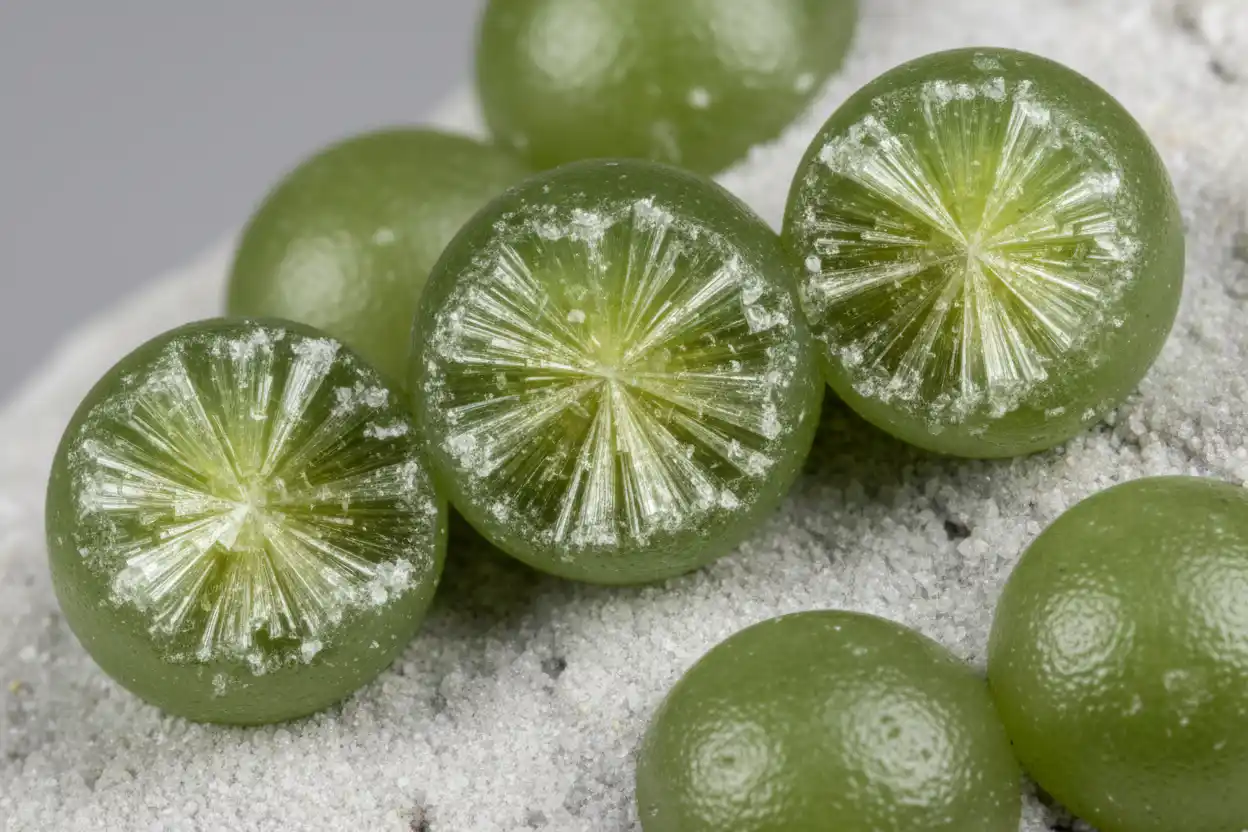
Wavellite is a hydrated aluminum phosphate famous for forming rounded green hemispheres composed of crystals that radiate from a central point. When a nodule is broken or cut, its interior can reveal a striking starburst pattern resembling spokes, petals or a sliced citrus fruit.
Although compact material can be polished, wavellite is primarily a mineral specimen rather than a durable jewelry stone. Its softness, cleavage and fibrous structure distinguish it from conventional transparent gems in the types of gemstones guide.
Wavellite at a Glance
| Property | Wavellite |
|---|---|
| Mineral class | Hydrated phosphate |
| General formula | Al₃(PO₄)₂(OH,F)₃·5H₂O |
| Principal metal | Aluminum |
| Common colors | Green, yellow-green, blue-green, colorless, white, brown and dark brown |
| Crystal system | Orthorhombic |
| Common habit | Radial sprays, hemispheres, botryoidal crusts, stalactitic growths and rare prismatic crystals |
| Luster | Vitreous to pearly |
| Transparency | Transparent in rare crystals; commonly translucent |
| Refractive indices | Approximately 1.52–1.56 |
| Birefringence | Approximately 0.025–0.026 |
| Optical character | Biaxial positive |
| Specific gravity | About 2.3–2.4 |
| Mohs hardness | Approximately 3.5–4 |
| Cleavage | Perfect in one direction and good in another |
| Tenacity | Brittle |
| Common use | Mineral specimens, polished sections, occasional cabochons and carvings |
| Main care concern | Radial fibers, cleavage and soft surfaces can chip, separate and trap dirt |
What Is Wavellite?
Wavellite is a hydrated aluminum phosphate containing hydroxyl and variable fluorine. Its most recognizable specimens consist of numerous needle-like crystals arranged radially.
The separate crystals may be too small to see without magnification, yet their alignment creates a distinctive internal structure. A broken hemisphere often shows rays extending from its center to the outer surface.
This structure gives wavellite its collector appeal but also makes it mechanically vulnerable. Impact can separate entire wedges or peel the outer crust from its matrix.
Its mineral identity differs from the related green phosphate variscite, even though both occur in similar colors and near-surface geological environments.
How Wavellite Got Its Name
Wavellite was named after William Wavell, who discovered the mineral in Devon, England. The classic locality lies near Barnstaple.
The mineral was formally recognized during the early nineteenth century. Its name does not refer to wavy color bands or water-like patterns, despite the convenient visual association.
“Radiating wavellite,” “botryoidal wavellite” and “starburst wavellite” describe crystal habit rather than separate species.
Trade descriptions such as emerald wavellite or ocean wavellite are promotional color labels without formal mineralogical boundaries.
Wavellite Colors
Apple-Green Wavellite
Apple green is the most familiar color in the collector market. Fine specimens show lively saturation and clear radial structure without a muddy brown coating.
The color can vary across one hemisphere, creating darker outer layers and a paler center.
Yellow-Green Wavellite
Yellow-green material is common in Arkansas and other deposits. Warm tones may reflect iron-related impurities, associated minerals or changes in crystal chemistry.
Bright yellow-green specimens can be attractive, although brown staining often lowers visual quality.
Blue-Green Wavellite
Blue-green and teal material is less common and can command a premium when the color is natural and the surface remains lustrous.
Photographs can exaggerate blue components through cool lighting. Buyers should request neutral-light images before paying a substantial color premium.
Colorless and White Wavellite
Rare individual crystals may be colorless or nearly white. White radial aggregates also occur where trace-element coloration is minimal.
Pale material can resemble gypsum, calcite or colorless phosphate minerals, requiring optical or spectroscopic testing.
Brown and Dark Wavellite
Iron oxides, alteration and inclusions can create brown, reddish-brown or nearly black areas. Some dark specimens reveal green radial interiors after cutting.
Dark color is not automatically evidence of treatment. However, surface coatings can obscure the natural luster and structure.
Radial, Botryoidal and Starburst Forms
Radial Hemispheres
The classic wavellite form begins at a nucleation point and grows outward as numerous acicular crystals. A complete sphere may form in a cavity, while growth on a rock surface usually produces a hemisphere.
The outer surface can appear smooth, bubbly or finely sparkling. Broken examples expose the internal rays.
Botryoidal Crusts
Closely packed hemispheres create botryoidal surfaces resembling clusters of grapes. Fine specimens cover a large area with evenly sized green domes.
Coverage, color and surface integrity all influence collector value.
Stalactitic Wavellite
Some deposits produce pendant or columnar growths. Their interiors retain the same radial structure around a central axis.
Stalactitic pieces are uncommon and can be fragile where the column joins the matrix.
Prismatic Crystals
Distinct prismatic crystals occur but are much less common than radial aggregates. They may form small sprays or isolated transparent crystals.
Well-developed individual crystals are valued by systematic mineral collectors even when their color is less vivid than common green hemispheres.
How Wavellite Forms
Wavellite is a secondary mineral. It forms when phosphate-bearing groundwater reacts with aluminum-rich rocks, clay minerals or weathered phosphatic material.
Acidic water can leach phosphate from one part of a rock and redeposit it where aluminum becomes available. The mineral then grows along fractures, bedding planes and cavity surfaces.
Wavellite also occurs in aluminous low-grade metamorphic rocks and weathered phosphate deposits. Its formation temperature is far lower than that of most pegmatite gems.
The broad phosphate relationship connects it with apatite and the varieties covered in types of apatite, although wavellite’s hydration, softness and radial habit remain distinct.
Iron-rich reducing conditions can instead favor vivianite, while different aluminum-phosphate chemistry produces variscite.
Arkansas Wavellite
Arkansas is one of the world’s best-known sources of collector wavellite. Green hemispheres occur in fractures and cavities within the Arkansas Novaculite and associated rocks.
The Avant and Mauldin Mountain areas have supplied particularly attractive specimens. Individual pockets can differ markedly in color, hemisphere size, luster and matrix.
Mining often requires careful removal of hard novaculite around fragile wavellite surfaces. Consequently, freshly recovered specimens may show contact damage or repaired matrix.
Arkansas material ranges from pale yellow-green crusts to rich teal and dark green botryoidal pieces. Old-stock specimens from depleted pockets can receive a provenance premium.
Other Important Localities
Devon, England, is historically important as the type area. British material includes pale green, yellow and colorless radial aggregates.
Australia has produced green and yellow-green crystal sprays, including material from South Australia and Western Australia.
Bolivia supplies vivid green botryoidal specimens, while Brazil, Germany, Ireland, Portugal and the Czech Republic contain notable occurrences.
United States localities outside Arkansas include Pennsylvania, Alabama, Nevada, California and several additional phosphate-bearing districts.
Locality labels should be preserved because similar-looking specimens can have very different geological and collector significance.
Internal Structure and Inclusions
Wavellite’s most important internal feature is its radial architecture. Fine needles extend outward from a central point, producing spokes visible in broken or polished sections.
Color bands may cross those rays as trace-element concentrations change during growth. A hemisphere can therefore display alternating green, yellow and pale zones.
Iron oxides, clay, quartz, crandallite, variscite and other phosphates may occupy spaces between crystal bundles.
Small cavities and fractures can trap dirt, polishing compound and adhesive. Once contamination enters the radial spaces, it can be difficult to remove safely.
Some wavellite fluoresces under ultraviolet light in pale blue, yellow or mixed colors. The response varies and should not be used as a stand-alone identification test.
How to Identify Wavellite
A radial starburst exposed in a broken nodule is one of the strongest visual indicators. Nevertheless, several minerals form spherical or fibrous aggregates, so structure alone is not conclusive.
Wavellite is softer than quartz and most conventional jewelry gems. Its position around 3.5–4 on the gemstone hardness chart explains why metal, grit and harder specimens can scratch it.
Cleavage adds a second damage mechanism. The distinction in gemstone toughness versus hardness is useful because wavellite can split along crystal directions even when its surface has not been heavily scratched.
A gemologist or mineral laboratory may use refractive-index measurements, Raman spectroscopy, infrared spectroscopy, X-ray diffraction and chemical analysis.
The broader crystal identification guide explains why a green botryoidal surface should not be identified from photographs alone.
Wavellite Versus Variscite
Both minerals are hydrated aluminum phosphates and can appear apple green, yellow-green or blue-green.
Variscite is commonly massive, nodular or vein-forming, with a waxy polished surface. Wavellite more often shows visible radial fibers, hemispheres and starburst interiors.
Their hardness values overlap enough that scratch testing provides limited help. Raman or X-ray analysis offers a more dependable distinction.
Mixed phosphate deposits can contain both minerals. A cabochon may therefore include wavellite, variscite and associated material rather than one perfectly pure phase.
Wavellite Versus Turquoise
Turquoise contains copper and aluminum, while wavellite lacks essential copper.
Turquoise commonly forms compact opaque veins and nodules. Wavellite’s fibrous radial structure is usually more obvious, particularly on natural specimen surfaces.
Green turquoise can resemble polished wavellite, especially after stabilization. The checks in real versus fake turquoise help identify common imitations, but laboratory testing is needed when the mineral itself remains uncertain.
Wavellite should not be marketed as Arkansas turquoise merely because both materials can be green and come from the United States.
Other Lookalikes
Prehnite can form pale green botryoidal surfaces but is harder and commonly has a different translucent, internally crystalline appearance.
Smithsonite may occur as blue-green or apple-green botryoidal crusts. Its greater density, carbonate chemistry and different optical properties separate it from wavellite.
Hemimorphite can also form pale blue or green botryoidal material. It commonly occurs in zinc deposits rather than aluminum-rich phosphate settings.
Calcite forms radial and botryoidal aggregates in many colors but reacts strongly with dilute acid and has different cleavage.
Dyed quartz drusy may imitate a sparkling green surface. Hexagonal quartz points and concentrated artificial color distinguish it from wavellite’s acicular radial crystals.
Treatments, Synthetics and Imitations
Most collector wavellite is untreated. Its natural color and unusual growth form create its value.
Wax or oil may deepen green color and improve surface contrast. These coatings can attract dust and should be disclosed when they materially change appearance.
Resin may stabilize fractured matrix or secure a thin botryoidal crust. Repairs are common enough in large display pieces that buyers should ask directly about adhesive.
Dye can enhance pale or porous material, although it is not considered a standard treatment. Unnatural color concentration in cracks and cavities is a warning sign.
Laboratory-grown wavellite has scientific relevance but no meaningful commercial gem market. Resin castings, dyed minerals and mislabeled botryoidal specimens are more likely imitations.
The terminology in gemstone treatments explained helps distinguish a repaired natural specimen from a reconstructed or manufactured object.
Cutting and Polishing Behavior
Compact wavellite can be cut into cabochons and polished sections, particularly when a radial interior creates an attractive pattern.
The cutter must orient the slice through the center of a hemisphere to reveal a balanced starburst. An off-center cut produces uneven rays.
Softness makes shaping easy, but cleavage and fibrous structure cause undercutting. Crystal bundles may separate or leave pits during polishing.
Resin stabilization may be necessary when the radial aggregate is fractured. The treatment should be disclosed because it affects value and care.
Wavellite is not among the easiest materials covered in best gemstones for carving and cabochons. Its softness and fiber boundaries require more support than compact quartz.
Although polished pieces appear among tumbled stones, wavellite is a poor choice for the ordinary process described in rock tumbling for beginners. It can bruise, split and contaminate harder material.
Durability and Jewelry Suitability
Wavellite is too soft for exposed everyday rings. Its surface scratches easily, while impact can detach radial segments.
Cabochons may work in pendants, earrings or brooches when protected by a bezel. The wearer should still avoid contact with clothing fasteners, cosmetics and hard surfaces.
Bracelets are not recommended because repeated impact and skin exposure can dull the polish or loosen fibers.
Natural botryoidal specimen surfaces should not be mounted in wearable jewelry unless enclosed behind a protective cover. Tiny crystal tips readily collect dirt and break.
A display box or cabinet remains the best setting for high-quality radial material.
Wavellite Prices in 2026
Small common Arkansas or worldwide specimens commonly retail for approximately $15–$50. A current specialist listing places an attractive small Arkansas miniature around $45.
Better miniatures with rich green color and clear hemispheres often range from $50–$200.
Large, evenly covered specimens with strong luster and desirable teal or blue-green color may sell for $200–$1,000. Exceptional old-stock Arkansas pieces have been offered around or above $1,000.
Simple polished cabochons commonly cost $20–$100, while large centered starburst cuts and designer pieces may reach $100–$300.
Museum-quality specimens with uncommon color, large intact spheres or important provenance can exceed the broad ranges. Damage and repair history substantially affect the final price.
What Determines Wavellite Value?
Color is important, with bright apple green, deep green and uncommon teal-blue material receiving the strongest attention.
Crystal architecture matters just as much. Clearly defined hemispheres, sharp radial fibers and a broad undamaged surface add value.
Luster distinguishes fine material from dull weathered crusts. A glossy or pearly surface reflects light more effectively across the rounded forms.
Matrix can improve contrast, particularly when pale novaculite surrounds vivid green wavellite. Excess matrix that hides the mineral adds weight but not necessarily value.
Condition and repair disclosure are essential. Missing domes, crushed crystal surfaces and undisclosed adhesive reduce collector value.
Buying Guidance
Request photographs in neutral light from several angles. Saturated green editing can hide dull surfaces and brown staining.
For natural specimens, inspect the edges of each hemisphere for chips and detached segments. A surface that looks intact from the front may have significant side damage.
Ask whether the matrix has been repaired or reconstructed. Large Arkansas specimens sometimes require stabilization after extraction from hard host rock.
For polished material, look for a centered radial pattern, even polish and limited resin-filled voids.
Preserve any old labels. Precise mine and pocket information can be more valuable than a broad “Arkansas” origin.
Cleaning, Water, Heat and Sunlight
Remove loose dust with a hand air blower or a very soft artist’s brush. Avoid pressing bristles between radial fibers.
Brief contact with clean lukewarm water may be acceptable for compact untreated material, but soaking is not recommended.
The broad water guidance in which crystals can and cannot go in water should be modified for the specimen’s matrix, repairs and porosity.
Do not use ultrasonic or steam cleaners. Vibration can separate fibers, while heat can affect structural water, resin and adhesive.
Avoid acids, bleach, ammonia and jewelry dips. Phosphate minerals and associated matrix may react unpredictably.
Most natural wavellite colors are reasonably stable under ordinary indoor light. Nevertheless, direct sunlight can heat the specimen and weaken resin or glue, so follow conservative guidance from crystals that fade in sunlight.
For personal cleansing practices, choose dry, contact-free methods from how to cleanse crystals.
Meaning and Symbolism
Modern crystal traditions often associate wavellite with cooperation, fresh perspective, emotional organization and gradual personal growth.
Its crystals radiate outward from one center, encouraging symbolism involving individual efforts contributing to a larger whole.
Green material is also linked in contemporary practice with renewal, patience and connection with nature, while yellow-green pieces may be associated with optimism and learning.
These meanings are cultural, spiritual or personal interpretations rather than scientifically demonstrated effects.
Wavellite can also be included in modern collections of green crystals and yellow crystals, though color symbolism does not establish mineral identity.
Frequently Asked Questions
1. Is wavellite a mineral or a rock?
Wavellite is a recognized mineral species. Most specimens consist of many tiny wavellite crystals growing together on rock matrix.
2. Why does wavellite form starburst patterns?
Needle-like crystals grow outward from a shared center. A broken or polished hemisphere exposes the radial arrangement.
3. Is wavellite always green?
No. It also occurs in yellow-green, blue-green, colorless, white, brown and dark material, although green is the best-known color.
4. Is Arkansas wavellite rare?
Wavellite itself occurs worldwide, but fine Arkansas specimens with vivid color, strong luster and intact hemispheres are collectible and can be expensive.
5. Is wavellite the same as variscite?
No. Both are hydrated aluminum phosphates, but they have different structures and typical growth habits.
6. Can wavellite be confused with turquoise?
Yes, especially when polished. Turquoise contains copper and is usually more compact, while wavellite commonly has a radial fibrous structure.
7. Does wavellite fluoresce under ultraviolet light?
Some specimens show pale blue, yellow or mixed fluorescence. The response varies and cannot confirm identity by itself.
8. Is wavellite normally treated?
Most mineral specimens are untreated, although wax, resin, dye and matrix repairs may occur.
9. Can wavellite be worn in a ring?
It is not recommended for an exposed ring because its softness, cleavage and radial structure make it vulnerable to scratches and impact.
10. Can wavellite go in water?
Brief gentle rinsing may be acceptable for sound untreated material, but soaking should be avoided, especially when the specimen is porous or repaired.
11. How much is wavellite worth?
Small specimens often cost $15–$50, while fine collector pieces range from hundreds of dollars to $1,000 or more.
12. Does wavellite have scientifically proven healing properties?
No. Its symbolism may have personal meaning, but scientific research does not establish healing effects from the mineral.
Wavellite’s appeal lies in its architecture as much as its color. An intact hemisphere records thousands of small crystals growing outward in coordinated directions, while a polished cross-section reveals the hidden radial structure that makes the mineral immediately recognizable.
Wavellite appears in Crystals That Start With W.