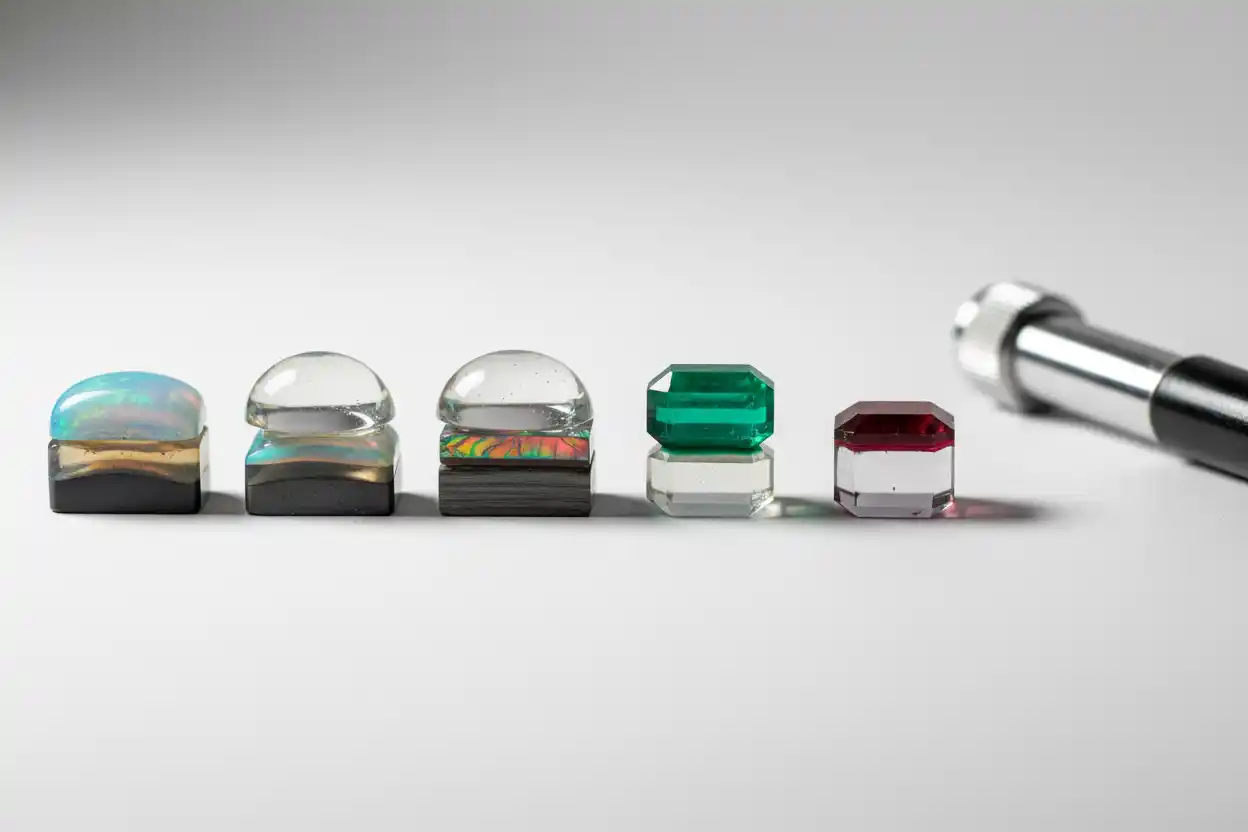
Gemstone Doublets and Triplets: Spotting Composites
A gemstone doublet consists of two joined sections. A triplet contains three sections or, in some gemological usage, two solid parts separated by a distinct colored bonding layer. Composite or assembled stone is the broader term for a gem object constructed from two or more previously separate components.
The components may be natural, synthetic, glass, plastic, resin, host rock, or combinations of these materials. Some composites make thin natural gem layers durable enough for jewelry. Others imitate a rarer or more valuable gemstone.
A properly disclosed opal doublet or ammolite triplet is not automatically fraudulent. The problem arises when a composite is sold as a solid natural gemstone or its natural component is used to describe the entire assembled object.
Doublets, Triplets, and Composites at a Glance
| Term | Basic construction | Common purpose |
|---|---|---|
| Doublet | Two joined components | Reinforce a thin gem layer, deepen color, or imitate another stone |
| Triplet | Three components or two solid sections with a separate colored layer | Add protection, backing, color, or deceptive appearance |
| Composite stone | Broad term for two or more assembled components | Covers doublets, triplets, mosaics, and complex constructions |
| Assembled stone | Another term for a composite | Emphasizes that separate parts were joined |
| Opal doublet | Thin natural opal bonded to a base | Makes a thin color bar wearable and appears darker |
| Opal triplet | Thin natural opal between a dark base and clear protective cap | Increases durability and intensifies apparent play-of-color |
| Ammolite doublet | Ammolite layer attached to backing | Supports fragile shell material |
| Ammolite triplet | Ammolite between backing and transparent cap | Adds protection above and support below |
| Garnet-glass doublet | Natural garnet crown joined to glass pavilion | Imitates ruby, sapphire, emerald, or another colored gem |
| Emerald composite | Beryl, glass, synthetic, or natural sections joined together | Creates emerald-like color and apparent inclusions |
| Mosaic | Multiple pieces placed side by side | Creates a larger image, pattern, or apparent stone |
A Composite Is Not the Same as a Treated Solid Stone
A treated gemstone remains one principal piece of material whose appearance or durability was modified.
A doublet or triplet is physically assembled from separate components.
For example:
- An oiled emerald is treated but not necessarily composite.
- A natural emerald crown bonded to glass is a doublet.
- An impregnated opal is treated.
- An opal slice bonded to black backing is a doublet.
- A coated topaz has an applied surface film but is not usually called a doublet.
- A ruby-glass composite may contain a complex network of corundum and glass rather than two simple layers.
The gemstone treatments guide explains heat, oiling, filling, coating, diffusion, irradiation, and impregnation separately.
A Composite Is Not Automatically an Imitation
Some composites contain a genuine natural gemstone layer and are sold for practical reasons.
Thin opal or ammolite may be too fragile or too shallow to use alone. Backing supports it, while a transparent cap can protect the surface.
Nevertheless, the assembled product is not equivalent to a solid natural stone. Its value, care, thickness, repair options, and resale market differ.
Other composites are deliberately designed to imitate a more valuable gem. Historical and modern examples include garnet-and-glass doublets, synthetic corundum combinations, emerald-like triplets, star-stone composites, and quartz assemblies.
Disclosure determines whether the buyer understands what is being purchased.
How Opal Doublets Are Constructed
An opal doublet normally contains a thin natural opal layer bonded to a dark base.
The base may be:
- Black potch
- Ironstone
- Chalcedony
- Onyx
- Glass
- Plastic
- Another dark material
The backing supports the thin opal and creates a darker background, often making play-of-color appear stronger.
The opal buying guide explains why solid, boulder, matrix, doublet, and triplet categories should be evaluated separately.
An opal doublet can be beautiful and economical. However, the seller should state that only the upper color layer is opal and identify the backing when known.
How Opal Triplets Are Constructed
An opal triplet generally contains:
- A dark supporting base
- A very thin natural opal layer
- A transparent domed cap
The cap may consist of quartz, glass, synthetic corundum, plastic, or another transparent material.
The dome can magnify the play-of-color and protect the thin opal. Consequently, a triplet may display a stronger apparent color pattern than the natural layer would show on its own.
The dedicated real-versus-fake opal guide owns the complete comparison among solid opal, doublets, triplets, synthetic opal, treated material, and imitations.
Doublet or Solid Boulder Opal?
Boulder opal forms naturally as precious opal attached to its ironstone host.
A properly cut boulder opal is not automatically a doublet because the opal and host rock formed together rather than being bonded after mining.
The boulder opal buying guide explains how to distinguish natural ironstone attachment from an adhesive join.
Inspect the side. Natural boulder opal commonly has an irregular transition between opal and host rock. A doublet often shows a flatter, more uniform bonding plane.
However, polished edges and complex natural seams can make visual interpretation difficult.
Black Opal and Dark Backing
A pale or crystal opal layer can appear darker and more intense when attached to a black base.
That does not make the finished object a natural black opal. The backing creates or strengthens the dark body appearance.
The black opal buying guide should be used when comparing solid dark opal with backed composite material.
A listing should not use black opal as the headline description while hiding the word doublet or triplet in small print.
Treated Opal Versus Assembled Opal
Opal can be smoke treated, sugar-acid treated, dyed, impregnated, coated, or assembled.
A stone may also combine treatment and assembly. For example, an opal layer might be treated before being bonded to backing.
The treated opal guide owns the detailed treatment-detection scope, while the types of opal guide explains the major natural body types and commercial categories.
Ask both questions:
- Is the item solid or assembled?
- Has any component been treated?
Ammolite Doublets and Triplets
Ammolite consists of iridescent fossil ammonite shell material that can be thin and fragile.
A doublet usually bonds ammolite to a supporting base. A triplet adds a transparent protective cap.
The ammolite buying guide explains how color range, brightness, pattern, thickness, stabilization, backing, and cap material influence quality.
The ammolite price guide should be used for value context because a solid natural piece, doublet, and triplet cannot share one price structure.
A cap may protect the iridescent layer, but it also means the visible dome is not ammolite itself.
Garnet-and-Glass Doublets
Garnet-and-glass doublets were historically used to imitate ruby, sapphire, emerald, and other colored stones.
A natural garnet crown may be bonded to a colored-glass pavilion. Viewed face-up, the garnet supplies a durable polished surface and attractive luster, while the glass provides most of the apparent color.
Warning signs can include:
- A straight join near the girdle
- Different luster above and below the join
- Bubbles in the glass section
- Color concentrated in the pavilion
- A red or orange ring effect
- Different wear patterns
- Inclusions restricted to one section
Mounted examples can be difficult to identify when the join is hidden by a bezel.
Corundum and Synthetic Assemblages
Natural sapphire may be joined to synthetic ruby or synthetic sapphire. Synthetic spinel sections can also be bonded together with colorless or colored cement.
A natural upper component does not make the entire object a natural sapphire or ruby.
The seller should identify the components and the assembled construction, not merely the most valuable layer.
The ruby buying guide and sapphire buying guide explain why natural or laboratory-grown origin, treatment, and composite construction must be separated.
Emerald Doublets and Triplets
Emerald-like composites can be constructed from:
- Natural emerald and glass
- Pale beryl with colored cement
- Two natural emerald sections
- Quartz and colored glass
- Synthetic spinel
- Layered glass
- Other natural and artificial components
Some examples contain natural-looking inclusions in one or more sections. Therefore, seeing an emerald-type inclusion does not prove that the entire stone is solid natural emerald.
A flat separation plane, bubbles, colored adhesive, mismatched inclusions, or different fluorescence across the stone can reveal the assembly.
The emerald buying guide should be used for treatment, clarity enhancement, color, origin, and buying criteria after construction has been established.
Star and Cat’s-Eye Composites
Asterism and chatoyancy can be imitated or strengthened through assembled constructions.
Possible methods include:
- Attaching a natural or synthetic star-producing layer
- Engraving lines beneath a cabochon
- Using patterned foil
- Bonding a thin phenomenal layer to backing
- Creating a cap over an artificial pattern
The star or eye should move naturally with the light and appear to originate within the material.
A convincing optical effect is not enough to prove that the stone is solid or natural.
How to Spot a Doublet From the Side
The side profile often provides the easiest initial evidence.
Look for:
- A straight horizontal join
- A change in bodycolor
- Different facet wear
- A thin dark base
- A transparent cap
- Glue residue
- A layer with different luster
- Bubbles along a boundary
- A sudden change in inclusions
- A seam hidden just above or below the girdle
Use diffused reflected light first, then transmitted light. Rotate the stone rather than inspecting one fixed angle.
A loupe may reveal obvious construction, but the absence of a visible line does not prove that the gem is solid.
Check the Girdle
Manufacturers may position the join at or near the girdle because a setting can hide it.
Inspect the full circumference. A seam may appear only on one side if the layers were cut at an angle.
Warning signs include:
- A polished line crossing several facets
- Different colors above and below the girdle
- Cement protruding from the seam
- A change in surface texture
- Small chips exposing another material
- Abrasion limited to one component
A closed-back mounting can conceal the most useful evidence.
Look for Bubbles and Cement
Flattened gas bubbles can occur within an adhesive layer. Rounded bubbles may appear in glass components.
Colored cement can supply most of the face-up hue while the solid components remain pale or colorless.
However, bubbles are not present in every composite, and natural fluid inclusions can also appear bubble-like.
Use several features together rather than treating one bubble as conclusive proof.
Follow Inclusions Across the Boundary
In a solid natural stone, an inclusion or growth structure may continue through the area where a suspected join appears.
In a composite, inclusions generally stop at the boundary because the two pieces formed separately.
Ask whether:
- Needles cross the plane
- Fractures continue through both components
- Growth zoning changes abruptly
- One section is inclusion rich and the other clean
- Fluorescence differs sharply
- Refractive behavior changes
Professional microscopy is valuable when the assembly uses two sections of the same mineral.
Observe Color Concentration
A colored adhesive layer can make the entire stone appear saturated when viewed face-up.
Tilt the gemstone and examine it through the crown and pavilion. The color may appear concentrated along one narrow plane.
In an emerald imitation, the crown and pavilion might look nearly colorless from the side while the face-up stone appears vivid green.
Likewise, a dark backing can transform pale opal into a black-opal-like appearance.
Check Surface Luster
Different materials can polish to different lusters.
A glass pavilion may look softer or more worn than a garnet crown. A quartz cap may resist scratching differently from the natural opal beneath it.
Nevertheless, modern composites can use materials with similar optical properties, making luster differences subtle.
Surface examination is a screening method, not a substitute for testing.
Ultraviolet and Optical Differences
Separate components may react differently under ultraviolet light.
One section might fluoresce while another remains inert. A sharp fluorescence boundary can support composite identification.
Gemologists may also use refractive indices, spectroscopy, polarization, microscopy, immersion, Raman analysis, and other methods to identify each component.
Home ultraviolet observations should not be treated as conclusive because fluorescence varies naturally and can be affected by treatments.
Mounted Doublets Are Harder to Detect
A bezel, closed back, dark lining, or decorative gallery can hide the join.
The setting may also prevent accurate refractive testing or inspection of the pavilion.
Ask for pre-setting photographs, previous reports, or permission for independent examination. Removing a fragile composite from its setting can damage the adhesive or thin gem layer, so disassembly should not be attempted casually.
The gemstone certification guide explains which laboratory service is appropriate for unusual or mounted material.
Read the Report Wording Exactly
A laboratory may describe an assembled object by listing the materials in order from the top downward.
Examples could include:
- Opal doublet
- Opal triplet
- Garnet/glass doublet
- Emerald/glass doublet
- Quartz/glass triplet
- Composite ruby and glass
- Ammolite triplet
The report should not be paraphrased as natural opal, natural emerald, or ruby when the construction is composite.
Use how to read a gem lab report to match the report number, measurements, shape, photograph, and comments to the object.
How Composites Affect Value
A doublet or triplet normally contains less natural gem material than a visually similar solid stone.
Value can still reflect:
- Quality of the natural layer
- Color and phenomenon
- Construction precision
- Cap quality
- Backing durability
- Design
- Brand
- Craftsmanship
- Age and historical interest
- Condition
However, composite pricing should not be compared directly with solid-natural price-per-carat figures.
The opal price guide and ammolite price guide retain their dedicated material-specific value scopes.
Durability of Doublets and Triplets
Each component can have different hardness, toughness, cleavage, and chemical stability.
The bonding layer creates an additional vulnerability. Water, solvents, steam, heat, ultrasonic vibration, and age can weaken some adhesives.
The gemstone hardness chart explains surface abrasion, while gemstone toughness versus hardness explains chipping and breakage.
The gemstone cleavage guide remains relevant when one component is topaz, corundum, quartz, or another crystalline material.
Care should follow the most vulnerable layer and adhesive rather than the strongest component.
Cleaning Opal and Ammolite Composites
Warm, lightly soapy water and a soft damp cloth are generally safer than soaking or mechanical cleaning.
Avoid:
- Ultrasonic equipment
- Steam
- Hot water
- Prolonged immersion
- Acetone
- Alcohol-based solvents
- Harsh jewelry dips
- Abrasive polishing
- Direct repair heat
The dedicated guides to cleaning opal jewelry and cleaning ammolite jewelry provide material-specific procedures.
Disclosure Before Purchase
The listing and invoice should state:
- Doublet, triplet, or composite
- Identity of the upper layer
- Identity of the base
- Identity of the cap
- Whether adhesive supplies color
- Any additional treatment
- Care restrictions
- Repair limitations
- Actual natural-gem thickness when known
The word genuine should not be used to make a composite appear solid. A genuine natural opal layer does not turn the entire triplet into solid natural opal.
Buying Doublets and Triplets Online
Request:
- Side-profile photographs
- Back views
- Girdle close-ups
- Front and transmitted-light images
- Cap thickness
- Backing material
- Component disclosure
- Treatment disclosure
- Laboratory report
- Return and inspection terms
The safeguards in how to buy gemstones online are especially important because macro face-up photographs can conceal construction completely.
Final Composite-Stone Checklist
Before purchasing, confirm that:
- The item is solid, doublet, triplet, mosaic, or another composite.
- Every component is identified when possible.
- The natural-gem layer is not described as the whole object.
- The join is shown from the side.
- Adhesive color is disclosed.
- Backing and cap materials are stated.
- Additional treatments are addressed.
- The report matches the object.
- Price is compared with similar composites rather than solid gems.
- Cleaning restrictions are understood.
- Repair heat and solvents will be avoided.
- Return terms permit professional verification.
Frequently Asked Questions
1. What is a gemstone doublet?
A doublet is a composite stone made from two previously separate sections joined together.
2. What is a gemstone triplet?
A triplet normally contains three sections or two solid components separated by a distinct additional layer such as colored cement.
3. Are opal doublets fake?
They contain natural opal but are assembled products rather than solid opals. Properly disclosed examples are legitimate jewelry materials.
4. Why are opal triplets capped?
The transparent cap protects and may magnify the very thin natural opal layer beneath it.
5. Is boulder opal a natural doublet?
No. In genuine boulder opal, the precious opal formed naturally attached to its host rock rather than being glued after mining.
6. Are ammolite triplets valuable?
They can be attractive and collectible, but their value differs from solid or uncapped material and depends on the natural layer, construction, color, and condition.
7. How can I see a doublet seam?
Examine the side and girdle for a straight join, color change, glue, bubbles, luster differences, or inclusions that stop abruptly.
8. Can a doublet contain two natural gemstones?
Yes. Both components can be natural, including rare examples made from two sections of the same mineral.
9. Is a doublet the same as a filled gemstone?
No. Filling introduces material into fractures or cavities within a stone; a doublet joins two distinct sections.
10. Can a laboratory identify a mounted triplet?
Often, but a closed setting can limit the examination and conceal important construction details.
11. Can opal triplets be soaked in water?
Prolonged soaking should be avoided because moisture may affect adhesives and enter the layered construction.
12. Should a seller disclose a doublet or triplet?
Yes. The assembled construction and relevant components should be stated clearly before sale and on commercial documentation.
Conclusion
Doublets and triplets should be judged as engineered gemstone products rather than automatically dismissed as fakes or accepted as solid natural stones. Examine the side, girdle, back, and bonding plane, then verify what each layer contributes to color, durability, and value. A disclosed opal or ammolite composite can be a practical purchase, while an undisclosed assembly fundamentally changes what the buyer is being offered.