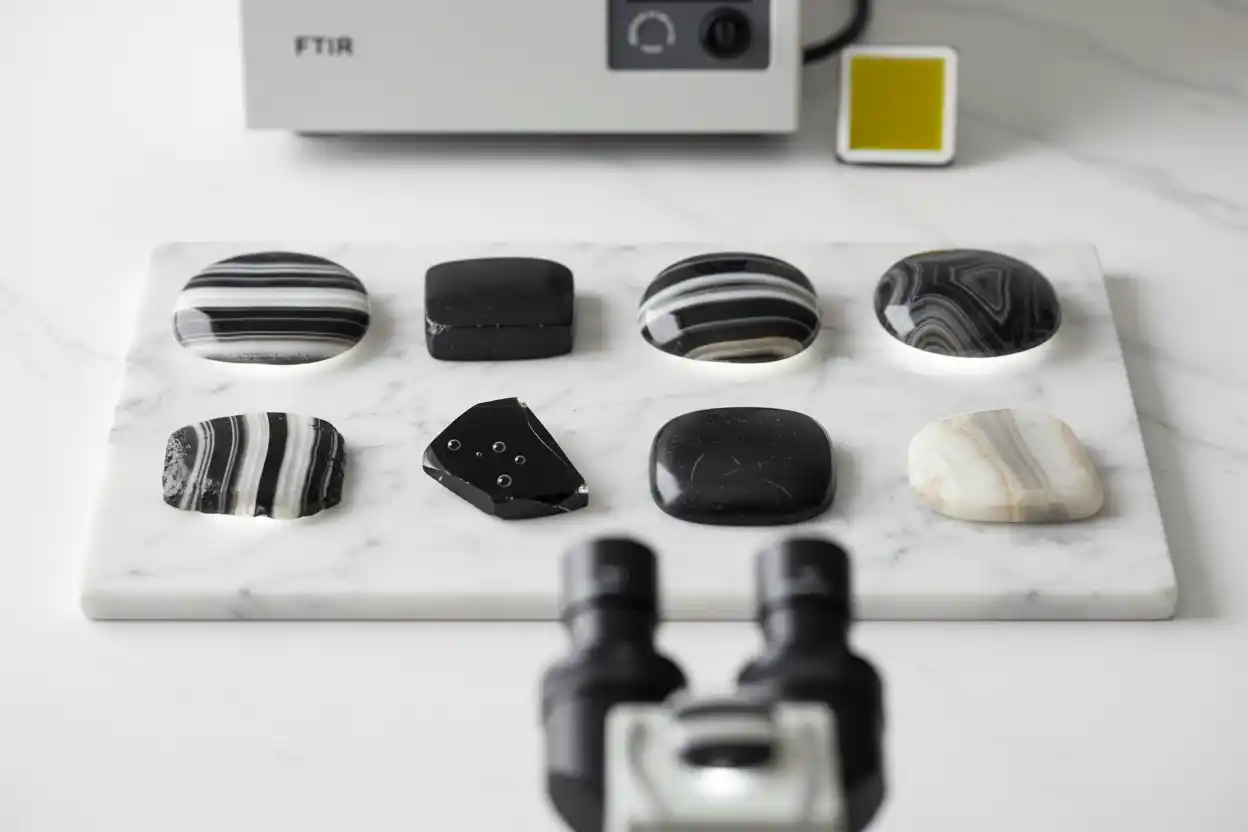
How to Spot Treated or Synthetic Onyx
Onyx is a banded variety of Chalcedony traditionally defined by straight, roughly parallel layers. Natural bands may be black and white, brown and white, reddish brown and white, or other muted combinations.
Uniform commercial black Onyx is different. Nearly all of the intensely black, evenly colored material sold under that name is Chalcedony whose color has been created or strengthened through dyeing or chemical blackening.
The treatment is longstanding, generally stable, and widely accepted when disclosed. However, the market also contains selectively dyed banded Agate, waxed or polymer-impregnated Chalcedony, coated stones, repaired carvings, reconstructed composites, black glass, resin, ceramic, Obsidian, and banded Calcite sold under Onyx terminology.
A strict synthetic Onyx counterpart is not a routine jewelry product. Listings described as synthetic Onyx usually contain an imitation or manufactured composite rather than laboratory-grown banded Chalcedony that reproduces natural Onyx.
Onyx treatment categories at a glance
| Product category | What it contains | Common evidence | Correct description |
|---|---|---|---|
| Natural banded Onyx | Naturally formed parallel-banded Chalcedony | Bands continue through the stone with microcrystalline quartz properties | Natural Onyx |
| Dyed black Onyx | Chalcedony chemically colored black | Uniform black body, color concentrations in pores or fractures | Dyed black Chalcedony or treated Onyx |
| Selectively dyed Onyx | Banded Agate whose porous layers absorbed dye differently | Darkened bands alternate with naturally resistant layers | Dyed banded Chalcedony |
| Bleached and dyed Onyx | Original color lightened before introduced coloring | Pale untreated areas combined with artificial dark bands | Bleached and dyed Chalcedony |
| Waxed or oiled Onyx | Surface or shallow pores treated to improve luster | Greasy shine, residue, temporary color deepening | Surface-treated Onyx |
| Polymer-impregnated Onyx | Fractures or porous areas permeated with resin | Filler bubbles, polymer fluorescence, FTIR absorption | Impregnated Chalcedony |
| Coated Onyx | A clear, black, metallic, or colored surface film | Peeling, worn edges, surface-only color | Coated stone |
| Reconstructed Onyx | Chalcedony fragments or powder bonded with resin | Binder between particles, bubbles, molded construction | Composite containing Chalcedony |
| Banded Calcite “Onyx” | Calcite or Aragonite sold under an Onyx trade name | Lower hardness, cleavage, carbonate properties | Banded Calcite or commercial Onyx marble |
| Artificial “synthetic Onyx” | Glass, resin, ceramic, or manufactured stone | Mold seams, bubbles, repeated patterns, wrong composition | Onyx imitation |
What mineralogical Onyx is
Onyx belongs to the Chalcedony branch of the quartz family. Chalcedony consists of microscopic intergrowths of quartz and commonly moganite rather than the large visible crystals found in rock crystal.
The complete material profile appears in Onyx: Meaning, Healing Properties & Uses. Its legitimate colors, banding styles, and trade varieties belong to Types of Onyx.
True Onyx has bands that are straighter and more parallel than the curved, concentric, or fortification-like patterns typical of many Agates. Nevertheless, the boundary between Onyx and banded Agate is partly based on visual habit rather than a different chemical composition.
The broader host material appears in Agate: Meaning, Types & Healing Properties and Quartz: Types, Properties & Meaning.
Natural Onyx does not need to be uniformly black. In fact, an even jet-black appearance is more strongly associated with treated Chalcedony than with untreated parallel-banded material.
Why black Onyx is usually dyed
Natural Chalcedony can be gray, brown, white, blue-gray, reddish, or nearly black, but consistently uniform deep-black material is uncommon.
Chalcedony’s microscopic structure contains pores, channels, grain boundaries, and pathways through which treatment liquids can move. This allows pale or gray material to be darkened throughout much of its body.
Traditional blackening methods commonly impregnate the Chalcedony with a carbon-bearing substance and then convert that substance into a dark deposit within the stone. Other modern dyes and chemical agents may also be used.
The treatment may penetrate deeply enough that a small scratch or chip does not reveal a pale interior. Therefore, black color extending beneath the surface does not prove natural origin.
A correct sales description can use dyed black Onyx or dyed black Chalcedony. The problem is not the treatment itself, but presenting the color as naturally formed when it was introduced.
How dye can appear under magnification
Introduced color often becomes more concentrated where a liquid could enter most easily. These areas include surface-reaching fractures, pores, pits, cavities, drill holes, grain boundaries, and rough or weathered sections.
A bead may show stronger black coloration around its drill opening. A carving can display darker treatment within recessed cuts than across dense polished areas.
However, professionally blackened Chalcedony may appear uniformly dark and show few obvious concentrations. Its treatment can be considerably harder to recognize than brightly dyed crackle quartz or porous Howlite.
Natural dark inclusions and mineral staining can also follow fractures. Consequently, magnification provides supporting evidence rather than a universal pass-or-fail test.
The broader color-distribution workflow appears in How to Spot Dyed Crystals.
Selective dyeing of bands
Different Chalcedony bands can have different porosity and microstructure. One layer may absorb treatment readily while the next resists it.
Treaters use this contrast to produce sharp black-and-white banding from material whose original colors were pale, gray, or weakly differentiated.
The darkened layer may remain stable because the coloring agent entered its microscopic structure rather than sitting as surface paint.
Selective dyeing can produce extremely natural-looking patterns. Band continuity, parallel structure, and quartz properties may all be genuine even though the contrast was enhanced after mining.
This is especially relevant to cameo and intaglio material, where sharply contrasting layers help the carver create a pale figure above a dark background.
Bleaching before dyeing
Some banded Chalcedony may be bleached to reduce unwanted brown, yellow, or gray coloration before the desired dye is introduced.
Bleaching produces a cleaner starting background and can make black, blue, red, or another color appear more distinct.
Visual detection is difficult after the second treatment has been completed. A pale interior or chalky untreated area may offer a clue, but many stones reveal no obvious evidence.
Bleaching and dyeing should be considered one treatment sequence when both were used.
Sardonyx and colored bands
Sardonyx combines reddish-brown sard with contrasting Onyx layers. It belongs to the same Chalcedony family but has its own traditional identity and market.
The material profile appears in Sardonyx: Meaning, Properties & Symbolism.
Sardonyx can also be dyed to strengthen contrast or create more desirable red-brown bands. Heat may alter iron-related coloration in some Chalcedony, although dye remains the more significant treatment concern in sharply contrasted commercial banded material.
A seller should not use antique, Roman, natural sard, or another heritage phrase as a substitute for treatment disclosure.
Waxing and oiling
Wax or oil can deepen black color, conceal fine scratches, reduce a dry surface appearance, and improve luster.
The treatment may be applied after dyeing to seal the surface or make the polish appear richer. Residue can collect in drill holes, carving recesses, pits, and rough edges.
Oil may migrate or evaporate. Wax can soften under heat and may be removed during repolishing or cleaning.
Natural Chalcedony can already have a waxy luster, so appearance alone is not conclusive. FTIR spectroscopy provides stronger evidence for organic material.
Polymer impregnation
Fractured, porous, or low-quality Chalcedony can be impregnated with epoxy or another resin.
The polymer may strengthen the stone, fill surface-reaching openings, improve transparency, or create a smoother polish. Colored resin can also deepen or modify the apparent black body.
Under magnification, the examiner may see bubbles, transparent filler, smooth material across a rough cavity, or a different luster where polymer reaches the surface.
Ultraviolet fluorescence may reveal treated areas, but resin reactions vary. FTIR and Raman spectroscopy are more dependable for confirming an organic filler.
An impregnated stone can still contain natural Chalcedony, but its durability and appearance depend partly on foreign material.
Fracture filling and repairs
A specific crack can be filled without impregnating the entire stone.
Clear or black resin may reduce the fracture’s visibility and keep a damaged carving, cabochon, or bead from separating. Adhesive may also be used to rejoin a broken object.
Possible evidence includes bubbles, a straight or curved glue line, interrupted banding, different fluorescence, excess material near the surface, or a seam that polishes differently.
A repaired carving can retain artistic and historical value, but the repair should be disclosed because it affects structural reliability and resale.
Coated Onyx
A pale stone, glass object, resin carving, or natural Chalcedony can receive a black surface coating.
Possible clues include scratches through the film, peeling, color concentrated beneath protected setting areas, and chips exposing a lighter interior.
Metallic coatings may create gold, silver, bronze, or iridescent finishes over black Chalcedony. A GIA laboratory has documented metallic coating on material identified as black Onyx.
A clear polymer coating can also seal dye or improve gloss without changing the visible color dramatically.
Surface coating is less stable than deeply dyed Chalcedony. Abrasion, repolishing, solvents, and jewelry repair can damage or remove it.
Reconstructed Onyx
Chalcedony fragments, powder, pigment, glass, and resin can be mixed and molded into beads, cabochons, bangles, carvings, and decorative slabs.
The object may contain genuine quartz-rich material, but its continuous body was manufactured rather than deposited naturally.
Under magnification, angular grains may sit in transparent binder. Round resin bubbles, repeated grain sizes, artificial bands, mold seams, or a plastic-rich surface can become visible.
A reconstructed product should be described as bonded, composite, reconstituted, or reconstructed Onyx rather than solid natural stone.
“Synthetic Onyx” is usually an imprecise label
A strict synthetic gemstone reproduces the essential composition and crystal structure of the named natural material.
Laboratory production of silica materials is possible, but mainstream jewelry does not contain a significant market of laboratory-grown parallel-banded Chalcedony sold as true synthetic Onyx.
Instead, synthetic Onyx commonly refers to glass, resin, ceramic, engineered stone, pressed mineral powder, or another manufactured product with a black or banded appearance.
The exact material should be stated. Synthetic resin imitation, ceramic imitation, or reconstructed Chalcedony communicates more information than the vague phrase lab Onyx.
The origin terminology is explained in Lab-Grown vs Natural Gemstones.
Green Onyx and Onyx marble
Green Onyx is often a commercial name for banded Calcite or Aragonite rather than quartz-family Onyx.
The separate trade material appears in Green Onyx: Meaning, Properties & Symbolism.
Calcite Onyx can be naturally green, brown, cream, yellow, red, or white, but it can also be dyed, resin filled, polished, or reconstructed.
It is much softer than Chalcedony and has prominent cleavage. An acid test could separate carbonate from quartz, but it would permanently damage the object and should not be used.
A seller should identify banded Calcite rather than relying only on the word Onyx.
Obsidian and other black lookalikes
Black Obsidian is natural volcanic glass. It commonly has a more glassy, homogeneous body and conchoidal fracture rather than Chalcedony’s microcrystalline structure.
The direct comparison appears in Onyx vs Obsidian, while the volcanic glass profile appears in Obsidian: Meaning, Healing Properties & Uses.
Black Tourmaline, jet, glass, black Spinel, Hematite, plastic, and ceramic may also be represented as Onyx.
The three-way practical comparison in Black Tourmaline vs Obsidian vs Onyx owns those broader mineral differences.
The completed Real vs Fake Onyx page owns the full authenticity decision tree. This treatment page remains focused on what was done to the material after formation.
Gemological testing
Chalcedony commonly produces a spot refractive-index reading near the quartz range and has specific gravity around 2.6.
Microscopy can reveal dye concentrations, polymer, coating, reconstruction, band structure, and repair.
Raman spectroscopy confirms quartz or moganite-rich Chalcedony and separates it from Calcite, glass, resin, Obsidian, and ceramic. FTIR identifies polymer, wax, oil, and some dye-related organic components.
Ultraviolet-visible spectroscopy and chemical mapping may help distinguish natural color from introduced pigment in difficult colored Chalcedonies.
The broader treatment framework appears in Gemstone Treatments Explained, while the amorphous-material distinction appears in Glass vs. Crystal.
Reports and buying disclosure
A laboratory report is rarely necessary for an inexpensive ordinary black bead. It becomes useful for valuable carvings, antique cameos, natural-color claims, repaired objects, unusual banded material, and suspected composites.
The completed Gemstone Certification Labs Compared explains available report services. How to Read a Gem Lab Report helps match the material, treatment, photograph, measurements, and construction to the exact object.
Seller selection belongs to Where to Buy Real Onyx. Before purchasing from an unfamiliar marketplace, follow How to Buy Gemstones Online Without Getting Scammed.
Care
Chalcedony Onyx has Mohs hardness around 6.5–7 and generally resists ordinary wear, although fractures, filler, coatings, and repairs can reduce durability.
Its position on the scale appears in the Gemstone Hardness Chart.
Warm water, mild soap, and a soft cloth or brush provide the safest routine method. Avoid steam, prolonged ultrasonic cleaning, strong solvents, bleach, acids, and high repair heat when treatment is uncertain.
The complete maintenance process appears in How to Clean Onyx Jewelry Safely.
Frequently Asked Questions
1. Is black Onyx naturally black?
Natural dark Chalcedony exists, but nearly all uniformly black commercial Onyx has been dyed or chemically blackened.
2. Is dyed black Onyx still genuine?
The host can be natural Chalcedony, but the black color was treatment produced and should be disclosed.
3. How is black Onyx colored?
Traditional processes introduce carbon-bearing material into porous Chalcedony and convert it into a stable dark deposit. Modern dyes may also be used.
4. Can Onyx bands be dyed selectively?
Yes. Different Chalcedony layers absorb treatment at different rates, allowing sharp black-and-white contrast to be created or strengthened.
5. Does black color rubbing off prove treatment?
It can reveal an unstable surface dye, but stable treated Onyx may not transfer color at all.
6. Can Onyx be resin impregnated?
Yes. Polymer may enter fractures or porous areas to strengthen the stone and improve its polish.
7. Is waxed Onyx fake?
No. The underlying stone can be natural Chalcedony, although waxing changes its surface and care requirements.
8. What is reconstructed Onyx?
It is a manufactured composite containing Chalcedony chips or powder bonded with resin, glass, cement, or another binder.
9. Is synthetic Onyx widely available?
Strict laboratory-grown banded Chalcedony is not a routine jewelry category. Most synthetic Onyx listings refer to imitation or composite materials.
10. Is green Onyx the same mineral as black Onyx?
Often it is not. Much green Onyx is banded Calcite or Aragonite rather than Chalcedony.
11. Can a laboratory detect Onyx treatment?
Microscopy, FTIR, Raman spectroscopy, ultraviolet-visible analysis, and chemical mapping can identify many dyes, coatings, fillers, and composites.
12. When should Onyx receive a laboratory report?
Testing is most useful for valuable carvings, antique cameos, natural-color claims, unusual banding, repairs, and suspected reconstruction.
Conclusion
Onyx treatment is dominated by dye. Uniform black Onyx is usually blackened Chalcedony, while selective treatment can strengthen the contrast between parallel bands.
Wax, oil, polymer impregnation, fracture filling, coating, repair, and reconstruction create additional categories. Meanwhile, many products called synthetic Onyx are actually glass, resin, ceramic, engineered stone, or bonded mineral fragments.
The dependable sequence confirms whether the material is Chalcedony, Calcite, glass, or another substance before evaluating dye, organic treatment, and construction. An even black surface alone cannot reveal what the object contains or how its color formed.