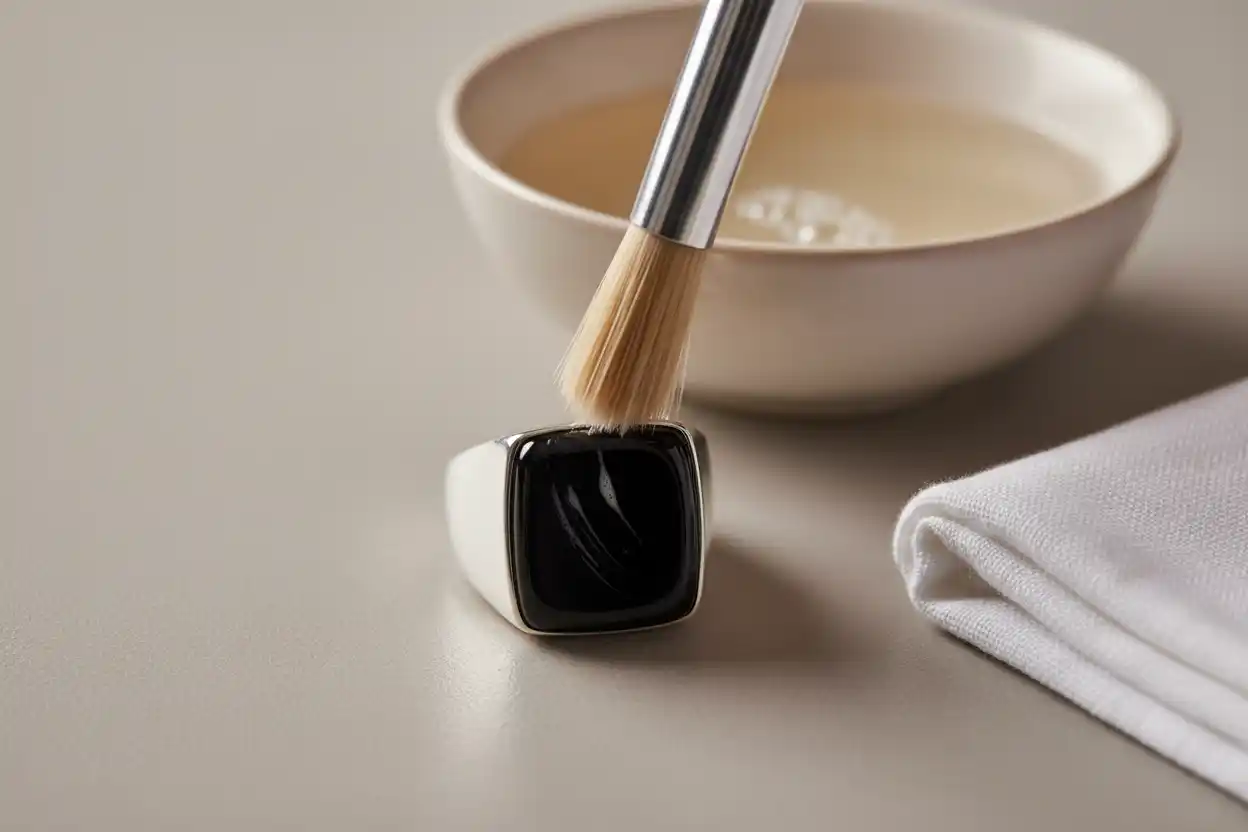
How to Clean Onyx Jewelry Safely
Onyx jewelry should be cleaned with lukewarm water, mild liquid soap, and a soft cloth or brush. Ultrasonic and steam cleaning may be tolerated by sound, untreated chalcedony, but they should be used cautiously because Onyx is frequently dyed, backed, glued, carved, inlaid, repaired, or mounted with more vulnerable materials.
Warm soapy water is therefore the safest routine method. It removes skin oil, cosmetics, dried soap, and setting residue without exposing dyed chalcedony or uncertain construction to excessive heat, vibration, or aggressive chemicals.
Why the Name Onyx Can Complicate Cleaning
True Onyx is a banded variety of chalcedony, which is microcrystalline quartz. Its bands are traditionally straight or nearly parallel, distinguishing it from many agates with curved, irregular, or concentric banding.
The material’s history, symbolism, varieties, and wider gemological background belong to the Onyx guide, while its parent mineral group appears in the Chalcedony guide.
The word onyx is also used commercially for other materials. Calcite or aragonite decorative stone may be sold as Mexican Onyx, Pakistan Onyx, Green Onyx, or Onyx Marble even though it is not chalcedony.
That distinction matters because carbonate material is softer and more vulnerable to acids than quartz-based Onyx. When identity is uncertain, use minimal moisture and avoid vinegar, lemon juice, metal dip, steam, and ultrasound.
| Property | Cleaning implication |
|---|---|
| True gemological material | Banded chalcedony |
| Composition | Microcrystalline quartz |
| Mohs hardness | Approximately 6.5 to 7 |
| Cleavage | None |
| Fracture | Commonly conchoidal or uneven |
| Safest routine cleaning | Lukewarm water, mild soap, and soft brushing |
| Ultrasonic cleaning | Use cautiously and only when untreated and securely mounted |
| Steam cleaning | Use cautiously; avoid dyed or assembled pieces |
| Main concerns | Dye, backing, glue, antique carving, inlay, metal, and trade-name confusion |
The gemstone hardness chart explains why chalcedony has useful scratch resistance but can still be marked by harder gems.
Resistance to scratches differs from resistance to breaking or setting damage. That distinction appears in Gemstone Toughness vs Hardness and Gemstone Cleavage Explained.
Most Black Onyx Should Be Treated as Dyed
Black chalcedony occurs naturally, but commercial black Onyx is frequently produced by darkening lighter chalcedony.
Dye may penetrate deeply and remain stable during ordinary wear. Nevertheless, high heat, strong chemicals, prolonged exposure, repolishing, and repair procedures may affect treated color.
Some green, blue, red, and other vividly colored Onyx products may also be dyed. The wider treatment-identification workflow belongs to How to Spot Treated or Synthetic Onyx and Gemstone Treatments Explained.
Treatment does not make Onyx unsuitable for jewelry. It means the owner should use a conservative cleaning method and disclose the treatment before repair or repolishing.
Inspect the Jewelry Before Cleaning
Examine the Onyx and mounting under bright, indirect light. Look for loose prongs, bezel gaps, moving cabochons, chipped edges, open fractures, missing inlay, cloudy glue, damaged drill holes, and peeling coatings.
Black Onyx can conceal grime and setting problems because its dark, opaque surface prevents light from passing through the stone. Inspect its edges and underside carefully.
Carved cameos, intaglios, seals, and relief designs may contain thin raised details that can chip under concentrated pressure.
Do not immerse an antique piece, glued cabochon, cracked carving, or lifting inlay. Begin with dry wiping and seek professional advice when construction is uncertain.
Test Dyed or Coated Onyx
Dampen a white cotton swab or a corner of a soft white cloth with clean water. Touch an inconspicuous area briefly.
Stop if black, green, blue, or another color transfers to the cloth. Unstable color indicates that the jewel should receive dry cleaning only until a professional assesses it.
Do not use acetone, alcohol, bleach, or acid as a home dye test. These substances may damage treatment, glue, metal finishes, and companion materials.
The complete authenticity workflow belongs to Real vs Fake Onyx.
Prepare a Mild Cleaning Solution
Fill a shallow bowl with lukewarm water and add several drops of mild liquid dish soap.
Prepare a second bowl of clean lukewarm water for rinsing. Use a soft toothbrush, fine jewelry brush, soft makeup brush, or lint-free cloth.
Place a folded towel beneath the work area. The padding protects a cabochon or carving if it slips.
Do not clean over an uncovered drain. A loosened stone, earring, or bead may disappear during rinsing.
Clean Onyx Gently
Place a securely mounted, stable piece briefly in the mild solution or hold it above the bowl while cleaning.
Brush the polished surface, bezel, prongs, gallery, bail, drill holes, and setting edges with light pressure.
Rinse loose dust before rubbing the stone. Although chalcedony is reasonably hard, grit containing harder minerals may scratch its polish.
For carved Onyx, use a soft brush to lift debris from recesses. Do not scrape grooves with a pin, needle, knife, or metal pick.
A short wash is sufficient. Extended soaking may weaken glue, enter backing seams, stretch stringing, or affect unstable dye.
Rinse and Dry Thoroughly
Rinse the jewel in the second bowl of clean lukewarm water or remove soap with a clean damp cloth.
Blot with a lint-free cloth and allow moisture around settings and drill holes to evaporate naturally.
Do not use a hair dryer, radiator, heated display lamp, or direct concentrated heat. High temperatures may alter dyed chalcedony, glue, coating, repairs, or metal finishes.
Inspect the mounting after drying. A moving cabochon or metal edge that catches on fabric needs professional repair.
Can Onyx Go in an Ultrasonic Cleaner?
Sound, untreated chalcedony can sometimes tolerate ultrasonic cleaning, but many Onyx jewels contain care-sensitive treatments or constructions.
| Onyx condition | Ultrasonic recommendation |
|---|---|
| Confirmed untreated chalcedony in a secure modern setting | Potentially suitable |
| Dyed Onyx | Prefer manual cleaning |
| Glued cabochon | Avoid |
| Inlay, cameo, or intaglio | Avoid unless professionally assessed |
| Antique or repaired jewelry | Avoid |
| Coated, filled, or backed material | Avoid |
| Cracked or chipped Onyx | Avoid |
| Identity uncertain | Use warm soapy water manually |
Vibration may release a glued stone, loosen inlay, enlarge an existing fracture, or expose a weak setting.
The broader machine-safety comparison belongs to Which Gemstones Can Go in an Ultrasonic Cleaner?.
Can Onyx Be Steam Cleaned?
Untreated chalcedony may tolerate steam, but commercial Onyx is too frequently dyed or assembled for steam to be a sensible household default.
Heat may affect dye, glue, lacquer, resin, foil backing, enamel, antique solder, and companion stones.
Warm manual cleaning removes ordinary grime without creating those uncertainties.
Cleaning an Onyx Ring
An Onyx ring collects hand lotion, soap, sanitizer, cosmetics, and skin oils.
Signet rings may have engraved or recessed surfaces that trap residue. Use a soft brush without scraping the design.
Remove the ring before gardening, exercise, household cleaning, swimming, and heavy manual work.
Inspect the bezel around a large cabochon. A small gap can collect moisture and allow the stone to move.
Cleaning Onyx Earrings
Onyx earrings may use beads, cabochons, drops, carved elements, glue, metal caps, posts, hooks, or clips.
Clean the Onyx separately from the metal fittings. Keep alcohol-based disinfectant on compatible posts or hooks and away from dyed stone, glue, lacquer, and coatings.
Dry drill holes, caps, backs, and hinges completely before storage.
Cleaning an Onyx Necklace
An Onyx necklace or pendant may contain carved plaques, beads, cameos, intaglios, wire, knots, silk, or glue.
Lay a bead strand flat and wipe individual beads instead of soaking the necklace. Wet thread can stretch, weaken, or collect dye.
Prevent beads from rubbing together because trapped grit may scratch their polish.
A pendant should be supported by its setting rather than gripped by a carved or exposed stone edge.
Cleaning an Onyx Bracelet
An Onyx bracelet receives repeated impact against desks, doors, counters, and furniture.
Inspect every bead, cabochon, link, knot, elastic section, hinge, and clasp.
Wipe elastic or corded bracelets rather than immersing them. Dry the piece flat so damp stringing does not stretch.
Remove the bracelet before activities that repeatedly strike the wrist against hard surfaces.
Onyx, Agate, and Chalcedony
Onyx belongs within the chalcedony family and is closely related to agate. The main traditional distinction concerns banding pattern.
The broader variety structure belongs to Types of Chalcedony and Types of Onyx.
The Agate guide owns agate’s wider geology and varieties, while How to Spot Treated or Synthetic Agate covers treatments affecting related chalcedony.
All three materials may be dyed, but the individual construction of the jewel still determines whether soaking, heat, or machinery is appropriate.
Black Onyx Versus Obsidian
Onyx and obsidian can both appear opaque and black, but Onyx is microcrystalline quartz while obsidian is volcanic glass.
The full distinction belongs to Onyx vs Obsidian.
A broader comparison involving another black material appears in Black Tourmaline vs Obsidian vs Onyx.
Cleaning response is not a reliable identification test. Scratching, heat, acid, and destructive procedures can damage any of these materials.
Green Onyx and Calcite Trade Names
Some material sold as Green Onyx is genuine dyed or naturally colored chalcedony. Other products are banded calcite or aragonite sold under a decorative trade name.
The tracker’s Green Onyx guide owns the material and naming discussion.
When a green stone is carbonate rather than chalcedony, acids can etch it and the surface may scratch more easily. Therefore, uncertain Green Onyx should receive only a barely damp cloth and mild soap.
Chemicals and Abrasives to Avoid
Do not use toothpaste, baking soda, scouring powder, polishing compounds, wire brushes, or abrasive cloths.
Keep the jewel away from bleach, chlorine, acetone, paint thinner, drain cleaner, oven cleaner, and concentrated acids or alkalis.
Vinegar and lemon juice offer no advantage over mild soap. They are especially dangerous when the so-called Onyx is actually calcite.
Commercial metal dips should not contact the stone unless the product explicitly permits treated chalcedony and every other component in the jewel.
Storage and Preventive Care
Store Onyx in a separate lined compartment or soft pouch.
Diamond, sapphire, ruby, topaz, and harder stones can scratch it. Onyx can also scratch softer ornamental materials.
Keep chains, clasps, and earring posts away from polished cabochons and carved surfaces.
Questions about prolonged environmental exposure belong to the tracker’s guides to crystals in water and crystals in sunlight.
Frequently Asked Questions
1. What is the safest way to clean Onyx?
Use lukewarm water, mild liquid soap, and a soft cloth or brush, then rinse briefly and dry thoroughly.
2. Can Onyx get wet?
Brief washing is generally safe for stable chalcedony. Avoid soaking dyed, glued, coated, backed, strung, antique, or unidentified material.
3. Can Onyx go in an ultrasonic cleaner?
Untreated chalcedony may tolerate ultrasound, but dyed, glued, carved, inlaid, repaired, or uncertain Onyx should be cleaned manually.
4. Can Onyx be steam cleaned?
Steam is not a sensible default because heat may affect dye, glue, backing, repairs, and companion materials.
5. Is black Onyx commonly dyed?
Yes. Commercial black chalcedony is frequently darkened or dyed, so treatment-sensitive care is appropriate.
6. Can vinegar clean Onyx?
No. Vinegar is unnecessary and may damage treatments, metal, glue, or calcite sold under an Onyx trade name.
7. Can toothpaste polish Onyx?
No. Toothpaste is abrasive and can scratch the stone or damage its metal setting.
8. Is dish soap safe for Onyx?
A few drops of mild liquid dish soap are usually suitable. Avoid bleach, abrasives, acids, and aggressive degreasers.
9. Why is color transferring to my cloth?
The Onyx may contain unstable dye or a surface coating. Stop cleaning and seek professional advice.
10. Is Green Onyx cleaned the same way?
Only when it is confirmed as chalcedony. Calcite or aragonite sold as Green Onyx requires stricter acid and scratch protection.
11. How often should Onyx jewelry be cleaned?
Wipe it after wear and wash it when cosmetics, oil, or residue remain visible.
12. When should Onyx receive professional care?
Professional help is appropriate for antique carvings, cameos, inlay, loose settings, unstable dye, deep scratches, or uncertain material identity.
Conclusion
True Onyx is a durable form of chalcedony, yet commercial treatment and trade-name ambiguity make cautious cleaning essential. Lukewarm soapy water cleans genuine quartz-based Onyx without assuming that its color is natural or that every component can tolerate machinery. When a stone is sold as Green Onyx or Onyx Marble, identify the material before applying acid, steam, or ultrasound.