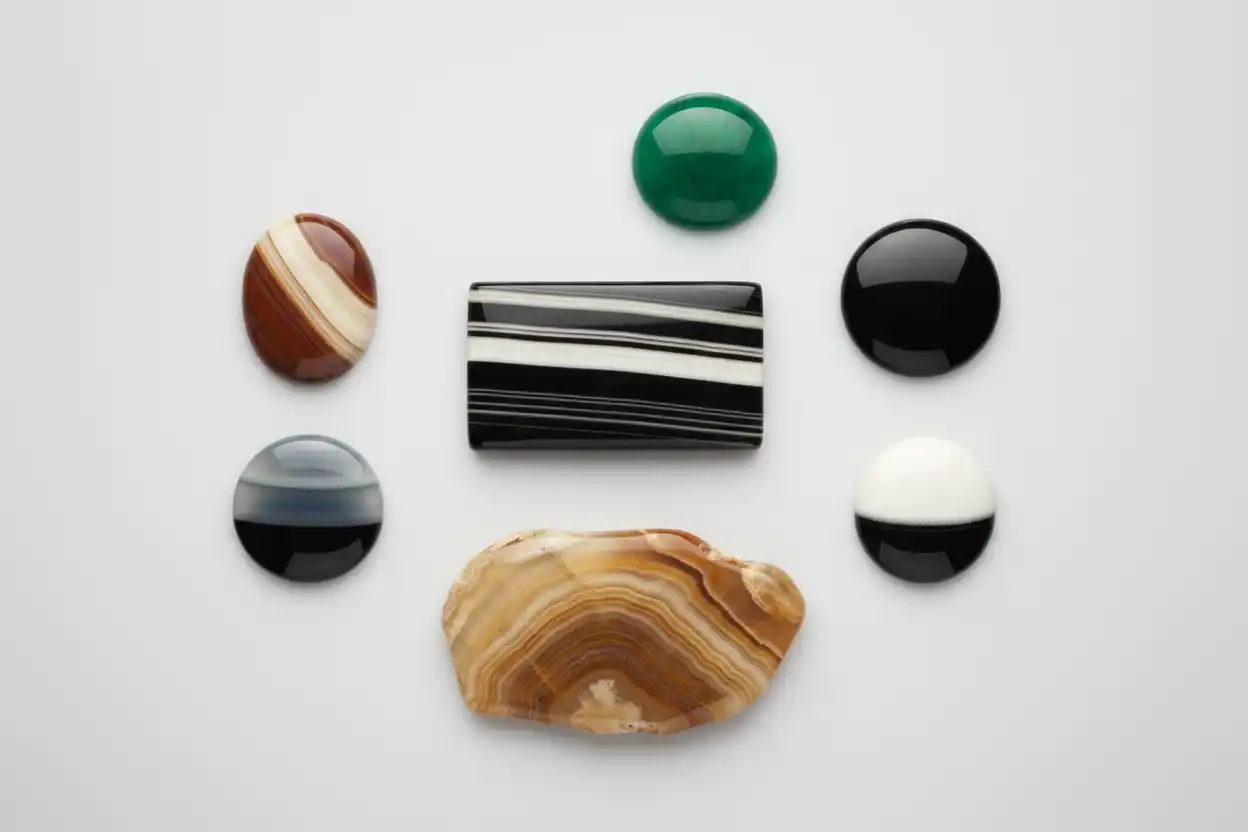
Types of Onyx: Colors and Varieties Explained
Onyx is a parallel-banded variety of chalcedony, the microcrystalline form of quartz. Its classic appearance consists of straight or gently curved layers in contrasting colors, particularly black and white, brown and white, or red-brown and white.
The modern market also uses “onyx” for uniformly dyed black chalcedony and for banded calcite or aragonite decorative stone. Those materials can be attractive, but they do not share identical mineralogy or durability. The main onyx meaning and properties guide covers the established gemstone, while this article separates its mineralogical varieties and major trade usages.
Onyx at a Glance
| Property | Chalcedony Onyx |
|---|---|
| Composition | Silicon dioxide, SiO₂, with microscopic quartz and variable moganite |
| Mineral group | Quartz–chalcedony family |
| Main colors | Black, white, gray, brown, red-brown, orange-brown, blue-gray, green, and dyed colors |
| Structure | Dense microcrystalline aggregate with straight or parallel layers |
| Typical habit | Massive nodules, vein fillings, layered bands, cabochons, cameos, beads, and carved plaques |
| Luster | Waxy to dull when rough; vitreous to glossy when polished |
| Transparency | Translucent at thin edges to opaque |
| Mohs hardness | Approximately 6.5–7 |
| Cleavage | None |
| Tenacity | Brittle, but compact aggregate texture performs well in carvings |
| Common uses | Cabochons, beads, cameos, intaglios, signet rings, pendants, earrings, inlay, and carvings |
| Main care concern | Undisclosed dye, acid-sensitive calcite sold as onyx, hidden fractures, and scratches from harder gemstones |
Onyx Within the Chalcedony Family
Onyx belongs within chalcedony, the fine-grained quartz material that also includes many agates, carnelians, chrysoprase, bloodstone, and related varieties.
Agate normally shows curved, concentric, lace-like, fortification, or irregular bands. In contrast, traditional onyx has comparatively straight, parallel layers.
The boundary is imperfect because natural bands may curve gradually, and trade usage varies. Some dealers call any strongly banded chalcedony onyx, while others reserve the word for black-and-white material.
The types of chalcedony guide explains the broader family, while types of agate retains curved and patterned agate varieties.
Natural Black-and-White Onyx
Classic natural onyx contains alternating dark and pale parallel layers.
The dark bands may be black, brown-black, charcoal, or deep gray. Pale layers commonly appear white, cream, gray, or translucent.
Completely natural sharply contrasted material is less common than the volume of black onyx jewelry suggests. Many commercial stones begin as gray, brown, or lightly banded chalcedony and receive dye to create uniform black.
Natural layers make onyx particularly suitable for cameos and intaglios. A cutter places one band as the image and another as the contrasting background.
Uniform Black Onyx
Most uniformly black onyx in modern jewelry is dyed chalcedony.
The treatment can create a stable, attractive black stone with good polish and useful durability. Dyeing does not make the material glass or plastic, but it should be disclosed.
Natural chalcedony provides the structure and hardness, while the color comes from human processing. Historically, sugar-acid darkening, carbonization, chemical dyes, and other techniques have been used.
Under strong transmitted light, some dyed stones reveal brown, blue-gray, or translucent areas. Dye may also concentrate along fractures, drill holes, and porous bands.
Black onyx remains a practical jewelry stone when priced according to treatment and workmanship rather than promoted as exceptionally rare natural black material.
Sardonyx
Sardonyx combines sard—brownish red, orange-brown, or dark red chalcedony—with white, black, or pale parallel bands.
Its strong layer contrast made it a traditional material for seals, cameos, intaglios, beads, and signet rings.
Fine sardonyx has crisp parallel layers, warm natural color, and enough thickness for carving. Cutters plan the image around the band structure rather than centering a generic cabochon.
Sardonyx can be natural, heated, dyed, or otherwise enhanced. Its dedicated page owns the full variety-level history and symbolism, while the sardonyx buying guide retains transaction intent.
Carnelian Onyx
Carnelian onyx has orange, reddish orange, or red chalcedony layers alternating with white, cream, or darker bands.
The name may overlap with sardonyx. Some dealers use carnelian onyx for brighter orange-red material and sardonyx for darker brown-red bands.
Because no universal color boundary separates them, the actual band colors and treatment history matter more than the label.
Heating and dyeing can strengthen orange or red areas. Disclosure becomes especially important when a seller claims an unusually vivid natural color.
Nicolo Onyx
Nicolo onyx, also spelled niccolo or nicolo, has a dark base beneath a thin pale blue, gray-blue, or whitish upper layer.
When cut correctly, the top appears bluish against the dark background. Antique cameos and intaglios used this natural contrast to create detailed designs.
The term is sometimes applied broadly to layered chalcedony with a bluish surface zone. Authenticity depends on the actual structure rather than a modern marketing name.
Old carved nicolo pieces may derive far more value from age, subject, provenance, and workmanship than from the raw stone.
Arabic Onyx
Arabic onyx traditionally describes dark chalcedony with contrasting white bands or markings.
Historical usage varies, and the term does not identify one modern mine, chemistry, or standardized pattern. Some antique sources apply it to black-and-white onyx, while modern sellers use it for banded black, brown, and cream material.
A precise listing should describe the actual colors and disclose whether the name reflects provenance, an antique convention, or only appearance.
Brown Onyx
Brown onyx ranges from beige and caramel to chocolate, coffee, and nearly black brown.
White, cream, gray, and translucent layers may alternate with the brown bands. Iron-bearing compounds and other inclusions influence the color.
Brown-and-white natural material can be attractive for cameos, beads, and men’s jewelry. However, “brown onyx” also appears in the decorative-stone market for banded calcite, requiring a composition check.
White Onyx
White onyx in strict chalcedony usage consists of pale parallel bands in white, cream, gray, or translucent colorless material.
Completely uniform white chalcedony may be marketed as white onyx even when obvious parallel banding is absent. That reflects loose trade usage rather than a separate mineral variety.
White onyx can resemble agate, common chalcedony, opal, glass, quartzite, and calcite. Hardness and acid sensitivity help separate the materials through professional testing.
The broader white gemstones guide places white onyx beside other pale jewelry stones.
Gray and Blue-Gray Onyx
Gray onyx may show silver, smoke, blue-gray, charcoal, and white parallel layers.
Natural blue-gray tones tend to be muted. Vivid cobalt-blue or turquoise “onyx” is commonly dyed chalcedony or dyed calcite.
A well-polished gray onyx can suit contemporary jewelry, especially when bands remain visible beneath the surface.
Green Onyx
Green onyx is one of the most inconsistently used names in the gem trade.
Some material is naturally greenish chalcedony with parallel layers. A larger proportion consists of dyed chalcedony, dyed agate, calcite, aragonite, or another pale porous stone.
Natural chrome-bearing or nickel-bearing green chalcedony should not automatically be called onyx unless it has the appropriate layered structure.
For significant green material, the invoice should state both composition and treatment rather than relying on the color name.
Banded Calcite Sold as Onyx
“Calcite onyx,” “onyx marble,” “Mexican onyx,” “Pakistan onyx,” and “onyx stone” commonly refer to banded calcite or aragonite.
These decorative materials may show cream, honey, green, brown, white, pink, orange, and yellow layers. They polish attractively and occur in large blocks suitable for bowls, tiles, lamps, tabletops, and carvings.
However, calcite has hardness 3 and reacts with acids. True chalcedony onyx has hardness near 7 and does not effervesce readily in weak household acids.
The word marble is also misleading because much banded calcite onyx is deposited from mineral-rich water rather than formed as metamorphic marble.
A compositionally accurate description might read banded calcite, trade name green onyx, rather than implying quartz-family durability.
Aragonite Onyx
Banded aragonite can resemble calcite onyx and may occur in the same decorative-stone deposits.
Aragonite shares the formula CaCO₃ with calcite but has a different crystal structure. Both remain softer and more acid-sensitive than chalcedony.
Commercial slabs may contain calcite, aragonite, or mixtures. Laboratory analysis becomes relevant when exact composition affects conservation or care.
Travertine and Cave Onyx Trade Material
Layered calcite deposited by springs, caves, and groundwater is sometimes sold as cave onyx.
Bands can form as water chemistry changes over time. Iron oxides, clay, and organic material create yellow, orange, brown, red, green, and gray tones.
The material may be geologically interesting and visually beautiful, but it remains carbonate stone rather than silica onyx.
Black Onyx Versus Black Agate
The terms often overlap in retail listings.
Strictly, onyx should have parallel layers, while agate can display curved or irregular banding. A uniformly dyed black chalcedony cabochon may show neither pattern clearly.
Consequently, many mass-market “black onyx” and “black agate” products are effectively the same treated chalcedony under different names.
The stone’s actual composition, dye disclosure, cutting quality, and price matter more than choosing one label for a uniform black cabochon.
Onyx Formation
Chalcedony onyx forms when silica-rich fluids deposit repeated microscopic quartz and moganite layers inside fractures, cavities, or open spaces.
Changes in iron, manganese, organic matter, particle content, and fluid chemistry create contrasts among the bands.
The relatively straight layers suggest deposition along planar fractures or steady parallel growth surfaces rather than the concentric cavity-filling patterns common in many agates.
Banded calcite onyx forms differently. Calcium-carbonate-rich water deposits successive layers in caves, springs, veins, and sedimentary settings.
Major Sources and Cutting Centers
Natural and treated chalcedony onyx enters the market from India, Brazil, Uruguay, Madagascar, Mexico, the United States, and many other silica-producing regions.
India has a long history of agate and chalcedony cutting, dyeing, heating, and bead manufacture.
Banded calcite marketed as onyx is strongly associated with Mexico, Pakistan, Iran, Turkey, Afghanistan, and several other carbonate-producing regions.
Cutting location should not be confused with geological origin. An Italian cameo, for example, may have been carved in Italy from imported sardonyx rough.
Inclusions and Internal Features
Onyx may contain color bands, fine quartz grains, moganite, iron oxides, manganese compounds, healed fractures, pores, dendritic markings, and remnants of host rock.
Natural band boundaries can be sharp or diffuse. Dye may exaggerate their contrast by entering more porous layers preferentially.
Under magnification, dyed black material can reveal concentrations along cracks and drill holes. Surface-reaching fractures also influence durability.
Calcite onyx may contain cleavage reflections, fibrous growth, pores, and softer layers that polish unevenly.
How Onyx Is Identified
Chalcedony onyx has hardness approximately 6.5–7, no cleavage, conchoidal fracture, and quartz-family refractive properties.
Its dense microcrystalline texture separates it from volcanic glass. Unlike calcite onyx, it does not have rhombohedral cleavage or immediate acid sensitivity.
A gemologist can use refractive index, specific gravity, microscopic structure, spectroscopy, and fluorescence to identify the material and detect some treatments.
The real versus fake onyx guide owns consumer-level identification, while the general crystal identification guide explains a multi-test approach.
Common Lookalikes
Obsidian is natural glass and commonly shows conchoidal fracture, flow lines, and lower hardness. Their direct differences belong in the onyx versus obsidian guide.
Black tourmaline is a crystalline borosilicate mineral with strong lengthwise striations. The black tourmaline, obsidian, and onyx comparison addresses all three.
Jet, black spinel, black jade, glass, resin, plastic, basalt, and dyed quartzite can also resemble black onyx.
Calcite, aragonite, marble, travertine, and dyed carbonate stone commonly imitate colorful onyx varieties.
Treatments
Dyeing is normal and widespread in black onyx.
Traditional processes exploit porosity differences within chalcedony. A darkening substance enters the stone and receives chemical or heat treatment to create a durable black color.
Green, blue, red, purple, and other colors may also be dyed. Wax, oil, resin, and coatings can improve polish or conceal pores.
The dedicated treated onyx guide owns the full enhancement-detection intent. General terminology appears in gemstone treatments explained.
Treatment should influence disclosure and value, but dyed chalcedony can still provide durable, attractive jewelry.
Synthetics, Reconstructed Material, and Imitations
True laboratory-grown microcrystalline onyx is not a mainstream jewelry product.
Reconstructed material can combine chalcedony fragments or stone powder with resin and pigment. Molded resin, glass, ceramic, and plastic create additional imitations.
Layered glass can imitate banded onyx cameos. Repeated patterns, bubbles, mold seams, and low hardness may provide clues.
Antique-looking carved pieces deserve scrutiny because artificial aging, modern reproductions, and assembled layers can imitate older cameos.
Cutting and Carving Behavior
Onyx’s parallel bands make orientation central to cutting.
For a cameo, the cutter places a light layer above a dark base, then removes the upper material selectively to form the image. Intaglios reverse the process by carving below the surface.
Uniform black material is commonly shaped into cabochons, beads, tablets, signet stones, and geometric inlay.
Chalcedony accepts a high polish and resists undercutting when compact. Hidden fractures can still open during drilling, especially in thin plaques and bead holes.
Calcite onyx cuts more easily but scratches and cleaves far more readily. Lapidaries must adjust tools and polishing methods according to composition.
Durability and Jewelry Suitability
Chalcedony onyx has hardness near 7 and no cleavage, making it suitable for rings, earrings, necklaces, bracelets, and carved objects.
Its compact aggregate texture handles ordinary wear better than many soft ornamental stones. Nevertheless, sharp corners and thin cameos can chip.
The gemstone hardness chart places chalcedony above feldspar and below topaz. The distinction between scratching and breaking appears in gemstone toughness versus hardness.
Calcite onyx needs much gentler wear because hardness near 3 allows rapid scratching. It also reacts with acids in perfume, food, household cleaners, and perspiration.
Onyx Prices in 2026
Commercial black onyx remains affordable because dyed chalcedony is abundant.
Small cabochons, beads, and calibrated stones commonly cost $2–$20 per piece. Current loose-stone listings show many dyed black cabochons selling around $1–$5 per carat, although large matched stones and special shapes vary.
Better large cabochons, precision-cut tablets, matched earring pairs, and carved signet stones commonly range from $20–$150.
Natural parallel-banded material with strong contrast can cost more, particularly when suitable for cameo carving. Fine sardonyx, unusual natural banding, documented locality rough, and artist-cut pieces occupy specialist markets.
Antique cameos and intaglios may cost hundreds, thousands, or considerably more. Their value depends mainly on age, subject, artist, provenance, condition, and setting rather than raw chalcedony weight.
Banded calcite carvings are usually priced by object size and craftsmanship rather than by carat.
Buying Guidance
Ask whether the product is chalcedony onyx, dyed black chalcedony, banded calcite, aragonite, reconstructed stone, or another material.
Dye disclosure is especially important for uniform black, bright green, blue, and red products. A treatment statement should appear on the invoice rather than only in verbal sales language.
For cameos, inspect the layer structure, carving quality, chips, repairs, backing, signature, and age claims. For black cabochons, examine polish, flatness, drill holes, and surface-reaching fractures.
The complete transaction checklist belongs in the onyx buying guide. General online-shopping protection appears in how to buy gemstones online.
Onyx Jewelry
An onyx ring commonly uses cabochons, signet tablets, carved crests, cameos, or geometric inlay.
Onyx earrings can support larger stones because chalcedony is lighter than many dense black gems and experiences relatively little impact.
An onyx necklace may feature beads, carved pendants, crosses, cameos, or black-and-white layered plaques.
Onyx bracelets require secure stringing and protection from harder gemstone spacers that can scratch the polish.
Cleaning and Storage
Clean chalcedony onyx with lukewarm water, mild soap, and a soft brush or cloth.
Avoid prolonged soaking when dye, resin, glue, foil, or assembled construction is possible. Abrasive cleaners can dull the polish.
Steam and ultrasonic cleaning may be acceptable for some sound untreated chalcedony, but unknown treatments, antique settings, fractures, and glued cameos make conservative hand cleaning safer.
Calcite onyx must be kept away from vinegar, lemon juice, acids, bathroom cleaners, and jewelry dips.
The dedicated onyx jewelry cleaning guide retains the complete step-by-step process.
Store pieces separately from topaz, sapphire, diamond, and abrasive metal edges.
Meaning and Symbolism
Onyx has been carved into seals, amulets, cameos, beads, and ceremonial objects across many historical periods.
Modern spiritual traditions commonly associate black onyx with steadiness, boundaries, discipline, and composure. Banded material can symbolize contrast, balance, or the integration of different experiences.
The dedicated onyx healing properties guide owns the broader spiritual-practice intent.
These meanings arise from culture, history, color symbolism, and personal belief. They are not scientifically demonstrated effects of microcrystalline silica or black dye.
Frequently Asked Questions
1. What is true onyx?
True onyx is parallel-banded chalcedony, commonly with black, white, gray, brown, or reddish layers.
2. Is all black onyx naturally black?
No. Most uniformly black onyx used in modern jewelry is dyed chalcedony.
3. Is dyed black onyx fake?
No. It is natural chalcedony with an artificially darkened color, provided the treatment is disclosed accurately.
4. What is sardonyx?
Sardonyx combines red-brown or orange-brown sard with white, black, or pale parallel chalcedony bands.
5. What is nicolo onyx?
Nicolo onyx has a dark base beneath a thin pale blue, gray-blue, or white upper layer, traditionally used for cameos and intaglios.
6. Is green onyx natural?
Some natural greenish chalcedony exists, but much commercial green onyx is dyed chalcedony, calcite, aragonite, or another material.
7. Is Mexican onyx true quartz onyx?
Usually not. Mexican onyx commonly refers to banded calcite or aragonite decorative stone.
8. How can chalcedony onyx be separated from calcite onyx?
Chalcedony is much harder, lacks cleavage, and resists weak acids. Calcite is soft, cleaves readily, and reacts with acid.
9. What is the difference between onyx and agate?
Traditional onyx has relatively straight parallel bands, while agate generally has curved, concentric, lace-like, or irregular banding.
10. Is onyx suitable for everyday rings?
Sound chalcedony onyx performs well in rings, although thin cameos and sharp corners need protection. Calcite onyx is too soft for unrestricted daily wear.
11. Does black onyx fade?
Well-executed dye can remain stable, but strong chemicals, heat, prolonged sunlight, coatings, and low-quality treatment may alter the appearance.
12. Which onyx type is most valuable?
Fine natural layered material suitable for carving, exceptional sardonyx, artist-cut cameos, and important antique intaglios can command the strongest prices.
Onyx terminology becomes clear once composition comes before color. Parallel-banded chalcedony, uniformly dyed black chalcedony, reddish sardonyx, blue-layered nicolo, and soft banded calcite can all appear under the same retail word, yet they differ in geology, treatment, durability, and value. Related O entries appear in the crystals that start with O directory and the gemstones that start with O guide.
Safety disclaimer: Cutting or grinding chalcedony onyx can release respirable crystalline silica dust, while carbonate “onyx” can produce fine mineral dust and sharp chips. Use wet lapidary methods, effective extraction, eye protection, and correctly rated respiratory protection.