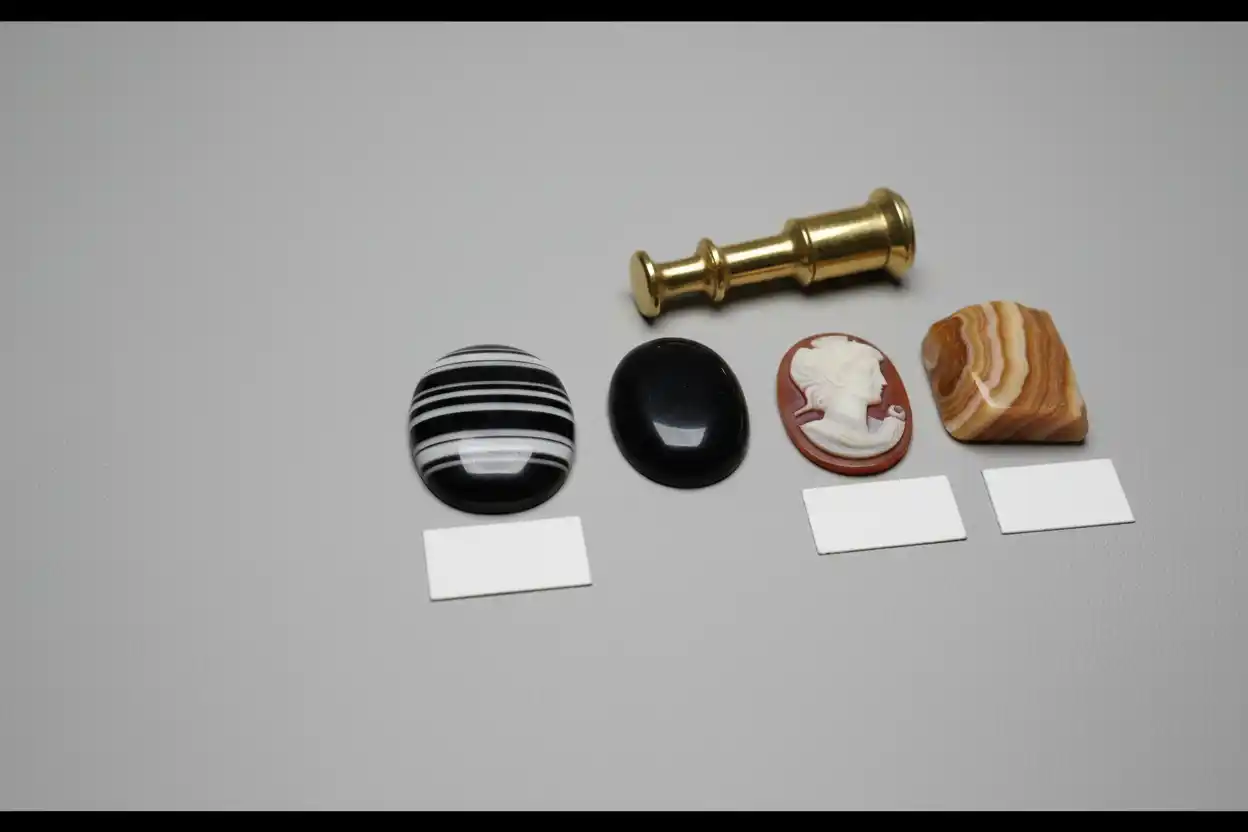
Where to Buy Real Onyx and Avoid Dyed or Calcite Fakes
Real Onyx, in its traditional gemological meaning, is chalcedony with straight, parallel bands. Classic material may combine black and white, while Sardonyx uses reddish-brown, orange, white or black layers.
However, the modern market uses “Onyx” for several different products. Most solid-black Black Onyx jewelry consists of genuine chalcedony dyed black. Meanwhile, green, honey, cream and multicolored architectural “onyx” is often banded Calcite or Aragonite rather than chalcedony.
Those materials can all be natural, attractive and commercially established. The buying problem begins when the seller fails to identify which Onyx market the object belongs to.
The Onyx meaning and properties guide covers identity, history and traditional symbolism. This guide focuses on terminology, dye, Chalcedony versus carbonate Onyx, simulants, product construction and buying a stone whose composition matches its intended use.
Onyx Has More Than One Commercial Meaning
The word Onyx is used in at least three important ways.
Chalcedony Onyx is microcrystalline quartz with straight, parallel bands.
Black Onyx usually means natural chalcedony that has been dyed a uniform black.
Calcite Onyx, Onyx Marble or Mexican Onyx refers to banded calcium-carbonate decorative stone, commonly composed of Calcite, Aragonite or both.
A fourth loose usage applies Onyx to almost any polished black stone. That practice creates confusion with Obsidian, Jet, Hematite, black glass, Spinel, Tourmaline and dyed Marble.
A responsible seller should state the composition before relying on the familiar name.
Traditional Chalcedony Onyx
Chalcedony is a microcrystalline aggregate of quartz.
The Chalcedony meaning guide provides the family context, while the Agate meaning guide explains banded chalcedony more broadly.
Traditional Onyx has relatively straight, parallel layers rather than the curved, concentric or fortification bands common in many Agates.
Natural colors can include white, gray, brown, reddish brown and black. Nevertheless, completely uniform natural black chalcedony is uncommon.
The types of Onyx guide separates Black Onyx, Sardonyx, Chalcedony Onyx and commercial carbonate materials.
Choose the Product Form Before Shopping
| Onyx product | Best source | Main buying concern |
|---|---|---|
| Natural banded chalcedony slab | Chalcedony or lapidary dealer | Straight banding, dye, fractures and locality |
| Black Onyx cabochon | Established gem dealer | Dyed chalcedony versus glass or other black stone |
| Sardonyx cameo | Antique or carving specialist | Natural layers, dye, assembly and workmanship |
| Green “Onyx” carving | Carbonate-stone specialist | Calcite or Aragonite composition and resin |
| Onyx Marble slab | Architectural stone supplier | Accurate carbonate labeling, sealing and repairs |
| Bead strand | Established bead supplier | Dyed Chalcedony, glass, coating and drill-hole damage |
| Ring | Jeweler with treatment disclosure | Material type, setting and dye stability |
| Brooch or intaglio | Antique-jewelry specialist | Replacement stones, glue and carving method |
| Sphere or tower | Experienced carving retailer | Calcite substitution, resin and molded glass |
| Black stone parcel | Gem dealer with testing | Onyx versus Obsidian, Jade, Spinel and glass |
A Black Onyx ring and a green architectural Onyx bowl may require entirely different care because their compositions differ.
Where to Buy Genuine Onyx
Chalcedony and Agate specialists
A specialist dealer is the strongest source for straight-banded natural Onyx, Sardonyx and carving rough.
Ask to see a dry sawn face and the slab edges. Bands should continue through the material rather than sitting as paint on one surface.
Request treatment disclosure. Dye is common in Chalcedony and should not be treated as an exceptional scandal when stated honestly.
Established gem dealers
A Black Onyx seller should identify the material as dyed chalcedony when that is the product.
The listing should include dimensions, treatment, construction and whether the stone is solid or assembled.
An independent report is sensible for an expensive carving, unusual natural-black claim or object represented as another valuable black gemstone.
Gem and mineral shows
Shows allow comparison with Black Obsidian, Jet, Hematite, dyed Marble, glass and natural banded Chalcedony.
Use a loupe to inspect drill holes, chips, bands, dye concentration and coatings.
Do not scratch, apply acid or use solvents. Those tests can damage the material and become misleading when the item is dyed, assembled or composed of carbonate.
The crystal identification guide provides safer approaches.
Antique and cameo specialists
Layered Onyx and Sardonyx have long been used for cameos and intaglios because the carver can place the design across contrasting bands.
Ask whether the carving is hand-finished, mechanically engraved or molded.
Request a condition report covering repairs, replacement mounts, filled chips and later dye.
Architectural stone suppliers
For green, honey, cream or multicolored Onyx slabs, ask whether the material is Calcite, Aragonite or mixed carbonate.
A reputable supplier should use phrases such as “Calcite Onyx,” “Onyx Marble” or “banded carbonate” rather than suggesting that it is quartz-family Black Onyx.
Ask about fiberglass backing, mesh, resin, sealant and repaired cracks.
Established online stores
The online gemstone buying guide covers payment protection and seller identity.
Request exact-item photographs under neutral light. Black stones conceal scratches and chips in dark backgrounds.
Ask for the back, girdle, drill holes and edges. Those areas frequently reveal dye, glass, backing and composite construction.
What Genuine Chalcedony Onyx Looks Like
Traditional Onyx should show relatively straight, parallel bands.
The layers can differ in color, translucency and thickness. They may be black and white, gray and white, brown and cream or reddish and pale.
The material should have a fine microcrystalline texture without visible granular crystals.
Polished Chalcedony Onyx takes a smooth, vitreous-to-waxy polish. Thin light-colored bands may transmit light.
Natural bands continue through the stone. Their position changes across the front, edge and back according to the cut.
A perfectly uniform black cabochon can still be genuine dyed chalcedony, but the Onyx identity comes from trade usage rather than visible straight bands.
Black Onyx
Black Onyx is one of the most established dyed-gem products.
Natural pale or banded chalcedony is treated to produce a uniform black appearance. The result remains natural chalcedony with treated color.
The treated-Onyx guide owns detailed dye and enhancement identification. The real-versus-fake Onyx guide provides the direct diagnostic workflow.
A seller should not advertise ordinary Black Onyx as “guaranteed naturally jet black and completely untreated” without strong laboratory evidence.
Treatment disclosure matters, but stable, well-dyed Black Onyx can still be durable and appropriate for jewelry.
Sardonyx
Sardonyx is layered chalcedony combining sard-like red, orange or brown bands with white or black layers.
Its contrasting structure makes it particularly suitable for cameos, seals and carved plaques.
The future guide to buying genuine Sardonyx will own red-brown band quality, dye, imitation and source.
A plain red Carnelian cabochon without parallel layers should not automatically receive the Sardonyx name.
Green Onyx
Green Onyx is one of the most ambiguous names in the market.
It can refer to dyed green chalcedony, naturally green Chalcedony or banded green carbonate material.
The seller should state which one is being offered. Their hardness, treatment and acid sensitivity differ significantly.
A bright translucent green sphere with cream bands may be Calcite or Aragonite Onyx rather than quartz-family Chalcedony.
Calcite Onyx and Onyx Marble
Banded Calcite and Aragonite are widely used for bowls, tiles, lamps, carvings, slabs and decorative objects.
These carbonate products can be white, cream, yellow, honey, orange, red, brown, green or multicolored.
The name Onyx Marble is commercially established but geologically imprecise. Many products are neither true Chalcedony Onyx nor metamorphic Marble.
Carbonate Onyx is softer and acid-sensitive. It must not be cleaned or worn as though it were quartz-family Onyx.
The Calcite meaning guide and Aragonite meaning guide provide the relevant mineral context.
Onyx Versus Obsidian
Obsidian is natural volcanic glass. Onyx is traditionally banded Chalcedony.
The Onyx-versus-Obsidian guide owns the full comparison.
Obsidian has glassy conchoidal fracture and lower scratch resistance. Chalcedony Onyx has a microcrystalline aggregate structure and hardness around 6.5 to 7.
The completed guide to buying real Obsidian addresses slag, manufactured glass and volcanic-source claims.
Onyx Versus Jet
Jet is a lightweight organic material derived from ancient wood.
The completed guide to buying real Jet explains how to separate it from glass, vulcanite and bog oak.
Jet is much lighter and softer than Chalcedony Onyx. Antique black jewelry may combine both materials.
Onyx Versus Hematite
Hematite is an iron oxide with metallic gray-to-black appearance and a reddish-brown streak.
The completed guide to buying genuine Hematite covers magnetic ferrite and polished black substitutes.
Hematite feels significantly denser and has metallic-to-submetallic luster, while Onyx has a glassy or waxy polish.
Onyx Versus Black Tourmaline
Black Tourmaline commonly shows prismatic crystal habit and lengthwise striations.
Polished stones can become difficult to separate visually. Refractive index, microscopy and spectroscopy offer safer evidence.
The Black Tourmaline, Obsidian and Onyx comparison addresses the overlapping black-stone market.
Onyx Versus Black Spinel and Black Sapphire
Black Spinel and Sapphire are crystalline gemstones with substantially greater hardness and different optical properties.
They may be faceted more commonly than Onyx and can take sharp, durable facet junctions.
A faceted black stone sold simply as “Onyx” deserves testing, particularly when its price or claimed hardness suggests another material.
Dyed Chalcedony
Dye can turn Chalcedony black, green, blue, red, brown or another color.
Artificial color may concentrate in pores, fractures and band boundaries. However, well-executed black treatment can appear uniform even under magnification.
A polished chip or drill hole may expose a lighter interior, though some dye penetrates deeply.
The gemstone treatments guide explains why treatment disclosure should address both method and stability.
Glass Imitations
Black, green or banded glass can imitate Onyx.
Round bubbles, flow lines, mold seams and conchoidal chips support glass.
Opaque black glass can lack visible bubbles and remain difficult to identify by sight.
The glass-versus-crystal guide provides broader testing context.
Plastic and Resin
Resin can be molded into black cabochons, beads, cameos and carvings.
Mold seams, soft scratches, bubbles and repeated patterns suggest polymer manufacture.
Stone powder may be added to increase weight. Therefore, a cool or heavy feel does not prove natural Onyx.
Coatings and Metallic Finishes
A clear coating can improve gloss, while an opaque black layer can conceal another substrate.
Gold, silver and iridescent coatings may also be applied over Black Onyx.
Inspect high points and drill holes for peeling or color loss.
A coating over genuine Onyx is a treated product rather than a fake mineral, provided the seller discloses it.
Assembled Stones and Backing
Black Onyx is commonly used as backing beneath Opal doublets and triplets. Conversely, a thin Onyx layer can be attached to glass, quartz or another support.
Inspect the edge for straight seams and adhesive.
A layered cameo may intentionally combine differently colored materials. It should be identified as assembled when the layers were joined rather than naturally banded.
The gem imitation guide provides broader construction context, although Onyx doublets are treatment and assembly questions rather than lab-grown material.
How to Evaluate Banded Onyx Rough
Request a dry sawn face and edge photographs.
Bands should be sufficiently straight and parallel for the intended carving or cabochon.
Inspect fractures crossing the layers. A crack can split a cameo along the color boundary.
Ask whether the rough was dyed before or after slicing and whether the color penetrates the full thickness.
How to Judge Black Onyx Cabochons
The surface should have an even black appearance and a high polish without broad flat areas.
Inspect the girdle for chips and the back for color consistency, coating or backing.
A deep scratch that reveals pale Chalcedony supports dyed construction but damages the stone. Do not create one intentionally.
Ask whether the item is solid chalcedony or an assembled layer.
Evaluating Cameos and Intaglios
The design should use natural or disclosed treated layers deliberately.
Inspect noses, edges, lettering and raised relief for chips or filler.
Under magnification, hand-finishing may show subtle tool variation, while molded resin commonly repeats identical designs.
The back should reveal the band structure and any adhesive.
Buying Beads
Natural Chalcedony beads should maintain the same fine-grained material through the drill holes.
Inspect for lighter interiors, resin, coating and chips.
Perfectly identical black beads can still be calibrated dyed Onyx, but the seller should identify the material rather than treating uniformity as proof of rarity.
Ask whether a strand contains Onyx, glass, Obsidian or mixed black stones.
Buying Onyx Rings and Jewelry
Chalcedony Onyx is generally practical for jewelry, with hardness around 6.5 to 7 and good toughness.
The gemstone hardness chart provides scratch-resistance context.
A low bezel setting protects cabochon edges. Faceted corners can chip after sharp impacts.
Carbonate Onyx requires much gentler wear because it is softer and acid-sensitive.
The Onyx ring guide, Onyx bracelet guide, Onyx earrings guide and Onyx necklace guide cover form-specific styling and construction.
Locality and Provenance
Chalcedony and Agate occur worldwide, with important commercial sources in Brazil, Uruguay, India, Madagascar, Germany, the United States and other regions.
Sardonyx with strong contrasting bands is particularly associated with India in the modern trade.
Black Onyx is usually defined more by treatment and cutting quality than a rare locality.
Green, honey and multicolored carbonate Onyx may come from Mexico, Pakistan, Iran, Türkiye, Afghanistan and other sources.
The country should not substitute for composition. A Mexican green carving can be genuine natural Calcite Onyx without being Chalcedony Onyx.
Price and Value
Ordinary dyed Black Onyx is affordable. Price rises with size, cutting quality, exceptional natural banding, carving, antique provenance and jewelry workmanship.
Important factors include:
- Correct material identification
- Straight, usable layers
- Strong contrast
- Stable dye
- Even polish
- Minimal chips
- Solid versus assembled construction
- Treatment disclosure
- Skilled carving
- Antique integrity and provenance
A uniform black cabochon should not receive a rare-natural-black premium merely because the dye is difficult to see.
Architectural Onyx price depends heavily on slab size, translucency, band pattern, resin repair and fabrication labor.
The gemstone pricing guide explains how material, treatment and workmanship interact.
Questions to Ask the Seller
Ask whether the item is chalcedony Onyx, dyed Black Onyx, Sardonyx, Calcite Onyx, Aragonite Onyx, glass or resin.
Request disclosure of dye, coating, resin, backing, glue and assembly.
For banded material, request front, back and edge photographs. For black cabochons, ask for the reverse and girdle.
For architectural stone, confirm mesh, fiberglass backing, resin and sealant.
For antique carvings, request a restoration statement and material assessment.
Finally, obtain a return policy that allows nondestructive gemological testing.
Professional Identification
Refractive index, specific gravity and microscopy can distinguish Chalcedony Onyx from glass, Obsidian, Jet and many black minerals.
Raman spectroscopy and X-ray diffraction can separate quartz-family Onyx from Calcite, Aragonite and other carbonate materials.
Microscopy can reveal dye, coatings, seams and filler.
Identifying chalcedony does not prove natural black color. Treatment assessment remains a separate part of the report.
Cleaning and Storage
The completed Onyx jewelry cleaning guide provides detailed care.
For chalcedony Onyx, use lukewarm water, mild soap and a soft cloth. Avoid harsh solvents when dye, coating, glue or antique settings may be present.
Carbonate Onyx must be kept away from vinegar, lemon juice, acidic cleaners and descalers.
Do not use ultrasonic or steam cleaning on assembled, fractured, filled or antique objects.
Store Onyx separately from diamonds, sapphires and other harder gems.
Frequently Asked Questions
1. Is real Onyx naturally black?
Traditional Onyx can contain dark bands, but most uniform Black Onyx in jewelry is dyed chalcedony.
2. Is dyed Black Onyx fake?
No. It is genuine natural chalcedony with treated color when labeled accurately.
3. What is traditional Onyx?
It is chalcedony with relatively straight, parallel layers of contrasting colors.
4. Is green Onyx genuine Onyx?
The name may refer to dyed green chalcedony or banded green Calcite or Aragonite. The seller must state the composition.
5. What is Mexican Onyx?
It commonly refers to translucent banded Calcite or Aragonite decorative stone rather than chalcedony.
6. Is Onyx Marble true Marble?
Often not in the strict geological sense. The term usually describes banded carbonate stone used architecturally.
7. Is Onyx the same as Obsidian?
No. Onyx is traditionally banded Chalcedony, while Obsidian is volcanic glass.
8. Is Sardonyx a type of Onyx?
Yes. Sardonyx is banded chalcedony containing sard-like red, orange or brown layers with white or dark bands.
9. Can glass imitate Black Onyx?
Yes. Opaque black glass can closely resemble dyed chalcedony.
10. Can Onyx be assembled or backed?
Yes. Thin layers may be joined to other materials, and Black Onyx is also used as backing in other gem composites.
11. Is Onyx suitable for everyday rings?
Chalcedony Onyx is generally practical in protected settings. Calcite Onyx is much softer and less suitable.
12. What is the biggest warning sign in a listing?
Be cautious when a seller calls green, honey or multicolored banded material simply “natural Onyx” but refuses to identify whether it is quartz or carbonate.
Buy the Correct Material Behind the Onyx Name
Onyx can mean durable dyed black chalcedony, naturally banded Chalcedony, carved Sardonyx or soft translucent carbonate stone. Each can be legitimate, but they are not interchangeable.
The O crystal directory, O gemstone directory, black gemstones guide and visual gemstone guide provide wider comparisons. Choose a seller who identifies the composition before describing the color.
Safety note: Do not use acid to test an Onyx product. Acid permanently etches Calcite and Aragonite and can damage settings or coatings. Cutting chalcedony also creates hazardous respirable silica dust and requires professional wet methods, extraction and protective equipment.