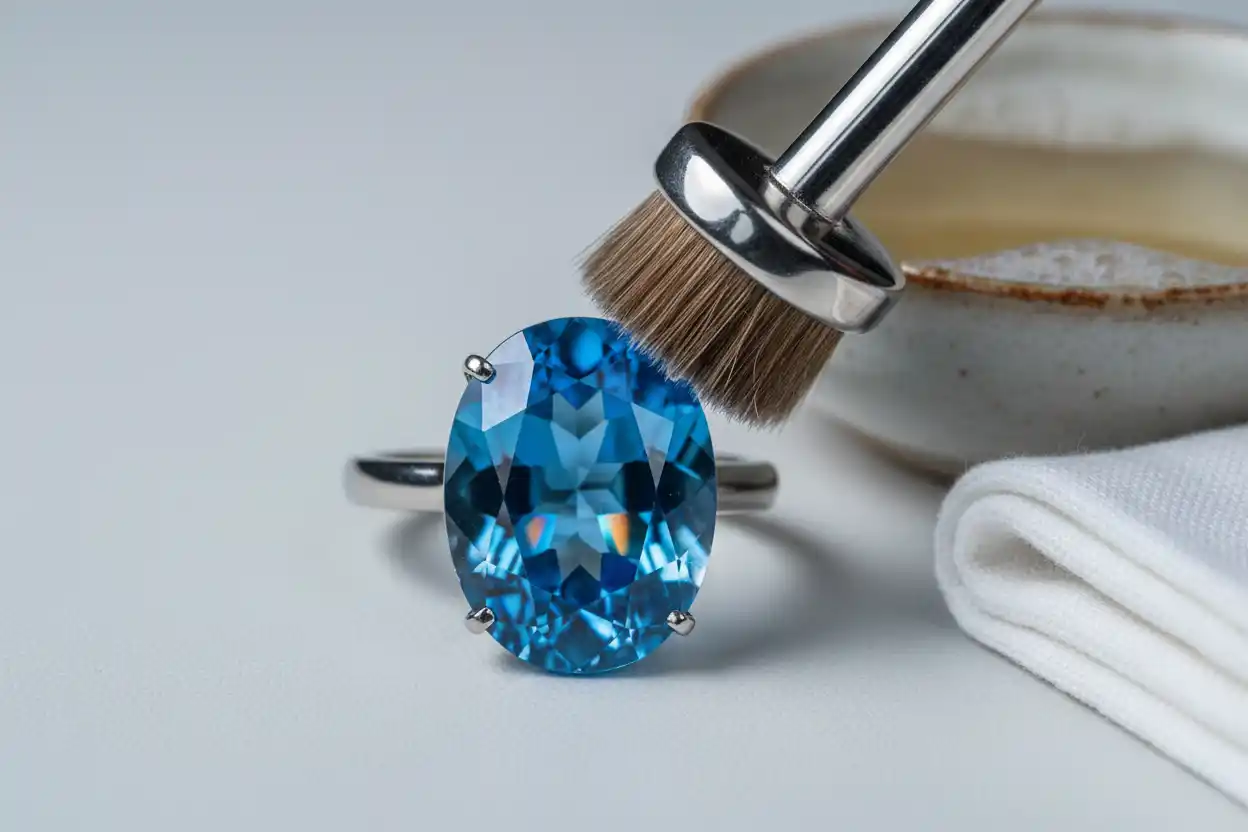
How to Clean Zircon Jewelry Safely
Zircon jewelry should be cleaned with warm water, mild liquid soap, and a soft-bristled brush. Ultrasonic and steam cleaners should not be used because Zircon can be brittle, its facet edges may abrade or chip, and some stones contain radiation-related structural damage or rare fracture filling.
A brief manual wash removes skin oil, cosmetics, soap film, and setting residue without exposing the gemstone to vibration, pressure, or concentrated heat. This method is suitable for natural-color Zircon as well as most heat-treated blue and colorless material.
Zircon Is Not Cubic Zirconia
Natural Zircon is zirconium silicate, an ancient mineral found in igneous, metamorphic, and sedimentary environments. Its geology, colors, optical properties, and symbolism belong to the broader Zircon guide.
Cubic zirconia is a laboratory-created zirconium oxide used primarily as a diamond simulant. It is chemically and structurally different from natural Zircon.
The separate material profile belongs to the Cubic Zirconia guide, while its physical-care instructions appear in How to Clean Cubic Zirconia Jewelry Safely.
Do not apply cubic-zirconia cleaning assumptions to natural Zircon. CZ is generally harder and structurally more uniform, while Zircon has variable hardness and may contain radiation-related lattice damage.
Why Zircon Needs Individual Care
Zircon can display exceptional brilliance, luster, and spectral fire. Strong double refraction may make rear facet edges appear doubled when the gemstone is viewed through its crown.
Its hardness varies considerably because Zircon’s crystal structure may be intact, partly damaged, or heavily altered by natural internal radiation.
| Property | Cleaning implication |
|---|---|
| Mineral species | Zircon |
| Chemical composition | Zirconium silicate |
| Typical colors | Blue, colorless, brown, yellow, orange, red, or green |
| Mohs hardness | Approximately 6 to 7.5 |
| Toughness | Fair to good, but the gemstone may be brittle |
| Optical character | High brilliance, dispersion, and possible strong doubling |
| Safest cleaning method | Warm water, mild soap, and a soft brush |
| Ultrasonic cleaning | Not recommended |
| Steam cleaning | Not recommended |
| Main risks | Abrasion, chipping, structural damage, heat-treated color, filler, and weak settings |
The gemstone hardness chart explains why one Zircon may resist wear better than another.
Hardness alone does not describe resistance to chipped facet edges or impact. The broader distinction appears in Gemstone Toughness vs Hardness.
Although Zircon does not have the pronounced cleavage of Topaz, structural weakness and brittleness still matter. The wider breakage framework appears in Gemstone Cleavage Explained.
High, Intermediate, and Low Zircon
Zircon may contain trace amounts of uranium and thorium. Over geological time, radiation emitted by those elements can disrupt the crystal lattice.
Material with a relatively intact lattice is often called high Zircon. Intermediate Zircon shows partial damage, while heavily damaged material is described as low or metamict Zircon.
Metamictization may reduce hardness, density, refractive properties, and structural integrity. Low Zircon can appear less brilliant or more resinous than high Zircon.
These categories are gemological rather than cleanliness grades. Washing cannot restore a radiation-damaged lattice or turn low Zircon into high Zircon.
Heat treatment can sometimes improve crystallinity as well as change color, but that process belongs to controlled treatment facilities rather than household care.
Heat-Treated Blue and Colorless Zircon
Much commercial Blue Zircon begins as brown material that is heated under controlled conditions. Heat can also produce near-colorless stones.
The resulting colors are commonly stable during normal wear. However, some treated Zircons may gradually return toward a light-brown appearance after prolonged exposure to bright light.
High temperature can also change Zircon color. Therefore, avoid steam cleaning, repair torches, hot display lamps, radiators, and prolonged storage on a sunny windowsill.
Treatment identification and disclosure belong to Gemstone Treatments Explained.
A temporary or permanent color shift is not surface dirt. Stronger soap will not restore treatment-related color.
Inspect the Jewel Before Cleaning
Examine the Zircon beneath bright, indirect light.
Check every prong, bezel edge, halo bead, channel wall, gallery rail, hinge, link, clasp, and solder joint.
Look for rounded facet junctions, small chips, surface-reaching fractures, damaged corners, missing accent stones, and movement in the setting.
Zircon’s strong brilliance can conceal minor abrasion when viewed face-up. Tilt the jewel and inspect the girdle and facet edges from the side.
Do not wash a stone that clicks, shifts, or catches against fabric. Have the setting repaired first.
Check for Rare Fracture Filling
Zircon may rarely be fracture filled to reduce the visibility of surface-reaching breaks.
Filler can respond poorly to heat, solvents, vibration, acids, and repair procedures. A filled stone should receive warm-soapy-water cleaning only.
When treatment is unknown but the gemstone contains visible fissures, choose manual cleaning and avoid all machines.
Tell the jeweler about possible filling before resizing, soldering, polishing, retipping, or resetting the piece.
Prepare a Padded Cleaning Area
Place a folded towel beneath the jewelry. Zircon can chip if it falls onto a stone counter, tile floor, metal sink, or glass surface.
Fill a shallow bowl with warm—not hot—water and add a few drops of mild liquid dish soap.
Prepare a second bowl of clean warm water for rinsing. Use a soft toothbrush or fine jewelry brush.
Do not clean directly over an uncovered sink. A small earring or loosened accent stone may disappear through the drain.
Avoid bleach, abrasive powders, strong solvents, concentrated acids, and aggressive alkaline cleaners.
Clean Zircon Step by Step
Place the jewel briefly in the mild solution so skin oil, lotion, cosmetics, and soap residue begin to loosen.
Brush the crown, pavilion, girdle, gallery, bezel, prongs, and underside of the gemstone.
The rear facets deserve particular attention. Zircon’s brilliance falls sharply when an oily layer blocks light beneath the stone.
Use light pressure around worn facet junctions, exposed corners, thin girdles, and visible fractures.
Do not insert a pin, needle, or knife beneath the gemstone. Metal tools can bend prongs or press against a brittle girdle.
Rinse and Dry Carefully
Rinse the jewel in the second bowl of clean warm water.
Inspect the underside closely because dried soap can resemble cloudiness and reduce the gemstone’s fire.
Blot the jewel with a lint-free cloth. Do not rub vigorously across abraded facet edges.
Allow hidden moisture to evaporate naturally at room temperature.
After drying, check whether any prong catches on the cloth. A raised metal edge should be professionally repaired.
Never Use an Ultrasonic Cleaner
Zircon should not enter an ultrasonic cleaner.
Vibration may enlarge fractures, chip abraded facet edges, disturb rare filler, or expose weak prongs.
Low or metamict Zircon may have a more disrupted internal structure than an intact high Zircon. An owner normally cannot establish that structural category at home.
The broader equipment boundaries appear in Which Gemstones Can Go in an Ultrasonic Cleaner?.
Manual cleaning provides sufficient brilliance without machine risk.
Never Steam Clean Zircon
Steam combines concentrated heat, pressure, and rapid temperature change.
Heat may alter treated color, while thermal stress can worsen fractures or damage filler, glue, enamel, antique solder, and companion stones.
Warm soapy water is the recommended method across natural-color and heat-treated Zircon.
Cleaning a Zircon Ring
A Zircon ring collects hand lotion, sanitizer, soap, and skin oil around the pavilion.
Brush through the gallery openings without pressing on the crown or girdle.
Remove the ring before gardening, exercise, household cleaning, swimming, washing dishes, and heavy manual work.
Protective settings reduce impact risk, although they may collect residue around the metal edge.
Cleaning Zircon Earrings
Zircon earrings receive less impact than rings but collect cosmetics, hairspray, and skin oils behind their baskets.
Clean posts, hooks, backs, hinges, and lower facets separately.
Keep alcohol-based disinfectant on compatible metal fittings and away from filler, glue, coatings, plating, and the gemstone.
Store each earring separately so its post cannot strike the other Zircon.
Cleaning a Zircon Necklace
A Zircon necklace or pendant may develop residue from perfume, sunscreen, lotion, and skin contact.
Apply cosmetics before putting on the jewel and allow them to dry.
Prevent the chain from rubbing across exposed facets during cleaning and storage. Support a pendant by its setting rather than gripping the stone.
Large Zircons are relatively dense, so inspect the bail and connecting ring regularly.
Cleaning a Zircon Bracelet
A Zircon bracelet combines multiple stones with flexible links, hinges, clasps, and small prongs.
Support the bracelet while cleaning and work on one section at a time.
Inspect every gemstone after rinsing. Remove the bracelet before desk work or activities that repeatedly bring the wrist against hard surfaces.
Protect Facet Edges During Storage
Zircon’s facet edges can abrade through repeated contact even when the stone has good brilliance.
Store each jewel in a separate padded compartment or soft pouch.
Diamond, Sapphire, Ruby, Spinel, Topaz, and harder materials can scratch Zircon. Meanwhile, two Zircons rubbing together may also create wear.
Prevent chains, clasps, and earring posts from resting against polished facets.
Do not pile loose jewelry on top of a Zircon ring or pendant.
Buying, Color, and Value Context
The Zircon buying guide covers color, brilliance, doubling, clarity, cut, metamictization, heat treatment, and setting quality.
Market factors belong to the Zircon price guide.
The tracker’s Types of Zircon page owns distinctions among blue, white, brown, yellow, orange, red, green, high, intermediate, and low Zircon.
Symbolic interpretations of different hues belong to Zircon Color Meaning.
Cleaning can reveal luster and fire more accurately, but it cannot restore rounded facet edges, reverse metamictization, or correct a poorly proportioned cut.
Laboratory Reports and December Birthstone Context
A laboratory can identify natural Zircon, assess optical properties, and sometimes detect treatment or unusual structural characteristics.
The gemstone certification guide explains laboratory services, while How to Read a Gem Lab Report covers identity, measurements, treatment comments, and limitations.
Zircon is one of December’s recognized birthstones alongside Tanzanite and Turquoise, covered in the December birthstone guide.
Keep reports, treatment disclosures, invoices, measurements, and repair records with valuable blue, red, green, or antique Zircon.
Frequently Asked Questions
1. What is the safest way to clean Zircon?
Use warm water, mild liquid soap, and a soft brush, then rinse and dry the jewel carefully.
2. Can Zircon get wet?
Yes. Brief washing is normally safe, although glue, filling, coatings, watches, and delicate settings may impose limits.
3. Can Zircon go in an ultrasonic cleaner?
No. Vibration may damage fractures, filler, abraded facets, and weak settings.
4. Can Zircon be steam cleaned?
No. Steam introduces heat and pressure that may affect color, structural damage, filler, and jewelry construction.
5. Is Blue Zircon heat treated?
Most commercial Blue Zircon receives heat treatment, often beginning as brown material.
6. Can Blue Zircon fade?
Some heat-treated stones may gradually return toward a light-brown color after prolonged bright-light exposure.
7. Is Zircon the same as cubic zirconia?
No. Zircon is a natural zirconium-silicate mineral, while cubic zirconia is laboratory-created zirconium oxide.
8. Is dish soap safe for Zircon?
A few drops of mild liquid dish soap are suitable. Avoid abrasive and aggressively chemical formulas.
9. Can toothpaste polish Zircon?
No. Toothpaste can scratch metal, worsen facet abrasion, and leave residue beneath the setting.
10. Why do Zircon’s facets look doubled?
Strong double refraction can make rear facet edges appear doubled when viewed through the stone.
11. How often should Zircon jewelry be cleaned?
Wipe it after wear and wash it when oil or cosmetics visibly reduce its brilliance.
12. When should Zircon receive professional care?
Professional attention is appropriate for chipped facets, open fractures, possible filling, valuable stones, loose settings, or unexplained color changes.
Conclusion
Zircon’s brilliance can rival far harder gemstones, but its variable structure and brittle facet edges require conservative care. Warm soapy water restores its fire without exposing heat-treated color, rare filler, or worn settings to vibration and steam. When the jewel remains dull, inspect its facet abrasion and internal structure rather than escalating to machinery.