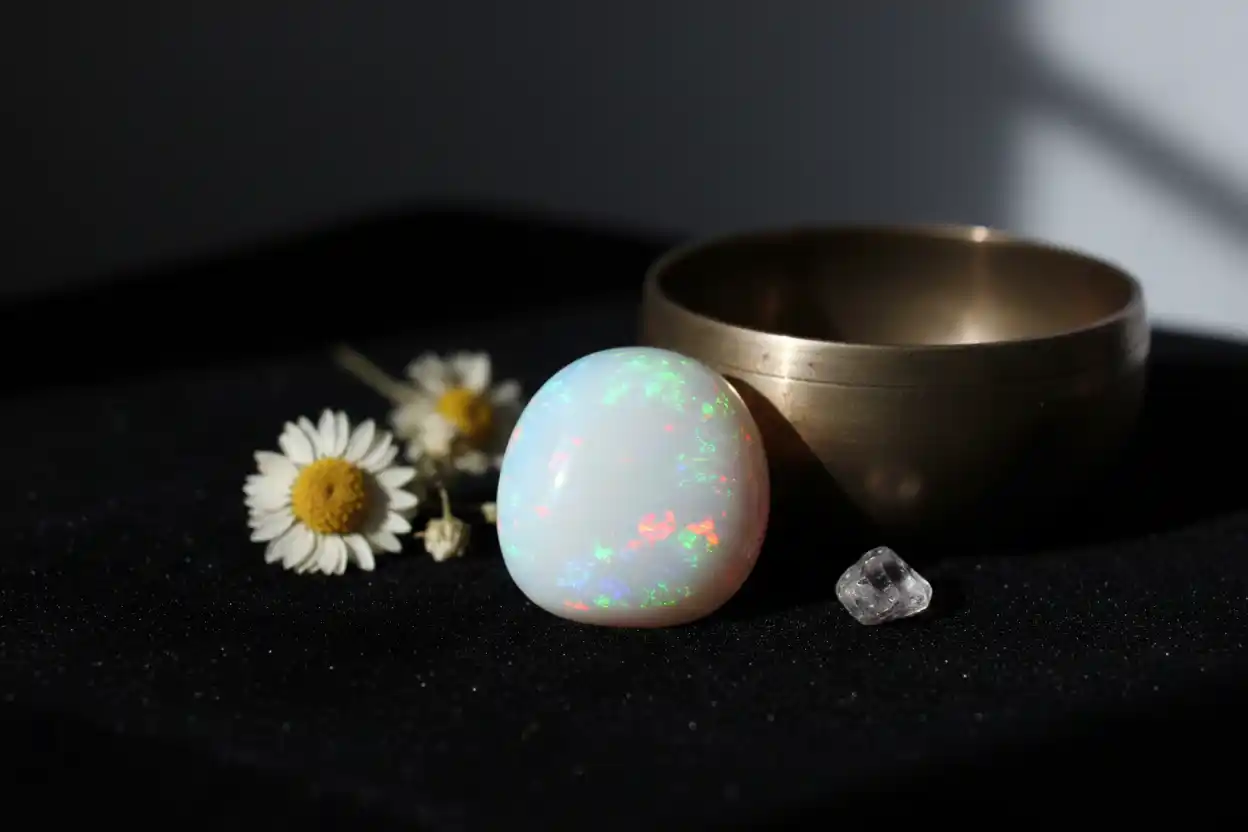
How to Cleanse and Charge Opal
The safest ways to cleanse and charge Opal are sound, intention, visualization, gentle breath, indirect indoor moonlight, and a written dedication. A brief warm-soapy-water cleaning may suit many solid Opals, but ritual soaking should be avoided because Opal type, water absorption, treatments, backing, adhesive, and fracture condition can vary widely.
Opal should not be charged on a hot windowsill, exposed to steam, moved abruptly between hot and cold environments, buried in salt, or placed in an ultrasonic cleaner. Heat and thermal shock can cause fractures or crazing, while hydrophane Opal, doublets, triplets, treated stones, and repaired pieces require stricter moisture control.
What Cleansing and Charging Mean
Cleansing is a personal or spiritual ritual used to mark a transition, release previous associations, or prepare an object for intentional use.
Charging generally means connecting the Opal with a purpose, memory, creative practice, relationship, or personal value.
Neither process is required to preserve Opal physically. No established scientific evidence shows that cleansing alters its silica structure, play-of-color, health effects, or measurable energy.
The gemstone’s formation, color, sources, play-of-color, and traditional symbolism belong to the broader Opal guide.
Belief-based wellness claims belong separately to Opal Healing Properties.
Opal Is Hydrated Silica
Opal is a hydrated form of silica rather than a crystalline Quartz variety.
Its structure can contain significant water, while hardness, porosity, toughness, and stability vary according to formation conditions and exact material.
| Property | Ritual implication |
|---|---|
| Material | Hydrated silica |
| Typical colors | Every body color, with or without play-of-color |
| Mohs hardness | Approximately 5 to 6.5 |
| Toughness | Very poor to fair |
| Cleavage | None |
| Main optical effect | Play-of-color in precious Opal |
| Safest ritual methods | Sound, intention, visualization, breath, and indoor moonlight |
| Water exposure | Depends on Opal type, treatment, and construction |
| Main risks | Crazing, thermal shock, water absorption, treatment, adhesives, scratches, and fractures |
The gemstone hardness chart explains why Quartz, Topaz, Sapphire, and many common gemstones can scratch Opal.
A lack of cleavage does not make Opal impact resistant. Its toughness can range from very poor to fair.
The difference between surface hardness and resistance to breakage appears in Gemstone Toughness vs Hardness.
Play-of-Color Is an Internal Optical Effect
Precious Opal displays play-of-color when light interacts with ordered structures of silica spheres.
Different sphere sizes and arrangements produce different spectral colors, patterns, and viewing effects.
Common Opal lacks play-of-color but may still show attractive body color, translucency, dendrites, or inclusions.
Cleaning can remove oil that dulls the surface. It cannot improve weak color play, enlarge a flash, change the pattern, or create spectral colors in common Opal.
The full material range belongs to Types of Opal, while hue-specific symbolism belongs to Opal Color Meaning.
Inspect the Opal Before Beginning
Examine the stone beneath bright, indirect light.
Look for fine crazing lines, open fractures, chipped edges, cloudy adhesive, lifted layers, loose backing, damaged drill holes, surface pits, worn polish, missing inlay, and movement in the setting.
Crazing often appears as a network of fine cracks caused by structural stress or water loss.
Do not flex a thin Opal, press against a crack, or use oil to hide crazing.
Check the side of the gemstone for visible layers. A doublet or triplet may contain natural Opal joined to a backing or transparent cap with adhesive.
When the construction is uncertain, use sound, intention, or visualization rather than water.
Solid Opal, Doublets, and Triplets Need Different Care
A solid Opal consists primarily of one piece of natural Opal, although it may retain natural host rock in a boulder or matrix form.
An Opal doublet commonly joins a thin precious-Opal layer to a dark backing.
A triplet generally adds a transparent cap above a thin Opal layer and backing.
Adhesive joins make prolonged water exposure, heat, steam, and solvents especially inappropriate.
The complete identification workflow belongs to Real vs. Fake Opal, which owns doublet, triplet, synthetic, glass, and imitation distinctions.
A ritual should follow the assembled object’s limits rather than the Opal layer alone.
Hydrophane Opal Can Absorb Water
Some Opals—particularly much Ethiopian material—are hydrophane, meaning they can absorb water into their pore structure.
Water absorption may temporarily change transparency, play-of-color, body color, or apparent clarity.
The stone may take hours or days to return to its earlier appearance as it dries.
Repeated or uneven wetting can also reveal cracks, absorbed oils, contamination, or treatment issues.
The material profile belongs to the Ethiopian Opal guide.
Hydrophane Opal should not be soaked as a spiritual ritual. Dry sound, intention, and moonlight are more predictable.
Treatments Affect Ritual Safety
Opal may be impregnated with oil, wax, plastic, or resin.
Sugar treatment followed by acid treatment can darken porous material and increase contrast. Smoke treatment may also darken the body color.
Some Opals are dyed, coated, filled, stabilized, or assembled.
The treatment-identification workflow belongs to How to Spot Treated or Synthetic Opal.
The broader enhancement framework appears in Gemstone Treatments Explained.
Heat, solvents, prolonged water exposure, oils, and abrasive cleaning may alter these treatments.
Physical Cleaning Is Separate
Symbolic cleansing does not remove skin oil, cosmetics, soap residue, or dust.
The complete physical-care method belongs to How to Clean Opal Jewelry Safely.
Warm water with mild soap is the safest physical-cleaning method for a suitable Opal. However, doublets, triplets, glued inlay, hydrophane material, and unstable treatments should receive minimal controlled moisture.
Steam and ultrasonic cleaners should never be used.
The wider equipment restriction belongs to Which Gemstones Can Go in an Ultrasonic Cleaner?.
Method 1: Cleanse Opal with Sound
Place the Opal on a thick folded cloth or padded tray.
Ring a bell, chime, tuning fork, or singing bowl nearby. You may also hum, chant, clap softly, or play calm music.
Do not place the stone inside a hard metal bowl while striking it.
Concentrated vibration and contact can chip an edge, disturb an adhesive layer, or worsen an existing fracture.
Several gentle tones are sufficient.
Sound offers the widest compatibility across solid, hydrophane, assembled, treated, and antique Opal.
Method 2: Use Intention
Leave the Opal supported on a soft surface or hold it loosely above a cloth.
Choose one concise purpose. It might remind you to protect creative time, communicate honestly, approach an emotional decision with clarity, or remain open to several possible outcomes.
State the intention silently or aloud.
The stone does not need to display dramatic color play during the ritual.
A change in lighting angle can make the same Opal appear vivid or subdued without reflecting any change in its symbolic condition.
Method 3: Use Visualization
Place the Opal where it cannot roll or fall.
Imagine earlier associations fading while its body color or play-of-color becomes linked with your chosen purpose.
Some practitioners visualize a rainbow, white light, fire-like color, or a neutral glow.
The imagery is symbolic rather than a physical change inside the silica structure.
Continue for several slow breaths or a few minutes.
Visualization is especially suitable for hydrophane, assembled, crazed, treated, valuable, or antique Opal because it requires no exposure.
Method 4: Use Gentle Breath
Keep the Opal resting on a padded cloth.
Take several slow breaths and exhale gently toward it once or twice.
Avoid visible condensation, particularly around fractures, layer seams, drilled holes, and settings.
Do not grip the Opal tightly or hold a thin doublet by its edges.
State the intention afterward.
Method 5: Use Indirect Moonlight Indoors
Place Opal indoors near a window on a padded tray or inside an open lined jewelry box.
An hour, an evening, or overnight indoor placement may be used.
Keep the Opal away from direct morning sun and hot window glass.
Intense light combined with heat can contribute to crazing, while sudden temperature change can cause fractures.
Outdoor placement adds dew, rain, grit, animals, loss, and rapid environmental changes.
The wider light-exposure framework belongs to Which Crystals Can and Can’t Go in the Sun.
Method 6: Use a Written Dedication
Write one concise statement and place it beside the Opal.
A practical statement might focus on finishing a creative project, considering several perspectives, expressing an idea clearly, or making time for play and experimentation.
Keep pens, staples, clips, and metal objects away from the soft surface.
Leave the note beside the stone for several minutes or an evening.
A written dedication works for every Opal type because it requires no moisture, heat, or physical contact.
Method 7: Use a Brief Damp-Cloth Ritual
A stable solid Opal may receive a brief wipe with a soft cloth dampened in lukewarm water.
This method should be avoided for hydrophane Opal, doublets, triplets, inlay, crazed stones, glued pieces, and treatment-sensitive material unless a professional has confirmed compatibility.
Do not immerse the piece or leave it wet.
Blot it immediately and allow moisture around the setting to evaporate naturally.
The broader water-selection framework belongs to Which Crystals Can and Can’t Go in Water.
Water is optional. A dry ritual provides the same symbolic purpose without creating appearance changes.
Method 8: Use a Companion Object with Separation
Opal may be placed near Moonstone, Tourmaline, Clear Quartz, Selenite, a photograph, a journal, or another meaningful object.
Use separate padded supports.
Quartz and many other stones are harder and can scratch Opal. Metal chains, earring posts, and crystal points may chip the surface.
Direct contact is unnecessary for symbolic charging.
The comparison with a visually similar phenomenal gem belongs to Moonstone vs Opal.
Black Opal
Black Opal has dark body tone that can intensify the apparent brightness of play-of-color.
Its material profile belongs to the Black Opal guide.
Natural dark body color should not be confused automatically with smoke or sugar treatment.
Nevertheless, treated dark Opal exists, so dry ritual methods are preferable when treatment is unknown.
The stone’s rarity and market context belong to the Black Opal buying guide and Black Opal price guide.
Boulder Opal
Boulder Opal retains natural ironstone or another host rock attached to the precious-Opal layer.
Its material profile belongs to the Boulder Opal guide.
Differences in expansion, porosity, surface texture, and fracture behavior between Opal and host rock make prolonged soaking unnecessary.
A dry sound or intention ritual avoids moisture moving through cracks at the Opal–matrix boundary.
Fire Opal
Fire Opal is defined principally by yellow, orange, or red body color and may or may not display play-of-color.
Its profile belongs to the Fire Opal guide.
Transparent faceted Fire Opal may have exposed facet edges and internal fractures, while cabochons may conceal treatments or porosity.
Its dedicated physical-care method belongs to How to Clean Fire Opal Jewelry Safely.
The same sound, intention, visualization, and protected moonlight methods apply.
Avoid Direct Salt Contact
Salt grains can scratch Opal and become trapped in cracks, pits, inlay seams, and settings.
Saltwater adds prolonged moisture and may affect adhesive, backing, cap layers, metal, stringing, and hydrophane material.
Do not bury an Opal in coarse salt.
When salt carries personal symbolism, keep it in a separate bowl while the Opal remains on a lined dish nearby.
Avoid Soil Burial
Soil contains Quartz grains, moisture, organic acids, microorganisms, fertilizers, and mineral debris.
These materials can scratch Opal, enter crazing lines, stain porous material, and damage settings.
Outdoor burial also creates rapid humidity changes and loss risks.
A safer nature-based ritual places the Opal near a plant while keeping it dry and physically separated from soil.
Avoid Oils and Essential Oils
Opal may already contain oil, wax, polymer, or another impregnation treatment.
Applying household oil can temporarily alter transparency or color while attracting dirt and complicating later assessment.
Essential oils may contain solvents or reactive compounds that affect treatment, adhesive, backing, or metal.
Do not apply oil to prevent crazing or “feed” the stone. Professional condition management is more appropriate for a valuable unstable Opal.
Avoid Flame, Steam, and Hot Windowsills
Heat from intense light can cause crazing, while high heat and sudden temperature changes may fracture Opal.
Keep the stone away from candle flames, incense coals, radiators, fireplaces, boiling water, steam cleaners, saunas, and hot vehicle interiors.
Do not move a warm Opal directly into cold water.
An impact origin, volcanic association, or fire-colored body does not make any Opal heat safe.
Use Smoke Conservatively
A brief cool-smoke ritual may be used cautiously, but smoke may leave soot or oil on porous, pale, or treated surfaces.
Keep the Opal far from flames, hot ash, and incense coals.
A smoke-treated Opal is a gemological treatment, not the same as briefly passing a stone through ritual smoke. However, adding more smoke provides no care benefit.
Sound and visualization offer cleaner alternatives.
Buying, Price, and Birthstone Context
The Opal buying guide covers Opal type, play-of-color, pattern, body tone, transparency, treatments, assembly, durability, and setting quality.
Market factors belong to the Opal price guide.
Opal is one of October’s birthstones alongside Tourmaline, covered in the October birthstone guide.
No ritual can repair crazing, restore a detached doublet, reverse permanent staining, or improve poor play-of-color. Those issues belong to material condition and construction.
Frequently Asked Questions
1. What is the safest way to cleanse Opal?
Sound, intention, visualization, gentle breath, a written dedication, and indirect indoor moonlight are safest.
2. Can Opal be cleansed in water?
Water suitability depends on the Opal. Avoid soaking hydrophane stones, doublets, triplets, inlay, crazed Opal, and treated or glued pieces.
3. Can Opal be left in moonlight overnight?
Yes, when kept indoors on a padded surface away from direct morning sun and temperature extremes.
4. Can Opal be charged in sunlight?
Prolonged direct sunlight and heat are not recommended because they can contribute to crazing and fractures.
5. Can Opal be cleansed with salt?
No. Salt can scratch the surface and become trapped in cracks, seams, pits, and settings.
6. Can Opal be cleansed with smoke?
A brief cool-smoke ritual is possible, but soot may enter porous surfaces and treatments.
7. Should Opal be stored in water?
Routine water storage is not recommended for finished jewelry. Opal type, stability, treatment, and assembly must be considered.
8. Why does Ethiopian Opal change after getting wet?
Many Ethiopian Opals are hydrophane and can absorb water, temporarily changing transparency and play-of-color.
9. Can Clear Quartz charge Opal?
Some practitioners use it symbolically. Keep the stones separated because Quartz is harder and can scratch Opal.
10. Does cleansing restore play-of-color?
No. Play-of-color depends on internal silica structure, lighting, orientation, polish, and physical condition.
11. How long should Opal charge?
A few minutes or an evening is sufficient. There is no scientifically required duration.
12. Does cleansing change Opal scientifically?
No established evidence shows that cleansing changes its silica structure, health effects, play-of-color, or measurable physical energy.
Conclusion
Opal’s internal water and silica structure make it visually extraordinary but physically variable. Sound, intention, visualization, and protected moonlight work across solid, hydrophane, assembled, and treated material without forcing moisture into the decision. A responsible ritual protects play-of-color by avoiding heat, soaking, abrasion, and adhesives rather than trying to intensify the stone through exposure.
Crystal cleansing and charging are spiritual or personal practices, not scientifically established methods for changing health, energy, or the physical properties of Opal.