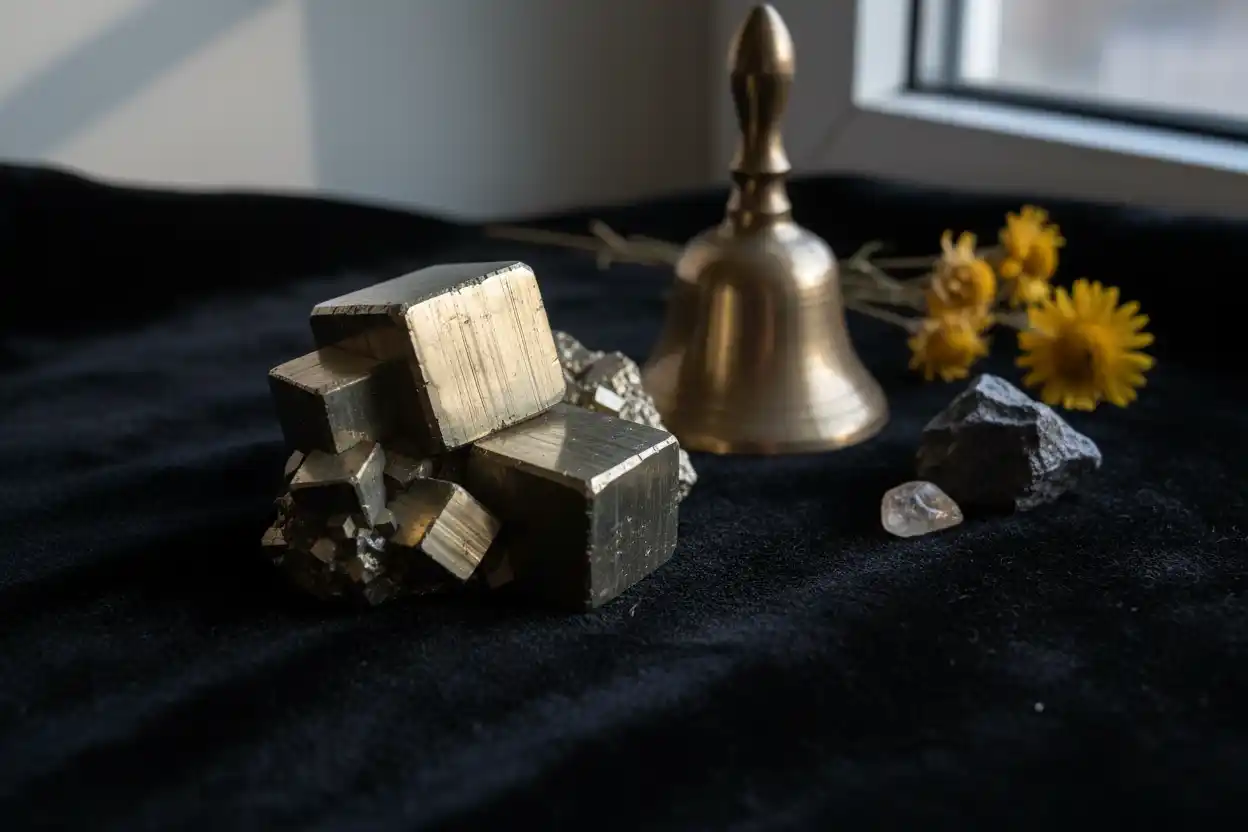
How to Cleanse and Charge Pyrite
The safest ways to cleanse and charge Pyrite are dry sound, intention, visualization, a written dedication, indirect indoor moonlight, and a stable display ritual. Water, saltwater, soil burial, steam, humidity, essential oils, and direct soaking should be avoided because some Pyrite specimens can oxidize and develop acidic deterioration products.
Pyrite is relatively hard but brittle. Sharp cubic corners, striated faces, fragile matrix, framboidal material, and specimens already affected by pyrite decay require minimal handling and a dry environment.
What Cleansing and Charging Mean
Cleansing is a personal or spiritual ritual used to mark a transition, release previous associations, or prepare an object for intentional use.
Charging generally means dedicating the specimen to a purpose, habit, value, project, or personal reminder.
Neither practice is required to preserve Pyrite. No established scientific evidence shows that cleansing changes its iron-sulfide chemistry, health effects, conductivity, or measurable physical energy.
The mineral’s geology, crystal forms, metallic luster, historical name, and traditional symbolism belong to the broader Pyrite guide.
This page focuses on rituals that do not accelerate oxidation or disturb brittle crystals.
Pyrite Is Iron Disulfide
Pyrite has the chemical formula FeS₂ and is the most widespread sulfide mineral.
It commonly forms cubes, pyritohedra, octahedra, penetration twins, granular masses, globular aggregates, framboids, stalactitic forms, replacement fossils, and fine-grained material within matrix.
| Property | Ritual implication |
|---|---|
| Composition | Iron disulfide |
| Typical color | Pale brass yellow, often tarnishing darker or iridescent |
| Mohs hardness | Approximately 6 to 6.5 |
| Tenacity | Brittle |
| Cleavage | Indistinct |
| Fracture | Conchoidal to uneven |
| Safest ritual methods | Dry sound, intention, visualization, writing, and protected moonlight |
| Water exposure | Avoid |
| Main risks | Oxidation, acidic decay products, humidity, crumbling matrix, sharp edges, and dust |
The gemstone hardness chart explains why Pyrite resists scratches better than many ornamental minerals.
However, hardness does not make its corners impact resistant or its aggregates structurally tough.
The difference between scratching and breaking appears in Gemstone Toughness vs Hardness, while Pyrite’s indistinct cleavage and brittle fracture are placed in context by Gemstone Cleavage Explained.
Pyrite Can Oxidize
Pyrite reacts with oxygen and moisture under suitable conditions.
The process may produce iron sulfates, iron oxides, sulfuric acid, pale or yellowish crystalline residues, cracking, swelling, powdering, discoloration, and breakdown of surrounding matrix.
Not every Pyrite specimen deteriorates at the same rate. Crystal size, impurities, porosity, associated minerals, previous storage, humidity, microbial activity, and surface damage can influence stability.
Fine-grained, framboidal, fossil-replacing, coal-associated, and marcasite-bearing material can be particularly vulnerable.
For ritual purposes, the important rule is simple: keep Pyrite dry and environmentally stable.
Recognize Possible Pyrite Decay
Inspect the specimen under bright, indirect light before handling it.
Warning signs include:
- White, pale yellow, greenish, or rusty crystalline deposits
- New cracks or flakes
- Powder collecting beneath the specimen
- Swollen or splitting matrix
- Darkening beyond ordinary surface tarnish
- A sharp sulfurous or acidic odor
- Damage spreading to labels, boxes, metal, or neighboring specimens
Do not brush, wash, or seal an actively deteriorating specimen without professional advice.
Separate it from unaffected minerals and paper materials. Store it in an appropriate dry enclosure and consult a geological conservator.
A cleansing ritual should never disturb active decay products.
Tarnish Is Not Always Decay
Pyrite can develop darker, bronze, brown, blue, purple, or iridescent tarnish.
A stable thin tarnish layer does not necessarily indicate active pyrite decay.
Likewise, natural striations and rough crystal faces are not dirt.
Do not use metal polish, vinegar, lemon juice, abrasive cloth, or a rotary tool to restore a bright gold appearance.
Polishing can permanently alter natural crystal faces and may expose fresh reactive material.
When the surface changes rapidly or develops powder and cracking, treat the condition as deterioration rather than ordinary tarnish.
Inspect Matrix and Associated Minerals
Pyrite commonly occurs with Quartz, Calcite, Barite, Fluorite, Galena, Sphalerite, Chalcopyrite, Marcasite, Hematite, and many other minerals.
A specimen must follow the strictest requirement of the complete assemblage.
Calcite and other carbonates can react with acid. Galena and arsenic-bearing sulfides introduce additional dust concerns. Porous shale, coal, and fossil material may retain moisture.
Do not assume that a bright Pyrite cube can be safely rinsed because its crystal face looks solid.
Physical Cleaning Is Separate
Symbolic cleansing does not remove oxidation products, soil, grease, or mineral deposits safely.
For a stable, clean Pyrite crystal, use a dry soft brush only when necessary. Support the specimen from beneath and avoid pressure on corners and matrix.
Do not use water, steam, ultrasonic equipment, chemical dip, metal polish, alcohol, oil, vinegar, or compressed air.
Ultrasonic vibration can detach crystals and spread deteriorated material. The broader machine boundary appears in Which Gemstones Can Go in an Ultrasonic Cleaner?.
Water suitability across other minerals is compared in Which Crystals Can and Can’t Go in Water, but Pyrite should remain in the dry category.
Method 1: Cleanse Pyrite with Sound
Place the Pyrite on a thick folded cloth or leave it inside a stable display box.
Ring a bell, chime, tuning fork, or singing bowl nearby. You may also hum, chant, clap gently, or play quiet music.
Do not place the specimen inside a metal bowl or directly against a vibrating surface.
Brittle corners, penetration twins, thin crystals, and matrix attachments can chip under contact.
Several gentle tones are sufficient.
Sound offers the widest compatibility because it adds no moisture or residue.
Method 2: Use Intention
Leave the Pyrite supported on its padded base.
Choose one clear purpose. It might represent completing a financial task, approaching work systematically, maintaining a professional boundary, or following through on a practical plan.
State the intention silently or aloud.
The ritual’s meaning comes from associating the object with a chosen action rather than from claiming that Pyrite produces money, health, or protection scientifically.
The specimen does not need to be held.
Method 3: Use Visualization
Place Pyrite where it cannot roll, tip, or shed particles onto other objects.
Imagine previous associations fading while its metallic geometric form becomes connected with your purpose.
Some practitioners visualize gold, silver, white, black, or neutral light.
The imagery is symbolic and does not alter the iron sulfide or prevent oxidation.
Continue for several breaths or a few minutes.
Visualization is the preferred method for fragile, powdery, tarnished, fossil-replacing, or actively deteriorating specimens because no contact is required.
Method 4: Use a Written Dedication
Write one concise statement and place it beside the Pyrite.
A practical statement might focus on reviewing a budget, completing a business task, following a schedule, or separating long-term goals from immediate distractions.
Do not place paper directly against a specimen showing possible decay. Acidic deterioration products can damage labels and documents.
Keep the note on a separate lined support.
This method allows the Pyrite to remain dry and undisturbed.
Method 5: Use Indirect Moonlight Indoors
Place stable Pyrite indoors near a window while keeping it in a dry padded tray or display enclosure.
An hour or an evening is sufficient.
Do not place Pyrite outdoors overnight. Dew, fog, rain, temperature fluctuations, and soil contamination create avoidable oxidation risks.
Ordinary light is not the principal concern. Moisture and unstable humidity are.
The broader sunlight comparison belongs to Which Crystals Can and Can’t Go in the Sun.
Method 6: Use a Dry Display Ritual
Arrange Pyrite in a dry display with a journal, photograph, project plan, or another non-reactive symbolic object.
Keep each item on a separate support.
Do not add water bowls, fresh flowers, wet soil, loose salt, candles, essential oils, or incense ash.
Avoid acidic paper, bare wood, and reactive metals when a specimen shows deterioration.
A stable archival box or display case can make the ritual part of a long-term workspace without repeated handling.
Method 7: Use a No-Contact Breath Practice
Breath contains moisture, so do not exhale directly onto Pyrite.
Instead, leave the specimen in place and perform several slow breaths while directing your attention toward the intention rather than the mineral’s surface.
State the dedication silently or aloud after the breathing cycle.
This preserves the symbolic breath practice without adding condensation to crystal faces or matrix.
The method is particularly appropriate in humid climates.
Method 8: Use a Companion Object with Separation
Pyrite may be placed near Hematite, Clear Quartz, a coin, a written plan, or another meaningful object.
Use separate padded supports and leave physical space between them.
Quartz is harder and can scratch Pyrite. Metal objects can chip crystal corners, while actively decaying Pyrite can damage neighboring materials.
Direct contact is unnecessary.
The broader ritual framework belongs to How to Cleanse Crystals.
Pyrite and Marcasite
Pyrite and Marcasite share the composition FeS₂ but have different crystal structures.
The separate mineral profile belongs to the Marcasite guide.
Marcasite is commonly more prone to deterioration, although reactive Pyrite also exists.
In jewelry terminology, small faceted pieces sold as marcasite are frequently Pyrite rather than true Marcasite.
Both materials should remain dry and should not be exposed to saltwater, soil, steam, or ultrasonic equipment.
Pyrite and Chalcopyrite
Pyrite and Chalcopyrite can both appear brassy yellow.
Chalcopyrite is a copper iron sulfide and is softer, often displaying stronger yellow color and iridescent tarnish.
Its material profile belongs to the Chalcopyrite guide.
Color alone cannot confirm identity.
Do not use scratching, acid, heat, or water exposure to distinguish sulfide minerals in a finished specimen.
Pyrite and Hematite
Pyrite is iron sulfide, while Hematite is iron oxide.
The Hematite material profile belongs to the Hematite guide, and its ritual care appears in How to Cleanse and Charge Hematite.
Hematite does not share Pyrite’s sulfur chemistry, although it may occur as an oxidation product or associated mineral.
The two should not be given identical water advice merely because both contain iron.
Avoid Water and Saltwater
Do not rinse or soak Pyrite as a cleansing ritual.
Moisture can contribute to oxidation, enter porous matrix, dissolve existing sulfate products, and spread acidic residue.
Saltwater is worse because it adds dissolved ions and prolonged moisture.
A single brief accidental splash will not necessarily destroy a stable crystal, but repeated intentional wetting offers no benefit.
Dry the surrounding area promptly and monitor the specimen if accidental exposure occurs.
Avoid Direct Salt Burial
Salt grains can lodge in striations, cracks, matrix cavities, and deteriorated surfaces.
Many salts absorb moisture from the air, potentially creating a locally humid environment.
Do not bury Pyrite in sea salt, Himalayan salt, table salt, or cleansing granules.
When salt carries personal symbolism, keep it sealed in a separate container away from the specimen.
Avoid Soil Burial
Soil introduces moisture, microorganisms, organic acids, fertilizer, mineral grit, and oxygenated pore water.
These conditions can accelerate deterioration and contaminate the specimen.
Outdoor burial also creates pressure, breakage, and loss risks.
A nature-based ritual may place Pyrite near a plant while keeping it inside a dry closed or well-buffered display container.
Avoid Smoke and Combustion
Do not heat or burn Pyrite.
Heating iron sulfide can release sulfur-containing fumes and alter the mineral.
Smoke and incense residue may also introduce acidic or oily deposits that are difficult to remove without water.
Keep Pyrite away from candles, fireplaces, hot ash, incense coal, radiators, and heated ritual bowls.
Sound, writing, and visualization are much safer.
Never Make Pyrite Water
Do not place Pyrite in drinking water, sprays, baths, or topical preparations.
Pyrite can oxidize and produce acidic sulfate-bearing solutions. Natural specimens may also contain arsenic-bearing sulfides, lead minerals, copper minerals, or other hazardous associates.
Do not lick, grind, sand, burn, or intentionally create dust.
The broader distinction between intact handling and hazardous ingestion or dust exposure belongs to the Toxic Crystals safety list.
Wash your hands after handling powdery, deteriorating, or matrix-rich specimens.
Keep Copper-Mineral Rituals Separate
Pyrite may occur beside Azurite, Chrysocolla, and Malachite in mineral collections, but these are different copper-bearing materials.
Their dedicated ritual pages are How to Cleanse and Charge Azurite, How to Cleanse and Charge Chrysocolla, and How to Cleanse and Charge Malachite.
All favor dry methods, but for different chemical reasons.
A mixed specimen must follow the strictest requirement among its sulfides, carbonates, silicates, matrix, repairs, and deterioration state.
Pyrite in Lapis Lazuli
Gold-colored flecks in Lapis Lazuli are commonly Pyrite.
The Lapis-specific ritual belongs to How to Cleanse and Charge Lapis Lazuli.
A polished Lapis object cannot be treated like a freestanding Pyrite cube because it also contains lazurite, Calcite, treatments, and possible glue.
The complete object determines care.
Authenticity, Treatment, and Buying Context
The family-wide identification workflow belongs to Real vs Fake Pyrite.
Repairs, coatings, polishing, reconstruction, and treatment disclosure belong to How to Spot Treated or Synthetic Pyrite.
Purchase and condition checks belong to Where to Buy Real Pyrite.
Look for stable crystal faces, intact corners, solid matrix, no active powder, no sulfurous odor, appropriate packaging, and honest disclosure of repairs.
A cleansing ritual cannot stabilize pyrite decay or reverse oxidation.
Frequently Asked Questions
1. What is the safest way to cleanse Pyrite?
Use dry sound, intention, visualization, writing, or indirect indoor moonlight in a moisture-controlled setting.
2. Can Pyrite be cleansed in water?
No. Water is unnecessary and can contribute to oxidation or spread acidic deterioration products.
3. Can Pyrite be left in moonlight overnight?
Yes, when kept indoors in a dry, stable environment. Do not place it outdoors where dew can form.
4. Can Pyrite be charged in sunlight?
Ordinary indirect light is generally acceptable, but hot windowsills and outdoor humidity add unnecessary risk.
5. Can Pyrite be cleansed with salt?
No. Salt can retain moisture and lodge within crystal faces, cracks, and matrix.
6. Can Pyrite be cleansed with smoke?
Smoke is not recommended because heat and residue may damage the specimen and heating sulfides can be hazardous.
7. What is pyrite decay?
It is oxidative deterioration that can produce acidic sulfate products, cracking, powdering, and breakdown of the specimen or matrix.
8. What should I do if Pyrite develops white or yellow crystals?
Isolate the specimen, keep it dry, avoid brushing or washing it, and consult a geological conservator.
9. Is Pyrite the same as Marcasite?
No. They share FeS₂ composition but have different crystal structures and stability characteristics.
10. Can Pyrite be used in drinking water?
No. Oxidation products and associated minerals may make direct-soak water unsafe.
11. How long should Pyrite charge?
A few minutes or an evening is sufficient. There is no scientifically required duration.
12. Does cleansing change Pyrite scientifically?
No established evidence shows that cleansing changes its chemistry, health effects, oxidation behavior, or measurable physical energy.
Conclusion
Pyrite’s metallic luster can hide a chemically sensitive sulfide that benefits from dryness and environmental stability. Sound, intention, visualization, and written dedication provide meaningful ritual options without introducing the moisture that drives deterioration. A responsible practice protects the crystal, its matrix, and nearby objects while treating any powder, cracking, or acidic residue as a conservation problem rather than an energetic one.
Crystal cleansing and charging are spiritual or personal practices, not scientifically established methods for changing health, energy, or the physical properties of Pyrite.