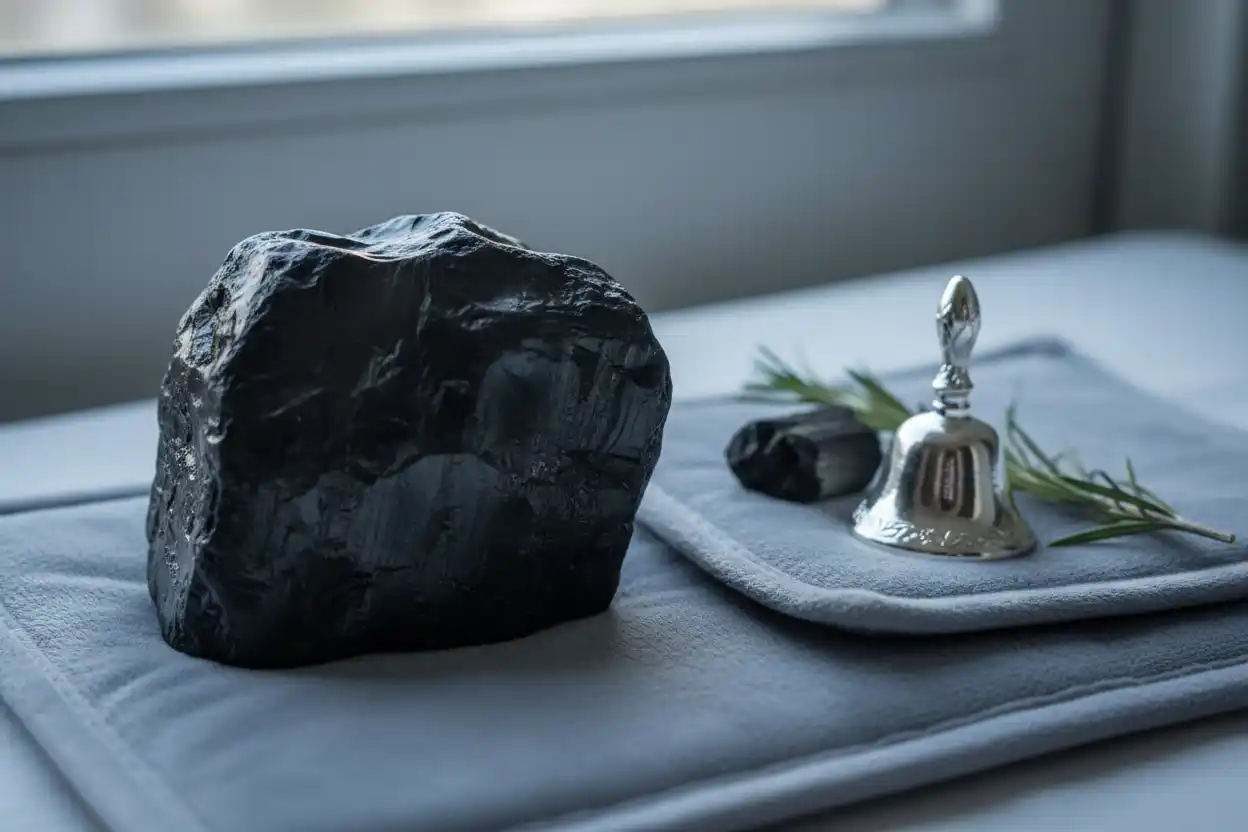
How to Cleanse and Charge Shungite
The safest ways to cleanse and charge Shungite are dry sound, intention, visualization, a written dedication, indirect indoor moonlight, and a stable display ritual. These methods accommodate Shungite’s variable carbon, silica, sulfide, oxide, carbonate, and host-rock content without creating dust or soaking an incompletely characterized specimen.
Shungite should not be used to prepare drinking water as a casual spiritual ritual. Published research has found that some samples can release metals into water. Likewise, no reliable evidence shows that wearing or displaying a small Shungite object neutralizes wireless signals or protects a person from electromagnetic radiation.
What Cleansing and Charging Mean
Cleansing is a personal or spiritual ritual used to mark a transition, release earlier associations, or prepare an object for intentional use.
Charging generally means connecting it with a purpose, habit, value, project, or personal reminder.
Neither practice changes Shungite’s carbon content, mineral composition, conductivity, health effects, or measurable physical energy.
The material’s geological background, symbolism, and popular uses belong to the broader Shungite guide.
This page focuses on physically conservative and evidence-aware ritual methods.
Shungite Is Not One Uniform Mineral
The name Shungite is used for carbon-rich material and rocks associated particularly with Paleoproterozoic deposits in Karelia, Russia.
Scientific and commercial usage can differ. High-carbon lustrous material may approach a carbon-rich mineraloid, while lower grades contain substantial silicate, carbonate, oxide, and sulfide minerals.
| Property | Ritual implication |
|---|---|
| Material type | Carbon-rich mineraloid or carbon-bearing rock |
| Typical appearance | Matte black, gray black, semimetallic, or highly lustrous black |
| Carbon content | Highly variable by type and deposit |
| Associated material | Silica, aluminosilicates, iron oxides, sulfides, carbonates, and other minerals |
| Hardness | Variable because the material is not compositionally uniform |
| Fracture | May be conchoidal, uneven, earthy, or crumbly depending on type |
| Safest ritual methods | Dry sound, intention, visualization, writing, and indoor moonlight |
| Water exposure | Avoid ritual soaking |
| Main risks | Dust, crumbling, staining, sulfides, metal leaching, coatings, and uncertain composition |
The full commercial classification belongs to Types of Shungite.
Because Shungite is not one uniform crystal species, a single hardness value does not reliably describe every object.
The broader principles behind scratch resistance, breakage, and structural weakness appear in the gemstone hardness chart, Gemstone Toughness vs Hardness, and Gemstone Cleavage Explained.
“Elite,” “Noble,” and Regular Shungite
Highly lustrous, relatively carbon-rich material is commonly marketed as elite, noble, silver, or Type I Shungite.
More common matte black material contains lower carbon proportions and larger amounts of host-rock minerals.
Retail labels and numerical grade systems are not always standardized consistently.
A lightweight, lustrous fragment may be more fragile than a dense matte carving. Meanwhile, a polished sphere may contain resin, filler, or a manufactured composite.
Do not assume that a higher price or brighter surface makes a piece suitable for water, rubbing, or impact.
Fullerenes Do Not Prove Metaphysical Claims
Scientific studies have reported fullerene-related or fullerene-like carbon structures in some Shungite samples.
However, fullerenes occur in trace quantities, and their presence does not establish that a hand-sized specimen heals disease, blocks harmful radiation, detoxifies a room, or protects a person from wireless technology.
Conductive material may interact with electromagnetic fields under controlled engineering conditions. That is not equivalent to a small pendant creating a medically protective field around the wearer.
A ritual can still hold personal meaning without using nanostructure terminology as proof of health or EMF claims.
Inspect the Shungite Before Beginning
Examine the object under bright, indirect light.
Look for crumbling edges, loose black powder, open fractures, rusty or pale deposits, metallic sulfide grains, peeling coatings, cloudy glue, chipped corners, and color transferring onto cloth.
Matte Shungite may leave some black residue through abrasion, especially when rough or poorly finished.
Highly lustrous material may fracture along sharp conchoidal edges.
Do not rub, scrape, or sand the object to test carbon content.
When the piece sheds particles, leave it in a shallow lined container and use a completely non-contact ritual.
Separate Physical Cleaning from Symbolic Cleansing
Symbolic cleansing does not remove dirt or stabilize friable rock.
A stable polished piece can be wiped gently with a soft dry cloth.
A rough object may be dusted using a very soft brush, provided the surface remains cohesive.
Do not use a stiff brush, compressed air, steam, ultrasonic equipment, oil, alcohol, acid, or abrasive polish.
The broader equipment boundary belongs to Which Gemstones Can Go in an Ultrasonic Cleaner?.
When black powder, sulfide grains, or unstable coatings are present, minimize handling and keep the material away from food-preparation surfaces.
Method 1: Cleanse Shungite with Sound
Place the Shungite on a folded cloth or leave it inside a shallow lined container.
Ring a bell, chime, tuning fork, or singing bowl nearby. You may also hum, chant, clap softly, or play quiet music.
Do not place the object directly inside a metal bowl while striking it.
Brittle lustrous fragments, coated pieces, carvings, and glued shapes can chip under hard contact.
Several gentle tones are sufficient.
Sound avoids water, salt, oils, and unnecessary rubbing.
Method 2: Use Intention
Leave the Shungite supported on its padded surface.
Choose one clear purpose. It might represent reducing digital distractions, creating a more deliberate workspace, following a practical health routine recommended by professionals, or keeping a consistent boundary around rest time.
State the intention silently or aloud.
The ritual can use Shungite as a reminder to change behavior without claiming that the material itself shields the body from Wi-Fi, cellular signals, or illness.
Return it to a stable display location afterward.
Method 3: Use Visualization
Place the object where it cannot roll, chip, or shed particles onto other items.
Imagine earlier associations fading while the dark surface becomes connected with your chosen purpose.
Some practitioners visualize black, gray, silver, white, or neutral light.
The imagery is symbolic and does not change conductivity, carbon structure, or exposure to electromagnetic fields.
Continue for several slow breaths or a few minutes.
Visualization is particularly suitable for fragile, crumbly, repaired, or high-carbon lustrous pieces.
Method 4: Use a Written Dedication
Write one concise statement and place it beside the Shungite.
A practical statement might focus on turning off unnecessary notifications, taking regular screen breaks, completing one technical task at a time, or keeping devices out of the bedroom.
Do not place the note directly beneath a powdery stone.
Keep it on a separate lined support so carbon residue does not transfer to paper.
This method allows the object to remain stable and dry.
Method 5: Use Indirect Moonlight Indoors
Place Shungite indoors near a window while keeping it on a padded tray.
An hour or an evening is sufficient. Overnight indoor placement may also be used.
Ordinary visible light is not the principal material concern.
Outdoor placement introduces dew, rain, grit, animals, theft, and temperature changes, while water may interact unpredictably with associated sulfides and metals.
The moon phase affects personal symbolism rather than Shungite’s physical properties.
The broader environmental comparison belongs to Which Crystals Can and Can’t Go in the Sun.
Method 6: Use a Dry Display Ritual
Place Shungite near a written plan, switched-off device, notebook, clock, or another non-abrasive symbolic object.
Use separate padded supports.
Do not add water bowls, fresh flowers, damp soil, loose salt, essential oils, candles, or incense ash.
A dry display can make the object part of a practical digital-wellness routine without claiming that it blocks radiation.
Position it where it cannot fall onto electronics or scratch furniture.
Method 7: Use a No-Contact Breath Practice
Breath contains moisture, so avoid blowing directly onto powdery or porous material.
Leave the Shungite in place and perform several slow breaths while focusing on the selected intention.
State the dedication silently or aloud afterward.
This method preserves the breathing ritual without adding condensation or spreading black particles.
It is particularly suitable when the piece contains visible sulfide grains or loose material.
Method 8: Use Companion Objects with Separation
Shungite may be placed near Hematite, Pyrite, Jet, Obsidian, a photograph, or a written intention.
Use separate cloths and leave physical space between every object.
Pyrite may oxidize, Hematite can leave red-brown powder, Jet is soft organic material, and Obsidian is brittle volcanic glass. None should be stacked directly together.
The related material profiles belong to the Hematite guide, Pyrite guide, Jet guide, and Obsidian guide.
Their physical differences show why black color alone cannot determine care.
Do Not Prepare Shungite Water Casually
Shungite is widely promoted as a water purifier.
Laboratory and technical research has found adsorption properties, but studies have also reported the release of nickel, copper, lead, cadmium, chromium, arsenic, zinc, and other elements from certain samples into water.
Consequently, a retail stone of unknown grade, origin, mineralogy, cleanliness, and testing history should not be placed in drinking water as a home ritual.
Do not prepare Shungite tea, elixirs, sprays, baths, or direct-soak water.
Established certified filtration equipment and potable-water standards should take priority over metaphysical claims.
The broader mineral-water framework belongs to Which Crystals Can and Can’t Go in Water.
Avoid Rinsing and Soaking
A brief accidental splash does not necessarily destroy a stable polished piece, but ritual soaking provides no advantage.
Water can enter pores, loosen black residue, reveal coatings, affect glue, and interact with sulfide or metal-bearing components.
A wet black stone is also more difficult to inspect for residue and cracks.
Use dry cleaning only unless a conservator or material specialist has identified the exact object and recommended another method.
Avoid Direct Salt Contact
Salt grains can lodge in pores, fractures, carvings, and rough surfaces.
Some salts absorb moisture from the air, creating a locally humid environment.
Saltwater combines moisture, dissolved ions, and potential mineral leaching.
Do not bury Shungite in sea salt, Himalayan salt, table salt, or cleansing granules.
When salt has personal symbolism, keep it sealed in a separate container nearby.
Avoid Soil Burial
Soil introduces moisture, microorganisms, organic acids, fertilizer, mineral grit, and potential contamination.
These materials can lodge in pores and rough surfaces or react with associated minerals.
Outdoor burial also creates pressure, loss, and identification problems because Shungite can resemble ordinary black rock.
A nature-based alternative places it near a plant while keeping it dry on a separate lined dish.
Avoid Smoke, Flame, and Heat
Shungite is carbon rich, and some material contains organic-derived carbon, sulfides, and other minerals.
Do not burn, heat, or place it beside open flame.
Heating may release unpleasant or hazardous fumes from carbonaceous matter, sulfides, coatings, glue, or contamination.
Smoke can also leave residue that requires additional cleaning.
Use sound, writing, or visualization instead.
Do Not Grind or Polish Shungite During a Ritual
Grinding and sanding create fine carbon-rich and mineral dust.
The associated rock may contain silica, sulfides, iron oxides, trace metals, and other constituents.
Do not drill, crush, tumble, or polish Shungite without appropriate industrial controls.
A glossy commercial surface may come from polishing, wax, resin, coating, or naturally lustrous high-carbon material. The treatment-identification workflow belongs to How to Spot Treated or Synthetic Shungite.
Shungite and Hematite Are Not the Same
Shungite is carbon-rich material or rock, while Hematite is iron oxide.
The Hematite-specific ritual method belongs to How to Cleanse and Charge Hematite.
Both may appear black or metallic, but Hematite usually produces a red-brown streak and has different density, hardness, composition, and magnetic behavior.
Cleaning response should never be used as an identity test.
Shungite and Pyrite Need Different Dry-Care Logic
Pyrite is iron disulfide rather than carbon-rich rock.
Its ritual care belongs to How to Cleanse and Charge Pyrite.
Pyrite requires dry storage because it can oxidize and generate acidic sulfate products.
Shungite’s water restriction comes instead from variable composition, possible leaching, dust, coatings, sulfides, and uncertain commercial material.
Mixed specimens should follow the strictest component.
EMF and 5G Claims
Shungite is electrically conductive to varying degrees depending on its carbon content and structure.
Conductivity alone does not demonstrate that wearing a pendant or placing a small pyramid beside a router protects a person from electromagnetic fields.
Effective electromagnetic shielding is an engineering problem involving material conductivity, permeability, thickness, continuity, geometry, frequency, and complete enclosure or grounding design.
A loose decorative object does not satisfy those conditions automatically.
Use Shungite as a symbolic reminder to manage screen habits rather than as a substitute for evidence-based safety standards or medical guidance.
Authentication and Buying Context
The complete identity workflow belongs to Real vs Fake Shungite.
The Where to Buy Real Shungite guide covers origin claims, carbon grade, weight, conductivity demonstrations, coatings, manufactured composites, dust, and seller transparency.
Retail electrical tests can be suggestive but do not prove Karelian origin or exact carbon percentage.
Shungite also belongs visually to the broader Black Gemstones family, although it is commonly a rock or mineraloid rather than a conventional transparent gem.
A cleansing ritual cannot establish origin, composition, carbon content, fullerene concentration, or authenticity.
Safe Ritual Handling
Do not lick, ingest, grind, burn, or place Shungite directly in drinking water.
Wash your hands after handling powdery or rough pieces and keep loose particles away from food, children’s mouths, and pets.
Ordinary display of a stable intact object differs from consuming leached material or inhaling dust.
The broader handling framework belongs to the Toxic Crystals safety list.
Frequently Asked Questions
1. What is the safest way to cleanse Shungite?
Use dry sound, intention, visualization, writing, or indirect indoor moonlight.
2. Can Shungite be cleansed in water?
Ritual soaking is not recommended because composition, sulfides, coatings, porosity, and metal leaching can vary.
3. Can Shungite be left in moonlight overnight?
Yes, when kept indoors on a dry padded surface.
4. Can Shungite be charged in sunlight?
Ordinary indirect light is generally acceptable, but outdoor weather and hot surfaces are unnecessary.
5. Can Shungite be cleansed with salt?
No. Salt can retain moisture and lodge in pores, cracks, and carvings.
6. Can Shungite be cleansed with smoke?
Smoke is not ideal because heat and residue may affect carbon-rich material, sulfides, coatings, and glue.
7. Does Shungite block 5G or Wi-Fi?
No reliable evidence shows that a small decorative Shungite object provides meaningful personal shielding from wireless signals.
8. Can Shungite be used to make drinking water?
Direct-soak Shungite water is not recommended because published studies have found metal leaching from some samples.
9. Is elite Shungite always better?
It generally contains more carbon and greater luster, but it can be brittle, expensive, inconsistently labeled, or coated.
10. Does all Shungite contain fullerenes?
Fullerene-related structures have been reported in some samples, but concentrations and interpretations vary, and they do not prove health claims.
11. How long should Shungite charge?
A few minutes or an evening is sufficient. There is no scientifically required duration.
12. Does cleansing change Shungite scientifically?
No established evidence shows that cleansing changes its composition, conductivity, health effects, or measurable physical energy.
Conclusion
Shungite is best treated as a variable carbon-rich geological material rather than a uniform miracle mineral. Sound, intention, visualization, writing, and protected moonlight provide meaningful rituals without soaking unknown sulfides, releasing particles, or relying on unsupported shielding claims. A responsible practice keeps the object dry, stable, and separate from drinking water while using it as a personal reminder rather than a medical or technical device.
Crystal cleansing and charging are spiritual or personal practices, not scientifically established methods for changing health, energy, electromagnetic exposure, or the physical properties of Shungite.