Lapis Lazuli vs Sodalite: Differences and Identification
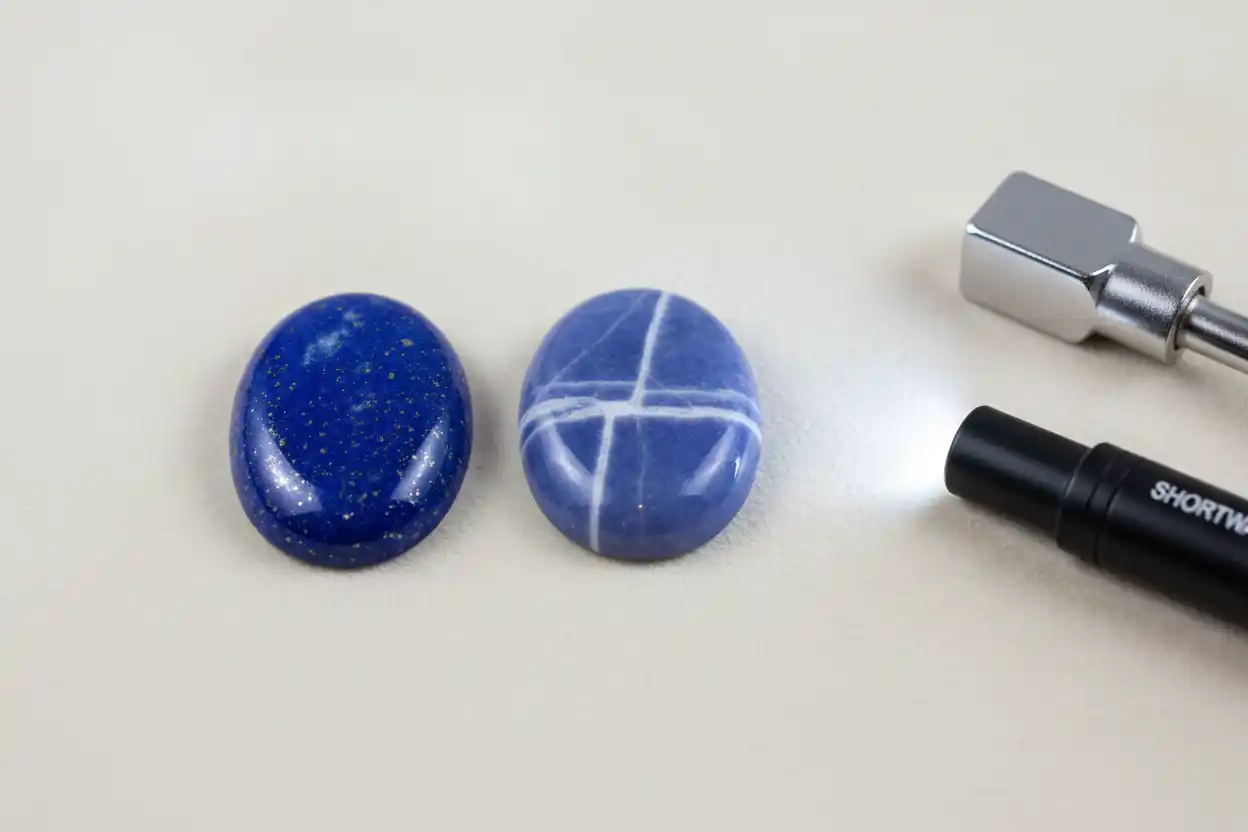
Lapis lazuli and sodalite can both appear opaque, strongly blue, and crossed by white calcite veins. The resemblance is close enough that pyrite-poor lapis, sodalite-rich rock, dyed material, and polished commercial beads are frequently mislabeled.
The central distinction is mineralogical. Lapis lazuli is a rock composed mainly of lazurite, calcite, pyrite, and other minerals. Sodalite is a mineral species within the sodalite group, although massive ornamental sodalite can also contain calcite and associated minerals.
Gold-colored pyrite strongly supports lapis, but its absence does not prove sodalite. Color, texture, mineral distribution, density, streak, fluorescence, spectroscopy, and professional analysis may all be needed.
The broad lapis lazuli guide and sodalite guide own each material’s complete identity and symbolism. This article focuses strictly on separating them.
Lapis Lazuli vs Sodalite at a Glance
| Property | Lapis lazuli | Sodalite |
|---|---|---|
| Material type | Multi-mineral rock | Mineral species, commonly sold in massive form |
| Main blue component | Lazurite-rich material | Sodalite |
| Chemical identity | Variable aggregate | Sodium aluminum silicate chloride |
| Typical color | Royal, violetish, indigo, or medium-dark blue | Violetish blue, royal blue, gray-blue, or mottled blue |
| Pyrite | Common but not always visible | Not a normal component of pure sodalite |
| Calcite | Common as white patches or veins | Commonly associated as white veining |
| Mohs hardness | Approximately 5–6, depending on composition | Approximately 5.5–6 |
| Specific gravity | Variable, commonly around 2.7–2.9 | Commonly around 2.1–2.3 |
| Streak | Blue from lazurite-rich material, but variable in the rock | White to pale blue |
| Transparency | Semitranslucent to opaque | Transparent in rare crystals; commonly translucent to opaque |
| Fluorescence | Variable according to components | May fluoresce, especially in some varieties |
| Common treatment | Dye, wax, oil, resin, and coating | Dye, coating, and impregnation may occur |
| Typical value | Fine lapis generally commands more | Usually more affordable |
| Main visual clue | Saturated blue with pyrite and limited calcite | Blue with white calcite veining and no pyrite |
Rock vs Mineral
Lapis lazuli is a rock. Its appearance results from the relative proportions and textures of several minerals.
Fine lapis is dominated visually by blue lazurite-rich material, but calcite, pyrite, diopside, mica, afghanite, and other minerals may be present.
Sodalite is a mineral with an idealized sodium-rich aluminosilicate chloride composition. It belongs to the sodalite group, which also includes lazurite-related minerals, haüyne, nosean, and other species.
This close group relationship helps explain why the materials can look similar and why identification is not always possible from one visual clue.
Color Differences
Fine lapis commonly shows intense medium-dark blue to slightly violetish blue. It may appear rich, dense, and relatively uniform.
Sodalite commonly appears violetish blue, royal blue, gray-blue, or mottled blue. White calcite veining is widespread.
However, color overlaps substantially.
High-quality sodalite can look richly royal blue. Calcite-rich lapis can appear pale and mottled. Dye can deepen either material and reduce natural visual differences.
Color should therefore begin the examination rather than end it.
The blue gemstones guide places both materials among other blue gems without treating them as interchangeable.
Pyrite
Pyrite is the most familiar visual clue favoring lapis.
It appears as small metallic gold-colored flecks, spots, or veins. Fine particles scattered across a rich blue ground create the classic lapis appearance.
Pure sodalite should not contain pyrite as part of its mineral formula. However, massive rock sold as sodalite can include associated minerals, and imitations may contain added metallic particles.
The absence of pyrite does not prove sodalite. Some fine lapis contains little or no visible pyrite.
The presence of pyrite therefore supports lapis but should be interpreted with the complete texture.
Calcite Veining
Both materials can contain white calcite.
In lapis, calcite may appear as spots, patches, or veins that interrupt the blue. Large white areas generally lower commercial value.
Massive sodalite frequently shows white calcite veining, sometimes in broad irregular patterns.
A blue stone with extensive white veins and no pyrite is more likely to be sodalite, but calcite-rich lapis remains possible.
Calcite also reacts with acids, so acid testing is unsafe and destructive.
Texture
Lapis often has a fine granular rock texture because several minerals occur together. Under magnification, blue, white, and metallic grains may appear interlocked.
Sodalite may look more uniform and waxy, although massive material can also be granular and veined.
Fine lapis may show tiny pyrite crystals embedded throughout the blue. Sodalite often shows broader white veins without metallic particles.
Polishing, dye, coating, and resin can conceal natural texture.
A highly glossy plastic-like surface may indicate coating or imitation rather than either untreated material.
Hardness
The hardness ranges overlap.
Lapis typically measures around 5–6, depending on its mineral composition. Sodalite commonly ranks around 5.5–6.
A scratch test cannot reliably separate them and will damage the polished surface.
The gemstone hardness chart provides context but should not be used as a destructive identification instruction.
Both materials require protection from quartz dust, topaz, sapphire, diamond, and hard metal edges.
Density
Density offers a useful professional clue.
Lapis lazuli is commonly denser than sodalite because its aggregate can include pyrite and calcium-bearing minerals. Its specific gravity varies with composition.
Sodalite commonly has a lower specific gravity, often around the low 2.2 range.
A loose stone of known dimensions and weight may therefore feel lighter when it is sodalite. Hand estimation remains unreliable, especially when cuts and porosity differ.
Hydrostatic weighing can provide stronger evidence. Mounted stones, trapped air, backing, resin, and porous surfaces can distort results.
Streak
Streak describes the color of powdered material left on an unglazed porcelain plate.
Lazurite-rich lapis may produce a blue streak, while sodalite generally gives a white to pale-blue streak.
However, streak testing removes material and creates a permanent mark. It should not be used on jewelry, carvings, polished specimens, historical objects, or valuable rough.
The result can also vary across lapis because the rock contains several minerals.
Streak is more appropriate for expendable mineral samples under controlled identification conditions.
Ultraviolet Fluorescence
Some sodalite fluoresces, and hackmanite—a sulfur-bearing variety within the sodalite group—can show strong fluorescence and reversible color change called tenebrescence.
Lapis fluorescence varies because its mineral composition varies. Calcite and other components may react differently.
A UV reaction can provide evidence but does not prove either identity by itself.
Dyes, coatings, resins, and adhesives can also fluoresce.
The stone should be observed under both long-wave and short-wave ultraviolet sources by someone familiar with mineral responses.
Hackmanite and Tenebrescence
Hackmanite is a variety of sodalite capable of changing color after exposure to ultraviolet light or sunlight, then fading back over time.
This reversible phenomenon is called tenebrescence.
Ordinary lapis lazuli does not display hackmanite-style reversible color change as a defining property.
A blue stone that changes noticeably after controlled UV exposure may belong to the sodalite group. However, deliberate sunlight testing can fade dyes or alter treatments, so professional examination is safer.
The sodalite guide owns the full discussion of hackmanite and sodalite varieties.
Transparency
Most jewelry-grade lapis is semitranslucent to opaque.
Massive ornamental sodalite is also usually translucent to opaque, but rare sodalite crystals can be transparent or nearly colorless.
Transparency therefore provides limited help for common blue cabochons and beads.
A transparent blue or near-colorless stone represented as sodalite requires different evaluation from ordinary massive material.
A transparent specimen is unlikely to be conventional lapis because lapis is an aggregate rock.
Inclusions and Internal Features
Lapis Lazuli
Magnification may reveal:
- Blue lazurite-rich grains
- White calcite
- Metallic pyrite
- Mixed mineral texture
- Pores
- Veins
- Dye concentration
- Wax or resin
- Reconstructed particles
Sodalite
Possible features include:
- White calcite veins
- Blue or violetish granular material
- Cleavage-related fractures
- Associated feldspathoid minerals
- Transparent zones
- Fluid inclusions in rare crystals
- Dye within pores or cracks
No single inclusion establishes identity. The complete mineral assemblage matters.
Treatments
Lapis Lazuli Treatments
Lapis is commonly dyed, waxed, oiled, resin-sealed, coated, or reconstructed.
Dye may conceal calcite and deepen blue. Wax and oil improve surface appearance. Resin may stabilize porous material or bind fragments.
The treated lapis lazuli guide owns this workflow.
Sodalite Treatments
Sodalite can also be dyed or coated to strengthen blue or imitate more expensive lapis.
Porous material may accept color unevenly, particularly along fractures and white veins.
The treated sodalite guide should guide sodalite-specific treatment questions.
Treatment can make two originally different materials look more similar.
Imitations
Both materials can be imitated by:
- Dyed howlite
- Dyed magnesite
- Dyed marble
- Glass
- Ceramic
- Resin
- Reconstructed stone
- Synthetic blue material
- Composite products
- Coated white stone
The Real vs Fake Lapis Lazuli guide owns the lapis authenticity workflow, while Real vs Fake Sodalite owns the corresponding sodalite process.
Metallic particles in resin can imitate pyrite. Painted veins can imitate calcite. A visual inspection should therefore include magnification and surface examination.
Price Differences
Fine natural lapis generally commands more than common sodalite.
Lapis value rises with intense, even blue color, little calcite, attractive pyrite, strong polish, and documented origin. The lapis lazuli price guide owns that valuation.
Sodalite is usually more widely affordable, although unusual transparent crystals, hackmanite, fine carvings, and documented collector specimens can have greater value than ordinary blue material.
Price is not an identification test. Dyed or reconstructed lapis can be inexpensive, while branded sodalite jewelry can be costly.
Geographic Sources
Afghanistan is the most famous lapis source. Chile, Russia, Pakistan, and other regions also supply material.
Sodalite occurs in silica-poor igneous rocks and related environments in countries including Brazil, Canada, Namibia, Russia, and others.
A seller cannot prove locality from color or white veining alone.
Origin requires reliable provenance and, in some cases, advanced laboratory comparison.
The Where to Buy Real Sodalite guide covers seller and origin claims for sodalite, while the Lapis Lazuli Buying Guide owns lapis purchase quality.
Jewelry Durability
Both materials need careful wear.
Lapis has fair toughness and variable hardness around 5–6. Sodalite has similar hardness and can also scratch, chip, and respond poorly to harsh chemicals.
Pendants and earrings are safer than rings and bracelets. Low bezels protect edges better than open prongs.
The lapis lazuli ring guide explains lapis-specific hand-level care.
Neither stone should be stacked directly beside diamond, sapphire, topaz, or rough metal jewelry.
Safe At-Home Observations
Look for Metallic Pyrite
Fine metallic flecks favor lapis, although added particles and pyrite-poor lapis complicate the clue.
Examine the White Pattern
Broad white calcite veining with no metallic grains favors sodalite. Calcite-rich lapis remains possible.
Compare Color
Dense violetish royal blue with fine mineral texture favors lapis. Grayish or mottled violet-blue can favor sodalite, but overlap is substantial.
Inspect Drill Holes and Fractures
Dye concentrated in openings indicates treatment but does not identify the original material.
Compare Weight
A clearly lighter stone of similar size may support sodalite. A scale and accurate dimensions provide better evidence than hand feel.
These observations generate a working hypothesis rather than a definitive result.
Tests to Avoid
Do not use:
- Scratch tests
- Acid
- Acetone
- Alcohol
- Flame
- Hot needles
- Drop tests
- Destructive streak tests on finished objects
- Prolonged sunlight tests
- Bleach
- Household jewelry dips
Both stones, their treatments, and their settings can be permanently damaged.
Professional Identification
A gemologist may use:
- Microscopy
- Specific gravity
- Raman spectroscopy
- Infrared spectroscopy
- X-ray diffraction
- Chemical analysis
- Ultraviolet response
- Streak on expendable samples
- Mineral assemblage examination
Raman spectroscopy or X-ray diffraction can identify mineral phases directly.
Lapis analysis may reveal several minerals rather than one clean sodalite spectrum. This multi-phase result strongly supports a rock aggregate.
The gemstone certification guide explains when a report is justified.
Testing is most useful for high-value carvings, historic objects, treatment disputes, unusual transparent material, or strong origin claims.
Buying Either Material
Use written descriptions rather than relying only on the word blue stone.
For lapis, request information about calcite, pyrite, dye, wax, oil, resin, reconstruction, and origin.
For sodalite, request disclosure of dye, coating, calcite veining, hackmanite behavior, and whether the product is solid mineral or composite.
Follow How to Buy Gemstones Online Without Getting Scammed for transaction safeguards.
Continuous video under neutral lighting is more useful than highly saturated still photography.
Cleaning Differences
Both materials should be cleaned conservatively.
Follow How to Clean Lapis Lazuli Jewelry Safely for confirmed lapis.
Use a soft damp cloth or mild soapy water for stable sodalite, while avoiding prolonged soaking when dye, porous material, glue, or metal is present.
Neither material should receive steam or ultrasonic cleaning.
Acids can attack calcite, while solvents can remove dye, wax, oil, or resin.
Frequently Asked Questions
1. Is sodalite a type of lapis lazuli?
No. Sodalite is a mineral species. Lapis lazuli is a rock composed mainly of lazurite, calcite, pyrite, and other minerals.
2. Does pyrite prove a stone is lapis?
Pyrite strongly supports lapis, but imitations can contain added metallic particles. Its absence also does not exclude lapis.
3. Can lapis have no visible pyrite?
Yes. Fine lapis may contain little or no visible pyrite.
4. Why do both stones have white veins?
Calcite commonly occurs with both lapis and massive sodalite.
5. Which material is usually denser?
Lapis is generally denser because of its mixed mineral composition and possible pyrite content.
6. Which stone is harder?
Their hardness ranges overlap. Lapis is approximately 5–6, while sodalite is commonly around 5.5–6.
7. Can ultraviolet light separate them?
It can provide clues, particularly with fluorescent sodalite or hackmanite, but the response is not conclusive by itself.
8. Does sodalite change color in sunlight?
Hackmanite, a sodalite-group variety, can show reversible tenebrescence. Ordinary sodalite may not.
9. Are both materials dyed?
Both can be dyed. Lapis is particularly well known for commercial dye, wax, oil, and resin treatments.
10. Which stone is usually more valuable?
Fine natural lapis generally commands more than ordinary sodalite, although unusual collector sodalite can have significant value.
11. Can I distinguish them with a scratch test?
No. Their hardness overlaps, and the test damages the stone.
12. When is laboratory testing worthwhile?
Testing is useful for valuable, historic, treated, transparent, disputed, or strongly represented material.
Lapis lazuli and sodalite overlap because their blue components belong to closely related mineral chemistry, but their identities remain distinct. Lapis is a mineral-rich rock whose classic appearance combines lazurite blue, calcite, and pyrite. Sodalite is a mineral that more commonly presents blue with white veining and no metallic pyrite. Visual clues can narrow the possibilities, while density and mineral-phase analysis provide the stronger conclusion.