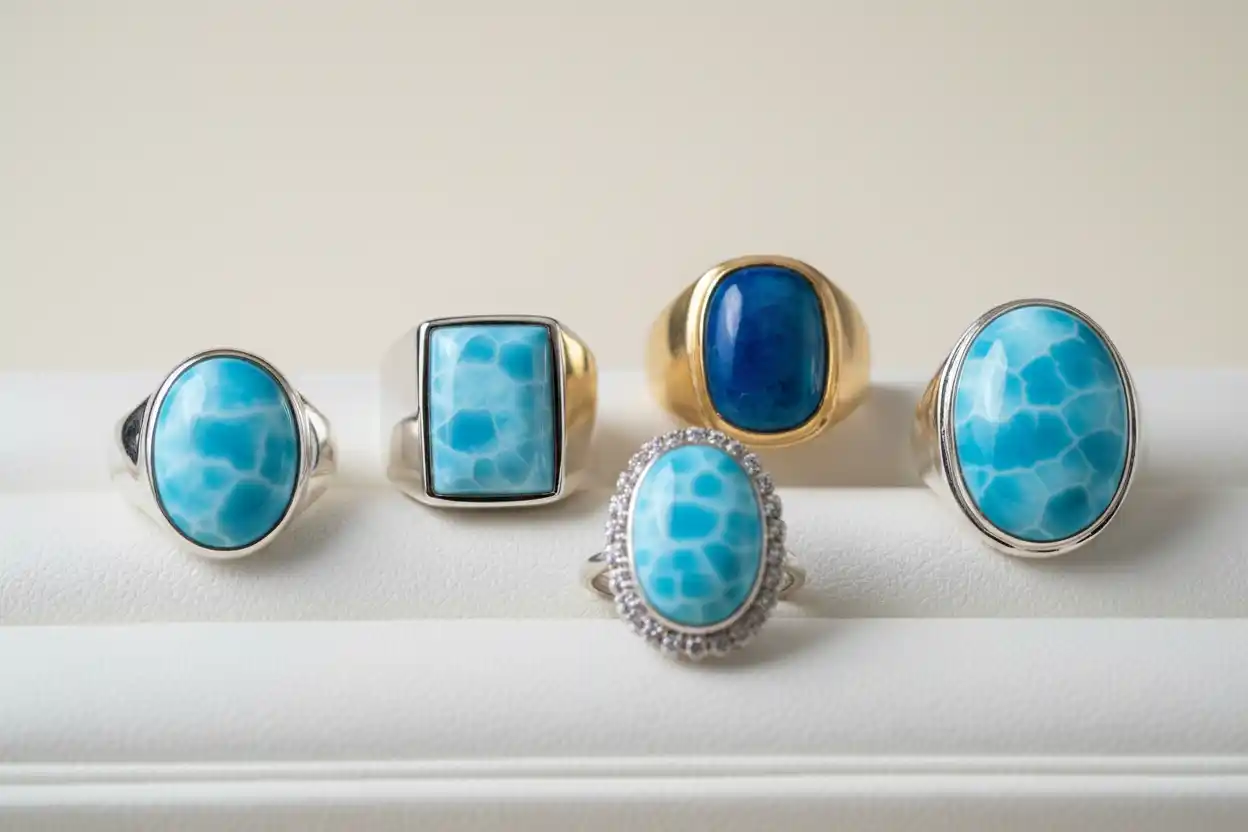
Larimar Rings: Styles, Durability and Buying Tips
Larimar rings place the stone’s blue-and-white Caribbean appearance in constant view, but they also expose it to the greatest mechanical risk. Hands strike desks, doors, tools, bags and other jewelry throughout an ordinary day.
The material can perform well in a thoughtfully designed occasional-wear ring, especially when a compact cabochon sits low inside a protective bezel. Nevertheless, Larimar remains pectolite with modest hardness, perfect cleavage directions and possible variations in structural strength across its white, blue and matrix-rich areas.
The best ring therefore does not simply use the deepest blue stone available. Setting height, edge protection, thickness, fracture condition, treatment, shank strength and sizing determine whether the jewelry can support the cabochon safely.
The general Larimar gemstone guide owns mineralogy, formation, history and symbolism. This article focuses on ring design, buying decisions and real-world wear.
Are Larimar Rings Practical?
Larimar rings are practical for careful, controlled wear rather than unrestricted daily use.
A low bezel ring worn during social, office or light personal activities can retain its polish for years when it is removed before impact-prone tasks. A high exposed ring worn continuously through housework, exercise and manual work is much more likely to scratch or chip.
The stone’s approximate position of 4.5–5 on the gemstone hardness chart means many common materials can abrade it. The distinction between surface hardness and breakage resistance is explained in Gemstone Toughness vs Hardness.
Compact fibrous Larimar may behave more cohesively than individual pectolite crystals, but thin areas can flake and concentrated pressure can still exploit cleavage or natural fractures.
For a wearer who does not want to remove a ring frequently, the guide to best gemstones for everyday wear provides more durable alternatives.
Larimar Ring Styles Compared
| Ring style | Protection | Practical assessment |
|---|---|---|
| Full bezel | High | Strongest general option for careful wear |
| Recessed signet | High | Low profile with substantial metal support |
| Partial bezel | Moderate to high | Protects selected sides but leaves exposed edges |
| Low halo | Moderate | Adds contrast and some lateral protection |
| Four-prong setting | Low to moderate | Open appearance but greater edge exposure |
| Six-prong setting | Moderate | More redundancy but more pressure points |
| Cocktail ring | Variable | Attractive for large cabochons but usually high impact |
| Tablet ring | Moderate | Broad pattern display with vulnerable corners |
| Inlay ring | Variable | Smooth surface but dependent on adhesive |
| Wire-wrapped ring | Low | Artistic but often insufficient for long-term protection |
| Adjustable ring | Low to moderate | Convenient sizing but repeated bending can distort the setting |
| Tension setting | Unsuitable | Concentrated pressure conflicts with cleavage and variable structure |
Full-Bezel Larimar Rings
A full bezel is generally the strongest choice.
The metal surrounds the stone’s perimeter and absorbs many impacts that would otherwise reach an exposed edge. It also produces a smooth profile that catches less readily on fabric.
The bezel must fit the exact cabochon. Gaps allow movement, while excessive pressure can chip an edge or exploit an internal weakness.
Look closely for uneven metal, visible glue, ripples, crushed corners and a stone that shifts when touched.
A closed back can support the cabochon, but it may conceal filler, backing, a thin slab or composite construction. The invoice should state whether the stone is solid Larimar and whether resin or adhesive contributes materially to its stability.
Recessed Signet Rings
A recessed signet provides one of the safest Larimar formats.
The metal face rises to or slightly above the cabochon, shielding its edges from side impacts. Oval, cushion, rectangular and shield-shaped stones can all work.
The face must remain thick enough to resist bending. An ultra-light signet can flex under pressure and transfer that movement into the stone.
A broad shank also helps distribute weight and prevents the top from rotating around the finger.
Signet styling may be marketed toward men, although it is suitable for any wearer. The best gemstones for men guide provides additional options for substantial ring designs.
Partial Bezels and Protective Rails
A partial bezel can protect the longest sides of an oval or rectangular cabochon while leaving other areas visible.
Its success depends on whether the exposed portions contain strong, rounded edges. A sharp corner or white fracture should not remain unprotected merely for visual openness.
A protective metal rail around the lower girdle can improve security without covering much of the face.
Partial bezels remain a compromise. They can be suitable for occasional wear but should not be presented as equivalent to a complete surround.
Prong-Set Larimar Rings
Prong settings show more of the stone but leave its perimeter exposed.
The cabochon should sit inside a basket with support beneath it. A design that holds the stone only between small tips creates unnecessary risk.
Prongs should meet the crown evenly and avoid open fractures, cavities and weak white seams. Tightening a prong over an unstable area can chip the pectolite before the ring is ever worn.
Rounded stones are generally safer than pears, marquises and sharp-cornered tablets. Where a pointed shape is used, a protective metal cap or V-shaped element should cover the tip.
Halo Larimar Rings
A halo can enlarge the ring’s face-up outline and create strong contrast around the blue center.
Diamonds, lab diamonds, sapphires, moissanite, white topaz and cubic zirconia may all be used as accents.
Those materials are harder than Larimar. Their girdles must not touch the pectolite, and the setting should not flex enough to bring them together.
A low halo may absorb some lateral impacts. A hidden halo placed beneath the center adds decoration but offers little protection to the visible edge.
The invoice should identify all accent stones rather than describing them only as white crystals.
Cocktail and Statement Rings
Larimar’s broad patterns make it popular in large cocktail rings.
Size, however, increases exposure. A wide cabochon catches more surfaces, while a tall setting creates leverage when struck.
A statement ring should use a low profile, substantial shank and complete back support. Split shanks can stabilize large stones and reduce spinning.
These rings are best worn for controlled occasions rather than routine housework, travel handling or manual tasks.
A large pale cabochon is not automatically more valuable than a smaller deep-blue stone. The Larimar price guide owns the value question.
Larimar Engagement Rings
Larimar can carry meaningful symbolism in an engagement ring, particularly for someone connected with the Dominican Republic, the Caribbean or the sea.
It is not among the strongest choices for a ring expected to remain on the hand continuously for decades. Surface wear, chipping and replacement difficulty should be anticipated.
The guide to best gemstones for engagement rings compares more durable materials. The blue gemstones for engagement rings guide provides sapphire, spinel, diamond, topaz and other blue alternatives.
A couple choosing Larimar should favor a recessed or full-bezel design and accept that the stone may eventually require repolishing or replacement.
A replacement cannot be matched perfectly because every Larimar pattern is different. That uniqueness should be considered before the stone becomes central to a permanent matching bridal set.
Choosing Blue Color and Pattern
Deeper blue generally receives greater commercial demand, especially when the stone retains good polish and substantial blue coverage.
White cellular, cloudlike and streaked patterns are part of Larimar’s identity. They can make the stone more recognizable and artistically interesting.
The pattern should not be confused with damage. An open fracture may interrupt the surface, reflect as a flat plane or collect residue. A natural white zone should normally remain integrated with the polish.
Brown, red or black matrix may be natural, although it generally reduces the uninterrupted blue area. Some artisan rings use matrix deliberately to create contrast.
The complete quality process belongs to the Larimar Buying Guide.
Cabochon Shape and Thickness
Rounded ovals, cushions and circles reduce the number of vulnerable corners.
Rectangular tablets and freeforms can preserve striking patterns but require more metal protection. Thin projections and sharp points should be avoided in rings.
The cabochon should contain enough thickness for structural security without carrying excessive hidden weight beneath the setting.
A very thin stone may depend on backing or resin. That construction should be disclosed because it changes repair options.
The underside should sit above the finger and surrounding surfaces rather than project below the basket.
Surface and Internal Condition
Examine the stone under diffused side lighting.
Fine scratches, pits, uneven polish, cloudy coating, open cavities and edge chips can disappear in frontal photographs.
A white line near a prong or bezel deserves close inspection. If it reaches the surface, it may create a setting risk even when the pattern looks attractive.
Larimar can contain calcite, natrolite, hematite, chalcocite and other associated materials. Different inclusions may polish or wear differently.
The strongest purchase balances visual pattern with sound structure rather than prioritizing blue saturation alone.
Treatments and Imitations
Resin, dye, coating, wax, oil, backing, filling and reconstructed material may occur.
The detailed treatment boundary belongs to How to Spot Treated or Synthetic Larimar.
Resin can stabilize weak areas but may respond badly to heat or solvents. A coating can improve gloss but scratch around exposed edges. Dye may concentrate in cracks or pale zones.
The Real vs Fake Larimar guide covers glass, chalcedony, howlite, magnesite, resin and composite lookalikes.
A ring should not be tested with acid, scratching, flame, hot needles or household solvents. These methods can damage genuine material and still leave identity uncertain.
Metal Selection
Sterling silver is common and provides cool visual contrast. It can support Larimar effectively when the shank and bezel contain sufficient metal.
White gold offers a similar appearance with different cost and maintenance characteristics. Yellow gold creates stronger contrast and can make deep blue appear richer.
Rose gold may suit pale blue but can warm greenish material.
The shank should not be reduced to an extremely thin line beneath a large cabochon. Bending metal can loosen or crack the stone even when the ring receives no direct impact.
The best gemstones and metals for sensitive skin explains alloy, plating and nickel concerns separately from the stone.
Ring Sizing and Resizing
Correct sizing limits rotation and impact.
A loose Larimar ring turns under the finger and strikes surfaces more often. A tight ring becomes uncomfortable and may require forceful removal.
Wide bands usually fit more tightly than narrow bands of the same nominal size.
Ask whether resizing is possible. Full bezels, inlay, carved shanks and elaborate galleries may limit alteration.
Bench heat can alter Larimar or damage resin, coating, glue and filler. In many cases, a skilled jeweler should remove the stone before applying substantial heat.
The repairer must be told that the center is Larimar rather than turquoise or another blue opaque stone.
Buying a Larimar Ring Online
Use the transaction safeguards in How to Buy Gemstones Online Without Getting Scammed.
Request continuous video of the ring worn upright, not only placed flat under a lamp. The seller should show the front, sides, reverse and interior of the setting.
Written details should identify treatment, stone dimensions, metal alloy, hallmark, ring size, resizing limits and return policy.
Independent testing may be worthwhile when the ring is expensive, the color appears unusually uniform or Dominican origin is central to the price. The gemstone certification guide explains what a laboratory report can establish.
Wearing, Cleaning and Storing the Ring
Wear the ring on the non-dominant hand when practical and remove it before exercise, cleaning, cooking, gardening, swimming, showering, luggage handling and sleep.
Do not stack it directly beside diamond, sapphire, topaz or rough-edged metal rings.
For lower-impact Larimar jewelry, Larimar earrings and a Larimar necklace provide safer alternatives. A Larimar bracelet faces similar exposure and should also be removed during demanding activities.
Follow How to Clean Larimar Jewelry Safely. Use lukewarm water, mild soap and a soft cloth or brush, avoiding prolonged soaking.
Steam and ultrasonic cleaning are unsuitable. Heat, vibration and chemical cleaners can affect the stone, fractures, filler and setting.
Store the ring alone in a padded compartment.
Frequently Asked Questions
1. Can a Larimar ring be worn every day?
It can be worn regularly by a careful owner, but unrestricted continuous wear is not advisable because the stone scratches and can chip.
2. What is the safest Larimar ring setting?
A low full bezel or recessed signet generally provides the best protection.
3. Is Larimar suitable for an engagement ring?
It can carry personal meaning, but sapphire, diamond, ruby and spinel are more practical for continuous long-term wear.
4. Is darker blue Larimar always better?
Deeper blue often attracts a premium, but pattern, structural condition, cut and treatment are equally important.
5. Are Larimar’s white lines cracks?
Some are natural patterning, while others may be fractures, calcite zones or cleavage-related planes. Close examination is needed.
6. Can Larimar be set with diamonds?
Yes, but diamond girdles must not contact the softer pectolite.
7. Are high prong settings safe?
They expose the stone to more impact and are generally less suitable than low bezels.
8. Can a backed Larimar stone be genuine?
Yes. Backing can support genuine Larimar, although it may also conceal treatment or thin construction and should be disclosed.
9. Can Larimar rings be resized?
Some can, but heat sensitivity, treatment and full-bezel construction may require stone removal or restrict the alteration.
10. Does Larimar scratch easily?
It is substantially softer than quartz, topaz, sapphire and diamond, so careful storage and wear are essential.
11. Can a Larimar ring be cleaned ultrasonically?
No. Ultrasonic vibration can worsen fractures and damage treatment or setting components.
12. What should I do if the stone becomes loose?
Stop wearing the ring and store it in a padded box. A jeweler familiar with soft opaque gems should inspect the stone before tightening the setting.
Larimar rings succeed through protection rather than brute durability. The pectolite can take an excellent polish and may be cohesive when compact, but hand-level impact remains unforgiving. A low profile, substantial metal, sound cabochon, accurate sizing and disciplined removal habits allow the stone’s blue pattern to remain the attraction rather than its weakness.