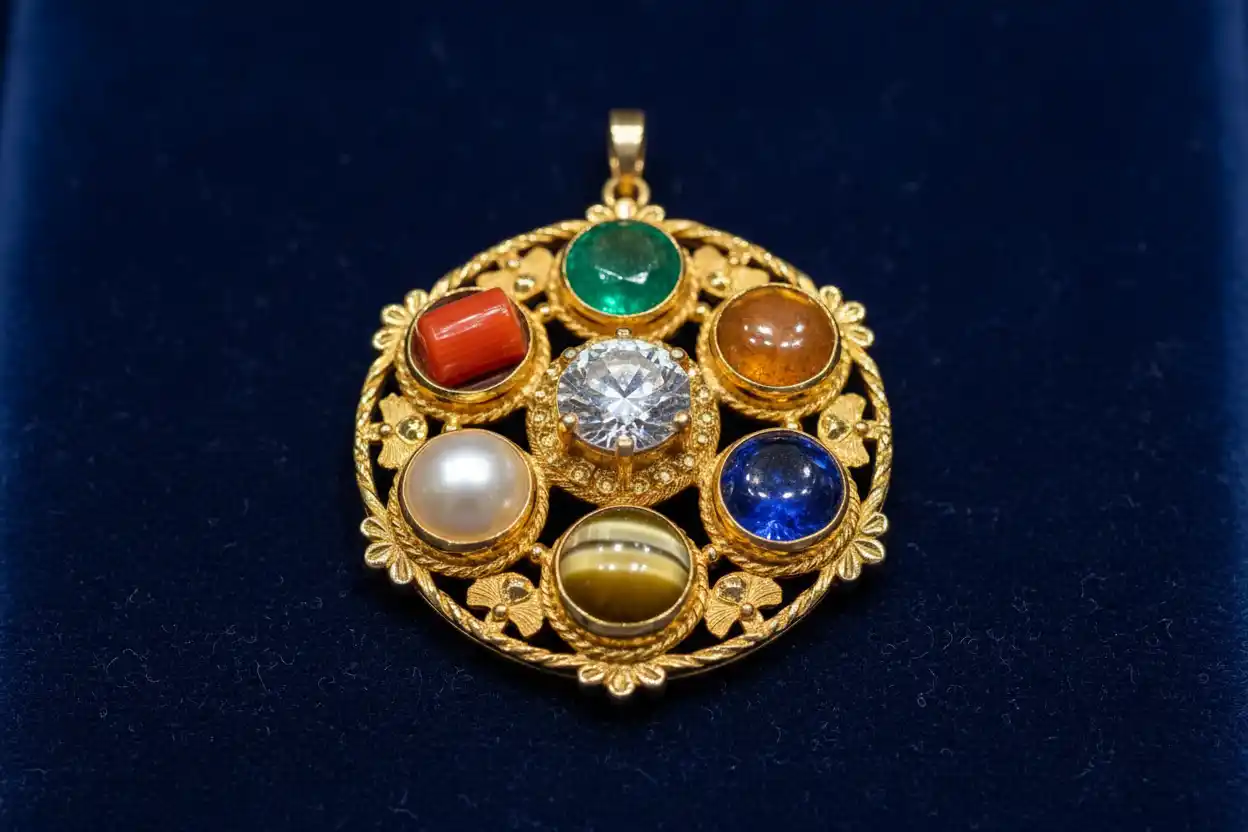
Navratna: Nine Gemstones, Planets and Meanings
Navratna is a traditional grouping of nine gems associated with the Navagraha—the nine celestial influences recognized within Indian astrological traditions. The word combines nava, meaning nine, with ratna, meaning gem, jewel or precious object.
A modern standard Navratna set contains Ruby, Pearl, Red Coral, Emerald, Yellow Sapphire, Diamond, Blue Sapphire, Hessonite Garnet and cat’s-eye Chrysoberyl. Each corresponds with a graha, including the Sun, Moon, five visible planets and the lunar nodes Rahu and Ketu.
Navratna jewelry has appeared in rings, pendants, necklaces, bracelets, amulets and royal ornaments across South Asia and related Southeast Asian traditions. Its cultural significance extends beyond one region or one uniform school of astrology.
The gems are also physically different from one another. Diamond and Sapphire are highly scratch-resistant, while Pearl and Coral are soft organic materials. Emerald commonly contains fissures and clarity enhancement. Consequently, Navratna jewelry requires more careful buying and cleaning than its colorful symmetry suggests.
The Nine Navratna Gems at a Glance
| Graha | Common name | Traditional gem | Common South Asian names | Gemological identity |
|---|---|---|---|---|
| Surya | Sun | Ruby | Manikya, Manik | Red corundum |
| Chandra | Moon | Pearl | Mukta, Moti | Organic nacreous gem |
| Mangala | Mars | Red Coral | Pravala, Moonga | Organic calcium-carbonate skeleton |
| Budha | Mercury | Emerald | Marakata, Panna | Green beryl |
| Brihaspati or Guru | Jupiter | Yellow Sapphire | Pushyaraga, Pukhraj | Yellow corundum |
| Shukra | Venus | Diamond | Vajra, Heera | Crystalline carbon |
| Shani | Saturn | Blue Sapphire | Nila, Neelam | Blue corundum |
| Rahu | Ascending lunar node | Hessonite Garnet | Gomeda, Gomed | Grossular Garnet variety |
| Ketu | Descending lunar node | Cat’s-eye Chrysoberyl | Vaidurya, Lehsunia | Chatoyant Chrysoberyl |
What Does Navratna Mean?
Navratna literally means nine gems.
The same expression can be used figuratively for nine distinguished people or treasures, but in jewelry it usually refers to the astrological gemstone grouping.
The system relates each gem to one member of the Navagraha. In traditional astrology, graha is broader than the modern scientific definition of planet.
The Sun and Moon are included because of their visible and symbolic importance. Rahu and Ketu are the ascending and descending lunar nodes—the points where the Moon’s orbit intersects the apparent path of the Sun—not physical planets.
Understanding that distinction helps preserve the tradition without confusing it with modern astronomy.
Historical and Cultural Context
Astrological gemstone traditions have a deep history in the Indian subcontinent.
Navratna ornaments appear in museum collections as talismanic bracelets, pendants, rings and royal jewelry. They were made in gold, silver and enamel and could contain both standard and substituted materials.
The tradition also spread into Sri Lanka, Nepal, Myanmar, Thailand, Cambodia, Indonesia and other South and Southeast Asian settings. Names, arrangements and specific gem substitutions may differ.
Hindu, Jain and Buddhist communities have all used nine-gem imagery in different cultural contexts.
It is therefore more accurate to describe Navratna as a family of related traditions than as one universally fixed jewelry formula practiced identically everywhere.
Traditional Arrangement
Ruby commonly occupies the center of a Navratna arrangement because it represents Surya, the Sun.
The other eight gems surround it. Some traditions prescribe a directional or clockwise order, while historical jewelry can show variations, substitutions and additional decorative stones.
A ring may arrange the gems in a three-by-three square, with Ruby at the center. Pendants and bracelets can use circular, floral or architectural layouts.
The traditional meaning depends on the group as a whole rather than simply placing nine colorful stones in any order.
However, one should not declare a historical ornament inauthentic merely because its arrangement differs from a modern commercial diagram. Regional workshops, patron preferences and available materials all influenced construction.
1. Ruby for Surya
Ruby represents Surya, the Sun.
Traditional symbolism connects it with vitality, authority, confidence, status and visibility. Its red color suggests heat, light and royal power.
Gemologically, Ruby is red corundum with Mohs hardness 9. Chromium produces the red color and may create red fluorescence.
Natural Ruby can be heated, diffusion treated, fracture filled or laboratory-grown. These categories have very different values.
The Treated Ruby guide explains why a glass-filled commercial Ruby cannot be valued like a fine unheated natural stone.
In Navratna jewelry, Ruby is frequently central and sometimes slightly larger than the surrounding gems.
2. Pearl for Chandra
Pearl represents Chandra, the Moon.
Its pale luster supports associations with calm, reflection, receptivity and changing phases.
Pearl is an organic gem formed when a mollusk deposits nacre around an irritant or implanted nucleus. Natural Pearls form without deliberate human intervention, while cultured Pearls develop with human assistance.
Traditional prescriptions may specify natural Pearl, but most modern commercial jewelry uses cultured Pearl because natural material is rare and expensive.
The type should be disclosed accurately. The Real vs Fake Pearl guide separates natural, cultured, imitation and shell-based products.
Pearl is soft and sensitive to acids, perfume, heat and abrasion.
3. Red Coral for Mangala
Coral represents Mangala or Mars.
Traditional meanings connect its red color with action, courage, physical force and determination.
Precious Coral is organic skeletal material produced by marine colonies. It consists mainly of calcium carbonate and is much softer than Ruby, Sapphire or Diamond.
Red Coral may be dyed, reconstructed or imitated with glass, plastic and other materials.
Ethical and legal sourcing requires care because coral ecosystems face environmental pressure and wildlife-trade rules vary by species and jurisdiction. The Coral Ethics guide owns that important boundary.
Buyers should request species, origin and treatment disclosure rather than relying only on the name Moonga.
4. Emerald for Budha
Emerald represents Budha or Mercury.
Traditional symbolism connects it with learning, speech, trade, calculation and intellectual clarity.
Emerald is green beryl colored principally by chromium, vanadium or both. It ranks 7.5–8 in hardness but commonly contains fissures that reduce practical toughness.
Oil, wax and resin are widely used to make surface-reaching fissures less visible.
The Treated Emerald guide explains why enhancement type and extent matter.
An Emerald in a Navratna piece should not be assumed untreated simply because the complete jewel is old or spiritually marketed.
5. Yellow Sapphire for Brihaspati
Yellow Sapphire represents Brihaspati or Guru, associated with Jupiter.
Traditional interpretations connect it with wisdom, teaching, prosperity, counsel and expansion.
Yellow Sapphire is yellow corundum with hardness 9. Color may be natural, heated, irradiated or influenced through diffusion-related treatment.
The dedicated Pukhraj guide owns its role within Vedic tradition.
Some historical or regional Navratna sets use yellow Topaz or another yellow gem in the Jupiter position. Modern high-value commercial descriptions normally expect Yellow Sapphire when the item is presented as a standard Navratna jewel.
6. Diamond for Shukra
Diamond represents Shukra or Venus.
Traditional meanings include beauty, attraction, luxury, artistic enjoyment and relationship harmony.
Diamond consists of crystalline carbon and ranks 10 on the Mohs scale.
A Navratna Diamond may be a small rose cut, table cut, old cut or modern brilliant. Historical pieces should not be judged by modern round-brilliant standards.
Laboratory-grown Diamond, Cubic Zirconia, white Sapphire and glass can occupy the position in modern commercial jewelry. Their identity must be stated rather than hidden behind the phrase white stone.
7. Blue Sapphire for Shani
Sapphire represents Shani or Saturn.
Traditional interpretations associate it with discipline, responsibility, delay, endurance, justice and consequences.
Blue Sapphire is blue corundum with hardness 9. Heat treatment is common, while diffusion and fracture filling may also occur.
The Neelam guide owns the gemstone’s specific Vedic context.
The Treated Sapphire guide explains why natural unheated Sapphire, heated Sapphire, diffusion-treated material and laboratory-grown corundum occupy different markets.
Astrological claims about rapid beneficial or harmful effects are matters of belief, not scientifically established gemstone behavior.
8. Hessonite for Rahu
Hessonite Garnet represents Rahu, the ascending lunar node.
Its usual color ranges from yellowish orange and honey brown to reddish brown. The gem belongs to the Grossular Garnet group.
Traditional interpretations connect Rahu with ambition, unconventional paths, confusion, foreign influence and worldly desire.
Hessonite often contains a characteristic roiled or heat-wave-like internal appearance.
It should not be confused with orange glass, Citrine, Zircon, Spessartite or another Garnet simply because the color is similar.
Some historical or regional sets may use Zircon or another orange-brown gem in this position.
9. Cat’s-Eye Chrysoberyl for Ketu
Chrysoberyl cat’s-eye represents Ketu, the descending lunar node.
The gem displays chatoyancy: a narrow band of reflected light that moves across a properly cut cabochon.
Traditional meanings connect Ketu with detachment, insight, spiritual inquiry and release from material fixation.
The unqualified trade name cat’s-eye is properly reserved for Chrysoberyl in professional gem usage. Quartz, Tourmaline, Apatite and other gems can also show chatoyancy but should include the mineral name.
A fine stone has a sharp, centered and mobile eye with attractive bodycolor.
The exact interpretation of historical terms such as vaidurya can vary, but modern Navratna trade generally expects cat’s-eye Chrysoberyl.
Natural vs Laboratory-Grown Gems
A laboratory-grown Ruby, Sapphire, Emerald or Diamond can have the essential structure and composition of its natural counterpart.
It does not have geological origin and should be identified as laboratory-created.
Traditional astrological practitioners often specify natural gems. Some also prescribe untreated material, minimum weights, particular metals or skin contact.
Those requirements differ among schools and advisors and are not gemological laws.
A modern Navratna jewel can use laboratory-grown gems for affordability and durability, provided the description remains accurate.
A buyer seeking strict traditional compliance should establish the intended standard before purchasing rather than discovering substitutions afterward.
Natural Pearl vs Cultured Pearl
Natural and cultured Pearls are both real organic gems.
The distinction concerns formation. Natural Pearls develop without intentional implantation, while cultured Pearls result from a managed process involving a mollusk.
Most Pearls in modern jewelry are cultured.
A listing that says natural Pearl may mean real rather than imitation, even when the product is technically cultured. This ambiguous use should be clarified.
Treatment can include bleaching, dyeing, irradiation, coating and filling. The Treated Pearl guide covers those processes.
Gemstone Substitutions
Historical and commercial Navratna jewelry sometimes uses substitutes.
Red Spinel may replace Ruby, yellow Topaz may replace Yellow Sapphire, Zircon may replace Hessonite, and Quartz cat’s-eye may replace Chrysoberyl cat’s-eye.
Cultured Pearl commonly replaces natural Pearl, while synthetic corundum or glass may replace Ruby and Sapphire in affordable pieces.
A substitution can preserve the color pattern but does not preserve the same mineral identity, rarity or traditional interpretation.
Sellers should list every material rather than describe the complete object simply as nine precious gems.
Treatments in Navratna Jewelry
The nine materials have very different treatment patterns.
Ruby and Sapphire are often heated. Emerald is commonly oil- or resin-filled. Pearl may be bleached or dyed. Coral can be dyed, filled or reconstructed.
Diamond may be laser drilled, fracture filled, irradiated or laboratory-grown. Hessonite and cat’s-eye Chrysoberyl are less routinely treated but still require correct identification.
A report for the complete piece may not test every small stone individually.
The Gemstone Certification guide explains why scope, laboratory and wording should be checked carefully.
Navratna Rings
A Navratna ring often places the nine stones in a square or circular cluster.
Ruby commonly occupies the center, while the other stones form the surrounding group.
The ring must reconcile materials with different hardness and toughness. Hard Diamond or Sapphire girdles should not rub directly against Pearl, Coral or Emerald.
A closed back can protect soft materials but may conceal foil, glue or replacement stones.
Some astrological traditions specify that gems should touch the skin through open backs. That is a ritual preference rather than a gemological requirement, and an open construction can increase exposure to perspiration and impact.
Pendants and Necklaces
Pendants provide a safer format because Pearl, Coral and Emerald receive less impact than they would in a ring.
A circular or square pendant can preserve the traditional arrangement while using bezels to separate the stones.
The bail and chain must support the weight of nine settings and substantial gold.
Long pendants swing more and can strike hard surfaces. Princess-length chains often keep the design visible while limiting movement.
A historical Navratna pendant may use table cuts, foil backs, enamel and irregular stones. Modern recutting can destroy historical workmanship and should not be undertaken casually.
Bracelets and Bangles
Navratna bracelets may arrange the gems across a line, within repeating clusters or around one central panel.
Wrist jewelry receives frequent impact. Pearl and Coral sections should remain low and protected.
A hinged bangle should move through its hinge rather than flex through the gem-set section.
The clasp deserves the same attention as the stones. A spiritually important bracelet can still be lost through an undersized tongue or open jump ring.
Metal and Setting Traditions
Gold is strongly associated with Navratna jewelry, but silver, mixed metals and enamel are also used.
Traditional practitioners may recommend specific metals for ritual reasons. Those recommendations vary and should not be represented as universal gemological rules.
From a structural perspective, the metal must separate incompatible stones and provide enough support for soft organic materials.
High-karat gold offers rich color but may be softer than lower-karat alloys. The setting should contain enough metal to resist bending.
Nickel, solder and plating can cause skin reactions independently from the gemstones.
Buying a Navratna Jewel
Begin by requesting a written inventory of all nine stones.
The description should identify natural, cultured, laboratory-grown or imitation origin where relevant and list known treatments.
An expensive Navratna piece may justify testing by a recognized laboratory, especially when natural Ruby, Diamond, Sapphire or Emerald claims contribute substantially to price.
Follow How to Buy Gemstones Online Without Getting Scammed when purchasing remotely.
Ask for front, side and back photographs, dimensions, metal purity, total weight, treatment disclosure and return terms.
The buyer should also decide whether the priority is historical artistry, astrological tradition, gemological quality or affordable visual design. One piece may not optimize all four.
Authenticity Concerns
A complete Navratna jewel can contain a mixture of natural, synthetic and imitation stones.
This does not automatically make the object fraudulent when every component is disclosed. Problems arise when glass or synthetic material is sold as high-quality natural gemstones.
Pearl identity is especially easy to describe ambiguously. The Real vs Fake Pearl guide explains natural, cultured and imitation distinctions.
Blue Sapphire may be replaced by glass-filled corundum, synthetic Sapphire or colored glass. The Real vs Fake Sapphire guide owns that diagnostic boundary.
A home scratch test is inappropriate because the set contains both very hard and very soft materials.
Cleaning Navratna Jewelry
Navratna jewelry must be cleaned according to its most delicate component.
Pearl and Coral are soft, acid-sensitive organic materials. Emerald may contain oil or resin. These three make steam and ultrasonic cleaning unsuitable for the complete piece.
Wipe the jewelry with a soft, slightly damp cloth after wear. When deeper cleaning is necessary, use a small amount of mild soap and lukewarm water, avoiding prolonged soaking.
Do not use ammonia, bleach, alcohol, toothpaste or abrasive powders.
Dry the piece immediately and store it separately from harder jewelry.
A jeweler familiar with antique and mixed-gem settings should handle repairs.
Navratna Meaning and Beliefs
Within astrological traditions, Navratna is believed to balance or harmonize the influences of the nine grahas.
Some practitioners view the complete set as safer or more balanced than wearing one strong planetary gem alone.
These beliefs have cultural and religious significance, but scientific evidence has not demonstrated that gemstones transmit planetary radiation, alter a birth chart or control external events.
A person may wear Navratna as cultural heritage, devotional jewelry, family tradition or a symbol of cosmic order.
Those meanings remain valid as personal and cultural experiences without being presented as experimentally proven forces.
Who Can Wear Navratna?
There is no gemological restriction based on birth date, religion, gender or astrological chart.
Astrological schools differ. Some say the complete nine-gem set can be worn broadly, while others recommend consultation and prescribe a specific arrangement, weight, metal or ritual.
Anyone following a religious or astrological discipline should consult a trusted practitioner within that tradition rather than rely on a generic commercial claim.
From a practical perspective, the wearer should consider metal sensitivity, lifestyle, stone durability and whether the piece contains ethically sourced Coral.
Frequently Asked Questions
1. What are the nine Navratna gemstones?
The modern standard set is Ruby, Pearl, Red Coral, Emerald, Yellow Sapphire, Diamond, Blue Sapphire, Hessonite Garnet and cat’s-eye Chrysoberyl.
2. What does Navratna mean?
It is a Sanskrit compound meaning nine gems or nine jewels.
3. Which gem represents the Sun?
Ruby represents Surya and commonly occupies the center of the arrangement.
4. Which gem represents the Moon?
Pearl represents Chandra. Traditional prescriptions may specify natural Pearl, while most modern jewelry uses cultured Pearl.
5. Are Rahu and Ketu planets?
They are lunar nodes within Indian astrology rather than physical planets in modern astronomy.
6. Must the stones follow one exact arrangement?
Ruby is commonly central, but historical and regional arrangements can vary.
7. Can synthetic gems be used?
They can be used in modern jewelry when disclosed, although some astrological traditions specify natural stones.
8. Is Yellow Topaz acceptable instead of Yellow Sapphire?
Some historical or regional sets use Topaz, but a modern standard Navratna description generally expects Yellow Sapphire unless a substitution is stated.
9. What type of cat’s-eye belongs in Navratna?
Modern gemological convention uses cat’s-eye Chrysoberyl for Ketu.
10. Is Navratna jewelry scientifically proven to change planetary influence?
No. Planetary and talismanic effects belong to astrological and religious belief rather than established science.
11. Can Navratna jewelry be cleaned ultrasonically?
No. Pearl, Coral and treated Emerald make ultrasonic and steam cleaning inappropriate for the complete piece.
12. Do Navratna jewels need laboratory reports?
Documentation is valuable when price depends on natural origin, treatment status or high-quality Ruby, Sapphire, Emerald and Diamond claims.
Navratna is both a gemstone system and a jewelry tradition. Its nine materials represent a symbolic cosmos, but they also create a practical gemological challenge: crystalline, organic, hard, soft, commonly treated and rarely treated materials must coexist in one object. A responsible Navratna jewel respects both dimensions by preserving the cultural framework while identifying and caring for every stone accurately.
Navratna’s planetary, health, protection and destiny-related effects are astrological or religious beliefs rather than scientifically established gemstone properties. Do not use the jewelry to replace medical care, financial advice, safety planning or informed personal decisions.