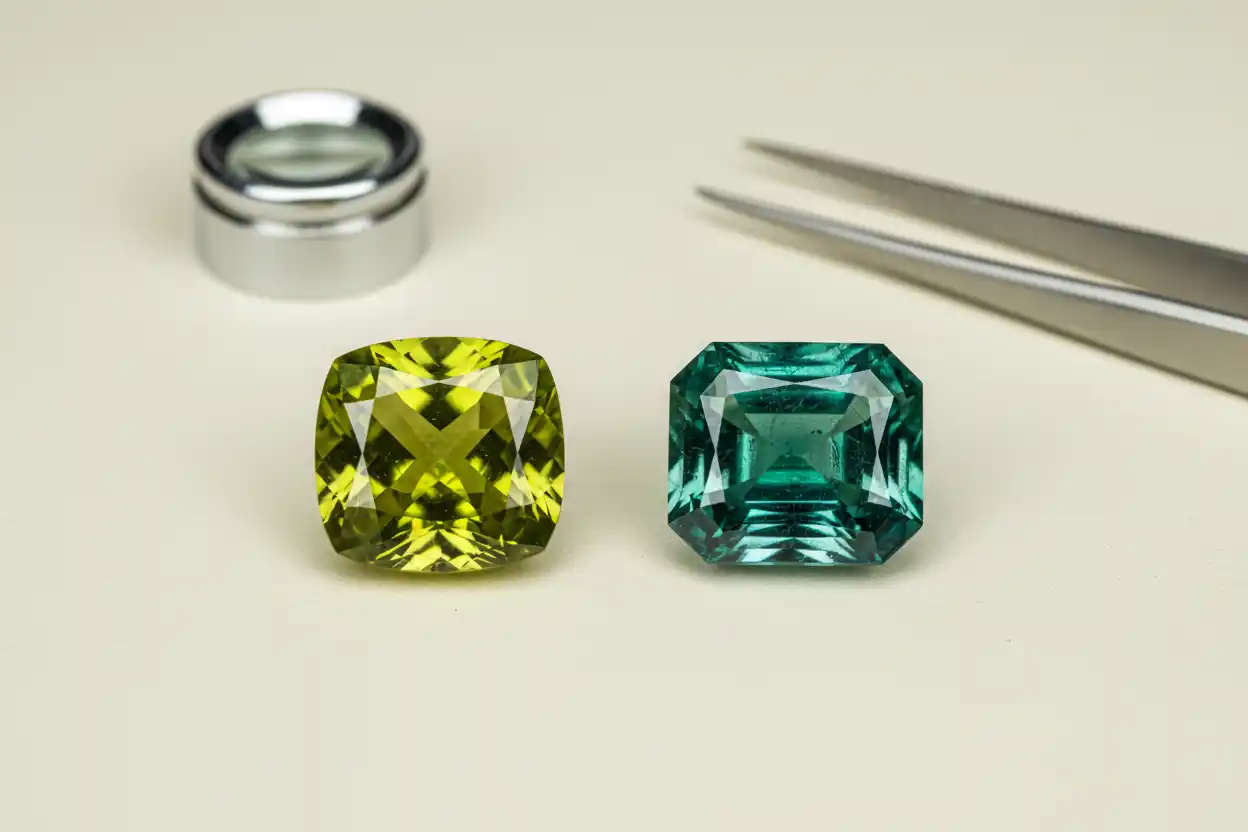
Peridot vs Emerald: Differences, Tests and Identification
Peridot and emerald can both appear vividly green, yet they are unrelated gemstones with different chemistry, optics, inclusions, treatments and durability. Peridot is gem-quality olivine colored by iron within its structure. Emerald is the green variety of beryl, colored principally by chromium, vanadium or a combination of the two.
The easiest visual clue is often undertone: peridot commonly leans yellowish green, whereas emerald more often appears green to bluish green. That observation is useful but not conclusive. Lighting, cut, saturation and individual chemistry create overlap, so a valuable stone should never be identified from color alone.
This page owns the direct comparison and identification workflow. The individual peridot guide and emerald guide cover each gem’s formation, history, varieties and symbolism in greater depth.
Peridot vs Emerald at a Glance
| Feature | Peridot | Emerald |
|---|---|---|
| Mineral identity | Gem variety of olivine | Green variety of beryl |
| General composition | Magnesium–iron silicate | Beryllium aluminum silicate |
| Crystal system | Orthorhombic | Hexagonal |
| Typical color | Greenish yellow to yellowish green or green | Green to bluish green |
| Main color cause | Iron within the crystal structure | Chromium and/or vanadium |
| Mohs hardness | Approximately 6.5–7 | Approximately 7.5–8 |
| Toughness in jewelry | Fair to good | Often reduced by fractures and inclusions |
| Refractive character | Strongly doubly refractive | Weakly doubly refractive |
| Approximate refractive index | 1.65–1.69 | 1.577–1.583 |
| Approximate specific gravity | 3.34 | 2.72 |
| Common inclusions | Dark crystals and reflective “lily pads” | Crystals, fissures, fluid inclusions and growth features |
| Common treatment | No routine appearance-enhancing treatment | Fissure filling with oil, resin or similar substances is common |
| Synthetic counterpart | Rarely encountered commercially | Hydrothermal and flux-grown synthetic emeralds are established |
| Typical market position | Accessible to moderately valuable | Broad range, with fine emerald commanding major premiums |
| Main identification clue | Strong facet doubling through some directions | Emerald color plus characteristic inclusions and lower optical values |
These properties are diagnostic only when measured or interpreted correctly. Home scratch tests, improvised chemicals and attempts to chip a hidden edge can permanently damage either gemstone.
Mineral and Chemical Difference
Peridot belongs to the olivine mineral series. Most gem material lies toward the magnesium-rich forsterite side, with iron producing the green color. Because iron is an essential structural component rather than an incidental surface stain, peridot’s green is intrinsic to the gem.
Emerald belongs to the beryl family, alongside aquamarine and morganite. Its crystal structure contains beryllium, aluminum, silicon and oxygen, while chromium or vanadium creates the qualifying green color.
The mineral distinction affects almost every practical property. Peridot is denser, more strongly birefringent and generally yellower. Emerald is harder on the Mohs scale, but its common fissures can make it less tolerant of impact than the hardness number suggests.
Comparing Color
Peridot usually displays a warm green. Common descriptions include lime, olive, yellowish green and grass green. Fine material minimizes brown and excessive darkness while retaining lively saturation.
Emerald usually ranges from green to bluish green. The market expects enough saturation and tone for the stone to be recognized as emerald rather than ordinary green beryl. However, the exact boundary can depend on laboratory and trade conventions.
A yellow-green stone is more likely to be peridot, while a strongly bluish-green stone is more likely to be emerald. Still, pale emerald, unusually green peridot, green glass, tourmaline and other gems can overlap visually.
Compare the stone under diffused daylight and neutral indoor light. Warm lamps can make peridot look yellower, while cool lighting can emphasize blue in emerald. Color remains a screening clue, not a final test.
The broader green gemstones guide places both materials among other green lookalikes without assigning every green stone to either category.
Double Refraction and Facet Doubling
Peridot has relatively strong birefringence. When viewed through certain directions with magnification, the rear facet junctions may appear doubled.
This doubling can be a useful clue in a faceted stone. Rotate the gem under a loupe and look through the table toward the pavilion facets. The effect may become clearer along some directions and disappear along others.
Emerald is also doubly refractive, but its birefringence is much weaker. Obvious doubled back facets are therefore more characteristic of peridot than emerald.
Facet doubling should not be confused with a blurred surface, poor polish or two reflections produced by a mounting. A gemologist can confirm the observation with a refractometer and other instruments.
Refractive Index
Peridot’s refractive index is higher than emerald’s. Typical peridot values fall around 1.65–1.69, while emerald generally measures around 1.577–1.583.
A refractometer can separate many loose or suitably mounted stones quickly. Peridot may also show a larger separation between its two readings because of its stronger birefringence.
Accurate refractive-index testing requires a clean facet, correct contact fluid, calibrated equipment and trained interpretation. It is not a useful kitchen-table experiment.
An unreadable result does not prove that the stone is fake. Very small gems, cabochons, heavily mounted stones and damaged facets can complicate testing.
Specific Gravity
Peridot is denser than emerald. A peridot and emerald of identical dimensions would therefore not have identical weights; the peridot should be heavier.
Specific gravity can support identification when measured correctly on a loose stone. Hydrostatic weighing compares weight in air with weight in water and requires a precise scale, careful suspension and attention to bubbles.
Mountings make the result unreliable because metal and accent stones contribute to the weight. Visual “heaviness in the hand” is too subjective to authenticate a gemstone.
The practical implication is that carat weight does not translate into the same millimeter dimensions for both stones. Peridot generally carries more weight within a given volume.
Inclusion Patterns
Peridot may contain small dark mineral crystals and reflective disk-like fractures commonly called lily-pad inclusions. Strong double refraction may also make internal features appear doubled.
Emerald frequently contains visible inclusions. These may include crystals, needles, partially healed fissures, liquid-filled cavities and multiphase inclusions. The collective internal appearance is often described informally as jardin, meaning “garden.”
Neither inclusion type appears in every stone. A clean peridot can lack obvious lily pads, while a high-clarity emerald may show little to the unaided eye. Synthetic emeralds and treated stones can also contain features that confuse inexperienced observers.
Magnification is most useful when several clues agree. One circular reflection does not automatically prove peridot, and one fissure does not prove emerald.
Hardness Is Not a Safe Home Test
Emerald is harder than peridot: approximately 7.5–8 Mohs versus 6.5–7. In theory, one material may scratch substances that the other does not.
In practice, scratch testing a finished or valuable gem is destructive and unreliable. A loose grain of harder material, an incorrect test surface or excessive pressure can create a permanent mark.
Hardness also cannot separate every lookalike. Quartz, tourmaline, glass and synthetic products create overlapping or misleading results.
The gemstone hardness chart explains scratch resistance, while gemstone toughness versus hardness explains why a harder gem can still break more readily in certain conditions.
Durability in Jewelry
Peridot’s moderate hardness means it can accumulate abrasions during frequent ring wear. It also needs protection from strong impacts and abrupt temperature changes.
Emerald is harder, but many stones contain fissures that reduce toughness. Clarity fillers can enter those fissures, and heat, solvents or ultrasonic vibration may affect the filler or the stone.
For daily rings, both benefit from protective settings. A bezel or substantial halo can shield the girdle, while exposed corners on emerald cuts, pears and marquises require extra attention.
The peridot ring guide owns peridot-specific settings and maintenance. The emerald ring guide covers emerald-specific construction, including the risks created by inclusions and clarity enhancement.
Treatments Provide an Important Clue
Peridot is not known for routine heat treatment to improve its appearance. Sellers sometimes market “unheated peridot,” but that wording does not establish unusual rarity because untreated status is normal for the material.
Emerald treatment is much more common. Colorless oils, resins and other fillers may be used to reduce the visibility of surface-reaching fissures. Laboratories can describe the presence and sometimes the degree of clarity enhancement.
A treated emerald is still emerald. The essential buying issue is disclosure, stability, care and whether the price reflects the treatment.
The treated emerald guide owns the complete enhancement discussion. The broader gemstone treatments guide explains the difference between heating, filling, coating, diffusion and other processes.
Natural, Synthetic and Imitation Material
Natural peridot is the standard commercial material. Synthetic olivine exists for technical and research purposes, but laboratory-grown peridot is not a common mainstream jewelry category.
Synthetic emerald is well established. Flux-grown and hydrothermal methods can produce material with essentially the same chemical and physical identity as natural emerald, although growth features and trace chemistry differ.
Green glass, cubic zirconia, synthetic spinel, YAG, doublets and other products may imitate either appearance. A visual guess cannot reliably separate every possibility.
The real versus fake emerald guide retains the emerald-specific authenticity workflow. For a significant purchase, request independent testing rather than relying on an informal “natural stone certificate.”
Cut and Typical Appearance
Peridot is often cut as an oval, cushion, round or pear. Strong birefringence can soften facet junctions visually, particularly in larger stones.
Emerald is famous for the rectangular step cut that bears its name. Cut corners help protect vulnerable points, while broad steps display color and clarity. Emeralds also appear as ovals, rounds, cushions, pears and cabochons.
A cut style does not identify the material. Peridot can be fashioned as an emerald cut, and emerald can be brilliant-cut.
Windowing may occur in either stone when the pavilion is too shallow. Extinction, asymmetry and excessive depth are cutting issues rather than natural proof of identity.
Price and Market Position
Commercial peridot is generally more accessible than fine emerald. Large, clean peridots are available, although exceptional color, size, origin or provenance can raise value substantially.
Emerald spans an enormous market range. Included commercial stones may be affordable, while fine gems with strong color, transparency, size, low enhancement and respected origin can command major premiums.
Detailed figures belong in the peridot price guide and emerald price guide. A low price may suggest imitation or weak quality, but price alone cannot establish identity.
Birthstone Difference
Peridot is an August birthstone. The August birthstone guide explains its relationship with spinel and sardonyx.
Emerald is the traditional modern birthstone for May. The May birthstone guide covers its history and gifting context.
Birthstone labels do not authenticate the stone. A green imitation sold in August or May jewelry still requires accurate material disclosure.
Cleaning Differences
Peridot should be cleaned with warm water, mild soap and a soft brush. Steam and ultrasonic cleaning are not recommended because heat, vibration and inclusions can increase risk.
The full procedure belongs in how to clean peridot jewelry safely.
Emerald requires even more treatment-aware care. Warm soapy water and gentle handling are generally safest, while ultrasonic or steam cleaning can affect fractured, filled or included stones.
The dedicated emerald cleaning guide covers filler-sensitive precautions and professional maintenance.
Professional Identification Workflow
A gemologist normally combines several observations rather than trusting one clue. The sequence may include unaided color assessment, magnification, refractive-index readings, birefringence, pleochroism, specific gravity, spectroscopy and inclusion analysis.
Mounted stones can limit testing. A laboratory may need advanced instruments to determine natural versus synthetic origin or characterize treatment.
The gemstone certification guide explains major report types. Once a report is available, how to read a gem lab report helps distinguish identity, treatment and origin statements.
For an online purchase, follow the safeguards in how to buy gemstones online. The seller should provide accurate dimensions, treatment disclosure, return terms and documentation that corresponds to the actual stone.
A Practical Non-Destructive Check
Begin with a clean stone under neutral light. Note whether the color leans yellow or blue, but do not stop there.
Next, inspect the back facets through the table with a loupe. Strong, directional facet doubling supports peridot. Examine inclusions for lily-pad-like reflections, crystals, fissures or complex fluid features.
Review the setting and seller paperwork. Emerald should prompt questions about fissure filling and synthetic origin, while “unheated peridot” should not be accepted as a meaningful premium claim.
If the gem is valuable, stop before performing any destructive test. A refractometer reading or independent laboratory report will provide far stronger evidence than scratching, heating or chemical exposure.
Frequently Asked Questions
1. Is peridot the same as emerald?
No. Peridot is gem-quality olivine, while emerald is chromium- or vanadium-colored beryl.
2. What is the easiest visual difference?
Peridot commonly appears more yellowish green, whereas emerald often appears green to bluish green. Color overlap means this clue is not conclusive.
3. Which stone is harder?
Emerald is harder at approximately 7.5–8 Mohs. Peridot measures approximately 6.5–7.
4. Why can emerald still be fragile if it is harder?
Many emeralds contain fissures and inclusions that reduce toughness. Hardness measures scratch resistance, not resistance to impact or fracture.
5. Does peridot show doubled facets?
It can. Peridot’s strong birefringence may make rear facet junctions appear doubled through certain viewing directions.
6. Do all peridots contain lily-pad inclusions?
No. Lily pads are useful when present, but a natural peridot may be clean or contain different inclusions.
7. Are all emeralds treated with oil?
No, but fissure filling with oil, resin or similar substances is common. Significant purchases should include treatment disclosure.
8. Is synthetic emerald real emerald?
Laboratory-grown emerald has essentially the same mineral identity as natural emerald but forms through a manufactured process. It must be disclosed as laboratory-grown.
9. Is synthetic peridot common?
No. Natural peridot dominates the jewelry market, and laboratory-grown peridot is not a common mainstream product.
10. Can I use a scratch test to separate them?
Do not scratch a gemstone. The test can damage the stone, produce misleading results and fail to exclude several lookalikes.
11. Which is better for an everyday ring?
Both require care. Emerald is harder but often fractured; peridot is softer but may be cleaner. The individual stone and protective setting matter more than the name alone.
12. When is a laboratory report worthwhile?
A report is worthwhile when the stone is expensive, treatment affects value, natural origin is important or visual identification remains uncertain.
Peridot and emerald stop looking interchangeable once their complete behavior is considered. Warm green color, strong facet doubling and greater density point toward peridot, while a richer green-to-bluish-green appearance, emerald-type inclusions and common fissure filling point toward emerald. Because individual stones and imitations can break those visual patterns, laboratory measurements remain the correct conclusion for a valuable or disputed gem.
Additional directory context is available through Gemstones That Start With P and Gemstones That Start With E.