Peridot Rings: Styles, Settings and Buying Tips
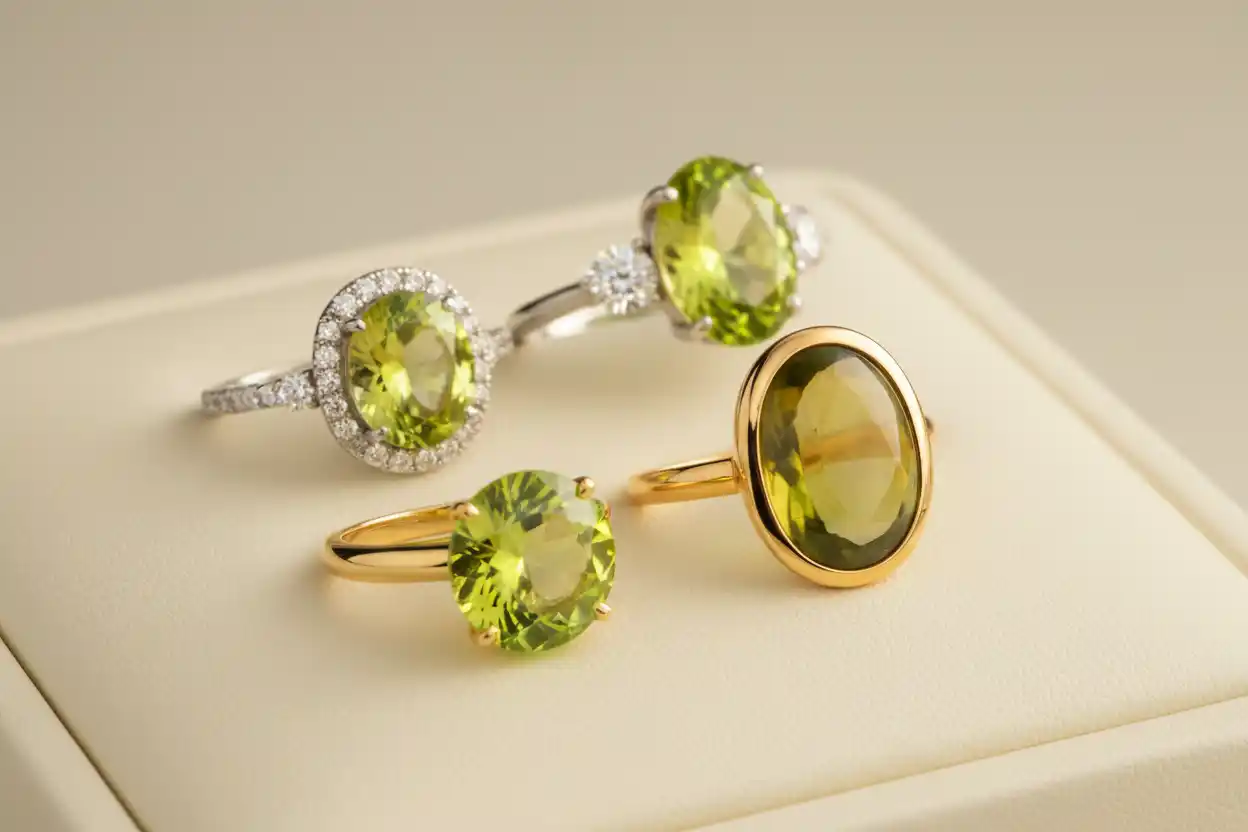
Peridot rings make the gem’s bright yellow-green color visible to the wearer throughout the day. Solitaires emphasize one clean center stone, halos increase visual spread, and three-stone or vintage-inspired designs allow peridot to interact with diamonds and contrasting metals.
The hand is also the most demanding place to wear peridot. The gemstone can be scratched by harder materials, chipped by impact and fractured by rapid or uneven heat. Therefore, a successful peridot ring depends as much on setting protection and wearing habits as it does on color or carat weight.
This guide focuses on ring styles, settings, durability, sizing, buying and maintenance. The peridot meaning guide owns the stone’s complete geology, history, material identity and symbolism.
Peridot Ring Styles
| Ring style | Visual character | Protection level | Main buying concern |
|---|---|---|---|
| Solitaire | Pure focus on one gem | Moderate | Prong security and height |
| Bezel ring | Modern and streamlined | High | Metal thickness and cleaning access |
| Halo ring | Bright and visually larger | Moderate to high | Halo proportion and shared prongs |
| Three-stone ring | Balanced and symbolic | Moderate | Side-stone alignment |
| Cluster ring | Wide green surface | Variable | Matching and replacement |
| East–west ring | Contemporary finger coverage | Moderate | Exposed side edges |
| Vintage-inspired ring | Detailed and romantic | Moderate | Fine prong and milgrain condition |
| Cocktail ring | Dramatic statement | Variable | Height, weight and occasional-wear suitability |
| Cabochon ring | Smooth organic color | Moderate | Surface condition and protective rim |
| Signet-style ring | Substantial and architectural | High when recessed | Metal weight and fit |
Why Peridot Needs Thoughtful Ring Design
Peridot is approximately 6.5–7 on the gemstone hardness chart. It can withstand normal jewelry wear, but it scratches more easily than sapphire, spinel or diamond.
Hardness is only one part of durability. The gemstone toughness-versus-hardness guide explains why a gem that resists some scratches can still chip or fracture.
Peridot has fair-to-good toughness and can be damaged by a hard blow. Rapid or uneven heating creates an additional risk, which matters during repairs and resizing.
Rings expose their gemstones to desks, doors, bags, exercise equipment and household surfaces. A low setting, protected girdle and substantial metal construction reduce that exposure.
Peridot Solitaire Rings
A solitaire places all attention on one center stone. Oval and cushion cuts are especially common because they provide useful face-up size and preserve weight from irregular rough.
Four-prong settings expose the outline but offer less redundancy than six-prong designs. Fine double prongs can protect corners while maintaining a delicate appearance.
The prongs should be substantial enough for future maintenance. Extremely thin claws may look refined when new but wear quickly or bend during an impact.
A cathedral setting lifts the center between rising shoulders. It can create an elegant profile and make space for a wedding band, although excessive height increases snagging and impact.
View the ring from the side. The gemstone should not sit unnecessarily high above the finger merely to create an exaggerated showroom appearance.
Bezel-Set Peridot Rings
A bezel surrounds the girdle with metal and offers some of the strongest protection for a peridot ring.
The bezel should be even and close to the gemstone without covering excessive portions of the crown. A thick rim can make the peridot appear smaller and reduce access for cleaning.
A partial or semi-bezel protects two sides while leaving more of the outline visible. This design works well for oval, emerald and east–west settings, provided the open ends do not expose vulnerable corners.
Bezel setting requires skill because pressure must be distributed around the gem. An included stone or thin girdle can be damaged by aggressive metal tightening.
Halo Peridot Rings
A diamond halo increases apparent diameter and creates bright contrast around peridot’s green.
The center should remain the primary focus. A broad double halo around a weak stone may create size but not quality.
Halos can protect parts of the girdle from side impact, though they do not make the center indestructible. High halos may still strike hard surfaces.
Shared prongs between accent stones need periodic inspection. If one small diamond is lost, the neighboring stones may also become vulnerable.
The halo should follow the center’s outline precisely. Uneven gaps or tilted sections are signs of weak execution.
Three-Stone Peridot Rings
A three-stone ring commonly pairs peridot with diamonds, sapphires, spinels or smaller peridots.
Colorless side stones create contrast and can make the green center appear more saturated. Tapered baguettes create a structured transition toward the shank, while round or pear side stones produce a softer outline.
The side gems should not press directly against the peridot’s girdle. Adequate spacing and secure individual settings prevent abrasion.
A three-stone design can provide broad finger coverage without requiring one exceptionally large peridot. However, the center should still display strong color and cutting rather than relying on side stones to create all the visual interest.
Cluster Rings
Cluster rings combine several small peridots or surround another center with peridot accents. They can create a broad field of green from calibrated stones.
Matching should be assessed across hue, tone, saturation and cut. One brownish or unusually pale gem can interrupt the design.
Replacement is a practical concern. Peridot is commercially available, but an exact size and color match may not be immediately available years later.
Cluster settings also contain many small prongs. The ring should be inspected regularly, particularly when worn often.
East–West Peridot Rings
An east–west ring sets an oval, emerald, marquise or elongated cushion horizontally across the finger.
The design creates strong finger coverage and often allows a lower profile than the same stone in a vertical setting. It can also make moderate-size gems look contemporary and substantial.
The exposed ends require protection. Semi-bezels, capped prongs or supportive shoulders can reduce impact at the narrow points.
An east–west setting may prevent a straight wedding band from sitting flush. Buyers should try the intended ring combination before committing to the design.
Vintage-Inspired Peridot Rings
Vintage-inspired designs may use milgrain, engraving, filigree, bead setting or geometric halos.
Fine decorative work should remain structurally sound. Worn antique prongs, cracked filigree or thin galleries need professional evaluation before regular wear.
Older rings may also contain replacement stones or repairs from different periods. A seller should distinguish documented antique peridot from a modern gemstone placed in an older mounting.
The ring’s age does not prove that the gemstone is untreated, rare or from a particular locality.
Peridot Cocktail Rings
Large peridots are available compared with many rare colored gems, making them suitable for dramatic cocktail rings.
The setting should account for the gem’s depth and weight. A broad under-gallery, supportive shoulders and balanced shank help prevent the ring from rotating.
High cocktail rings are best treated as occasional jewelry. They can catch clothing and strike surfaces more easily than a low bezel or compact solitaire.
A large carat weight should not distract from windowing. Some deep stones retain substantial weight while appearing smaller and darker than expected.
Choosing Peridot Color
Fine peridot generally shows vivid green or yellowish green with minimal brown. Pure green is uncommon, and a lively yellow-green can be more attractive than a dark stone advertised as “deep green.”
Evaluate the ring in daylight, neutral indoor light and warm evening illumination. The stone should remain attractive as the balance between green and yellow changes.
Yellow gold strengthens warmth, while white gold or platinum creates cooler contrast. Rose gold can produce a striking complementary combination with vivid green.
Color should extend across the face. A pale center surrounded by darker edges may indicate windowing or uneven light return rather than desirable zoning.
The planned green gemstones guide will compare the broader palette without making every green material suitable for the same ring use.
Clarity and Durability
Fine peridot is commonly expected to be eye-clean. Small dark crystals and lily-pad inclusions may appear under magnification.
In a ring, location matters. A surface-reaching fracture near a prong, corner or thin girdle can increase vulnerability during wear and repair.
A minor internal inclusion that does not affect transparency may be acceptable. Large dark spots under the table have a stronger visual effect, especially in pale stones.
Ask to inspect the peridot from the side and underside before purchase. A setting should not be used to conceal a chipped girdle or large cavity.
Cut and Face-Up Performance
Peridot is available in round, oval, cushion, pear, emerald, marquise and specialty cuts.
The best cut distributes color across the face and produces a balanced pattern of bright and dark reflections. A large transparent center is windowing, not extra clarity.
Overly deep stones may retain weight but look smaller from above. The carat-versus-millimeter size chart helps compare dimensions rather than relying only on carat weight.
Peridot’s double refraction can cause visible facet doubling. This is a natural optical property, though it does not excuse poor symmetry or polish.
Ring Setting Height
Low settings reduce snagging and impact. A bezel, basket or halo can keep the peridot closer to the finger while providing structural support.
High settings create a more prominent appearance and may allow a wedding band to sit flush. They also expose the center to more contact.
Examine the culet clearance beneath the stone. The pavilion should not touch the finger or rest against a thin metal bridge.
The gallery should allow cleaning access without leaving sharp edges against the skin.
Prongs and Girdle Protection
Prongs should contact the gemstone securely and lie smoothly against the crown. Lifted or uneven prongs can catch fabric.
Six-prong round and oval settings provide redundancy. Four-prong designs reveal more of the gem but leave larger sections of girdle exposed.
Pear and marquise tips need V-shaped or capped protection. Square cuts require prongs positioned correctly over corners.
The broader principles in gemstone cleavage explained help clarify why damage can result from localized pressure even when a gemstone does not have perfect cleavage.
Is Peridot Suitable for an Engagement Ring?
Peridot can be used in an engagement ring, but it is not the most damage-resistant choice for uninterrupted daily wear.
Someone who loves its color may accept periodic inspection, cautious habits and the possibility of repolishing or replacement. A bezel, protective halo or substantial six-prong setting is preferable to an exposed tension design.
The green engagement-ring gemstones guide places peridot beside more durable options such as sapphire, spinel and some garnets.
A wearer who works frequently with tools, machinery, sports equipment or hard surfaces may prefer peridot in a necklace and use a tougher green center for the engagement ring.
Peridot Versus Emerald Rings
Peridot commonly shows yellow-green color, while emerald often appears greener or bluish green. The gems also differ in composition, optical behavior, inclusion patterns and treatment practices.
Emerald is harder but frequently fractured and commonly clarity-enhanced. Peridot is softer and vulnerable to thermal shock, yet fine examples are often eye-clean and not routinely treated.
The complete identification boundary belongs in peridot versus emerald.
A retailer should not market peridot as “evening emerald” in a way that obscures its actual identity. It is a distinct gemstone rather than a low-cost grade of emerald.
Peridot Versus Prasiolite Rings
Prasiolite is green quartz and often has a pale, cool appearance. Peridot generally shows stronger yellow-green color and different optical properties.
Most commercial prasiolite is associated with treatment of suitable quartz, while routine appearance-enhancing heat treatment is not standard for peridot.
The planned prasiolite-versus-peridot guide owns the detailed comparison.
Both gems can be attractive in rings, but their value, durability and market representation should remain separate.
Treatments and Disclosure
Peridot is not known for routine heat treatment to improve its appearance. “Unheated” therefore does not establish exceptional rarity.
The gemstone treatments guide explains treatment disclosure across colored stones.
Coatings, glass imitations, assembled stones and misleading trade descriptions can still occur. The seller should identify the gemstone accurately and distinguish natural peridot from simulated green material.
Origin Claims
Peridot comes from several localities, including Myanmar, Pakistan, Arizona, China, Vietnam, Tanzania and historic Zabargad in Egypt.
Some origins attract collector interest, particularly large transparent material from Myanmar and Pakistan or documented historic Egyptian stones.
Color alone does not establish origin. A seller’s statement should not be treated as an independent laboratory conclusion.
Most buyers should prioritize the individual gem’s beauty and ring construction rather than paying heavily for an unsupported locality story.
Laboratory Reports
Routine small commercial peridot rings may not require reports. Large, costly, provenance-dependent or purported meteorite peridots deserve stronger documentation.
The gemstone certification guide explains the differences among identification reports, grading documents and appraisals.
Use how to read a gem lab report to compare measurements and descriptions with the mounted stone.
A report does not grade workmanship. Prongs, shank thickness, setting height and clasp-free ring construction still need physical inspection.
Buying a Peridot Ring
The peridot buying guide owns the complete gemstone selection sequence. Current market figures belong in the peridot price guide.
For online purchases, follow how to buy gemstones online. Request video of the exact ring in ordinary light, center-stone dimensions, carat weight, metal fineness, ring size, setting height and return terms.
Ask whether the ring has been resized previously and how much further alteration is possible. Fully patterned shanks, eternity settings and tension-style designs have limited sizing ranges.
The ring should arrive with enough time for independent inspection before the return window closes.
Ring Sizing
A wide shank fits more tightly than a narrow band at the same nominal size. Temperature, time of day and hand swelling also affect fit.
The ring should pass over the knuckle with moderate resistance and sit without rotating constantly. A top-heavy setting may need sizing beads, a broader shank or a lower profile.
Large resizing changes can distort the setting and move prongs out of alignment. Select the closest practical original size whenever possible.
Resizing and Repair
Peridot is vulnerable to rapid or uneven heat. A jeweler must know the center stone’s identity before soldering, resizing or retipping prongs.
The gem may need to be removed for extensive work. Protective compounds and careful heat control reduce risk but do not make every procedure safe.
Surface-reaching inclusions can complicate setting pressure. Choose a jeweler experienced with colored stones rather than assuming techniques used for diamond are automatically appropriate.
After repair, inspect the peridot for movement, new abrasions or damage around the girdle.
Wearing Peridot Rings Safely
Remove the ring before exercise, gardening, cleaning, cooking that involves rapid heat changes, lifting or mechanical work.
Do not wear it while applying strong household chemicals. Acidic products and abrasive powders can affect the gemstone or metal.
A frequently worn ring should be inspected after any hard impact. A lifted prong or slight movement can become a lost stone if ignored.
Peridot rings are better suited to mindful wear than constant wear under every condition.
Coordinating Peridot Jewelry
A peridot bracelet repeats green at the wrist but should not be stacked directly beside the ring where the settings can collide.
Peridot earrings provide balanced face-framing color, while a peridot necklace creates a stronger central focal point.
A complete matched suite can look formal. For everyday styling, one peridot ring paired with simple metal or diamond jewelry often gives the gem more visual space.
Peridot Ring Meaning
Some wearers choose peridot rings for symbolic associations with confidence, optimism, protection or renewal.
The peridot healing properties guide owns detailed spiritual practices and safety boundaries. Those beliefs should not be confused with physical protection for the gemstone or medical outcomes for the wearer.
A ring can serve as a personal reminder because it remains visible on the hand. The associated change still depends on the wearer’s actions.
August Birthstone Rings
Peridot is one of August’s recognized birthstones. The August birthstone guide explains its history alongside spinel and sardonyx.
The August birthstone jewelry guide covers gift formats and personalization.
An August association can make the ring meaningful, but it does not reduce the need for a durable setting and accurate disclosure.
Cleaning and Storage
Clean peridot rings with warm water, mild soap and a soft brush. Pay attention beneath the center stone, where lotion and soap residue collect.
Do not use steam or ultrasonic cleaning. Rapid heat and vibration can increase risk.
The full procedure appears in how to clean peridot jewelry safely.
Store the ring separately in a padded compartment. Diamonds and sapphires can scratch exposed peridot surfaces when pieces rub together.
Frequently Asked Questions
1. Is peridot durable enough for a ring?
Yes, but it requires more care than sapphire, spinel or diamond. Protective settings and removal during impact-prone activities are important.
2. Can a peridot ring be worn every day?
It can be worn frequently by a careful wearer, though uninterrupted daily wear increases scratching and impact risk.
3. What is the safest peridot ring setting?
A well-made bezel provides strong girdle protection. Protective halos and substantial multi-prong settings can also work well.
4. Is peridot suitable for an engagement ring?
It can be used when the wearer accepts its maintenance and durability limitations. More impact-resistant green gemstones may be better for very active daily wear.
5. Which peridot color is best?
Vivid green or yellowish green with minimal brown is generally preferred. Brightness matters more than simply choosing the darkest stone.
6. Does peridot scratch easily?
It is moderately hard at approximately 6.5–7 Mohs but can be scratched by harder gemstones and abrasive materials.
7. Can a peridot ring be resized?
Many can, but heat sensitivity and setting construction require an experienced jeweler. Large size changes may distort the ring.
8. Is unheated peridot more valuable?
Not automatically. Peridot is not routinely heated to improve its appearance, so unheated status is not a special rarity factor.
9. Does a peridot ring need a laboratory report?
Ordinary small rings generally do not. Reports are more useful for large, expensive, provenance-dependent or unusual material.
10. Why does peridot show doubled facets?
Peridot is doubly refractive, so back facets may appear doubled through some viewing directions.
11. Can peridot rings go in ultrasonic cleaners?
No. Warm soapy water and gentle brushing are safer than ultrasonic or steam cleaning.
12. How often should the setting be inspected?
Check it at home before wear and after impacts. Frequently worn valuable rings benefit from periodic professional inspection for worn or lifted prongs.
A strong peridot ring is not necessarily the one with the largest center or the least visible metal. It is the design that gives the gem enough protection, keeps the profile practical and uses a stone whose color remains lively beyond showroom lighting. When setting engineering and gem quality are considered together, peridot can provide distinctive green without being treated like a harder gemstone than it is.
Peridot is listed in Gemstones That Start With P.