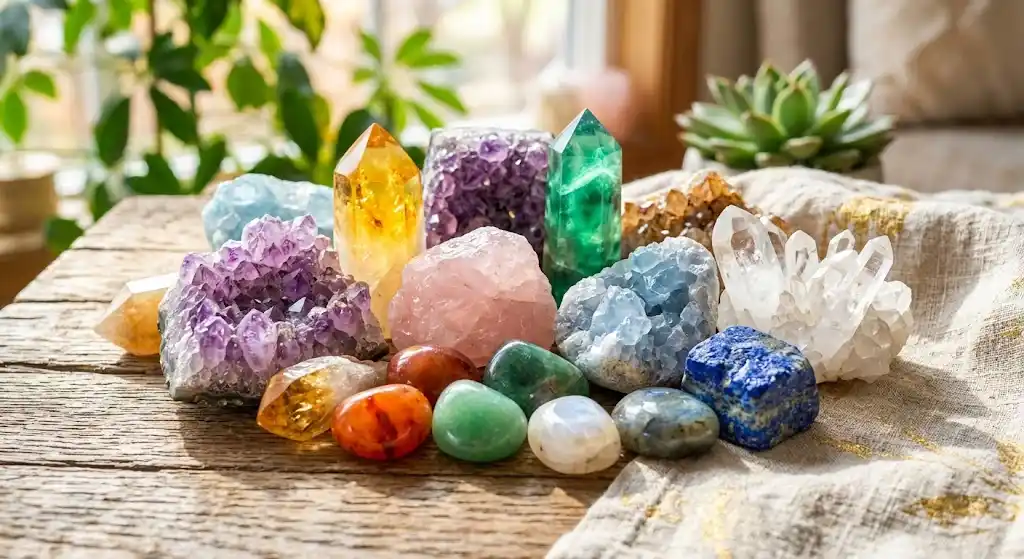
Best Crystals for Happiness: Top 10 Picks and Meanings
Crystals for happiness are traditionally selected for their bright colors and associations with optimism, playfulness, connection and renewed interest in everyday life. They cannot create continuous happiness or treat depression, but they may provide useful visual cues for habits that support enjoyment and meaning.
Sunstone and citrine represent warmth and optimism, while carnelian encourages active participation. Rose quartz brings connection and self-compassion, whereas moss agate highlights the quieter satisfaction found in gradual progress.
Top 10 Crystals for Happiness at a Glance
| Rank | Crystal | Traditional happiness association | Best symbolic use |
|---|---|---|---|
| 1 | Sunstone | Joy, warmth and independent confidence | Celebrating personal expression |
| 2 | Citrine | Optimism, possibility and constructive momentum | Recognizing opportunities |
| 3 | Carnelian | Vitality, creativity and social initiative | Participating rather than waiting |
| 4 | Orange calcite | Playfulness and renewed interest | Reintroducing enjoyable activities |
| 5 | Chrysoprase | Hope, renewal and emotional openness | Beginning again after disappointment |
| 6 | Peridot | Lightness, growth and release | Reducing comparison and resentment |
| 7 | Rose quartz | Compassion, affection and emotional softness | Connection and self-kindness |
| 8 | Yellow jasper | Steady optimism and confidence | Maintaining a sustainable positive routine |
| 9 | Clear quartz | Intention and awareness | Defining what happiness means personally |
| 10 | Moss agate | Patient growth and appreciation | Noticing quiet everyday satisfaction |
Happiness Is More Than Constant Positivity
Happiness can include pleasure, contentment, connection, curiosity, meaning and a sense that daily life contains something worth engaging with. Those experiences do not remain at the same intensity.
A healthy happiness practice leaves room for sadness, anger, boredom and disappointment. Difficult emotions provide information and do not automatically indicate that a person has failed to maintain positive energy.
Crystals may help define a small practice, but they should not be used to demand a particular mood. Someone can use sunstone as a reminder to seek one enjoyable activity while still acknowledging grief or stress.
1. Sunstone for Warmth and Personal Joy
Sunstone is traditionally associated with joy, vitality, independence and confident expression. Its sparkling aventurescence gives it one of the brightest appearances among popular happiness stones.
Use sunstone while identifying an activity that feels enjoyable because it reflects personal preference rather than external approval. That might involve music, movement, clothing, art or time outdoors.
Happiness becomes fragile when it depends entirely on praise. Therefore, sunstone’s strongest symbolic role involves recognizing what feels meaningful even when no audience is present.
Sunstone belongs to the feldspar group and can chip along cleavage planes. Protect jewelry and specimens from hard impacts.
2. Citrine for Constructive Optimism
Citrine is traditionally associated with optimism, abundance and confidence. Its warm yellow-to-orange color makes it a natural symbol of brightness.
Constructive optimism does not assume that every outcome will be favorable. Instead, it asks which possibility deserves a realistic attempt.
Use citrine when reviewing opportunities, planning something enjoyable or identifying what remains within personal control. Pair it with evidence and practical preparation.
The completed guide to crystals for good luck covers opportunity and favorable timing more directly. Here, citrine’s role centers on an optimistic approach to everyday engagement.
3. Carnelian for Active Enjoyment
Carnelian is traditionally connected with initiative, creativity and expressive energy. It suits situations in which happiness is being postponed until motivation appears spontaneously.
Choose one enjoyable activity with a low starting barrier. Play one song, sketch for ten minutes, cook something simple or contact a person whose company usually feels supportive.
Action does not guarantee enjoyment, but it creates an opportunity for it. Carnelian can mark the point at which planning ends and participation begins.
The guide to crystals for creativity examines inspiration and creative work more fully. Within a happiness practice, carnelian emphasizes the pleasure of doing rather than producing an impressive result.
4. Orange Calcite for Playfulness
Orange calcite is traditionally associated with enthusiasm, playfulness and emotional movement. Its bright color makes it especially suited to routines designed to reintroduce novelty.
Adults often treat play as unproductive, yet low-pressure exploration can provide rest, curiosity and social connection. Use orange calcite while choosing an activity with no requirement to perform well.
Try a new recipe, puzzle, craft, game or route through a familiar area. The purpose is to create interest rather than mastery.
Calcite is soft and reacts with acids. Keep it away from vinegar, citrus, harsh cleaners and prolonged water exposure.
5. Chrysoprase for Hope and Renewal
Chrysoprase is traditionally associated with hope, renewal and emotional openness. It suits happiness practices after disappointment, burnout or a period in which familiar activities no longer feel satisfying.
Renewal may involve returning to an old interest in a different form. It can also mean accepting that previous sources of happiness have changed.
Use chrysoprase while asking what might feel worth trying now, without demanding that it recreate the past.
Hope remains most useful when it permits uncertainty. A new routine can be explored without being declared the permanent answer.
6. Peridot for Lightness and Reduced Comparison
Peridot is traditionally associated with renewal, prosperity and the release of resentment or jealousy. Its bright yellow-green color creates a fresh visual character.
Comparison can make personal happiness dependent on another person having less. Peridot may serve as a reminder to identify what is genuinely wanted rather than copying an outcome that looks impressive from a distance.
Ask which part of another person’s success is actually appealing: autonomy, skill, recognition, security or time. That answer provides more useful direction than comparison alone.
Peridot is reasonably suitable for jewelry but requires care around impacts, acids and rapid temperature changes.
7. Rose Quartz for Connection and Self-Kindness
Rose quartz is traditionally associated with affection, compassion and emotional gentleness. Happiness often depends less on excitement than on feeling connected and accepted.
Use rose quartz as a reminder to express appreciation, ask for company or offer yourself a fair response after a difficult day.
Self-kindness should not become avoidance. A compassionate response may involve rest, but it can also require apologizing, seeking help or completing a necessary task.
The completed guide to crystals for gratitude focuses on recognizing value and support. This article keeps rose quartz centered on connection as one component of happiness.
8. Yellow Jasper for Steady Optimism
Yellow jasper carries traditional associations with confidence, protection and steady endurance. Compared with highly stimulating happiness stones, its symbolism feels more stable.
Use yellow jasper with routines that support contentment over time: eating regularly, maintaining a welcoming space, taking breaks or following through on social plans.
Happiness practices often fail when they demand a dramatic emotional result. Yellow jasper can represent small actions repeated without constant evaluation.
This stone may especially suit people who prefer an earthy, understated crystal rather than bright transparent material.
9. Clear Quartz for Defining Happiness
Clear quartz is widely used for intention-setting. It can help clarify what “being happier” means in observable terms.
Possible definitions include:
“I want more regular contact with supportive people.”
“I want one evening each week without work.”
“I want to return to an activity I stopped doing.”
“I want to notice when something feels satisfying instead of immediately moving to the next task.”
Clear quartz cannot create the outcome, but a precise intention makes practical action easier.
10. Moss Agate for Quiet Satisfaction
Moss agate is traditionally connected with nature, patience and gradual growth. It suits quieter forms of happiness that may be overlooked because they are not intense.
Use moss agate while noticing an ordinary improvement, familiar comfort or natural detail. Satisfaction may come from a task becoming easier, a plant growing or a routine feeling more stable.
This stone is especially useful when happiness has become associated only with novelty, achievement or public recognition.
A meaningful life can include excitement, but it also depends on the ability to recognize enoughness.
Choosing a Happiness Crystal by Intention
| Happiness intention | Recommended crystals | Grounded action |
|---|---|---|
| Increase enjoyable activity | Carnelian and orange calcite | Schedule one low-pressure activity |
| Develop optimism | Citrine and yellow jasper | Identify one realistic possibility |
| Reconnect socially | Rose quartz and sunstone | Contact a supportive person |
| Begin again after disappointment | Chrysoprase and moss agate | Try one new or revised routine |
| Reduce comparison | Peridot and clear quartz | Define the underlying personal need |
| Appreciate daily life | Moss agate and rose quartz | Record one specific satisfying moment |
| Express yourself | Sunstone and carnelian | Share or create without requiring praise |
| Clarify what happiness means | Clear quartz | Write an observable personal definition |
Happiness Versus Gratitude
Gratitude involves recognizing something valued or supportive. Happiness describes a broader emotional and life experience that may include pleasure, engagement, meaning and connection.
A person can feel grateful while sad, and a happy moment can occur without a formal gratitude practice.
The two intentions overlap, but they should not be treated as identical. Gratitude is one possible contributor to wellbeing rather than a demand to feel positive.
Happiness Versus Confidence
Confidence concerns trust in one’s ability to act, communicate or tolerate an outcome. Happiness concerns the experience of enjoyment, contentment or meaning.
Sunstone, citrine and carnelian appear in both categories because action and self-expression can support enjoyment. However, a person may act confidently without feeling happy, or feel content without seeking greater visibility.
The completed guide to crystals for confidence retains the performance, self-belief and assertiveness intent.
Happiness and Emotional Healing
Emotional healing may involve processing pain, recognizing patterns and developing more supportive responses. Happiness practices focus more specifically on enjoyment, connection and satisfying engagement.
The guide to crystals for emotional healing explores emotional honesty and gradual integration. It should be used when difficult experiences need direct attention rather than being balanced only with positive activities.
Both practices may coexist. However, happiness should never be used to bypass grief, trauma or unresolved harm.
A Simple Happiness Crystal Routine
Choose one crystal and one behavior. For example, carnelian may represent beginning an enjoyable activity, while rose quartz can mark a plan to contact a friend.
Write the activity in specific terms and decide when it will happen. “Do something fun” is less useful than “walk through the park for twenty minutes after lunch.”
Afterward, record whether the activity produced pleasure, calm, interest, connection or no noticeable change. The practice is an experiment, not a test of spiritual worth.
Continue what helps, revise what does not and avoid forcing an activity merely because it appears on a wellness list.
A Happiness Journal That Avoids Forced Positivity
A happiness journal can use four short prompts:
- What felt pleasant or satisfying?
- What contributed to that experience?
- What made enjoyment more difficult?
- What is one realistic action worth repeating?
This structure records both supportive and limiting factors. It avoids turning the journal into a list that denies difficulty.
Clear quartz or moss agate can remain near the journal as a consistent cue. One specific entry is enough.
Crystals for Social Happiness
Rose quartz, sunstone and carnelian support different aspects of social connection. Rose quartz symbolizes warmth, sunstone represents authentic presence and carnelian encourages initiative.
Invite someone to a specific activity rather than waiting for a spontaneous opportunity. Likewise, consider environments where repeated contact can develop naturally.
The completed guide to crystals for friendship focuses more deeply on trust, reciprocity and repairing platonic relationships. Here, connection remains one component of broader happiness.
Crystals for Creative Happiness
Creative activity can offer curiosity, expression and absorption even when the final product is not commercially useful.
Carnelian and orange calcite suit playful experimentation, while sunstone supports personal expression. Clear quartz can define a small project so that too many options do not prevent beginning.
Avoid turning every hobby into a performance metric. Enjoyment may decline when an activity becomes another obligation to optimize.
Creating a Happiness Crystal Set
A balanced three-stone set can include one stone for action, one for connection and one for steady appreciation.
Carnelian, rose quartz and moss agate form a versatile combination. Carnelian encourages participation, rose quartz represents care and moss agate highlights quiet growth.
For a brighter set, sunstone, citrine and chrysoprase support expression, optimism and renewal.
Assign each stone a distinct role. Overlapping descriptions make the practice difficult to remember.
Wearing Happiness Crystals
A pendant, bracelet or pocket stone can provide a portable reminder to participate in life rather than monitor mood continuously.
Choose secure jewelry suitable for the stone. Sunstone can cleave, calcite scratches easily and some metals or coatings may irritate the skin.
Remove jewelry around machinery, sports equipment and tasks where it could catch. Likewise, do not wear a piece solely because taking it off feels unlucky.
Placing Happiness Crystals at Home
Place each stone near the activity it represents. Carnelian can remain with art supplies, rose quartz near a journal or communication area and moss agate beside a plant.
Keep orange calcite away from kitchens and bathrooms where acids, water and cleaners may damage it. Heavy stones should rest on stable surfaces.
A crystal arrangement should support the room rather than add visual clutter. One intentional piece often creates a clearer cue than a crowded display.
Cleansing Happiness Crystals
Different minerals require different care. Quartz varieties are relatively durable, while calcite, sunstone and peridot have specific vulnerabilities.
The completed guide to cleansing crystals outlines symbolic methods. Sound, visualization and careful dry placement avoid many risks associated with soaking mixed collections.
A useful reset also involves reviewing the associated habit. Change the crystal’s intention when the original activity no longer supports wellbeing.
Happiness, Depression and Professional Care
Depression is not a lack of gratitude, insufficient positivity or failure to maintain high energy. It can involve persistent low mood, loss of interest, sleep changes, concentration difficulty and other symptoms requiring professional assessment.
Crystals cannot treat depression or replace therapy, medication or medical care. A person may still use a meaningful stone alongside appropriate treatment when it does not interfere with care.
Seek urgent help when someone may harm themselves, cannot meet basic needs or experiences severe deterioration.
Conclusion
The best crystals for happiness represent different paths toward enjoyment and meaning. Sunstone supports personal expression, citrine symbolizes constructive optimism and carnelian encourages active participation. Orange calcite adds playfulness, chrysoprase represents renewal and rose quartz emphasizes connection.
Happiness does not require constant positivity. A grounded crystal practice makes room for difficult emotions while creating realistic opportunities for pleasure, curiosity, support and quiet satisfaction.
Frequently Asked Questions
1. What is the best overall crystal for happiness?
Sunstone is one of the strongest traditional joy stones because it symbolizes warmth and authentic expression. Citrine may be better for optimism, while rose quartz suits connection.
2. Which crystal is best for joy and positivity?
Sunstone, citrine and orange calcite are popular choices. Their meanings are symbolic and should not be treated as guaranteed mood changes.
3. Can crystals make someone happy?
No. Crystals cannot create or maintain happiness. They may serve as reminders to engage in supportive activities and relationships.
4. Which crystal is suitable during sadness?
Rose quartz may symbolize self-compassion, while smoky or earthy stones may feel more grounding. Persistent or severe sadness requires appropriate support.
5. Is citrine or sunstone better for happiness?
Citrine emphasizes optimism and possibility, while sunstone focuses more on warmth, independence and self-expression.
6. Can happiness crystals help with depression?
Crystals cannot treat depression. They may be used as optional personal objects alongside professional assessment and evidence-based care.
7. Can I combine happiness crystals?
Yes. A balanced set might include carnelian for action, rose quartz for connection and moss agate for everyday appreciation.
8. Where should happiness crystals be placed?
Place them near the behavior they represent, such as art supplies, a journal or a social-planning area. Keep all specimens physically stable.
9. Can I sleep with a happiness crystal?
Use a secure bedside surface rather than placing loose stones in the bed. Stimulating colors or rituals should also be avoided when they interfere with sleep.
10. How often should happiness crystals be cleansed?
There is no scientific schedule. Clean the material physically when needed and reset its symbolic purpose when the associated habit changes.
11. Is gratitude the same as happiness?
No. Gratitude is recognition of value or support, while happiness may include pleasure, meaning, connection and contentment. They can occur independently.
12. What should I do if happiness practices make me feel worse?
Stop the exercise and avoid forcing positive statements. Persistent distress, loss of interest or hopelessness should be discussed with a qualified professional.
Disclaimer: Crystals are not treatments for depression, grief or another mental-health condition. Happiness practices should not suppress difficult emotions or replace therapy, medication, medical care or crisis support.