

Crystals for good luck are traditionally associated with opportunity, optimism, protection and the confidence to act when favorable circumstances appear. They cannot alter mathematical probability or guarantee a desired result, but they can become meaningful reminders to prepare carefully, notice opportunities and respond constructively.
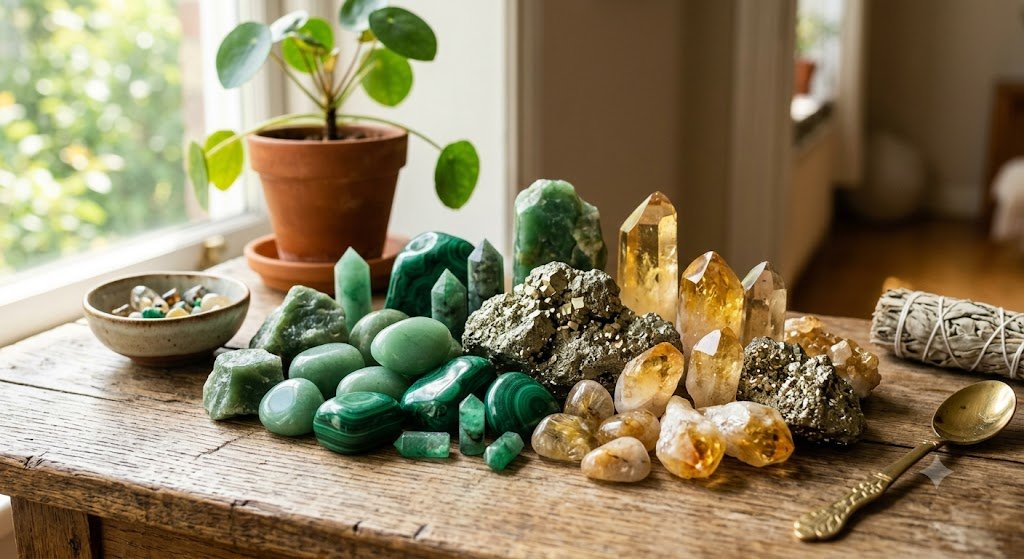
Green aventurine and jade have some of the strongest cultural associations with luck, while citrine and pyrite symbolize optimism and resourcefulness. Tiger’s eye adds discernment so that enthusiasm does not become unnecessary risk.
Top 10 Good-Luck Crystals at a Glance
| Rank | Crystal | Traditional luck association | Best symbolic use |
|---|---|---|---|
| 1 | Green aventurine | Opportunity and favorable change | New experiences and calculated chances |
| 2 | Jade | Fortune, harmony and long-term prosperity | Important milestones and steady growth |
| 3 | Citrine | Optimism, confidence and abundance | Launches and constructive opportunities |
| 4 | Tiger’s eye | Discernment and courageous decisions | Negotiations and risk assessment |
| 5 | Pyrite | Resourcefulness and material awareness | Business and financial review |
| 6 | Carnelian | Initiative and bold action | Interviews, presentations and beginnings |
| 7 | Sunstone | Independence, vitality and positive direction | Visibility and leadership |
| 8 | Moss agate | Patient growth and natural cycles | Long-term projects |
| 9 | Malachite | Transformation and pattern recognition | Deliberate change |
| 10 | Clear quartz | Intention and prioritization | Defining what a favorable outcome means |
What “Good Luck” Means in a Crystal Practice
Luck can refer to random chance, favorable timing, helpful relationships or the ability to recognize an opportunity. These are not the same process.
A crystal cannot change the odds of a lottery, game or medical outcome. However, carrying a stone before an interview may remind someone to arrive prepared, listen carefully and answer the question asked.
Similarly, a crystal placed near a planning area can reinforce habits that increase exposure to useful opportunities. Applying for suitable roles, maintaining professional relationships and developing skills do not guarantee success, but they create more realistic possibilities than waiting passively for fortune.
A grounded good-luck practice therefore connects symbolism with preparation and proportionate action.
1. Green Aventurine for Opportunity
Green aventurine is one of the most frequently recommended luck stones. It is traditionally associated with opportunity, growth and a willingness to engage with favorable change.
Its green color and subtle aventurescence have helped connect it with prosperity symbolism. Nevertheless, its most practical role involves becoming receptive to opportunities that require participation.
Use green aventurine before attending an event, submitting an application or trying an unfamiliar but reasonable activity. Then define the action that creates exposure to a possible benefit.
The broader guide to aventurine’s meaning and symbolism explains the quartz variety, its colors and its traditional associations.
Good fortune does not require saying yes to every possibility. A useful opportunity should still fit personal values, capacity and acceptable risk.
2. Jade for Long-Term Fortune and Harmony
Jade has strong historical associations with fortune, protection, status and harmony in several cultures, particularly across East Asia. However, “jade” can refer to jadeite or nephrite, which are distinct minerals with different market characteristics.
Within a personal luck practice, jade suits steady development rather than sudden windfalls. It may symbolize maintaining relationships, protecting resources and choosing decisions that remain beneficial over time.
A jade object can accompany a major transition such as beginning a job, moving home or establishing a long-term routine. Its symbolism is especially coherent when the goal involves stability rather than speculation.
Because dyed, polymer-impregnated and otherwise treated jade exists in the market, symbolic value should not be confused with material authenticity or price.
3. Citrine for Optimism and Constructive Momentum
Citrine is traditionally associated with abundance, confidence and positive energy. Its warm color makes it a popular good-luck stone for launches, interviews and creative opportunities.
Optimism becomes useful when it supports effort. Before an important event, identify what preparation is complete, what remains controllable and what outcome cannot be guaranteed.
Citrine can represent confidence in the process rather than certainty about the result. This distinction protects against interpreting disappointment as evidence that the crystal failed or that the person did not believe strongly enough.
Much commercial citrine consists of heat-treated amethyst. That treatment is accepted when disclosed, although natural origin, appearance and spiritual preference remain separate considerations.
4. Tiger’s Eye for Calculated Chances
Tiger’s eye is traditionally connected with courage, protection and discernment. It is one of the most balanced luck stones because it combines willingness to act with awareness of consequences.
Use tiger’s eye when an opportunity includes meaningful uncertainty. Write down the potential benefit, maximum acceptable loss and evidence needed before committing.
This approach is particularly useful in negotiations, travel planning, career changes and business decisions. A favorable opportunity should not require ignoring obvious warning signs.
Tiger’s eye does not guarantee a winning choice. Instead, its symbolism encourages courage that remains accountable to facts.
5. Pyrite for Resourcefulness
Pyrite is often associated with wealth because its metallic brass-yellow appearance resembles gold. Historically, that resemblance also earned it the name “fool’s gold.”
For good luck, pyrite is most constructive as a symbol of resourcefulness. Keep it near a budget, project plan or workspace used to evaluate practical opportunities.
Ask whether existing time, knowledge or materials can be used more effectively before seeking additional resources. Sometimes the favorable development comes from recognizing what is already available.
Pyrite contains iron sulfide and may oxidize in damp conditions. Keep specimens dry and avoid placing them in drinking water, bathrooms or outdoor locations exposed to moisture.
6. Carnelian for Taking the First Step
Carnelian is traditionally associated with initiative, courage and expressive confidence. It suits situations in which opportunity already exists but hesitation prevents action.
Carry carnelian before an interview, presentation, audition or networking event. Pair it with one observable behavior, such as introducing yourself, asking a prepared question or submitting the completed application.
Action should remain proportionate. Carnelian does not justify ignoring preparation or taking a risk that exceeds personal capacity.
Its useful message is straightforward: favorable circumstances cannot help when every meaningful step is postponed.
7. Sunstone for Visibility and Independent Direction
Sunstone carries traditional associations with warmth, leadership, independence and personal confidence. Its sparkling optical effect gives it a naturally bright appearance.
Sunstone may suit people seeking luck in situations that require visibility, such as presenting creative work, leading a meeting or applying for a public-facing position.
However, being noticed is not always the same as being valued. Use sunstone while clarifying what contribution, skill or message deserves attention.
The stone also supports the symbolic idea of defining success independently. A favorable outcome should reflect personal priorities rather than only external approval.
Sunstone has feldspar cleavage, so jewelry and specimens need protection from hard impacts.
8. Moss Agate for Patient Growth
Moss agate is traditionally connected with agriculture, gradual development and the rhythms of nature. It suits forms of luck that emerge through consistency rather than sudden change.
Use moss agate with long-term projects, skill development or relationships that need steady attention. Record small signs of progress instead of evaluating success only through dramatic milestones.
Many favorable outcomes appear accidental from the outside but rest on months or years of preparation. Moss agate provides a fitting symbol for that quieter process.
It may also appeal to people who feel pressured by intense abundance practices. Growth can remain meaningful without being immediate.
9. Malachite for Deliberate Change
Malachite is traditionally associated with transformation, protection and honest pattern recognition. Its bold green banding makes it visually compatible with prosperity and opportunity symbolism.
Malachite suits moments when a favorable outcome requires changing an established pattern. Ask which repeated behavior is limiting access to better circumstances.
The answer might involve avoiding feedback, remaining in an unsuitable arrangement or failing to communicate a necessary boundary.
Malachite contains copper and must never be ingested, placed in drinking water or used to make a crystal elixir. Broken, powdered or poorly polished pieces require especially careful handling.
10. Clear Quartz for Defining a Favorable Outcome
Clear quartz is traditionally used for intention-setting and symbolic amplification. It is helpful when “good luck” has not been defined clearly.
A vague intention such as “bring me luck” makes every result difficult to interpret. Instead, identify an outcome and the action that supports it.
For example:
“I want to meet two relevant professional contacts, so I will attend the event and begin three conversations.”
“I want a fair interview, so I will research the organization and prepare examples of my work.”
Clear quartz cannot control the outcome, yet it can keep attention on the part of the process that remains actionable.
Choosing a Good-Luck Crystal by Situation
| Situation | Suggested crystals | Practical preparation |
|---|---|---|
| Job interview | Carnelian and tiger’s eye | Research the role and prepare evidence-based examples |
| Business opportunity | Pyrite and citrine | Review costs, demand and downside risk |
| Starting a project | Green aventurine and clear quartz | Define the first milestone |
| Long-term growth | Moss agate and jade | Track consistent actions |
| Public presentation | Sunstone and carnelian | Rehearse the core message |
| Major transition | Jade and malachite | Identify what must change and what should remain stable |
| Negotiation | Tiger’s eye and pyrite | Set limits and understand the alternatives |
| Meeting new people | Green aventurine and sunstone | Enter environments where repeated contact is possible |
The crystal should match the behavior that creates a realistic opportunity. Selecting a stone only by color or popularity may result in a less coherent practice.
Good Luck Versus Money and Abundance
Luck, wealth and manifestation overlap in popular crystal content, but they should remain distinct.
A good-luck practice focuses on opportunity, timing and the readiness to respond. A money-focused practice would need to address income, budgeting, pricing and material resources more directly. Manifestation content, meanwhile, centers on intention and desired outcomes.
This article does not promise wealth or reproduce a complete financial ritual. Pyrite and citrine appear here because of their opportunity symbolism, not because they can generate money.
Entrepreneurs seeking a business-specific routine can use the completed guide to crystals for entrepreneurs, while broader professional development belongs to crystals for career and success.
Good-Luck Crystals for Confidence
An opportunity may be present even when someone feels uncertain about taking part. Carnelian, sunstone and tiger’s eye are traditionally associated with confident action.
Confidence should not require pretending fear is absent. Instead, prepare carefully, define the acceptable risk and act while uncertainty remains manageable.
The guide to crystals for confidence covers self-belief more fully. Within a luck practice, confidence serves the narrower purpose of responding to a realistic opportunity.
Good-Luck Crystals and Zodiac Traditions
Many zodiac birthstone systems describe certain gemstones as lucky for particular signs. However, these lists vary between historical sources, cultures and modern interpretations.
A person does not need to use a sign-specific stone. Green aventurine, jade, citrine and the other crystals in this guide can be selected according to intention rather than birth date.
The completed guide to zodiac birthstones explains the sign-based traditions without treating one correspondence system as universally authoritative.
Building a Three-Crystal Luck Set
A balanced set can include one opportunity stone, one action stone and one discernment stone.
Green aventurine, carnelian and tiger’s eye form a practical combination. Aventurine represents opportunity, carnelian encourages participation and tiger’s eye supports measured judgment.
For long-term development, jade, moss agate and clear quartz may be more suitable. Their combined symbolism emphasizes stability, patience and a clearly defined direction.
Avoid adding several stones that all carry an identical abundance intention. Distinct purposes create a more usable routine.
Carrying a Good-Luck Crystal
A smooth pocket stone or securely set pendant can act as a discreet reminder during an interview, trip or important meeting.
However, the object should not become a condition for functioning. Forgetting the crystal does not make an event unlucky or remove the value of preparation.
Jewelry should be removed around machinery, sports equipment or activities where it could catch. Fragile stones and loose specimens also need protection from falls.
Placing Good-Luck Crystals at Home or Work
Place a stone where its associated action occurs. Pyrite may stay near financial records, while clear quartz can sit beside a written priority. Moss agate may accompany a long-term project tracker.
Avoid unsafe placement above beds, chairs or frequently occupied workspaces. Heavy clusters and pointed specimens must rest on stable surfaces.
Malachite and pyrite should remain away from water, food-preparation surfaces and children who may handle or mouth objects.
Good-Luck Crystal Ritual
Choose one opportunity that deserves attention. Write the desired outcome, the available evidence and the next action within personal control.
Hold or observe the chosen crystal for a brief period, then complete the action. This may involve submitting an application, making a call, preparing documents or attending an event.
Afterward, evaluate the process rather than only the outcome. Record what worked, what needs improvement and whether another attempt is appropriate.
This structure prevents luck symbolism from becoming passive waiting.
Cleaning and Cleansing Good-Luck Crystals
Different minerals have different care requirements. Pyrite should remain dry, malachite must be protected from acids and prolonged moisture, and sunstone can chip along cleavage planes.
Symbolic cleansing can use sound, visualization or careful dry placement. Water, salt and sunlight are not universal methods.
Clean stones according to their material properties rather than assuming that a spiritually popular method is physically safe.
Conclusion
The best crystals for good luck represent readiness, opportunity and responsible action. Green aventurine symbolizes favorable change, jade reflects long-term fortune and citrine supports constructive optimism. Tiger’s eye adds discernment, pyrite emphasizes resourcefulness and carnelian encourages participation.
No stone can control chance or guarantee success. Its most useful role is to reinforce preparation, awareness and the willingness to take a proportionate step when an opportunity appears.
Frequently Asked Questions
1. What is the best overall crystal for good luck?
Green aventurine is the most widely recognized all-purpose luck stone. Tiger’s eye may be more suitable when the opportunity requires careful judgment.
2. Which crystal is traditionally associated with fortune?
Jade has strong historical associations with fortune, protection and harmony. Its symbolism often emphasizes long-term stability rather than sudden gain.
3. Can crystals change mathematical probability?
No. Crystals cannot alter the odds of a lottery, game, medical event or another chance-based outcome.
4. Which good-luck crystal is suitable for a job interview?
Carnelian supports symbolic courage and initiative, while tiger’s eye represents discernment. Preparation and relevant examples remain more important than the stone.
5. Which crystal is suitable for business luck?
Pyrite, citrine and tiger’s eye are popular business choices. They should be paired with accurate financial review, customer evidence and responsible decision-making.
6. Can I combine several luck crystals?
Yes. Choose stones with different roles, such as green aventurine for opportunity, carnelian for action and tiger’s eye for judgment.
7. Where should a good-luck crystal be placed?
Keep it near the action it represents, such as a project planner, application folder or financial review area. Ensure that the placement is physically stable.
8. Can I carry a luck crystal every day?
Yes, provided it is comfortable and securely stored. However, forgetting the crystal does not create bad luck.
9. Is pyrite safe to keep at home?
Pyrite can be displayed safely when kept dry and secure. It should not be placed in water, humid areas or drinking vessels.
10. Can malachite be used in luck water?
No. Malachite contains copper and should never be placed in drinking water or used to make a crystal elixir.
11. Do zodiac signs need different luck crystals?
Astrological systems suggest different correspondences, but anyone may choose a crystal according to personal intention, preference and practical use.
12. Can a crystal guarantee success?
No. Success depends on preparation, circumstances, other people’s decisions and many external factors. A crystal can only serve as an optional symbolic reminder.
Disclaimer: Crystal luck associations are spiritual and cultural traditions, not scientifically proven methods for changing probability or guaranteeing financial, professional, medical or personal outcomes. Never use crystals as a gambling strategy or substitute for qualified financial, legal, medical or business advice.