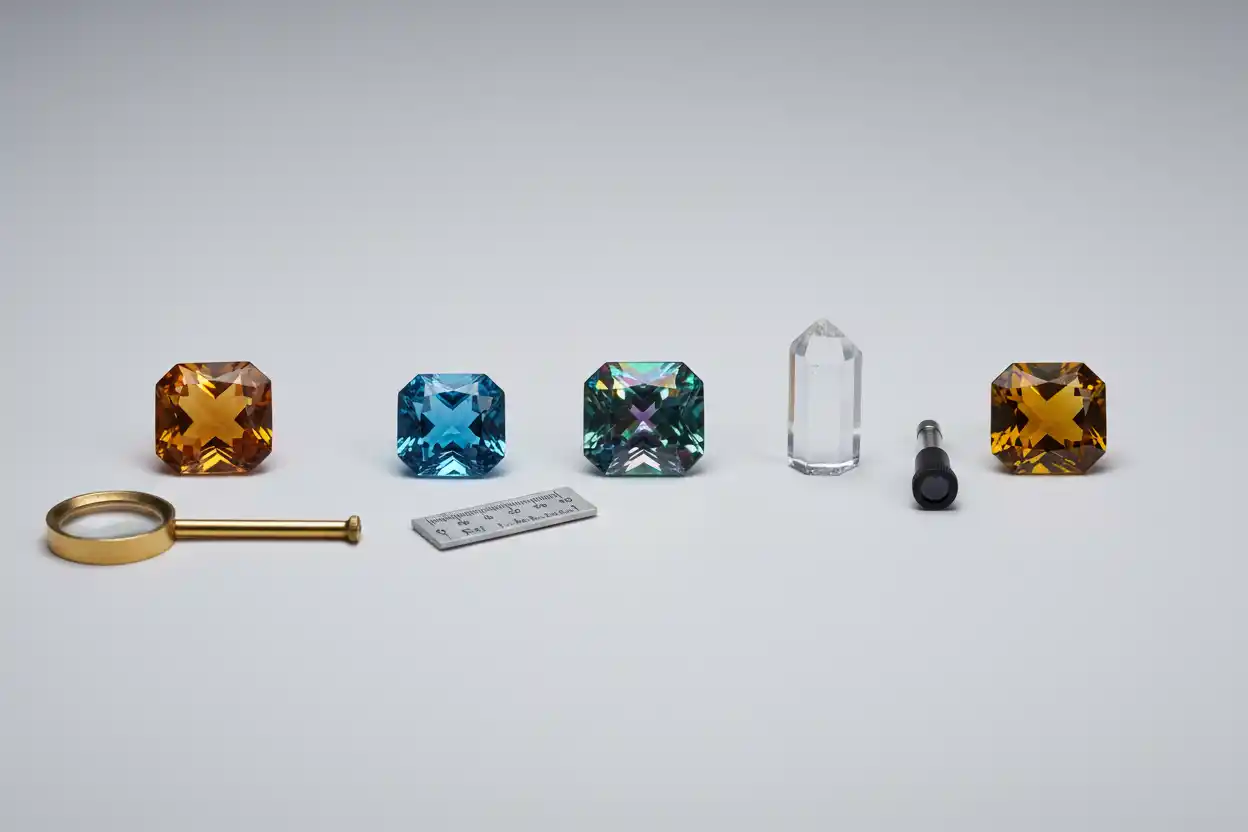
How to Spot Treated or Synthetic Topaz
Most blue Topaz in modern jewelry has been treated. Colorless natural Topaz is exposed to radiation and then heated to create the pale, bright or dark blue colors sold under trade descriptions such as Sky Blue, Swiss Blue and London Blue.
That routine treatment differs from a surface coating, which creates the rainbow appearance of Mystic Topaz or other artificial colors. It also differs from synthetic Topaz, which has essentially the same composition and crystal structure as natural Topaz but was grown in a laboratory.
True laboratory-grown Topaz has been produced, primarily for research, but it is uncommon in ordinary jewelry because large natural Topaz crystals are already abundant. Glass, cubic zirconia, synthetic Corundum and coated stones are more realistic identification concerns.
Treated Topaz at a Glance
| Material or process | What it means | Main identification issue |
|---|---|---|
| Natural untreated Topaz | Mined Topaz without intentional enhancement | Natural color may still be pale or unstable |
| Irradiated and heated Topaz | Radiation creates color centers; heat develops or adjusts blue | Usually impossible to confirm reliably at home |
| Coated Topaz | Thin artificial film creates or strengthens color | Wear appears along facet junctions and exposed edges |
| Mystic Topaz | Colorless Topaz with an iridescent surface coating | Rainbow effect can scratch or polish away |
| Heated natural Topaz | Heat alters an existing color center | Treatment may leave few visible clues |
| Hydrothermal synthetic Topaz | Laboratory-grown Topaz with corresponding mineral structure | Uncommon commercially; requires laboratory separation |
| Topaz imitation | Glass, cubic zirconia or another material made to resemble Topaz | Physical and optical properties differ |
| Assembled stone | Two or more materials joined together | Joining plane, glue or mismatched optical properties |
What Is Natural Topaz?
Topaz is an aluminum fluorosilicate mineral with a Mohs hardness of 8 and strong basal cleavage.
Pure Topaz is colorless. Structural defects and trace elements can create yellow, brown, orange, pink, red, violet, blue and pale green appearances.
Colorless material is naturally abundant and can occur in large, clean crystals. Consequently, it provides an inexpensive starting material for blue-color treatment and surface coating.
The completed Topaz meaning guide owns the mineral’s geology, formation and general symbolism. This page concentrates on treatments, synthetic growth, imitations and disclosure.
Treated, Synthetic and Imitation Topaz
A treated Topaz began as a naturally mined stone and was altered after recovery.
A synthetic Topaz was grown by people but has essentially the same composition and crystal structure as its natural counterpart.
An imitation is a different material selected or manufactured to resemble Topaz. Blue glass, cubic zirconia and synthetic Sapphire may imitate blue Topaz without being Topaz.
These terms should not be used interchangeably. A treated blue gem remains natural Topaz, whereas a blue glass stone is neither natural nor synthetic Topaz.
The completed lab-grown versus natural gemstones guide explains this distinction across other gem families.
Irradiated Blue Topaz
Most blue Topaz begins as colorless or very pale natural material.
Radiation changes defects within the crystal lattice and creates color centers. Heat may then adjust or stabilize the resulting color.
Different irradiation methods and processing sequences can produce pale, bright or dark blues. Commercial labels describe the appearance but do not provide a standardized treatment history.
Sky Blue generally refers to a pale, open blue. Swiss Blue usually describes a brighter cyan or electric blue, while London Blue is darker and may contain gray or green modifiers.
The completed London Blue Topaz guide provides the variety-specific identity and buying context.
Can Irradiation Be Detected at Home?
Routine blue-color treatment normally cannot be confirmed through appearance alone.
A well-treated Topaz can look evenly colored, transparent and completely natural under magnification. Natural blue Topaz also exists, although it is much less common than treated material.
Color intensity is not proof. Pale blue stones can be treated, while naturally blue stones can sometimes show attractive saturation.
A home hardness test, magnet test or visual comparison cannot establish irradiation history.
The practical assumption is that ordinary commercial Blue Topaz has been irradiated and heated unless reliable documentation states otherwise.
Is Irradiated Topaz Radioactive?
Irradiation does not mean that a properly processed gemstone remains dangerously radioactive.
Some irradiation methods can temporarily create radioactive isotopes. Regulations therefore require affected stones to remain in controlled storage until activity declines to acceptable levels and testing confirms that they can be released.
A legally distributed Blue Topaz from a reputable supply chain is considered suitable for ordinary jewelry wear.
A buyer does not need to avoid all irradiated Topaz. The relevant concerns are legal processing, accurate disclosure and responsible sourcing rather than fear created by the word “radiation.”
Heat Treatment
Heat is used with irradiation to develop or adjust blue color.
Heating may also affect some yellow, brown, orange or pink Topaz material, depending on its original color centers and composition.
A routine heating process may leave no obvious melted inclusions or dramatic internal changes. Consequently, magnification alone cannot always reveal it.
Treatment-related color can be stable during normal wear, although high repair temperatures and sudden thermal changes remain unsafe because Topaz has strong cleavage.
The completed Topaz buying guide explains how treatment should be considered with color, clarity, cut and price.
Mystic Topaz
Mystic Topaz is natural Topaz whose rainbow appearance comes from a thin artificial film.
The underlying stone is commonly colorless. A microscopic coating deposited on the surface creates purple, green, blue, gold and pink reflections.
The effect can be attractive, but it is less durable than Topaz itself. Abrasive cleaning, polishing wheels, scratches and careless repair can remove or damage the film.
Mystic Topaz should therefore be described as coated natural Topaz rather than a naturally rainbow-colored variety.
Other Coated Topaz
Coatings are not limited to the familiar Mystic rainbow effect.
Thin metallic-oxide or color-producing films can make colorless Topaz appear blue, green, pink or another commercial shade.
Some blue-to-green coated stones have been marketed as alternatives to irradiated Blue Topaz.
A surface-created color may be visible mainly on the pavilion or concentrated around particular facets. The face-up result can still look evenly colored because light reflects through the coated surface.
Written disclosure is essential because coating durability and value differ from color produced throughout the crystal.
How to Recognize a Surface Coating
Worn facet junctions are one of the most useful clues.
A coated stone may show pale, colorless or differently colored lines where raised facet edges have rubbed against metal or another gemstone.
Chips and scratches can expose a colorless layer beneath the film. Under magnification, the coating may also appear uneven, iridescent or concentrated near facet boundaries.
A surface film can sometimes collect around the girdle or setting contact points.
None of these observations should be created deliberately. Scratching the gemstone to check its color would damage the object and destroy evidence.
Coating Damage in Mounted Jewelry
The pavilion coating can be damaged when a jeweler tightens prongs, resets the stone or polishes the surrounding metal.
A previously vivid gem may develop pale contact marks where the setting touches it.
Cleaning compounds can also abrade exposed coated areas. Ultrasonic vibration is unnecessary, particularly when the treatment history remains uncertain.
Before repair, tell the jeweler that the stone may be coated. A professional can protect or remove the gem rather than treating it like an uncoated natural Topaz.
The completed Topaz ring guide provides setting-specific considerations.
Pink, Red and Imperial-Color Topaz
Fine natural pink, red and reddish-orange Topaz can be rare and valuable.
Some commercial pink or unusual colors may result from coating or treatment. Therefore, a vivid appearance should not be assumed to be natural solely because the seller uses terms such as rose, precious or Imperial.
Imperial Topaz commonly refers to prized warm yellow-orange, orange, peach, pinkish-orange or reddish material, although definitions vary.
The exact hue, natural color status and treatment should be documented when they support a substantial price.
The completed Topaz price guide owns the detailed market-value discussion.
Yellow and Brown Topaz
Natural Topaz can be yellow, golden, brownish-yellow or brown.
Some brown material may lose or change color after prolonged light exposure. Others may be treated to produce different appearances.
Yellow Topaz is frequently confused with Citrine, although the two belong to different mineral species.
The completed Citrine versus Yellow Topaz guide explains their gemological separation. The Yellow Topaz guide owns the variety-specific profile.
A natural-looking golden color alone cannot establish treatment history.
White Topaz
White Topaz is transparent colorless Topaz.
It may be sold as an affordable Diamond alternative, although it differs in brilliance, dispersion, toughness and long-term market value.
White Topaz can also serve as the starting material for irradiation or coating.
A colorless gem is not necessarily untreated simply because no visible color remains. It may have been recut, coated and stripped, or assembled with another material.
Identification should focus first on what the gemstone is, then on whether any treatment is present.
Does Synthetic Topaz Exist?
Yes. Laboratory-grown Topaz has been produced through hydrothermal methods.
Research material has been grown by dissolving natural Topaz and Quartz-related feed material in fluoride-bearing fluids under controlled temperature and pressure.
The resulting crystals can share natural Topaz’s essential structure and properties.
However, synthetic Topaz remains uncommon in mainstream jewelry. Natural colorless Topaz is readily available in large sizes, leaving little economic incentive to manufacture large quantities of laboratory-grown material.
A seller claiming “lab-created Topaz” should provide the exact material identity and supporting documentation.
Why Synthetic Topaz Is Uncommon
Laboratory growth is most commercially useful when the natural counterpart is rare, expensive or difficult to obtain in clean sizes.
Topaz does not usually meet that condition. Large natural colorless crystals are abundant, and treatment can create widely desired blue colors at relatively low cost.
Hydrothermal growth also requires specialized equipment, time and controlled chemistry.
For these reasons, imitation glass and cubic zirconia are more common than true synthetic Topaz in inexpensive jewelry.
A suspicious stone should not automatically be called synthetic. It may be treated natural Topaz or a completely different material.
Glass Imitations
Glass can be manufactured in almost any Topaz color.
Possible clues include spherical gas bubbles, curved flow lines, mold marks and rounded facet junctions.
Glass is generally softer and less dense than Topaz, although these differences should not be tested by scratching jewelry.
Coated glass can imitate Mystic Topaz and may show a vivid surface effect.
The completed glass-versus-crystal guide provides the broader identification boundary.
Cubic Zirconia
Cubic zirconia can imitate colorless, blue and pink Topaz.
It is singly refractive and denser than Topaz. Well-cut cubic zirconia may also display stronger fire.
Abraded facet junctions, rounded edges and a different brilliance pattern can provide clues, but visual appearance is not conclusive.
A loose stone can be separated through refractive-index, density and optical testing.
Cubic zirconia is a manufactured imitation rather than synthetic Topaz.
Synthetic Sapphire and Corundum Imitations
Synthetic Sapphire can be manufactured in blue, pink, yellow and colorless forms.
It is harder than Topaz and has different refractive properties, birefringence and specific gravity.
Flame-fusion curved growth lines or gas bubbles may appear in some synthetic Corundum, although advanced growth methods can show different features.
A stone sold as Topaz should not be identified from color alone.
The completed real-versus-fake Topaz guide owns the wider natural-versus-imitation workflow.
Quartz and Citrine Imitations
Quartz can resemble pale, colorless, yellow or brown Topaz.
Its hardness is lower, and its refractive index and density differ. Nevertheless, destructive scratch testing is not appropriate.
Citrine is especially likely to be mislabeled as Yellow Topaz through old-fashioned names such as “smoky topaz” or “Madeira topaz.”
These are misleading trade usages rather than genuine Topaz varieties.
The completed types-of-Topaz guide separates accepted varieties from confusing commercial names.
Assembled and Composite Stones
A doublet or triplet combines two or more layers.
One layer may provide the visible color, while another adds weight, durability or a valuable-looking optical effect.
A joining plane can sometimes be seen around the girdle or through the pavilion. Glue bubbles, color concentration and mismatched luster may also appear.
Mounted stones can conceal the join.
Raman spectroscopy or careful immersion examination may be required when a composite is expertly assembled.
What a Loupe Can Reveal
A loupe is useful for detecting coatings, assembled joins, gas bubbles, surface wear and filler-like material.
Natural Topaz may contain crystals, liquid inclusions, healed fractures and growth features, although many treated Blue Topaz stones are extremely clean.
The absence of inclusions does not prove synthetic origin. Large clean natural Topaz is common.
Likewise, a natural inclusion does not prove that the stone is untreated. Irradiation and heating do not necessarily remove original inclusions.
Magnification should be one part of a broader identification process.
Refractive Index and Birefringence
Topaz has a characteristic refractive-index range and measurable birefringence.
A refractometer can separate it from glass, cubic zirconia, synthetic Spinel and many other substitutes.
Mounted stones, poor polish and coated surfaces can complicate readings.
Optical tests identify the gem material more reliably than they reveal irradiation history.
A stone can test as Topaz while still being irradiated, heated or coated.
Specific Gravity
Topaz has a relatively high specific gravity compared with Quartz and many glasses.
Hydrostatic weighing can support identification of a loose gem.
Settings, cavities and assembled construction may distort the result.
Specific gravity does not reveal whether a natural Topaz was irradiated or heated.
The measurement should therefore answer the material-identification question before treatment analysis begins.
Spectroscopy and Surface Analysis
Ultraviolet-visible spectroscopy can help researchers study color centers.
Raman spectroscopy confirms mineral identity and can separate Topaz from many imitations.
X-ray photoelectron spectroscopy, fluorescence analysis and other advanced methods may characterize surface coatings.
A laboratory can also examine whether a color-producing layer contains metallic compounds not expected throughout the natural crystal.
The completed how-to-identify-crystals guide explains why professional methods are safer than destructive home experiments.
Laboratory Reports
A colored-stone report can identify the gem as natural or laboratory grown and state detectable treatments.
Routine irradiation may be assumed or reported according to the laboratory’s policy and available evidence.
A report is particularly useful for rare pink, red, Imperial-color or purportedly untreated blue material.
Seller-created grades such as AAA or premium do not replace laboratory identification.
Ask whether the report covers the exact stone being purchased rather than a representative sample.
Buying Treated Topaz
Assume ordinary Blue Topaz has been irradiated and heated.
Ask whether a rainbow, green, pink or unusually vivid appearance comes from a coating.
The invoice should identify Mystic Topaz as coated rather than implying natural rainbow color.
A seller claiming laboratory-grown Topaz should state the growth method and provide a recognized report.
Price should reflect treatment, rarity, cut and craftsmanship rather than color intensity alone.
The planned Topaz color-meaning guide remains separate from treatment and identification intent.
Jewelry-Specific Considerations
A Topaz bracelet exposes coated or cleavage-prone stones to regular desk contact.
Topaz earrings offer a safer position for large or coated material.
A Topaz necklace can display a substantial gemstone with relatively low abrasion.
Coated Topaz rings need the greatest care because the surface and cleavage-sensitive stone encounter repeated impact.
Treatment history should be shared with the jeweler before resizing, resetting or polishing.
Cleaning Treated Topaz
Use warm water, mild soap and a soft brush.
Avoid steam, ultrasonic equipment, abrasive powders and polishing compounds.
High heat and sudden temperature changes can cause cleavage-related damage.
A coated gem should never be buffed as though the color extends throughout the crystal.
The completed guide to cleaning Topaz jewelry provides the full care process.
Storage
Store each Topaz separately in a padded compartment.
Diamond and Sapphire can scratch it, while Topaz can scratch Quartz, feldspar and softer materials.
Coated surfaces should not rub against metal edges or neighboring gems.
Keep treated pieces away from direct heat and repair tools unless a qualified jeweler has examined them.
Topaz appears in the crystals beginning with T and gemstones beginning with T directories.
Final Perspective
Most treated Topaz is not deceptive. Irradiated Blue Topaz and coated Mystic Topaz are established commercial products when their treatment is disclosed clearly.
The important distinction is between natural treated Topaz, uncommon true synthetic Topaz and unrelated imitations. A home inspection can identify obvious coatings, bubbles and assembled layers, but it cannot reliably prove routine irradiation.
When natural color, untreated status or laboratory growth affects the price, obtain a professional report rather than using scratch, heat or chemical tests.
Frequently Asked Questions
1. Is most Blue Topaz treated?
Yes. Most commercial Blue Topaz is produced by irradiating and heating colorless natural Topaz.
2. Does irradiation make Topaz synthetic?
No. Irradiated Topaz remains a natural gemstone that was treated after mining.
3. Is irradiated Blue Topaz safe to wear?
Properly processed, tested and legally released irradiated Topaz is considered safe for ordinary jewelry wear.
4. Can irradiation be detected at home?
Not reliably. Routine Blue Topaz treatment may leave no visible feature that proves irradiation.
5. What is Mystic Topaz?
It is natural Topaz with a thin artificial surface coating that creates a rainbow effect.
6. How can coated Topaz be recognized?
Possible clues include pale worn facet junctions, chipped color layers, uneven films and color concentrated near the surface.
7. Does synthetic Topaz exist?
Yes. Hydrothermal synthetic Topaz has been produced, but it is uncommon in ordinary jewelry.
8. Why is laboratory-grown Topaz uncommon?
Large natural colorless Topaz is already abundant and inexpensive, reducing the commercial benefit of growing it in a laboratory.
9. Is cubic zirconia synthetic Topaz?
No. Cubic zirconia is a different manufactured material used as an imitation.
10. Can a loupe prove Topaz is untreated?
No. A loupe may reveal coatings or imitations, but irradiation and heating can be difficult or impossible to confirm visually.
11. Does treated Topaz need special care?
Coated material requires especially gentle care. All Topaz should be protected from impact, high heat and sudden temperature changes.
12. When is a laboratory report worthwhile?
A report is useful for rare natural-color, purportedly untreated, unusually expensive or claimed laboratory-grown Topaz.