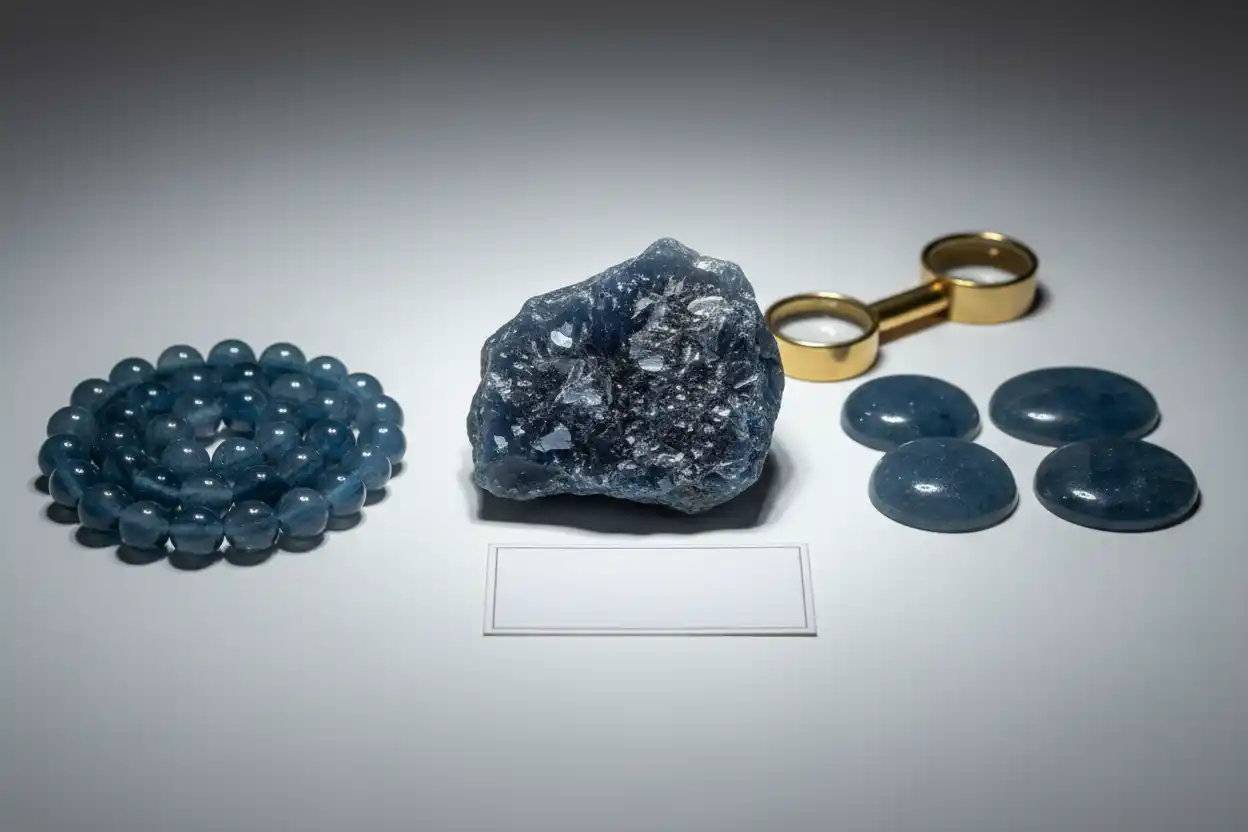
Where to Buy Real Blue Aventurine and Avoid Fakes
Blue aventurine is harder to buy confidently than the familiar green variety because the retail name is not applied consistently. Some sellers use it for genuine blue-toned aventurine quartz with reflective inclusions, while others apply it to blue quartzite, dumortierite-bearing quartz, dyed quartz, sodalite, glass or resin.
A dark blue color alone does not make a stone aventurine. Genuine material should belong to the quartz-rich aventurine family and display some form of aventurescence: light reflecting from small inclusions or internal planes as the stone moves. The effect may be subtle, especially in opaque material, but a completely featureless blue stone deserves closer investigation.
The blue aventurine meaning and properties guide covers the material’s identity and traditional symbolism. This page stays focused on sellers, treatment disclosure, authenticity, product quality and the limits of identifying blue aventurine from photographs.
Understand the Name Before Shopping
Aventurine is a commercial and mineralogical variety name applied to quartz-rich material with reflective inclusions. Green aventurine commonly contains mica that creates visible sparkle, while red and brown varieties may obtain their effect from iron-rich inclusions.
Blue material presents a more complicated market. Different deposits can contain different inclusion minerals, and some products sold as blue aventurine show only weak aventurescence. Consequently, a seller should explain why the material qualifies as aventurine rather than relying on color alone.
The broader aventurine guide explains the family, while the types of aventurine overview separates the major commercial colors. The completed general aventurine buying guide covers all-color purchases; this page owns the blue variety’s narrower naming and imitation risks.
Choose the Product Form First
The right seller depends partly on what you intend to buy.
| Blue aventurine product | Best source | Main concern |
|---|---|---|
| Natural rough | Mineral dealer or lapidary supplier | Weak naming evidence, hidden fractures and temporary oil enhancement |
| Slabs | Lapidary supplier | Low cutting yield, resin impregnation and uneven inclusion distribution |
| Cabochons | Gem dealer or independent lapidary | Dyed quartz, weak aventurescence and backing |
| Beads | Established bead supplier | Glass, dyed material, resin and inconsistent drill holes |
| Tumbled stones | Reputable crystal retailer | Sodalite or generic blue quartz substituted for aventurine |
| Spheres and carvings | Lapidary retailer | Composite construction, coating and concealed filler |
| Jewelry | Jeweler who discloses the material and treatment | Incorrect naming, adhesive settings and weak polish |
| Collector samples | Mineral dealer with locality information | Unsupported inclusion and origin claims |
Collectors should prioritize mineral identity and locality. Jewelry buyers should pay greater attention to structural condition, finish and treatment.
Where to Buy Genuine Blue Aventurine
Specialist lapidary suppliers
A lapidary supplier is often the best source for rough, slabs and calibrated cabochons. Experienced cutters understand whether the material produces a visible effect after polishing and whether its structure contains fractures or soft inclusion-rich areas.
A good listing shows the stone dry and under directional light. Wet photographs can reveal potential color, but they also conceal scratches and exaggerate saturation. Ask for matching dry images from the same angle.
The supplier should state whether the material is natural blue aventurine, quartzite with blue inclusions, dumortierite-bearing quartz or another commercial product. A cautious description is more useful than a confident name with no explanation.
Mineral and gem shows
Shows allow direct comparison with other blue stones. Rotate the material beneath a focused light and look for irregular reflective particles or internal planes that become brighter at different angles.
Bring a loupe, but do not perform scratch tests on merchandise. Instead, inspect the polish, drill holes, fractures and texture. The crystal identification guide explains how several observations should work together.
Established online gemstone shops
An online seller should provide exact-item photographs or clearly explain batch selection. Since inclusion patterns vary, one exceptional sample should not represent every tumble or bead in stock.
Request a moving-light video rather than a spinning platform under diffuse studio illumination. A single directional lamp makes genuine internal reflections easier to distinguish from surface glare.
The online gemstone buying guide covers seller identity, protected payment methods and return rights.
Bead suppliers
A reputable bead supplier should specify bead diameter, hole size, strand length, treatment and whether the product is natural stone or manufactured glass. It should also explain whether the photographs show the exact strand.
Blue aventurine beads often vary in tone and inclusion density. Moderate variation supports natural material, although variation alone does not prove authenticity.
Jewelry makers
Independent lapidaries and jewelry makers can be strong sources when they document the rough and cutting process. Ask whether the cabochon is solid, backed or resin-treated and whether the setting uses adhesive.
For earrings or matched pieces, expect visual harmony rather than identical internal patterns. Natural material rarely produces perfectly duplicated sparkle.
What Real Blue Aventurine Should Look Like
Genuine blue aventurine is generally opaque to translucent and may range from pale gray-blue to medium blue or dark navy. Its surface can appear granular or quartz-like rather than uniformly glassy.
Aventurescence may appear as fine silver, gray, white or darker reflective points. Depending on orientation, the effect can look stronger from one direction than another. Some stones show scattered sparkle, while others display broad reflective areas.
Natural inclusions should not look like evenly distributed craft glitter. Their size, shape, spacing and brightness normally vary. Under magnification, reflective particles may cross below the surface rather than resting in a coating.
Color can also vary across the piece. Pale zones, white quartz areas and inclusion-rich streaks are possible. However, vivid color concentrated around cracks or drill holes can indicate dye.
Blue Aventurine Versus Dumortierite-Bearing Quartz
Dumortierite is a blue aluminum-borosilicate mineral that can occur as inclusions within quartz. Such material may be sold as dumortierite quartz, blue quartz or, more loosely, blue aventurine.
The two commercial terms can overlap when reflective inclusions accompany the blue color. Nevertheless, not every dumortierite-bearing quartz displays aventurescence, and not every blue aventurine owes its color to dumortierite.
Ask the seller which feature justifies the aventurine name. If the answer is simply “because it is blue quartz,” the listing lacks an essential identification step.
Laboratory testing may identify quartz and inclusion phases, although a retail seller may reasonably describe inexpensive material according to established supplier provenance. The language should reflect that level of certainty.
Blue Aventurine Versus Sodalite
Sodalite is a different mineral that often appears blue with white or gray veining. Polished sodalite usually lacks the platy internal shimmer expected from aventurine.
However, dark opaque pieces can look similar in photographs. Sodalite may show patchy white calcite-rich areas, whereas blue aventurine more often has a quartz-rich granular appearance.
Color alone cannot separate them. A gemologist can use refractive index, specific gravity, microscopy and spectroscopy when the distinction matters.
Blue Aventurine Versus Lapis Lazuli
Lapis lazuli is a multi-mineral rock whose blue color primarily relates to lazurite. It may also contain pale calcite and metallic pyrite.
Blue aventurine should not display the characteristic golden pyrite flecks associated with many lapis pieces, although not every lapis specimen contains obvious pyrite. Aventurine’s reflective inclusions also behave differently from metallic pyrite grains.
Poorly informed sellers sometimes call any blue stone with sparkle “blue aventurine.” Therefore, ask for the mineral identity rather than accepting a color-based label.
Blue Aventurine Versus Blue Goldstone
Goldstone is manufactured glass containing abundant reflective crystals. Blue goldstone commonly has a dark blue glass body with dense, highly uniform sparkle.
Natural blue aventurine usually shows less regular inclusion placement and a more granular or cloudy body. Goldstone can display round gas bubbles, flow lines and consistently bright glitter throughout the piece.
Blue goldstone is a legitimate decorative material when sold honestly. The problem arises when a seller describes it as natural aventurine quartz.
Blue Aventurine Versus Dyed Quartz
Pale quartzite or quartz can absorb blue dye, particularly along fractures, pores and grain boundaries. A dyed product may still be natural stone, but it is not naturally colored blue aventurine unless it also meets the material definition and the treatment is disclosed.
Inspect drill holes and chipped edges. Stronger blue around those areas can reveal dye concentration. Nevertheless, some coatings mask the pattern, so visual inspection is not always conclusive.
The gemstone treatment guide explains why a stone can be natural in origin yet still significantly enhanced.
Blue Aventurine Versus Jade
Blue aventurine is not jade. The term jade refers to jadeite or nephrite, whereas aventurine is quartz-rich.
The planned aventurine versus jade comparison owns the detailed identification boundary. Buyers should be especially cautious when a listing uses vague names such as “blue jade aventurine” without specifying the actual mineral.
Common Fake and Misrepresented Products
Manufactured glass
Glass may imitate blue aventurine through metallic particles, clouding agents or colored inclusions. Mold seams, repeated shapes, round bubbles and uniform internal glitter support manufacture.
Resin with stone powder
Resin can contain crushed quartz, pigment and glitter. Such products may feel lighter and scratch more easily, but hand feel alone does not prove composition.
Dyed quartzite
Dyed quartzite can retain a convincing natural grain. Look for blue concentration in fractures and ask for written treatment disclosure.
Sodalite or generic blue stone
A wholesaler may supply mixed blue material under one marketing label. Sellers who purchase by color rather than mineral species can unknowingly repeat the error.
Polymer-impregnated aventurine
Natural aventurine can be treated with polymer to strengthen fractures or improve appearance. Such material still contains natural quartz, although the treatment must be stated because it changes value and care.
Surface-coated material
A blue or iridescent coating can deepen color and create artificial shine. Check around scratches, edges and drill holes for changes in surface appearance.
The fake-crystal buying guide provides a wider method for evaluating glass, resin, dye and misleading labels.
How to Evaluate Rough and Slabs
Begin with the dry surface. Strong blue color should not disappear when the stone dries after handling. Ask whether oil, wax or water was used for photography.
Next, inspect the edges. Inclusions and blue coloration should continue into the material rather than forming only a thin outer layer. A cut edge can also reveal whether the rough contains enough solid material for cabochons.
Fractures reduce usable yield. Some inclusion-rich zones may undercut during polishing, so ask whether the seller has test-cut stones from the same batch.
Finally, request the country or deposit when known. Origin supports identification but does not replace it.
How to Judge Cabochons
A quality cabochon should show its best reflective effect face-up. If the shimmer appears only from an extreme side angle, the cutter may have oriented the stone poorly.
The dome should have an even polish without flat spots, deep pits or thick surface coating. Examine the girdle for chips and inspect the back for resin, dark backing or color concentration.
Aventurescence should move or change as the cabochon rotates. A fixed white patch may be surface glare rather than an internal effect.
Buying Beads and Bracelets
Beads should have smooth, centered holes without radiating fractures. Because quartz is comparatively hard, chipped holes often indicate careless drilling or pre-existing cracks rather than ordinary softness.
Expect variation across a natural strand. One bead may show strong sparkle, while another displays more body color. Perfectly identical glitter patterns would be unusual.
Ask whether the strand contains only blue aventurine or whether similar blue stones have been mixed for color consistency. Sellers should disclose mixed-material strands.
Buying Spheres, Towers and Carvings
A large polished object should show the complete distribution of blue color and reflective inclusions. Request a rotating video because one photograph can hide pale zones, fractures and filled cavities.
Spheres should be balanced and free from concealed flat areas. Towers require sound tips and stable bases, while carvings should not have thin projections crossing major fractures.
Resin impregnation can be practical in large pieces, but it must be stated. A thick glossy coating that hides a rough polish should not be confused with natural luster.
Buying Blue Aventurine Jewelry
Quartz provides useful scratch resistance, but fractures and drilled sections can still fail. The gemstone hardness chart explains Mohs hardness, while the guide to gemstone toughness versus hardness explains why impact resistance remains separate.
Cabochons suit rings better than fragile crystal points, although a bezel is safer than high prongs. Pendants and earrings generally face fewer impacts.
Ask whether the stone is solid, backed or glued. In inexpensive jewelry, confirm the metal composition so the setting’s value does not become confused with the stone’s value.
Price and Value
Blue aventurine is usually a decorative and collector material rather than a high-value transparent gemstone. Pricing should reflect color, inclusion effect, structural condition, usable size, polish, cutting skill and treatment disclosure.
A strong blue body with visible but natural-looking aventurescence may command more than dull or weakly patterned material. However, a dark stone with dense manufactured glitter should not receive a natural rarity premium.
Large spheres and carvings cost more partly because they require substantial rough and cutting labor. Likewise, carefully matched beads can justify a higher price than random mixed strands.
The gemstone pricing guide explains why workmanship and usable yield often matter more than raw weight.
Questions to Ask the Seller
Ask the seller what mineralogical or trade definition they use for blue aventurine. Determine whether the body is quartz or quartzite and whether the reflective inclusions have been identified.
Request disclosure of dye, polymer, resin, coating, wax, oil, filler and backing. Ask whether photographs show the exact item, which lighting was used and whether saturation was adjusted.
For rough or slabs, request dry images and edge views. For beads, confirm that the strand contains one material. Finally, obtain the return policy in writing before purchase.
Professional Testing
A gemologist can confirm a quartz-rich host using refractive index, specific gravity, microscopy and Raman spectroscopy. Inclusion identification may require Raman analysis or other mineralogical methods at carefully selected points.
Fourier-transform infrared spectroscopy can help detect some polymer impregnation. Ultraviolet fluorescence may provide supporting evidence, although fluorescence alone does not prove treatment.
Professional testing makes the most sense for costly carvings, disputed material, wholesale batches or pieces represented as unusually rare and untreated.
Ethical and Responsible Buying
Blue aventurine supply chains may pass through miners, regional traders, cutters, bead manufacturers and retailers. Complete mine-level records are uncommon for inexpensive commercial goods.
Even so, a seller should separate verified origin from wholesaler assumption. The ethical crystal sourcing guide provides a practical framework for evaluating labor, environmental and traceability claims.
Cleaning and Storage
A sound untreated quartz-rich stone can usually be cleaned with lukewarm water, mild soap and a soft cloth. Rinse briefly and dry completely.
However, avoid prolonged soaking when the item is dyed, resin-treated, filled or glued. The planned crystal water-safety guide provides broader guidance, while the planned sunlight-fading guide addresses prolonged display exposure.
Do not use an ultrasonic machine on heavily fractured, filled or assembled pieces. The planned ultrasonic-cleaner guide explains how internal damage and treatments change cleaning safety.
Store blue aventurine separately from harder gems and metal edges. Bead strands should rest loosely so that the drill holes do not remain under constant tension.
Frequently Asked Questions
1. Is blue aventurine a natural stone?
Natural blue-toned aventurine material exists, but the commercial name is used inconsistently. Buyers should confirm that the product is quartz-rich and shows an inclusion-related aventurine effect.
2. What causes blue aventurine’s color?
The cause can vary with the material and its inclusions. Sellers sometimes attribute the color to dumortierite or other blue mineral matter, but an exact claim should come from reliable mineralogical evidence.
3. Does real blue aventurine always sparkle?
It should show some reflective inclusion effect if the aventurine name is used strictly. Nevertheless, the effect can be subtle in opaque or poorly oriented material.
4. Is blue aventurine the same as dumortierite quartz?
Not necessarily. Dumortierite-bearing quartz may be sold under the name when it also shows an aventurine-like effect, but the terms are not universally interchangeable.
5. How is blue aventurine different from sodalite?
Blue aventurine is quartz-rich and should show reflective inclusions. Sodalite is a different mineral that commonly has white or gray veining and usually lacks aventurescence.
6. Is blue goldstone a type of blue aventurine?
No. Blue goldstone is manufactured glass with reflective crystals. It may historically be called aventurine glass, but it is not natural aventurine quartz.
7. Can blue aventurine be dyed?
Yes. Quartz-rich material may be dyed to intensify its blue color. Dye commonly concentrates in cracks, pores and drill holes.
8. Can genuine aventurine contain polymer?
Yes. Natural aventurine may be polymer-impregnated to strengthen or improve it. The treatment should be disclosed.
9. Is blue aventurine suitable for daily jewelry?
Sound material can work in many jewelry designs, although fractures, drill holes and treatments can reduce durability. Protected settings remain preferable.
10. Do I need a laboratory report?
Usually not for inexpensive beads or tumbles. Testing becomes useful for costly carvings, disputed identification or large commercial purchases.
11. Why do blue aventurine beads vary in sparkle?
Natural inclusions are not distributed or oriented perfectly evenly. Variation across a strand is normal when all beads come from genuine material.
12. What is the biggest warning sign in a listing?
Be cautious when a seller offers perfectly uniform dark blue stones with identical glitter but cannot say whether the material is quartz, glass, dyed or polymer-treated.
Buy the Optical Effect, Not Just the Blue Label
A reliable blue aventurine purchase should make sense as quartz-rich material. Its reflective inclusions, internal texture, treatment disclosure and seller explanation should support the name.
The B crystal directory, B gemstone directory and visual gemstone guide provide broader comparison points. Choose the stone whose material can be explained clearly rather than the listing with the deepest digital-blue color.