Moonstone Necklaces and Pendants: A Style Guide
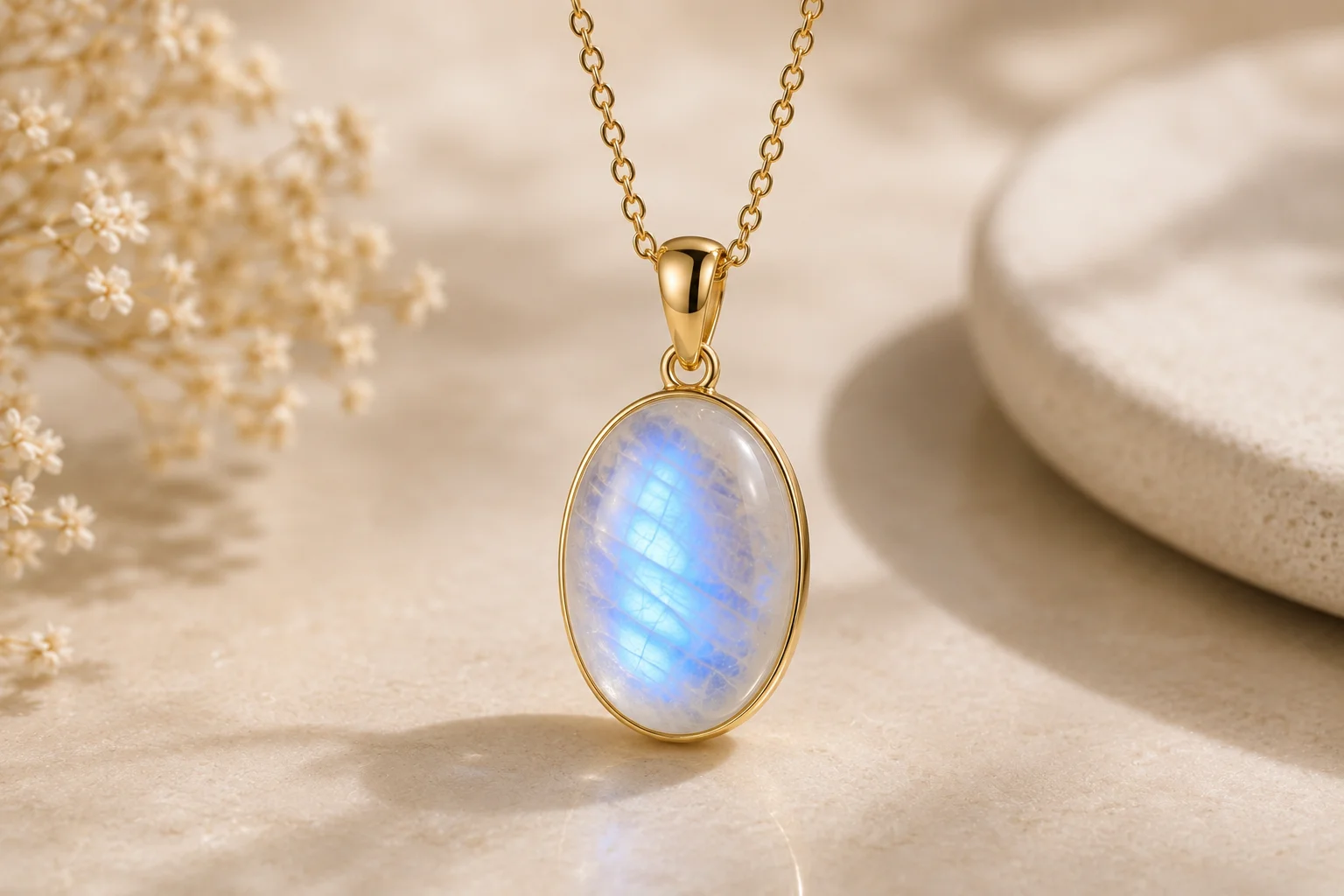
Moonstone necklaces place the gem’s moving internal light in one of its safest and most visible positions. A pendant can support a broad blue-sheen cabochon, carved moon motif or rose-cut stone without exposing the feldspar to the repeated impact experienced by rings and bracelets.
That protection does not remove the need for careful construction. Moonstone has hardness of 6–6.5, poor toughness and two cleavage directions. A high unsupported cabochon, weak bail or long swinging chain can still lead to chips, fractures or loss.
The strongest necklace uses a well-oriented stone, a setting that protects its edges and a chain proportionate to the pendant’s weight. The sheen should face forward when worn rather than appearing only when the piece lies flat beneath a display light.
The broad Moonstone gemstone guide owns geology, history and symbolism. This page focuses specifically on necklace styles, pendant engineering, chain selection, buying, wear and maintenance.
Moonstone Necklaces at a Glance
| Feature | What to evaluate |
|---|---|
| Gem family | Feldspar |
| Defining phenomenon | Adularescence |
| Mohs hardness | 6–6.5 |
| Toughness | Poor |
| Structural concern | Two cleavage directions |
| Common necklace forms | Solitaires, carvings, stations, beads, lariats and inlay |
| Most protective setting | Low full bezel with back support |
| Main quality factor | Bright mobile sheen oriented toward the visible face |
| Main pendant concern | Flipping, high setting and weak bail |
| Main chain concern | Gauge, length, clasp and end-fitting compatibility |
| Common treatments | Backing, coating, filling, resin and assembled construction |
| Safest cleaning | Warm water, mild soap and a soft brush |
Why Necklaces Suit Moonstone
Moonstone is significantly safer on the neck than on the hand or wrist.
A pendant normally avoids desks, tools and hard surfaces. It can therefore accommodate a larger cabochon and a more delicate optical variety than would be practical in a ring.
A Moonstone bracelet receives frequent impact, while Moonstone earrings provide similarly protected wear with different matching requirements.
A Moonstone ring needs an especially low, protective setting because cleavage and poor toughness become more important at hand level.
Long necklaces still swing into furniture, seat belts and desks. The benefit of necklace wear depends on choosing an appropriate length and secure construction.
Main Moonstone Necklace Styles
| Necklace style | Visual advantage | Main concern |
|---|---|---|
| Solitaire cabochon | Gives one optical effect complete focus | Balance and flipping |
| Full-bezel pendant | Protects most of the perimeter | Closed back may conceal construction |
| Prong-set pendant | Shows more of the gem | Exposed girdle and pressure points |
| Carved pendant | Uses sheen across a sculpted surface | Thin details and drilled loops |
| Moon-phase pendant | Strong symbolic styling | Several joints or inlay sections |
| Bead necklace | Displays several colors and flashes | Drill holes, cord and weight |
| Station necklace | Light contemporary design | Stones turning backward |
| Lariat | Adds movement and adjustable length | Swinging and slider security |
| Multi-stone pendant | Combines varieties or graduated stones | Matching and collision |
| Inlay necklace | Smooth geometric surface | Adhesive and thin material |
| Rainbow Moonstone necklace | Strong blue or multicolored flash | Correct trade-name disclosure |
| Cat’s-eye pendant | Focused moving band | Precise orientation |
Solitaire Moonstone Pendants
A solitaire places one cabochon at the center of the necklace.
Oval and round stones are common because their smooth outlines protect vulnerable edges. Pears, cushions, rectangles and freeforms can also work when the setting supports their points and corners.
The stone must remain attractive in a vertical position. Product images often show Moonstone lying flat, where its sheen may appear at an angle that disappears once the pendant hangs from a chain.
Request a video showing the exact pendant suspended and moving. The adularescence should travel across the face without requiring an extreme tilt.
A well-balanced pendant remains forward-facing instead of turning continuously toward the chest.
Full-Bezel Pendants
A full bezel usually provides the strongest perimeter protection.
The metal surrounds the girdle and absorbs many side impacts that would otherwise reach the feldspar.
The bezel should follow the cabochon evenly. Gaps, rippled metal, visible glue or a moving stone indicate poor workmanship.
A closed back may reinforce a thin Moonstone, but it can also conceal backing, filler, cracks or an assembled stone. The seller should disclose whether the visible gem is solid through its full depth.
An opening behind the cabochon improves cleaning access and allows some inspection of the reverse.
Prong-Set Pendants
Prong settings show more of the gem and can create a lighter appearance.
The stone should rest in a supportive basket rather than hang only between small metal tips.
Prongs must avoid surface-reaching fractures and weak corners. Excessive tightening can chip Moonstone during setting or repair.
Rounded cabochons tolerate prongs more effectively than sharp pears or rectangular tablets.
A low basket provides greater protection than a high open mounting that creates leverage when the pendant is struck.
Moonstone Carved Pendants
Moonstone may be carved into faces, leaves, flowers, animals, stars, crescent moons and abstract shapes.
The cutter can use adularescence to animate raised and recessed areas. As the carving moves, the sheen may travel across several planes rather than one smooth dome.
Thin projections, pierced sections and drilled loops are vulnerable.
A metal cap can support a carved pendant, although it may also conceal glue or a repaired hole. Close photographs should show the attachment area.
The carving should not have sharp chips or unfinished surfaces that catch clothing.
Moon-Phase and Celestial Designs
Crescent moons, stars and moon-phase sequences are natural design choices for Moonstone.
A crescent may use one carved gem, a cabochon framed by metal or several small stones arranged into a lunar shape.
Moon-phase necklaces commonly combine multiple settings along a bar or chain. Each joint should move without allowing the stones to collide.
The symbolism is cultural and decorative. The shape does not prove that the gem changes with lunar phases or receives measurable energy from moonlight.
A well-designed celestial pendant should remain wearable even for someone who values the appearance more than the spiritual meaning.
Moonstone Bead Necklaces
Moonstone bead strands may use round, oval, barrel-shaped, disk or graduated beads.
Each bead rotates independently, so the brightest sheen will not remain face-up continuously.
A good strand still shows enough bodycolor and optical interest to remain attractive during ordinary movement.
Drill holes should be free from major chips and radiating cracks. Cleavage or tension near the opening can enlarge as the cord pulls against it.
Knots between beads reduce direct contact and limit loss if the strand breaks.
Large beads can create substantial weight. The clasp, cord and reinforced end connections must support the complete necklace.
Station Necklaces
Station necklaces place small Moonstone cabochons or beads at intervals along a chain.
Flat settings should use balanced two-point connections when the stones are intended to remain face-up.
A single connection permits freer movement but allows the station to turn backward.
The chain must be strong enough for the total station weight. Very thin chains may stretch or break even when the Moonstones remain undamaged.
Enough spacing should remain between stones to prevent collision as the necklace curves around the neck.
The broader Crystal Necklaces guide covers general necklace symbolism and construction without replacing this material-specific guidance.
Lariat and Drop Necklaces
A lariat creates a vertical drop through a fixed crossing point or adjustable slider.
Moonstone can be placed at the ends, center or both.
The slider should hold its position without allowing the drop to lengthen gradually under the stone’s weight.
The lowest cabochon should not reach a desk during seated work.
Articulated drops increase movement and can strengthen visible adularescence, but the links must prevent stone-to-stone contact.
Inlay and Tablet Pendants
Inlay uses thin Moonstone sections fitted into metal channels or combined with other materials.
The finished surface should feel smooth, without raised edges, cloudy adhesive or open gaps.
Because the stone is thin, the backing and adhesive carry much of the structural load. Inlay should never be soaked or cleaned ultrasonically.
A pale tablet may be mounted over dark or reflective backing to strengthen apparent sheen. Such construction should be disclosed.
A broad flat stone with weak adularescence should not be represented as high-quality simply because it covers a large area.
Choosing Adularescence
Adularescence is the principal quality factor.
The finest traditional Moonstone shows vivid mobile blue sheen over a colorless, semitransparent-to-transparent body.
White and silver sheen are more common and can still be attractive.
The glow should sit near the center of the visible face and move across a broad area as the pendant turns.
A narrow flash visible only at one extreme angle provides less everyday impact.
The complete selection process belongs to the Moonstone Buying Guide, while current valuation belongs to the Moonstone Price Guide.
Bodycolor and Variety
The Types of Moonstone guide owns the complete variety framework.
White Moonstone provides the classic pale appearance and works in both cool and warm metals.
Peach Moonstone ranges from cream to orange-pink and pairs naturally with yellow or rose gold.
Black Moonstone offers dark gray or brown bodycolor with pale sheen and internal patterning.
A necklace containing several varieties should use an intentional sequence. Random changes in color, clarity and flash can make a design look assembled from unrelated stones.
Rainbow Moonstone Necklaces
Rainbow Moonstone is transparent Labradorite sold under a widely accepted trade name.
It may show blue, green, yellow or violet labradorescence.
The direct Labradorite vs Moonstone guide explains why rainbow material belongs to a different feldspar composition from traditional orthoclase Moonstone.
A seller should use the trade name accurately rather than implying that every multicolored feldspar is traditional Moonstone.
Rainbow Moonstone often contains visible fractures and internal tension features. Strong flash should not replace structural inspection.
Moonstone vs Opal in Pendants
Moonstone and Opal can both show luminous internal effects, but they are unrelated materials.
Moonstone is feldspar whose adularescence comes from layered internal structure. Opal is hydrated amorphous silica, and precious Opal displays play-of-color through diffraction within ordered silica spheres.
The direct Moonstone vs Opal guide owns the complete comparison.
Moonstone generally tolerates ordinary environmental changes better than some Opals, but its cleavage creates a distinct impact risk.
A pendant should be identified by material rather than sold through vague phrases such as opalescent moon gem.
Treatments and Imitations
Backing, coating, filling, resin and assembled construction may alter a Moonstone pendant.
Milky glass, Opalite, white Chalcedony and other feldspars may imitate its appearance.
The Real vs Fake Moonstone guide owns the complete diagnostic workflow.
A genuine optical effect should appear within the stone and move as the angle changes. Surface reflection remains attached to the polish.
A laboratory report may be useful for an expensive blue-sheen cabochon or disputed trade-name material. The Gemstone Certification guide explains when documentation is proportionate.
Choosing a Bail
The bail carries the pendant’s complete weight and controls how it hangs.
Its internal opening must accommodate both the chain and the chain’s end fitting.
An articulated bail allows natural movement and may help the cabochon face forward. A fixed bail can keep geometric tablets aligned when positioned correctly.
The connection between setting and bail should contain enough metal to resist bending.
A drilled Moonstone should not carry a heavy pendant through a tiny unsupported hole. A metal tube, cap or reinforced fitting distributes pressure more safely.
Choosing a Chain
Chain strength should match pendant weight.
Cable, box, wheat, rope and curb chains can all work when their gauge is appropriate.
A large cabochon on an extremely thin chain creates a mechanical mismatch even when the appearance is delicate.
Sterling silver and white gold complement blue or white sheen. Yellow gold creates stronger contrast, while rose gold works especially well with peach bodycolor.
Metal composition matters for skin sensitivity. The Best Gemstones and Metals for Sensitive Skin guide explains alloy, nickel, plating and solder concerns.
Necklace Length
Princess length places many pendants on the upper chest and limits excessive swinging.
A choker or collar remains close to cosmetics, perfume and perspiration.
Matinee and opera lengths create more movement and may allow the pendant to strike desks or furniture.
Actual measurement is more useful than a style name because body proportions and pendant dimensions change where the piece rests.
Adjustable chains provide flexibility, but the slider and extender must be strong enough for the pendant.
Weight and Comfort
Moonstone itself is not exceptionally dense, but broad cabochons, carvings and substantial metal settings can become heavy.
Ask for total pendant and necklace weight when the design is large.
A heavy pendant may feel more comfortable on a shorter or wider chain that distributes load.
The center of gravity should remain below the bail so the piece hangs steadily.
A pendant that flips repeatedly may need a different chain, a repositioned bail or additional attachment points.
Buying Moonstone Necklaces Online
Follow How to Buy Gemstones Online Without Getting Scammed.
Request continuous video showing the exact pendant hanging and moving under diffused light.
The seller should provide stone dimensions, pendant weight, treatment disclosure, metal alloy, chain length, chain gauge, bail opening and clasp type.
Views of the side and reverse can reveal backing, an excessively thin cabochon or a poorly supported setting.
A still photograph under one spotlight cannot establish the strength or mobility of adularescence.
Styling and Symbolism
Moonstone works naturally with white, gray, navy, black, cream and soft pastel clothing.
White and blue-sheen stones create a cool appearance in silver or white gold. Peach varieties add warmth in yellow and rose gold.
A necklace can coordinate with earrings or a bracelet through metal and bodycolor without matching the optical pattern exactly.
Moonstone is a recognized June birthstone. The June Birthstone guide explains its relationship with Pearl and Alexandrite.
Belief-based emotional and chakra traditions belong to Moonstone Healing Properties rather than this construction guide.
Cleaning, Storage and Repair
Follow How to Clean Moonstone Jewelry Safely.
Use lukewarm water, mild soap and a soft brush or cloth. Avoid prolonged soaking when glue, backing or treatment is present.
Never use ultrasonic or steam cleaning.
Store the necklace flat or in a broad curve. Keep the pendant in a separate padded area so the chain and clasp do not scratch the stone.
Belief-based energetic care belongs to How to Cleanse and Charge Moonstone.
Stop wearing the necklace if the stone moves, the bail opens, a crack reaches the surface or an inlay section lifts.
Frequently Asked Questions
1. Is Moonstone suitable for necklaces?
Yes. Necklaces are among the safest Moonstone formats because they receive less impact than rings and bracelets.
2. What is the safest pendant setting?
A low full bezel with adequate back support usually provides the strongest protection.
3. Why does a Moonstone pendant flip backward?
The bail, chain attachment or center of gravity may be unbalanced. A jeweler can evaluate the construction.
4. What is the best Moonstone sheen?
Strong mobile blue sheen over a clear colorless body generally receives the highest market demand.
5. Are white and peach Moonstone less valuable?
They are generally more available than fine transparent blue-sheen material, but attractive color, cut and jewelry design still matter.
6. Is rainbow Moonstone genuine Moonstone?
It is transparent Labradorite sold under an accepted trade name rather than traditional orthoclase Moonstone.
7. Can a Moonstone pendant be backed?
Yes. Backing may support a thin stone or strengthen apparent sheen, but it should be disclosed.
8. Are carved Moonstone pendants fragile?
Thin projections, drilled loops and openwork can chip more easily than a rounded cabochon.
9. What chain length works best?
Princess length is practical for many pendants because it limits swinging while keeping the stone visible.
10. Can Moonstone be cleaned ultrasonically?
No. Vibration can worsen fractures and cause cleavage-related damage.
11. Does an expensive Moonstone necklace need certification?
Testing may be useful for valuable blue-sheen stones, disputed identity or questionable rainbow-Moonstone descriptions.
12. What should I do if the cabochon becomes loose?
Stop wearing the necklace and store it flat until a jeweler familiar with cleavage-prone feldspar inspects the setting.
A Moonstone necklace succeeds when the optical and mechanical orientations agree. The internal layers must face the viewer, the cabochon must hang forward and the bail and chain must carry the piece without twisting it. When those elements align, the glow appears naturally during wear instead of only under a seller’s display light.