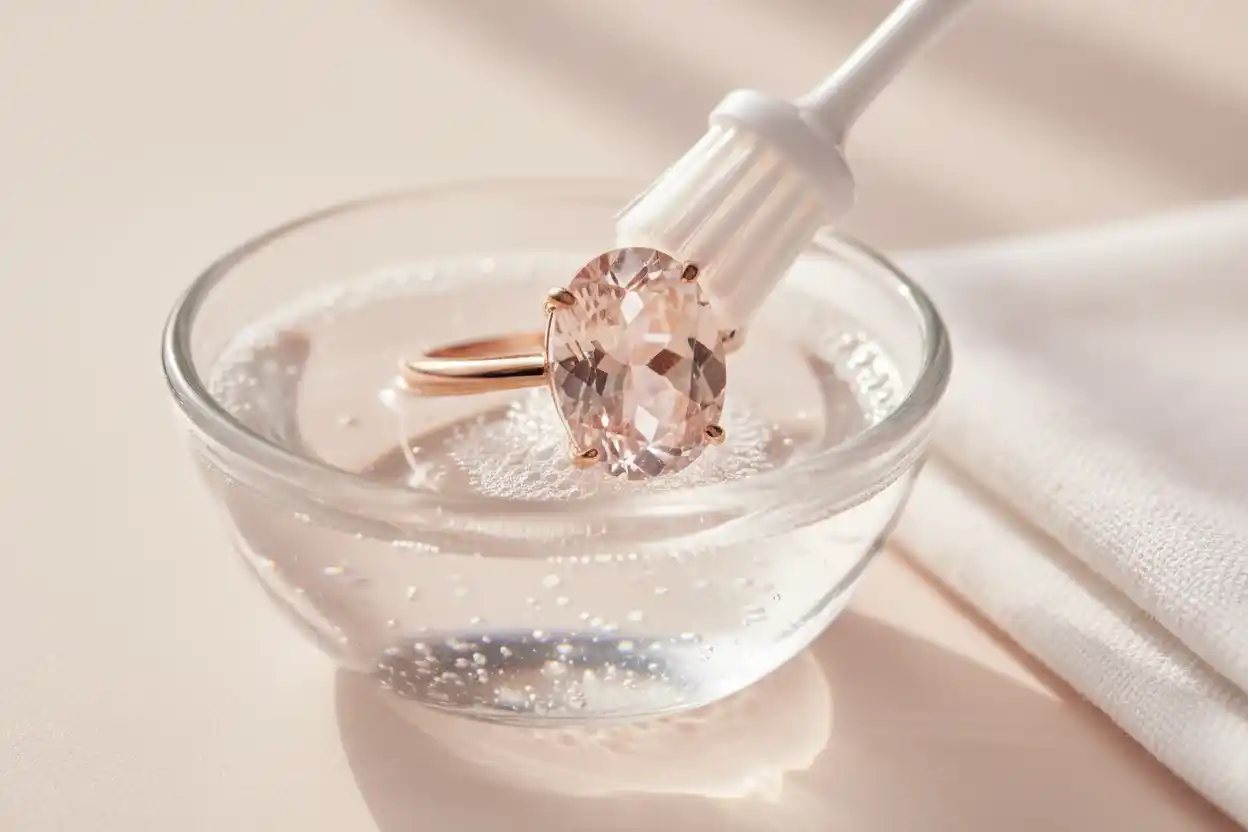
How to Clean Morganite Jewelry Safely
Morganite jewelry can be cleaned safely with warm water, mild liquid soap, and a soft-bristled brush. Ultrasonic and steam cleaning are usually suitable for a sound, unfilled Morganite in a secure setting, but both should be avoided when the stone contains fractures, liquid inclusions, fracture filling, glue, or vulnerable companion materials.
Warm soapy water remains the best household method because it removes the oils and cosmetics that commonly make pale Morganite look cloudy without placing the gem or setting under unnecessary stress.
Why Morganite Usually Cleans Well
Morganite is the pink, peach, salmon, or violet-pink variety of beryl. Its mineral family also includes Emerald, Aquamarine, Heliodor, Goshenite, and Red Beryl.
Its formation, colors, localities, and symbolism belong to the Morganite guide, while the family relationship appears in the Beryl guide.
Morganite ranks approximately 7.5 to 8 on the Mohs scale. It generally offers useful durability for rings, earrings, necklaces, and bracelets, although surface-reaching fractures and liquid inclusions can alter the cleaning decision.
| Property | Cleaning implication |
|---|---|
| Mineral species | Beryl |
| Typical color | Pink, peach, salmon, or violetish pink |
| Mohs hardness | Approximately 7.5 to 8 |
| Toughness | Good |
| Cleavage | Indistinct basal cleavage |
| Safest routine method | Warm water, mild soap, and a soft brush |
| Ultrasonic cleaning | Usually safe unless fractured, filled, or heavily included |
| Steam cleaning | Usually safe unless fractured or filled |
| Main risks | Liquid inclusions, fractures, filling, loose settings, and metal wear |
The gemstone hardness chart explains Morganite’s resistance to routine scratches.
Nevertheless, hardness is not the same as resistance to impact. The difference appears in Gemstone Toughness vs Hardness, while beryl’s structural weakness is placed in context by Gemstone Cleavage Explained.
Why Morganite Becomes Dull
Morganite’s pale colors make surface contamination particularly noticeable.
Skin oils, lotion, sunscreen, makeup, soap, perfume, hair products, and cooking residue can form a film over the stone. Debris beneath the pavilion may make the gem appear grayer, browner, or less transparent.
Morganite is sometimes cut in relatively large sizes because suitable crystals can occur in substantial dimensions. Larger tables and broad pavilion surfaces offer more area for fingerprints and residue.
Cleaning can restore transparency and brilliance. It cannot change weak saturation, uneven color, inclusions, extinction, windowing, or a worn polish.
Inspect the Setting Before Cleaning
Examine the jewel beneath bright light. Check every prong, bezel edge, gallery, halo bead, channel wall, hinge, link, and clasp.
Gently test for movement without twisting the stone. Clicking, shifting, or a visible gap means the setting needs repair before washing.
Morganite is frequently mounted in rose gold because the metal reinforces its pink or peach appearance. Gold alloys are much softer than Morganite and can be scratched by abrasive cleaning products.
Inspect pavé halos carefully. A secure center stone does not guarantee that every small diamond or accent gem remains tight.
Look for Fractures and Liquid Inclusions
Morganite can contain liquid inclusions, internal crystals, growth tubes, fingerprints, and fractures.
A fully enclosed inclusion may create no routine cleaning problem. However, surface-reaching fractures and liquid-filled cavities can respond poorly to vibration, heat, or rapid temperature changes.
Use manual cleaning when a fracture reaches the surface or when magnification reveals prominent fluid inclusions.
Do not assume that an eye-clean stone is structurally flawless. Some features are difficult to see without magnification.
Treatment and Fracture Filling
Morganite is commonly heated to reduce yellow or orange components and produce a purer pink color. This treatment is generally stable under normal wear and routine cleaning.
Fracture filling is rare but possible. A glass-like or resinous material may be introduced into a surface-reaching fracture to reduce its visibility.
Filled Morganite should receive warm soapy-water cleaning only. Ultrasound, steam, strong chemicals, and jeweler’s heat can damage the filler.
The complete disclosure and identification discussion belongs to How to Spot Treated or Synthetic Morganite and Gemstone Treatments Explained.
Prepare the Cleaning Solution
Fill a small bowl with warm—not hot—water and add a few drops of mild liquid dish soap.
Prepare a second bowl of clean warm water for rinsing. Use a new soft toothbrush or jewelry brush.
Place a lint-free cloth nearby for blotting and final fingerprint removal.
Do not clean over an open sink. A loose accent stone or small earring may disappear through the drain.
Avoid soaps containing bleach, abrasive particles, strong solvents, or heavy moisturizers that can leave a film.
Wash Morganite Thoroughly but Gently
Place the jewelry in the mild solution for a few minutes so oils and residue begin to soften.
Brush the crown, pavilion, girdle, prongs, gallery openings, and underside of the stone.
The rear facets deserve particular attention. Morganite can look noticeably darker when film accumulates beneath its pavilion.
Use light pressure around pavé, plating, enamel, and small settings. Morganite may tolerate the brush, but the surrounding metal and decorative finishes may not.
Do not insert pins or metal tools beneath the stone. They can bend a prong, scratch the setting, or push against the girdle.
Rinse and Dry Completely
Rinse the jewel in a separate bowl of clean warm water.
Check the underside carefully because dried soap can resemble cloudiness.
Blot with a lint-free cloth and allow hidden moisture to evaporate naturally.
Do not wear the piece until the setting and any enclosed gallery are completely dry.
After drying, inspect the prongs again. A raised edge that catches on the cloth should be repaired.
Can Morganite Go in an Ultrasonic Cleaner?
Ultrasonic cleaning is usually safe for a sound Morganite with no fractures, filling, or problematic inclusions.
| Morganite condition | Ultrasonic recommendation |
|---|---|
| Sound, unfilled stone in a secure setting | Usually safe |
| Conventionally heated Morganite | Usually safe if otherwise sound |
| Visible fracture | Avoid |
| Liquid inclusion of uncertain stability | Avoid |
| Fracture-filled Morganite | Avoid |
| Loose halo or pavé | Avoid |
| Antique or repaired setting | Professional assessment required |
| Mixed-gem jewelry | Follow the most vulnerable material |
Vibration can enlarge a fracture, disturb filling, or expose a weak setting.
The wider machine-safety guidance belongs to Which Gemstones Can Go in an Ultrasonic Cleaner?.
For routine home care, ultrasound is optional rather than necessary.
Can Morganite Be Steam Cleaned?
Steam is usually safe for a structurally sound, unfilled Morganite.
However, heat and pressure may affect fracture filling, liquid inclusions, glue, coatings, antique solder, enamel, plating, or companion gemstones.
Professional steam cleaning should follow a setting and treatment inspection. Warm soapy water is sufficient for ordinary maintenance.
Cleaning a Morganite Ring
A Morganite ring collects lotion, sanitizer, soap, makeup, and skin oils rapidly.
Clean beneath the center stone through the gallery openings. Inspect prongs and halo settings after drying.
Remove the ring before cleaning, swimming, gardening, exercise, and heavy manual work.
A large stone creates leverage against the setting when struck, even though Morganite itself has useful hardness.
Cleaning a Morganite Engagement Ring
A Morganite engagement ring worn daily needs more than cosmetic cleaning.
Check prongs, pavé beads, gallery rails, and the junction between the head and shank regularly.
Rose-gold settings can develop fine scratches and wear around the prongs. Avoid toothpaste, baking soda, and abrasive metal polish.
Periodic professional inspection is appropriate for a ring worn every day.
Cleaning Morganite Earrings
Morganite earrings collect cosmetics, hairspray, and skin oils behind their baskets.
Brush the posts, backs, hinges, hooks, and pavilion surfaces.
Keep alcohol-based disinfectant on compatible metal fittings and away from glue, filler, coatings, or vulnerable accent stones.
Dry screw backs and push backs completely before storage.
Cleaning a Morganite Necklace
A Morganite necklace or pendant may develop residue from perfume, sunscreen, and skin contact.
Apply cosmetics before putting on the necklace and allow them to dry.
Prevent the chain from rubbing against the Morganite during cleaning and storage. Support a large pendant by its metal setting.
Cleaning a Morganite Bracelet
A Morganite bracelet combines multiple stones with flexible links, hinges, clasps, and small prongs.
Support the bracelet during cleaning and work one section at a time.
Inspect every setting after rinsing. Remove the bracelet before activities that repeatedly strike the wrist against hard surfaces.
Morganite Versus Kunzite and Rose Quartz
Morganite and Kunzite can share pale pink or peach-pink color, but Morganite is beryl while Kunzite is cleavage-sensitive spodumene.
The complete distinction belongs to Kunzite vs Morganite.
Morganite and Rose Quartz also differ in mineral species, transparency, typical cutting, value, and optical behavior. That comparison appears in Morganite vs Rose Quartz.
Cleaning response should not be used as an identification test. Scratch, heat, chemical, and destructive testing can damage the jewel.
Buying, Value, and Authentication
The Morganite buying guide covers color, saturation, clarity, cut, treatment, size, and mounting quality.
Market factors belong to the Morganite price guide.
Glass, synthetic spinel, pale pink sapphire, Kunzite, and other materials may be sold or mistaken for Morganite. The complete identification workflow belongs to Real vs Fake Morganite.
For an important piece, the gemstone certification guide and How to Read a Gem Lab Report explain what laboratories can identify and disclose.
Storage and Preventive Care
Store Morganite separately in a lined compartment or soft pouch.
Diamond, sapphire, ruby, and harder stones can scratch it. Morganite can scratch softer gems and ornamental materials.
Keep chains and clasps away from the polished facets. Wipe the stone after wear so cosmetics and skin oils do not build into a persistent film.
Frequently Asked Questions
1. What is the safest way to clean Morganite?
Use warm water, mild liquid soap, and a soft brush, then rinse and dry the jewelry thoroughly.
2. Can Morganite get wet?
Yes. Brief washing is generally safe, although glue, filling, watches, and delicate components may impose restrictions.
3. Can Morganite go in an ultrasonic cleaner?
A sound, unfilled stone is usually suitable. Avoid ultrasound when fractures, liquid inclusions, loose settings, or filling are present.
4. Can Morganite be steam cleaned?
Steam is usually safe for sound, unfilled material, but the complete jewel should be inspected first.
5. Is dish soap safe for Morganite?
A few drops of mild liquid dish soap are suitable. Avoid abrasive or heavily moisturizing formulas.
6. Can toothpaste clean Morganite?
No. Toothpaste can scratch the setting, wear plating, and leave residue beneath the stone.
7. Why does Morganite become cloudy?
Lotion, soap, cosmetics, skin oils, debris beneath the pavilion, inclusions, or filling may reduce its clarity.
8. Is heat-treated Morganite safe to clean?
Conventional heat treatment is generally stable and does not prevent warm-soapy-water cleaning.
9. Can Morganite be fracture filled?
Yes, although the treatment is uncommon. Filled stones should receive manual warm-soapy-water cleaning only.
10. Why does Morganite look peach in one setting and pink in another?
Body color, lighting, cut, skin reflection, and the color of the metal can alter its apparent tone.
11. How often should Morganite jewelry be cleaned?
Frequently worn rings may need gentle cleaning every few weeks because pale stones show oil readily.
12. When should Morganite receive professional cleaning?
Professional care is appropriate for fractures, liquid inclusions, filling, loose pavé, antique jewelry, or persistent cloudiness.
Conclusion
Morganite is durable enough for routine jewelry, yet its pale color makes even a thin layer of oil conspicuous. Warm soapy water restores brightness without assuming that the stone is free from liquid inclusions or fracture filling. Before using ultrasound or steam, inspect the individual Morganite and every component of its setting.