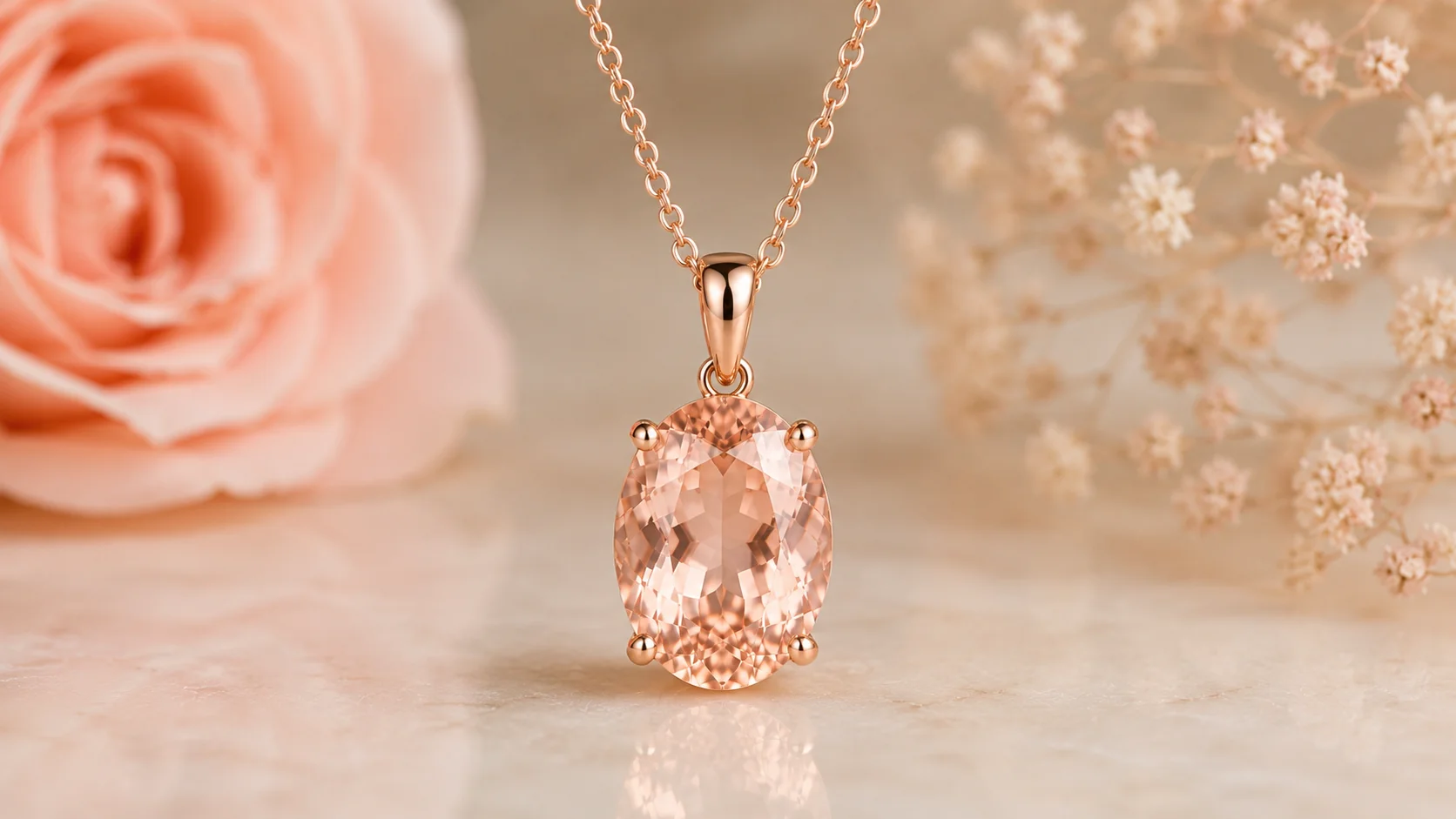
Morganite Necklaces and Pendants: A Style Guide
Morganite necklaces display the gemstone’s pale pink, peach, salmon and purplish-pink colors in one of its safest jewelry positions. A pendant can hold a substantial faceted stone without exposing it to the repeated impact faced by rings and bracelets, while a station or line necklace can create a softer sequence of blush-colored light.
Morganite is the pink-to-orange-pink variety of beryl. It has Mohs hardness of 7.5–8, good transparency and enough durability for frequent necklace wear when the setting, bail and chain are properly constructed.
The gem’s naturally light tone makes necklace design especially important. A larger pendant may show noticeably stronger color than small stations, while rose gold can make pale peach material appear pinker through reflected metal color. Cut depth, chain length and the color of clothing beneath the stone can also change its apparent saturation.
The broader Morganite gemstone guide owns the material’s geology, beryl identity, history and symbolism. This page focuses strictly on necklace styles, pendant construction, chains, buying, authenticity, comfort and care.
Morganite Necklaces at a Glance
| Feature | What to evaluate |
|---|---|
| Gem family | Beryl |
| Typical colors | Pale pink, peach, salmon, orangy pink and purplish pink |
| Mohs hardness | 7.5–8 |
| Transparency | Usually transparent to translucent |
| Most versatile format | Oval, round or cushion solitaire pendant |
| Smoothest setting | Full or partial bezel |
| Main visual concern | Sufficient color in the chosen size and cut |
| Main pendant concern | Balance, flipping and bail strength |
| Main chain concern | Gauge, length, clasp and bail compatibility |
| Common treatment | Heat to reduce yellow or orange components |
| Main disclosure concern | Natural or laboratory-grown origin and treatment |
| Safest cleaning | Lukewarm water, mild soap and a soft brush |
Why Morganite Suits Necklaces
A necklace keeps Morganite away from most hard surfaces. This reduces the risk of scratching, chipping and setting damage compared with hand-level jewelry.
The gem’s hardness makes it suitable for regular wear, but Morganite can still be scratched by Sapphire, Ruby, Moissanite and Diamond. Its position on the Gemstone Hardness Chart provides useful comparison.
A necklace can also accommodate a larger stone. Size often helps pale Morganite because greater light travel can strengthen the visible pink or peach color.
The advantage disappears when the pendant hangs too low and swings into desks or furniture. Necklace length and pendant balance should therefore be chosen according to the stone’s physical dimensions rather than appearance alone.
Main Morganite Necklace Styles
| Necklace style | Main advantage | Main concern |
|---|---|---|
| Solitaire pendant | Gives one gemstone complete focus | Color strength and flipping |
| Bezel pendant | Smooth, protective construction | More visible metal |
| Prong-set pendant | Shows more of the gem | Exposed girdle and prong maintenance |
| Halo pendant | Enlarges apparent spread | Numerous accent settings |
| Three-stone pendant | Balanced or symbolic design | Matching and articulation |
| Station necklace | Light contemporary appearance | Stations turning backward |
| Graduated necklace | Builds color toward the center | Smooth size and color progression |
| Tennis necklace | Continuous pink brilliance | Matching, links and clasp |
| Lariat | Adjustable vertical styling | Swinging and slider security |
| Bead necklace | Soft continuous color | Drill holes, stringing and clarity |
| Carved pendant | Artistic and individual | Thin projections and attachment |
| Mixed-beryl necklace | Pink Morganite with blue Aquamarine | Color balance and disclosure |
Solitaire Morganite Pendants
A solitaire places one Morganite at the center of the necklace.
Oval, round and cushion cuts are the most adaptable. Pears create a longer drop, while emerald cuts produce broad flashes and a cleaner architectural appearance.
The stone should retain visible color in its normal hanging position. Product images often use strong warm lighting, reflective rose-gold surfaces or dark backgrounds that make a pale gem appear more saturated.
Request video of the exact pendant against both a neutral background and skin. The stone should remain recognizably pink or peach without requiring one carefully controlled angle.
A well-balanced solitaire hangs face-forward. If the center of gravity sits behind or above the bail, the setting may rotate toward the chest.
Bezel-Set Morganite Pendants
A bezel surrounds the gemstone with metal.
This setting protects the girdle, creates a smooth outline and reduces snagging on hair or clothing. It works particularly well for daily necklaces and larger centers.
Rose-gold bezels can strengthen Morganite’s apparent warmth. White metal produces a sharper visual boundary and may reveal the gem’s independent bodycolor more clearly.
The bezel should follow the stone evenly without ripples, gaps or visible glue.
An opening behind the Morganite allows cleaning beneath the pavilion. Completely closed cups can collect lotion and soap, making a pale stone appear cloudy.
Prong-Set Morganite Pendants
Prongs expose more of the gem and create a lighter appearance.
Four-prong baskets are common for ovals, cushions and emerald cuts. Six prongs may offer additional redundancy around a large round center.
The Morganite should rest inside a supportive basket rather than hang solely between the prong tips.
A prong should not sit over a surface-reaching fracture. Concentrated setting pressure can enlarge an existing weakness during manufacturing or later repair.
Prongs should remain smooth enough not to catch chains, hair or knitwear.
Halo Morganite Pendants
A halo surrounds Morganite with Diamond, laboratory-grown Diamond, Moissanite, Sapphire or Cubic Zirconia accents.
The bright border creates contrast and increases apparent face-up size. It can make a lightly colored center easier to see at a distance.
Every accent material should be identified accurately on the invoice. White stones are not interchangeable in value, durability or optical appearance merely because they look colorless.
Diamond and Sapphire are harder than Morganite. Their girdles must remain separated from the center by metal so they cannot rub against the beryl.
A halo introduces many small prongs and therefore requires more maintenance than a solitaire.
Three-Stone and Multi-Stone Pendants
Three-stone pendants may arrange Morganites vertically, horizontally or as a compact cluster.
A vertical arrangement creates length and movement. A horizontal bar appears more contemporary and can remain closer to the neckline.
The stones may match exactly or form an intentional color gradient. One peach stone between two cool purplish-pink gems can look accidental unless the design clearly uses a transition.
Articulated sections should move without allowing the stones to strike one another.
A seller should provide the individual dimensions and identities of all stones rather than one combined carat-weight description.
Morganite Station Necklaces
Station necklaces place several Morganites at intervals along a chain.
Two-point connections help each station remain face-up. A station attached at only one point turns more freely and may display its reverse for much of the day.
The chain should be proportionate to the weight of the stones. Extremely fine chains can stretch or break even when the Morganites remain undamaged.
Enough spacing should remain between settings to prevent collision when the necklace curves around the neck.
An adjustable slider adds flexibility, but it should hold securely rather than allowing the necklace to lengthen gradually.
The wider Crystal Necklaces guide explains general necklace formats without replacing these Morganite-specific construction concerns.
Graduated and Tennis Necklaces
A graduated Morganite necklace increases stone size toward the center.
Larger stones often display stronger color, so a gradual size progression may naturally produce a richer pink center. The change should remain smooth rather than shifting abruptly from nearly colorless side stones to a saturated focal gem.
A tennis necklace uses a continuous articulated line. Each link should move independently and follow the neckline without stiff areas.
The clasp needs positive engagement and, for valuable pieces, a secondary safety feature.
A continuous line requires extensive matching. Hue, tone, saturation, cut style and visible dimensions all contribute to the finished effect.
Morganite Bead Necklaces
Morganite beads may be round, faceted, oval, barrel-shaped or irregular.
Transparent faceted beads create sparkle, while translucent material emphasizes soft continuous color. Included rough may be suitable for beads even when it would not meet faceted-gem clarity expectations.
Drill holes should remain smooth and free from radiating cracks.
Knots between valuable beads reduce direct contact and limit loss if the cord breaks.
A heavy strand should be stored flat rather than hanging permanently from the clasp. Cord and end fittings should be checked whenever the necklace begins hanging unevenly.
Carved Morganite Pendants
Morganite can be carved into leaves, flowers, hearts, animals, portraits and abstract forms.
The gem’s transparency allows light to move through raised and recessed areas, but the cutter must retain enough thickness around narrow sections.
Thin projections and drilled loops are vulnerable. A metal cap or reinforced bail can distribute the pendant’s weight more safely than a small unsupported hole.
The attachment area should be shown clearly in photographs. Decorative metal may conceal glue, a repaired break or a thin section of stone.
Craftsmanship can add value independently from gem weight.
Choosing Morganite Color
Color remains Morganite’s dominant quality factor.
Strong pure pink or purplish pink is less common than pale peach or blush. However, attractive peach material can be highly effective in warm-metal necklaces.
The Pink Gemstones guide compares Morganite with Pink Sapphire, Spinel, Tourmaline, Kunzite and Rose Quartz.
Color should be examined under daylight-equivalent light and ordinary indoor conditions. Warm retail lamps can exaggerate pink and reduce awareness of yellow or brown components.
The background also matters. A pale Morganite may disappear against skin close to its color but become more visible against dark clothing.
Size and Color Saturation
Small Morganites frequently appear very pale.
Larger gems can show greater color because light travels through more material. A substantial pendant may therefore provide better pink visibility than a cluster of tiny accents.
Size should not be maximized without considering cut. An excessively deep stone may retain weight below the setting while offering little additional face-up area.
Millimeter dimensions provide better visual information than carat weight alone.
A well-cut moderate stone with clear color often looks more impressive than a heavier gem with a broad central window.
Cut Quality
Round brilliants provide strong light return. Ovals and pears create vertical spread, while cushions can combine brilliance with a softer outline.
Emerald cuts reveal Morganite’s transparency through broad step flashes. They also make windowing and weak color easier to see.
A window appears as a pale or transparent central area through which the chain, skin or setting remains unusually visible.
The cut should distribute color and brightness across the face without hiding unnecessary weight below the girdle.
The complete loose-stone assessment belongs to the Morganite Buying Guide.
Pleochroism and Pendant Orientation
Morganite is pleochroic and can display different pink strengths along different crystallographic directions.
A cutter should orient the rough so the strongest attractive color faces upward.
Poor orientation may leave the stone pale from the front while stronger pink appears only through the side.
A necklace provides a relatively stable viewing direction, making orientation especially important. Unlike a loose gem that can be rotated freely, a pendant normally presents one face to the viewer.
Video should show the stone hanging vertically so its everyday appearance can be judged correctly.
Clarity and Structural Condition
Faceted Morganite is generally expected to appear clean to the unaided eye.
Liquid inclusions, tubes, crystals and fractures can occur. A small internal feature away from the girdle may have little practical effect.
Surface-reaching fractures near a prong, bail or pointed end require greater concern.
Pale Morganite also shows dirt readily. Oil beneath the pavilion can create apparent cloudiness even when the stone is internally clean.
Clean the necklace before assuming that reduced brilliance comes from inclusions.
Heat Treatment
Heating is common and usually reduces yellow or orange components, producing a purer pink.
The treatment is generally stable during normal wear. Heated Morganite remains natural beryl.
Known treatment should be disclosed, although routine testing may not always determine whether a particular stone was heated.
The dedicated Treated Morganite guide owns heat treatment, rare fracture filling and laboratory-grown material.
A necklace containing a fracture-filled stone requires more conservative cleaning and repair.
Natural, Laboratory-Grown and Imitation Material
Laboratory-grown Morganite has the essential beryl structure but forms through a controlled manufacturing process.
Its origin must be disclosed clearly.
Pink glass, Cubic Zirconia, synthetic Spinel, Kunzite, Pink Sapphire and other materials may imitate Morganite.
The Real vs Fake Morganite guide owns the full authentication workflow.
The direct Morganite vs Rose Quartz comparison separates transparent beryl from the commonly cloudy or translucent quartz material.
Kunzite vs Morganite addresses another transparent-pink comparison with different cleavage and light-stability concerns.
Morganite and Other Beryls
Morganite belongs to the Beryl family.
Aquamarine is blue-to-greenish-blue beryl, while Emerald is green beryl colored mainly by chromium, vanadium or both.
A mixed-beryl necklace can combine Morganite and Aquamarine in a pink-and-blue composition.
The stones have similar hardness, but differences in treatments, inclusions and individual condition still matter.
Emerald generally requires stricter cleaning because fissures and clarity enhancement are common.
Choosing a Bail
The bail carries the pendant’s complete weight and controls how it hangs.
Its internal opening must accommodate both the chain and the chain’s end fitting. A chain may fit through the bail while its end cap does not.
An articulated bail allows movement and can help a pendant settle naturally. A fixed bail may keep a geometric design aligned.
The connection between the setting and bail needs enough metal to resist bending.
Large Morganites should not hang from a thin decorative loop merely because the stone itself is durable.
Choosing a Chain
Chain gauge should correspond with pendant weight.
Cable, box, wheat, curb and rope chains can all work when appropriately sized. A very fine chain may suit a small solitaire but becomes a security risk with a large halo or carved pendant.
Rose gold strengthens Morganite’s warm appearance. Yellow gold emphasizes peach and salmon tones, while white gold and platinum create cooler contrast.
The Best Gemstones and Metals for Sensitive Skin guide explains alloy, nickel, solder and plating concerns.
A valuable pendant should not be supplied with a chain whose clasp or jump rings are visibly lighter than the setting.
Necklace Length and Comfort
Princess length suits many Morganite pendants because it places the stone on the upper chest and limits excessive swinging.
Chokers and collars remain close to perfume, cosmetics and perspiration. Longer matinee and opera chains create more movement and increase the chance of striking furniture.
Actual measurement is more useful than a style label.
A heavy pendant may feel more comfortable on a shorter or wider chain that distributes load.
The pendant should rest without rotating continuously or pulling the clasp toward the front.
Price and Value
Current material valuation belongs to the Morganite Price Guide.
Necklace price reflects color, clarity, cutting, size, treatment, metal weight, chain quality, accents, craftsmanship and brand.
Large Morganite is comparatively available, so carat weight alone does not establish rarity.
A well-built necklace with a moderate strongly colored stone may provide more value than an oversized pale center on a weak chain.
Morganite jewelry should not be marketed with guaranteed investment or appreciation claims.
Buying Morganite Necklaces Online
Follow How to Buy Gemstones Online Without Getting Scammed.
Request video of the exact necklace hanging under neutral light. Photographs of the pendant lying flat cannot confirm balance or everyday color.
The listing should include stone dimensions, total weight, metal alloy, chain length, chain gauge, bail opening, treatment, natural or laboratory origin and return terms.
Views of the side and reverse can reveal excessive depth, backing, glue or a weak bail connection.
A laboratory report may be proportionate for a valuable center or disputed origin. The Gemstone Certification guide explains what documentation can establish.
Coordinating Morganite Jewelry
A Morganite bracelet can repeat the necklace’s metal and color direction.
Morganite earrings coordinate naturally with a solitaire pendant, while a Morganite engagement ring may guide the preferred shape.
A general Morganite ring can use stronger statement proportions without following bridal conventions.
A matched set does not need identical carat weights. Consistent hue, metal and overall design language usually create a more refined result.
Cleaning and Maintenance
Follow How to Clean Morganite Jewelry Safely.
Use lukewarm water, mild dish soap and a soft brush. Clean behind the Morganite, where oil and residue reduce visible color and brilliance.
Warm soapy water is the universally safe routine method.
Steam and ultrasonic cleaning should be avoided when fractures, liquid inclusions or filling are present.
Store the necklace flat or in a broad curve. Keep the chain and clasp from rubbing against the gemstone.
Stop wearing the piece if the center moves, the bail opens, a prong catches or the chain begins stretching.
Frequently Asked Questions
1. Is Morganite suitable for necklaces?
Yes. Necklaces protect Morganite from most impact and can support larger stones that show stronger color.
2. What is the most versatile Morganite pendant?
An oval, round or cushion solitaire in a bezel or secure basket works with the widest range of clothing and occasions.
3. Why does Morganite sometimes look nearly colorless?
Morganite is usually light-toned, and small stones or poorly oriented cuts may show weak face-up color.
4. Does rose gold improve Morganite’s color?
Rose gold reflects warm pink into the gemstone and can make pale peach material appear more saturated.
5. Is a bezel better than prongs?
A bezel protects the girdle and snags less. Prongs show more of the gemstone but need periodic inspection.
6. Is Morganite usually heat-treated?
Yes. Heat commonly reduces yellow or orange components and produces a purer pink.
7. Is heated Morganite still natural?
Yes. Heating modifies color but does not change the stone’s geological origin.
8. Can Morganite necklaces contain laboratory-grown stones?
Yes. Laboratory-grown pink beryl exists and must be disclosed as manufactured.
9. What chain length is best?
Princess length is practical for many pendants because it keeps the stone visible while limiting excessive movement.
10. Does a Morganite necklace need certification?
Most commercial pieces do not, but documentation may help with valuable centers, treatment disputes or natural-origin claims.
11. Can Morganite be cleaned ultrasonically?
Some sound stones may tolerate it, but hand cleaning is safer when fractures, liquid inclusions or filling may be present.
12. What should I do if the pendant flips constantly?
A jeweler should inspect the bail position, center of gravity, chain thickness and setting balance.
A successful Morganite necklace uses size to reveal color without letting size overwhelm construction. The stone should remain pink in ordinary light, the bail should hold it forward and the chain should carry its weight without strain. When those elements work together, the necklace presents Morganite as a gemstone rather than relying on rose-gold reflections or showroom lighting to create its identity.