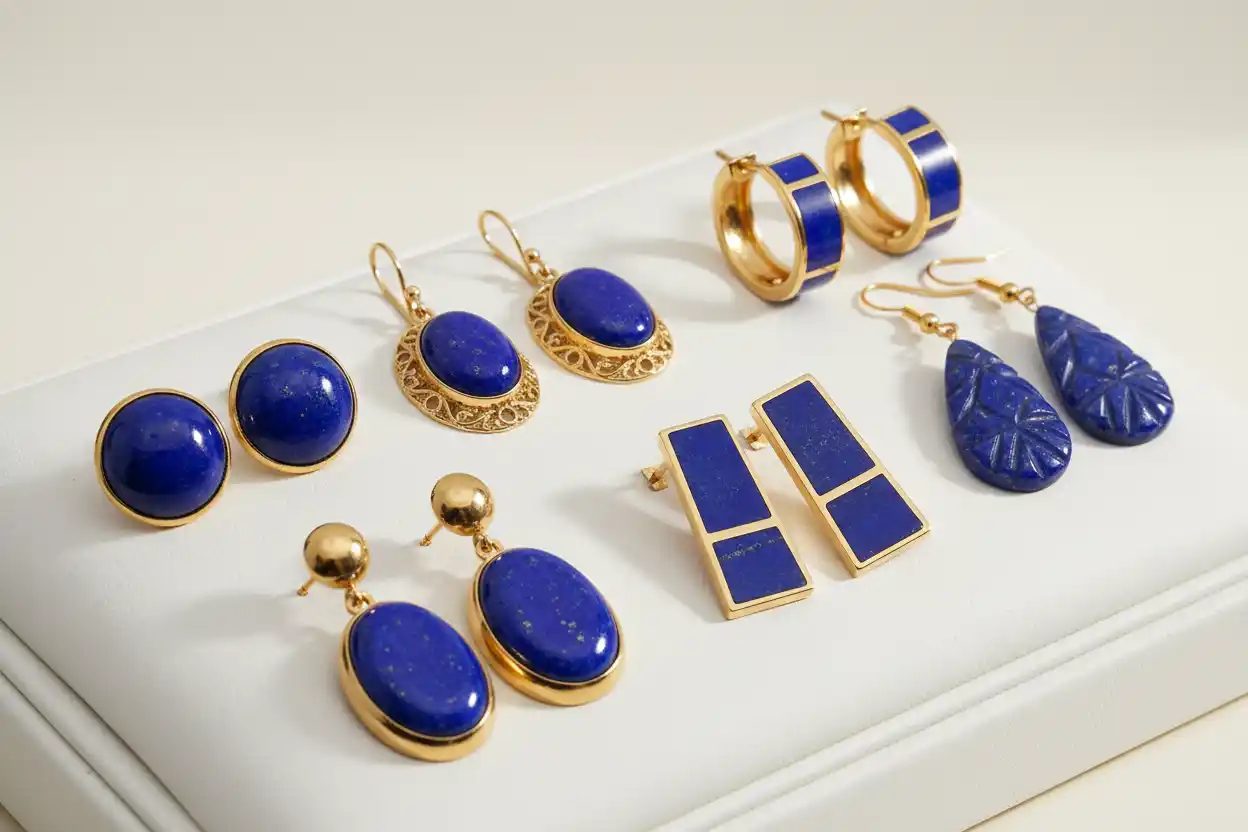
Lapis Lazuli Earrings: Styles, Quality and Buying Guide
Lapis lazuli earrings place one of the gem world’s strongest natural blues close to the face. Their appearance can range from uninterrupted royal blue to indigo material scattered with gold-colored pyrite or crossed by white calcite.
The stone is not a single mineral. Lapis lazuli is a rock made primarily from blue lazurite, with varying amounts of calcite, pyrite, and other minerals. Consequently, two earrings can have similar shapes yet differ noticeably in color, hardness, polish, pattern, and treatment.
Earrings offer one of the safer ways to wear lapis. They receive less impact than rings or bracelets, although thin inlay, carved points, drill holes, adhesives, settings, and metal findings still require inspection.
The broader lapis lazuli guide explains the rock’s geology, history, symbolism, and uses. This page focuses on earring design, pair matching, construction, treatment, comfort, buying, and care.
Lapis Lazuli Earrings at a Glance
| Feature | What to evaluate |
|---|---|
| Material | Natural lapis lazuli rock rather than dyed substitute or glass |
| Main minerals | Lazurite, calcite, and pyrite |
| Preferred color | Intense medium-dark blue to violetish blue |
| Mohs hardness | Approximately 5–6, depending on mineral mixture |
| Toughness | Fair |
| Common earring forms | Studs, drops, hoops, cabochons, tablets, beads, carvings, and inlay |
| Desirable pyrite | Small, attractively scattered metallic flecks |
| Less desirable feature | Large white calcite patches or dull greenish areas |
| Common treatments | Dye, wax, oil, resin, and coating |
| Main comfort issue | Weight of large cabochons and metal settings |
| Main care issue | Scratches, chemicals, dye stability, and adhesive construction |
Why Earrings Suit Lapis Lazuli
Lapis is softer than quartz, topaz, sapphire, and diamond. It can scratch when it contacts harder gemstones, abrasive dust, metal edges, or rough storage surfaces.
Earrings avoid much of the contact experienced by wrist and hand jewelry. Studs remain close to the ear, while short drops hang away from desks and tools.
The gemstone hardness chart places lapis within the broader durability scale. Its hardness varies because the material contains several minerals rather than one uniform crystal.
A pair can tolerate regular wear when the stones are sound, the settings are secure, and the earrings are removed before sleeping, exercise, swimming, showering, and hair styling.
Main Lapis Lazuli Earring Styles
| Earring style | Visual effect | Main advantage | Main concern |
|---|---|---|---|
| Cabochon studs | Compact field of blue | Low movement and impact | Pair matching and post security |
| Bezel studs | Smooth framed outline | Strong edge protection | Hidden backing or treatment |
| Prong-set studs | More visible stone | Open appearance | Exposed edges and pressure points |
| Drop earrings | Color and movement | Supports larger stones | Bail and connector strength |
| Dangle earrings | Dramatic length | Uses several beads or shapes | Weight, snagging, and collision |
| Hoop earrings | Contemporary design | Can use charms or inlay | Hinge and stone exposure |
| Tablet earrings | Geometric blue surface | Bold, clean styling | Chipped corners |
| Inlay earrings | Smooth patterned appearance | Detailed decorative design | Thin stone and adhesive failure |
| Carved earrings | Artistic motifs | Shows craftsmanship | Fragile projections and drill holes |
| Bead earrings | Casual and accessible | Lightweight in smaller sizes | Dye, drilling, and wire construction |
Lapis Lazuli Stud Earrings
Studs are the easiest style to wear frequently. They require no necklace length or ring size and expose lapis to relatively little impact.
A well-matched pair should coordinate in color, shape, dimensions, polish, pyrite distribution, and calcite content.
Bezel-Set Studs
A bezel surrounds the cabochon with metal and protects most of its edge. This setting works particularly well for lapis because the material can chip around exposed corners.
The bezel should follow the stone evenly. Look for gaps, glue seepage, rough metal folds, and sections where the stone appears forced into the setting.
A closed back may strengthen the earring, but it can conceal a thin lapis tablet, backing material, resin, dye concentration, or adhesive.
Ask whether the visible stone is a solid cabochon, an inlay section, a doublet, or a backed tablet.
Prong-Set Studs
Prongs expose more of the stone and can make a small cabochon appear larger. However, they provide less perimeter protection.
Four prongs may secure a round or oval stone. Angular tablets and freeforms need support near corners.
Prongs should not press directly on a visible calcite vein or fracture. Uneven tightening can chip softer areas within the rock.
Lapis Lazuli Drop Earrings
Drop earrings allow larger lapis cabochons, beads, tablets, or carvings to hang below the ear.
The connector above each stone should move freely without grinding against the lapis. Jump rings must close fully, and capped beads should not rely solely on a small amount of visible glue.
A pair of oval or pear-shaped cabochons should hang at the same angle. One stone should not rotate sideways while the other remains face-forward.
Gold-framed drops create a traditional blue-and-gold contrast, while silver produces a cooler appearance.
Long Dangle Earrings
Long dangles can combine lapis beads with gold, silver, pearl, carnelian, turquoise, onyx, or colorless accents.
The materials should remain separated when their hardness differs. Sapphire, diamond, quartz, and topaz can scratch lapis if they collide repeatedly.
Several lapis components should not strike each other during movement. Direct stone-to-stone contact can abrade edges and enlarge drill-hole chips.
Weight also becomes important. Request the weight per earring rather than only the combined weight.
Leverbacks or secure posts are generally preferable for valuable or heavy dangles. Open hooks should use stoppers.
Lapis Lazuli Hoop Earrings
Hoops may carry removable lapis charms, small cabochons, beads, or inlay sections.
A hinged hoop should open and close without forcing the stone-set portion to flex. The clasp must engage positively.
Lapis charms should not swing far enough to strike the metal hoop repeatedly. A small connecting ring can add movement while maintaining enough clearance.
Inlay hoops need especially gentle care because curved strips of lapis can be thin and adhesive-dependent.
Lapis Lazuli Inlay Earrings
Inlay uses small pieces of lapis fitted into channels or patterns. It can create geometric, floral, mosaic, and architectural designs that would be difficult with one large cabochon.
The finished surface should feel smooth. Raised edges, gaps, cloudy adhesive, and sunken pieces suggest wear or weak construction.
Inlay should not be soaked or cleaned ultrasonically. Water and cleaning solutions can enter seams and weaken adhesive.
A dark blue inlay may also contain reconstructed or dyed material. Ask for an exact material description rather than accepting “lapis-style” or “blue stone.”
Carved Lapis Earrings
Lapis can be carved into leaves, scarabs, flowers, stars, moons, animals, faces, tablets, and abstract forms.
The cutter must work around calcite veins, pyrite concentrations, and changes in hardness within the rock.
Thin projections and drilled loops are vulnerable. Examine the connection point between carving and finding for cracks, white stress marks, glue, and chips.
Carved earrings may be intentionally different rather than perfectly matched. Their color quality and workmanship should still feel balanced as a pair.
Matching the Pair
Matching lapis requires more than finding two stones of equal size.
| Matching factor | What to compare |
|---|---|
| Hue | Royal, violetish, indigo, medium, or greenish blue |
| Tone | Similar lightness or darkness |
| Saturation | Strength and richness of blue |
| Calcite | Similar absence or deliberate white pattern |
| Pyrite | Balanced distribution and particle size |
| Shape | Coordinated outline |
| Dimensions | Length, width, depth, and dome height |
| Polish | Similar luster and surface finish |
| Treatment | Same dye, wax, oil, or coating disclosure |
| Weight | Similar comfort and hang |
Natural variation is acceptable. One earring should not appear substantially paler, greener, or more calcite-rich unless the asymmetry is intentional.
Choosing the Best Blue
Fine lapis is usually intense medium to dark blue or violetish blue.
Very dark material should still look blue rather than black. Pale blue may be attractive in casual earrings but generally carries lower material value.
Greenish color can result from mineral composition, abundant pyrite, or lower lazurite content. Gray or chalky appearance often indicates substantial calcite.
Edited photographs can exaggerate saturation. Request images or video under diffused daylight and ordinary indoor lighting.
The blue gemstones guide places lapis beside sapphire, sodalite, azurite, turquoise, kyanite, and other blue materials without implying that they share its composition or durability.
Pyrite in Lapis Earrings
The metallic gold-colored particles in lapis are usually pyrite rather than gold.
Small, attractively scattered flecks can increase visual interest. They create a night-sky effect and work naturally with yellow-gold settings.
Large pyrite veins may interrupt the blue, create uneven polish, or contribute to a dull greenish appearance when excessively abundant.
Pyrite is not proof of natural lapis. Manufacturers can add metallic particles to glass, resin, or reconstructed material.
The presence of pyrite should be considered with lazurite color, calcite, texture, and professional testing when necessary.
Calcite Content
Calcite appears as white spots, patches, or veins.
Fine commercial lapis usually has little visible calcite. Large white areas interrupt the blue and commonly reduce value.
Calcite is softer than the lazurite-rich portions, so it can wear or polish differently. A white vein crossing a drilled hole or thin carved section may also create a weak point.
Visible calcite does not make the material fake. It indicates a different quality and mineral balance.
Treatments
Commercial lapis is often enhanced.
Dye
Dye deepens pale blue and can conceal visible calcite. It may concentrate around pores, fractures, drill holes, and lighter mineral areas.
Unstable dye can transfer to cloth or react with solvents, perspiration, cosmetics, and prolonged moisture.
Wax or Oil
Wax and oil improve luster and deepen color. These treatments may have fair rather than permanent stability.
Resin or Plastic Coating
Resin may seal porous material, stabilize lower-quality stone, or create a glossy finish.
A coating can scratch, cloud, peel, or react to heat and chemicals.
The treated lapis lazuli guide owns the complete treatment and synthetic-identification intent.
Treatment is not automatically unacceptable. It should be disclosed, priced appropriately, and cared for according to its stability.
Imitations and Lookalikes
Lapis earrings may contain:
- Dyed howlite
- Dyed magnesite
- Dyed marble
- Sodalite
- Glass
- Ceramic
- Resin
- Reconstituted lapis powder
- Synthetic blue products
- Composite material
The real-versus-fake lapis lazuli guide explains the broader identification process.
Sodalite can resemble lapis when pyrite is absent. The direct lapis lazuli versus sodalite comparison should guide that specific distinction.
Do not use acetone, acid, scratching, flame, or hot-needle tests on earrings. Those methods can damage the material and setting.
Metal Choices
Yellow gold creates a classic contrast and visually echoes pyrite flecks. It suits royal-blue and violetish-blue material particularly well.
Sterling silver and white gold produce a cooler, contemporary look. Oxidized silver can make the blue appear more saturated.
Rose gold creates a softer contrast but may make some greenish-blue lapis appear warmer.
The metal needs adequate strength. Large cabochons require substantial baskets, posts, and backs.
The best gemstones and metals for sensitive skin explains why post alloy, backs, solder, plating, and nickel content matter separately from the lapis.
Posts, Backs, and Closures
Small studs commonly use friction backs. Larger cabochons benefit from supportive disk backs that help them remain upright.
Screw backs offer additional security, although some wearers find them slower to use.
Drops may use leverbacks, hooks, hinged hoops, or post-and-back systems. Leverbacks reduce loss risk for substantial earrings.
Inspect the post connection. It should be soldered to a stable metal setting rather than glued directly to a thin stone without structural support.
Weight and Comfort
Lapis is not exceptionally dense, but large stones combined with heavy silver or gold can create substantial earrings.
Request:
- Weight per earring
- Total length
- Stone dimensions
- Post thickness
- Back type
- Metal weight
- Drop length
One earring should not be noticeably heavier than the other.
Long dangles should clear the shoulder rather than striking it repeatedly. Continuous impact can damage the stone or bend the connector.
Styling Lapis Lazuli Earrings
Lapis pairs naturally with white, cream, black, gray, navy, denim, and warm earth tones.
Simple studs can work in professional and casual settings. Gold-framed drops create a stronger historical or formal appearance, while geometric silver inlay feels modern.
A lapis lazuli necklace can coordinate through metal or blue tone without matching every pyrite fleck.
A lapis lazuli bracelet creates a broader field of blue but receives more impact. A lapis lazuli ring requires stricter protection from scratches and chemicals.
The dedicated lapis lazuli healing-properties guide owns symbolic communication and chakra claims rather than repeating them in a jewelry construction guide.
Price and Value
The lapis lazuli price guide owns detailed valuation.
Earring price may reflect:
- Color saturation
- Calcite content
- Pyrite distribution
- Pair matching
- Stone size
- Carving or inlay
- Treatment
- Metal weight
- Findings
- Designer workmanship
- Origin evidence
- Brand
A small pair of fine untreated royal-blue cabochons can cost more than large pale dyed earrings.
The finished jewelry may derive most of its value from gold, craftsmanship, or historical design rather than the lapis alone.
Buying Online
Use the Lapis Lazuli Buying Guide and the safeguards in How to Buy Gemstones Online Without Getting Scammed.
Request:
| Buying detail | What to confirm |
|---|---|
| Material | Natural lapis lazuli or disclosed alternative |
| Treatment | Dye, wax, oil, resin, coating, or reconstruction |
| Pair matching | Color, calcite, pyrite, shape, and dimensions |
| Stone size | Length, width, depth, and weight where available |
| Earring weight | Grams per earring |
| Metal | Alloy, hallmark, posts, backs, and plating |
| Construction | Solid cabochon, inlay, tablet, bead, carving, or composite |
| Condition | Chips, scratches, cracks, glue, and repairs |
| Origin | Evidence for Afghan, Chilean, or Russian claims |
| Returns | Time for inspection and comfort testing |
A laboratory report may help with unusually valuable, historic, or disputed material. The gemstone certification guide explains what an identification report can establish.
Cleaning and Storage
Follow How to Clean Lapis Lazuli Jewelry Safely.
Use lukewarm water, mild soap, and a soft cloth or brush after confirming that the material is not carrying unstable dye.
Never use steam or ultrasonic cleaning. Avoid acetone, alcohol, acids, abrasive powders, household jewelry dips, and harsh polishing compounds.
Hold the earrings over a padded bowl rather than a hard sink. Dry around settings, posts, hinges, and drill holes.
Store the earrings separately because posts and metal findings can scratch the opposite stone.
The Crystals That Start With L and Gemstones That Start With L directories provide the broader alphabetical context.
Repair and Maintenance
Inspect posts, backs, prongs, bezels, bails, hinges, jump rings, and adhesive connections.
Stop wearing an earring if the stone moves, a post bends, or an inlay section begins lifting.
Tell the jeweler that the stone is lapis lazuli and disclose known dye, wax, oil, resin, or coating. Heat and solvents used during ordinary repair can damage treated material.
Replacing one cabochon may be difficult because the new stone must match color, calcite, pyrite, shape, and polish.
Frequently Asked Questions
1. Are lapis lazuli earrings suitable for everyday wear?
Studs and short drops can be worn regularly with care. Remove them before sleep, exercise, swimming, showering, and hair styling.
2. What is the best color for lapis earrings?
Fine material is usually intense medium-dark blue to violetish blue with little visible calcite.
3. Is pyrite desirable in lapis earrings?
Small, attractively distributed pyrite flecks can add interest. Large concentrations may overwhelm the blue or affect polish.
4. Does white calcite mean the earrings are fake?
No. Calcite is a natural lapis component, although abundant white areas generally lower value.
5. Are lapis earrings commonly dyed?
Dye is common in commercial material. Ask for written treatment disclosure.
6. Can dyed lapis stain skin or clothing?
Unstable dye may transfer when exposed to perspiration, moisture, solvents, or cosmetics.
7. Is sodalite the same as lapis lazuli?
No. Sodalite is a mineral species, while lapis is a multi-mineral rock that often contains lazurite, calcite, and pyrite.
8. Which setting protects lapis studs best?
A well-fitted bezel protects more of the edge than an open prong setting.
9. Are large lapis earrings heavy?
They can be, especially in substantial silver or gold settings. Request the weight per earring before buying.
10. Can lapis earrings be cleaned ultrasonically?
No. Ultrasonic vibration and cleaning solutions can damage the stone, treatments, inlay, glue, and settings.
11. Do lapis earrings need laboratory certification?
Most commercial pairs do not. Reports become useful for high-value, historic, disputed, or strongly represented material.
12. What should I do if an inlay section becomes loose?
Stop wearing the earrings and keep all detached pieces. A jeweler experienced with inlay should repair the adhesive and setting.
The strongest lapis lazuli earrings balance blue color with construction. A saturated stone loses its appeal when the pair is poorly matched, the posts bend, the inlay lifts, or undisclosed dye begins transferring. Sound material, honest treatment information, comfortable weight, and secure findings determine whether the earrings remain wearable after the first impression.