Lapis Lazuli Bracelets: Styles, Quality and Buying Guide
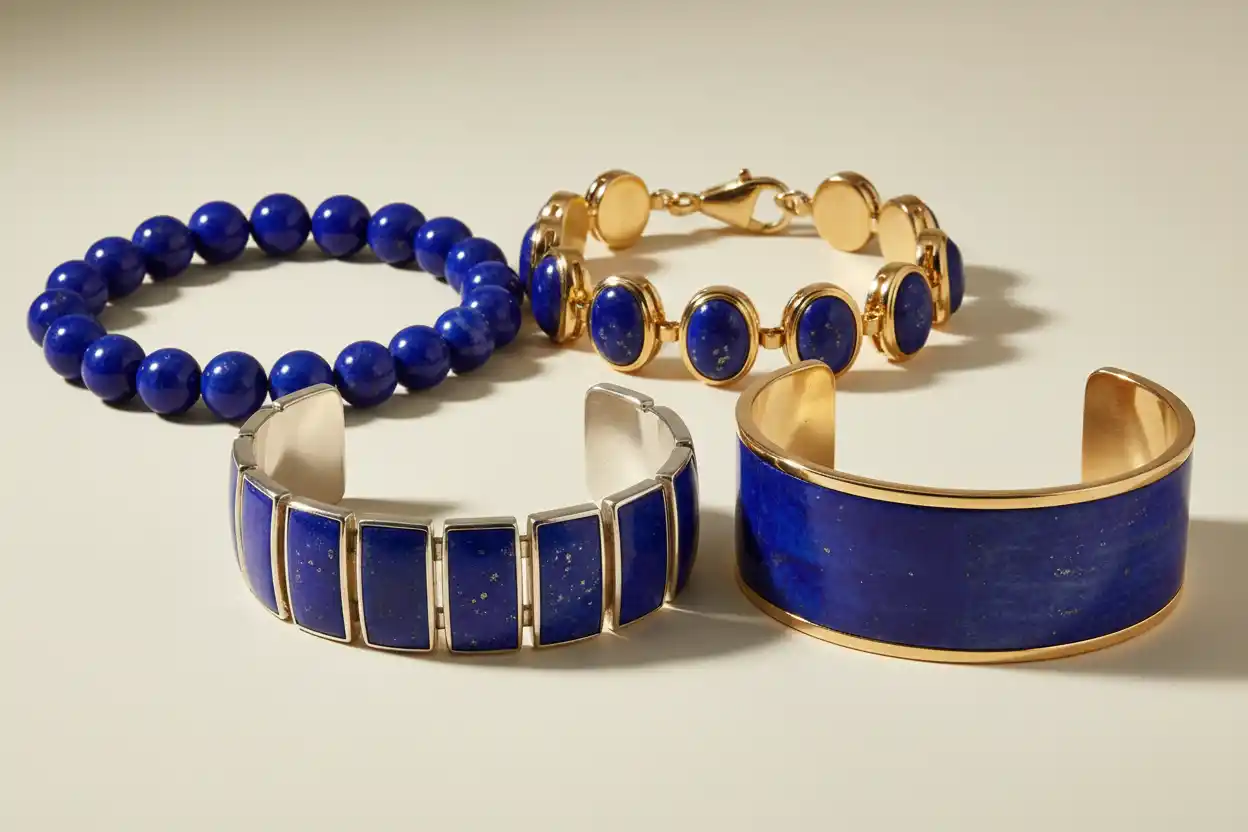
Lapis lazuli bracelets create a strong field of royal, indigo, or violetish blue around the wrist. Some pieces have an almost uninterrupted blue surface, while others display gold-colored pyrite flecks, white calcite veins, or natural variation from bead to bead.
Unlike sapphire or quartz, lapis lazuli is not a single mineral. It is a rock composed mainly of blue lazurite with varying amounts of calcite, pyrite, and other minerals. That mixed composition affects color, hardness, polish, durability, and value.
Bracelets require more care than earrings or pendants because the wrist repeatedly contacts desks, doors, bags, and other jewelry. Lapis ranges around 5–6 on the Mohs scale, depending on its mineral mixture, and commonly receives dye, wax, oil, or plastic sealing.
The broader lapis lazuli guide explains its geology, history, symbolism, and ancient uses. This article focuses on bracelet styles, quality, construction, treatment, fit, buying, and care.
Lapis Lazuli Bracelet at a Glance
| Feature | Practical meaning |
|---|---|
| Material type | Rock composed mainly of lazurite, calcite, and pyrite |
| Common colors | Royal blue, violetish blue, indigo, medium blue, and greenish blue |
| Mohs hardness | Approximately 5–6, depending on composition |
| Toughness | Fair |
| Common bracelet forms | Beads, cabochon links, tablets, cuffs, inlay, and charms |
| Desirable color | Strong, uniform medium-dark blue to violetish blue |
| Pyrite | Can be attractive in small, evenly distributed flecks |
| Calcite | White patches or veins generally reduce value |
| Common treatments | Dye, wax, oil, resin, and plastic coating |
| Main construction concern | Drill holes, stringing, clasp, and exposed inlay |
| Safest cleaning | Gentle warm soapy water after testing an inconspicuous area |
What Is Lapis Lazuli?
Lapis lazuli is an aggregate rather than a mineral species.
Its principal blue component is lazurite. White or pale areas are commonly calcite, while gold-colored metallic flecks are usually pyrite.
Other possible minerals include diopside, mica, feldspar, afghanite, and amphibole.
The relative amount and distribution of these minerals determine whether the material appears deep royal blue, pale mottled blue, greenish, white-streaked, or heavily metallic.
That variation is natural, but it does not mean every pattern has equal value or durability.
Is Lapis Lazuli Suitable for Bracelets?
Lapis can be used successfully in bracelets when the owner accepts moderate durability and gentle care.
It is softer than quartz, topaz, sapphire, and diamond. Dust containing quartz can gradually abrade its polish, while harder jewelry can scratch it directly.
The mixed rock can also include softer calcite areas and veins that wear differently from the surrounding blue material.
The gemstone hardness chart provides a wider comparison. Lapis bracelets should be treated as careful-wear jewelry rather than unrestricted gym, swimming, or work accessories.
Cabochon links and substantial beads generally perform better than thin inlay or delicate carved elements.
Main Lapis Lazuli Bracelet Styles
| Bracelet style | Visual advantage | Main concern |
|---|---|---|
| Round bead bracelet | Continuous blue color | Drill holes, cord, and bead abrasion |
| Faceted bead bracelet | Additional reflected light | Facet-edge wear and bead contact |
| Cabochon link bracelet | Displays individual patterns | Link, bezel, and clasp maintenance |
| Tablet bracelet | Bold geometric appearance | Corners and flat edges can chip |
| Inlay bracelet | Smooth uninterrupted design | Thin material and adhesive failure |
| Cuff | Large decorative surface | Correct fit and impact exposure |
| Charm bracelet | Personal and customizable | Charms collide with chain |
| Mixed-metal bracelet | Blue-gold or blue-silver contrast | Metal quality and stone contact |
| Mixed-gem bracelet | Additional colors and textures | Harder gems can scratch lapis |
| Stretch bracelet | Easy sizing and casual wear | Elastic deterioration |
| Knotted strand | Reduces bead contact | Cord wear and knot quality |
| Masculine link bracelet | Substantial low-profile design | Weight, clasp, and stone backing |
Lapis Lazuli Bead Bracelets
Bead bracelets are widely available and can range from inexpensive dyed commercial strands to fine natural material with strong, even color.
Round beads should be compared for:
- Bodycolor
- Pyrite distribution
- Calcite content
- Diameter
- Shape
- Polish
- Drill-hole condition
- Surface cracks
- Treatment
- Matching
The beads do not need to be identical, but the strand should appear deliberate. One pale calcite-rich bead within a uniformly deep-blue bracelet can disrupt the design.
A graduated bracelet can work when the size progression remains smooth and the color quality does not decline toward the clasp.
Stretch Lapis Bracelets
Elastic bracelets are easy to put on, but elastic gradually deteriorates through stretching, heat, perspiration, cosmetics, and time.
The cord should be thick enough for the bead size and pass smoothly through each drill hole.
Inspect the knot. It should be secure and concealed without being forced into a bead whose hole is too small.
A stretched bracelet should be restrung before the cord breaks. Waiting until individual fibers become visible risks losing the complete strand.
The general crystal bracelets guide discusses common bracelet formats and symbolic wearing.
Knotted Lapis Bracelets
Knots between beads reduce direct stone-to-stone contact and limit loss if the cord breaks.
This construction is especially useful for higher-quality beads or large strands.
The knotting material should suit the total weight. Silk creates a traditional appearance but can absorb perspiration and stretch. Modern synthetic cord may provide greater moisture resistance.
Knots should be consistent in size and sit tightly against the beads without pulling into chipped drill holes.
Lapis Cabochon Link Bracelets
A link bracelet may use oval, round, rectangular, cushion, or freeform cabochons.
Bezel settings protect the edges better than prongs and create a smooth wrist profile. The bezel should fit each stone evenly without glue seepage or gaps.
The links must articulate freely. A stiff bracelet can twist around the wrist and transfer force into the stones.
Closed backs can conceal treatment, repairs, or lower-quality material. Ask whether the cabochons are solid lapis, backed tablets, doublets, or inlay sections.
Lapis Tablet and Signet-Style Bracelets
Flat tablets create a bold architectural appearance. They may be set in silver or gold links, framed with geometric metalwork, or combined with onyx and other opaque stones.
Corners are more vulnerable than rounded cabochons. A metal frame should protect the outline.
Thin tablets can crack if the bracelet bends beyond its intended curve. The links should carry mechanical movement rather than forcing the stone sections to flex.
This style is often marketed toward men, although the design can suit any wearer. The best gemstones for men guide provides other choices for substantial rings and bracelets.
Lapis Inlay Bracelets
Inlay uses thin pieces fitted into channels or decorative patterns.
The surface may appear smooth and uninterrupted, but each seam introduces a possible failure point. Adhesive also becomes part of the structure.
Inspect for:
- Raised or sunken sections
- Visible gaps
- Glue lines
- Cracks crossing several pieces
- Missing fragments
- Uneven polish
- Separation from the metal
- Color mismatch
Inlay bracelets should not be soaked, steamed, ultrasonically cleaned, or exposed to strong solvents.
Choosing Lapis Color
Color is the most important visual quality factor.
Fine lapis commonly shows an intense, uniform, medium-dark blue to slightly violetish blue. It should remain rich rather than dull, greenish, or chalky.
Commercial material may appear pale because of abundant calcite or other light minerals.
An extremely uniform dark blue can be natural, but it can also result from dye. Color alone cannot establish treatment status.
The Lapis Lazuli Buying Guide owns the complete quality assessment.
Pyrite in Lapis Bracelets
Pyrite appears as gold-colored metallic flecks or veins.
Small, attractively distributed flecks can add visual interest and are widely accepted. Pyrite is not proof that lapis is natural because imitation material can contain metallic particles.
Heavy pyrite can disrupt the blue and create a greenish or dull appearance. Large veins may also produce uneven surfaces or structural weaknesses.
The ideal amount depends on personal taste. Some buyers prefer uninterrupted blue, while others value a night-sky appearance.
The seller should not describe pyrite as real gold.
Calcite Content
Calcite appears as white patches, veins, or mottled areas.
Visible calcite generally lowers commercial value because it interrupts the saturated blue. It can also affect wear because calcite is softer than lazurite-rich areas and may abrade more quickly.
Some natural patterns use white matrix deliberately, especially in casual bead bracelets. The material should still be priced according to its actual quality.
A bracelet with abundant calcite is not necessarily fake. It is usually lower-grade lapis or lapis-rich rock.
Matching a Bracelet
A well-matched strand or link bracelet should coordinate:
| Matching factor | What to evaluate |
|---|---|
| Blue hue | Royal, violetish, medium, or greenish blue |
| Tone | Similar darkness across the bracelet |
| Saturation | Consistent intensity |
| Pyrite | Balanced amount and pattern |
| Calcite | Similar absence or deliberate distribution |
| Shape | Uniform or smoothly graduated |
| Dimensions | Accurate bead or cabochon size |
| Polish | Comparable luster |
| Treatment | Consistent disclosure |
| Condition | No isolated cracked or badly chipped stone |
Matching does not require erasing natural variation. It requires a visual rhythm.
Drill Holes
Drill holes deserve careful inspection because they concentrate stress.
Look for:
- Chipped rims
- White calcite weakness
- Cracks radiating from the hole
- Off-center drilling
- Rough interiors
- Dye concentrated in the hole
- Cord abrasion
- Holes too close to the bead surface
Blue color that looks unusually intense inside the drill hole can indicate dye penetration.
Do not perform solvent testing on purchased jewelry. Acetone and alcohol can remove unstable dye or damage coatings.
Treatments
Lapis lazuli is commonly treated.
Dye
Dye deepens pale or mottled blue and can conceal visible calcite.
Some dyes are unstable around solvents, perspiration, cosmetics, and prolonged moisture.
Wax or Oil
Wax and oil can deepen color and improve luster. These treatments may be applied to dyed or undyed material.
Heat and solvents can alter the finish.
Plastic or Resin Coating
A clear coating can seal dye, improve polish, or stabilize porous material.
Coatings may scratch, peel, cloud, or deteriorate with wear.
The treated lapis lazuli guide owns detection, disclosure, and care.
Treatment is not automatically unacceptable. The seller should identify it, and the price should reflect it.
Natural Lapis, Imitations, and Lookalikes
Common substitutes include:
- Dyed howlite
- Dyed magnesite
- Dyed marble
- Dyed jasper
- Glass
- Ceramic
- Resin
- Reconstituted powder
- Synthetic products
- Sodalite
- Coated composite material
The Real vs Fake Lapis Lazuli guide owns the complete authenticity workflow.
Sodalite is a related blue mineral that can resemble pyrite-free lapis. The direct Lapis Lazuli vs Sodalite comparison explains their visual and gemological differences.
The broader sodalite guide should not be used as proof that every white-veined blue stone is sodalite.
Metal Choices
Yellow gold creates a strong historical-looking contrast with royal blue and echoes the color of pyrite flecks.
Sterling silver and white gold create a cooler, more contemporary appearance. Oxidized silver can strengthen contrast without changing the stone.
The metal must be strong enough for the bracelet’s weight. Heavy beads and large tablets require substantial clasps, end fittings, and jump rings.
The guide to gemstones and metals for sensitive skin explains alloy, plating, nickel, and clasp concerns.
Bracelet Fit
A lapis bracelet should remain secure without compressing the wrist.
Excessive looseness allows beads and cabochons to strike desks and doorframes. A tight fit places pressure on drill holes, elastic, links, and clasps.
Measure the wrist and add allowance based on the construction. Large beads require more internal circumference than small beads because they occupy additional space inside the bracelet.
Cuffs should match wrist shape. Repeated bending can weaken metal, loosen inlay, and crack stones.
Clasps and Safety
A link bracelet should use a clasp proportionate to its weight.
Box clasps with safety catches, substantial lobster clasps, and fold-over closures generally provide stronger security than tiny spring rings.
Check the end links and solder. A strong clasp connected to a weak jump ring does not make a secure bracelet.
A safety chain can reduce loss risk when it remains short enough not to catch or strike the stones.
Wearing Lapis Lazuli Bracelets
Wear the bracelet on the non-dominant wrist when practical.
Remove it before:
- Exercise
- Swimming
- Showering
- Cleaning
- Gardening
- Cooking
- Applying perfume or lotion
- Mechanical work
- Sleep
- Contact sports
Do not stack it directly beside diamond, sapphire, topaz, or rough metal bracelets.
For lower-impact jewelry, lapis lazuli earrings and a lapis lazuli necklace protect the material better. A lapis lazuli ring requires even stricter wear habits.
Symbolic Wearing
Lapis lazuli is traditionally and popularly associated with truth, wisdom, royalty, communication, self-expression, and insight.
The dedicated lapis lazuli healing-properties guide owns chakra and crystal-healing interpretations.
A bracelet may serve as a personal reminder to communicate honestly or prepare for an important conversation. It cannot scientifically regulate the throat, improve intelligence, cure anxiety, or guarantee social influence.
The wider blue gemstones guide places lapis among other blue materials without treating their symbolism or durability as identical.
Price and Value
The lapis lazuli price guide owns detailed value analysis.
Bracelet price depends on:
- Blue saturation
- Color uniformity
- Calcite content
- Pyrite distribution
- Bead or cabochon size
- Matching
- Treatment
- Locality claims
- Polish
- Metal
- Construction
- Designer workmanship
Large lapis material is available, so size alone does not establish rarity.
Fine Afghan material can command premiums, but origin should not be assigned from color alone.
Buying Online
Use the safeguards in How to Buy Gemstones Online Without Getting Scammed.
Request:
| Buying detail | What to confirm |
|---|---|
| Material | Natural lapis lazuli or disclosed imitation |
| Treatment | Dye, wax, oil, resin, coating, or reconstruction |
| Color | Neutral-light photographs and video |
| Pyrite and calcite | Actual distribution rather than edited removal |
| Dimensions | Bead size, bracelet length, and width |
| Construction | Elastic, cord, wire, knots, links, or inlay |
| Metal | Alloy, hallmark, plating, and clasp |
| Condition | Chips, cracks, scratches, and repairs |
| Origin | Evidence for Afghan, Chilean, or Russian claims |
| Returns | Enough time for non-destructive inspection |
An independent report may be useful for expensive, heavily represented, or disputed material.
The gemstone certification guide explains what a colored-stone identification report can establish.
Cleaning and Storage
Follow How to Clean Lapis Lazuli Jewelry Safely.
Warm soapy water is the safest general method, but first test a small inconspicuous area because some dyes are unstable.
Avoid acetone, alcohol, acids, household chemicals, steam, and ultrasonic cleaning.
Do not soak bead, inlay, glued, or coated bracelets.
Dry the piece promptly and store it flat in a separate padded compartment. Harder gemstones can scratch it.
Belief-based cleansing belongs to How to Cleanse and Charge Lapis Lazuli and should avoid salt, prolonged water, heat, and harsh smoke residue.
The Crystals That Start With L and Gemstones That Start With L directories provide the wider alphabetical context.
Frequently Asked Questions
1. Is lapis lazuli durable enough for a bracelet?
It can be worn carefully, but its hardness of approximately 5–6 and mixed mineral composition make it vulnerable to scratches and impact.
2. What is the best lapis bracelet color?
Fine material usually shows intense, uniform, medium-dark blue to slightly violetish blue.
3. Is pyrite in lapis desirable?
Small, attractively distributed pyrite flecks can add interest. Heavy pyrite can make the material dull or greenish.
4. Does white calcite mean lapis is fake?
No. Calcite is a natural component, although large white patches generally lower value.
5. Are most lapis bracelets dyed?
Not all are dyed, but dye is common in commercial material. Written treatment disclosure is important.
6. Can dyed lapis fade?
Some dyes can rub off or react to solvents, perspiration, cosmetics, and prolonged moisture.
7. Is a stretch lapis bracelet safe?
It can be wearable, but elastic deteriorates and should be replaced when it stretches or frays.
8. Can lapis beads crack around drill holes?
Yes. Off-center drilling, calcite-rich areas, and tight stringing can create or enlarge cracks.
9. Is lapis lazuli the same as sodalite?
No. Lapis is a rock aggregate that commonly contains lazurite, calcite, and pyrite. Sodalite is a mineral species.
10. Can a lapis bracelet be cleaned ultrasonically?
No. Ultrasonic vibration and cleaning solutions can damage treatments, inlay, glue, and the stone’s mixed structure.
11. Does a valuable lapis bracelet need a laboratory report?
A report can be useful for expensive material, disputed treatment, or important origin claims, though ordinary commercial strands rarely require one.
12. What should I do when the elastic begins stretching?
Stop wearing the bracelet and have it restrung before the elastic breaks. Preserve the bead order if matching or pattern matters.
A well-chosen lapis lazuli bracelet depends on more than a strong blue photograph. The quality of the rock, distribution of calcite and pyrite, honesty about dye or wax, condition of the drill holes, and strength of the construction determine whether the bracelet remains attractive after repeated wear.
Lapis lazuli symbolism, chakra associations, and healing claims are cultural or personal beliefs rather than scientifically established medical effects. Do not use the stone to diagnose illness, replace medication or therapy, guarantee communication outcomes, or make safety-critical decisions.