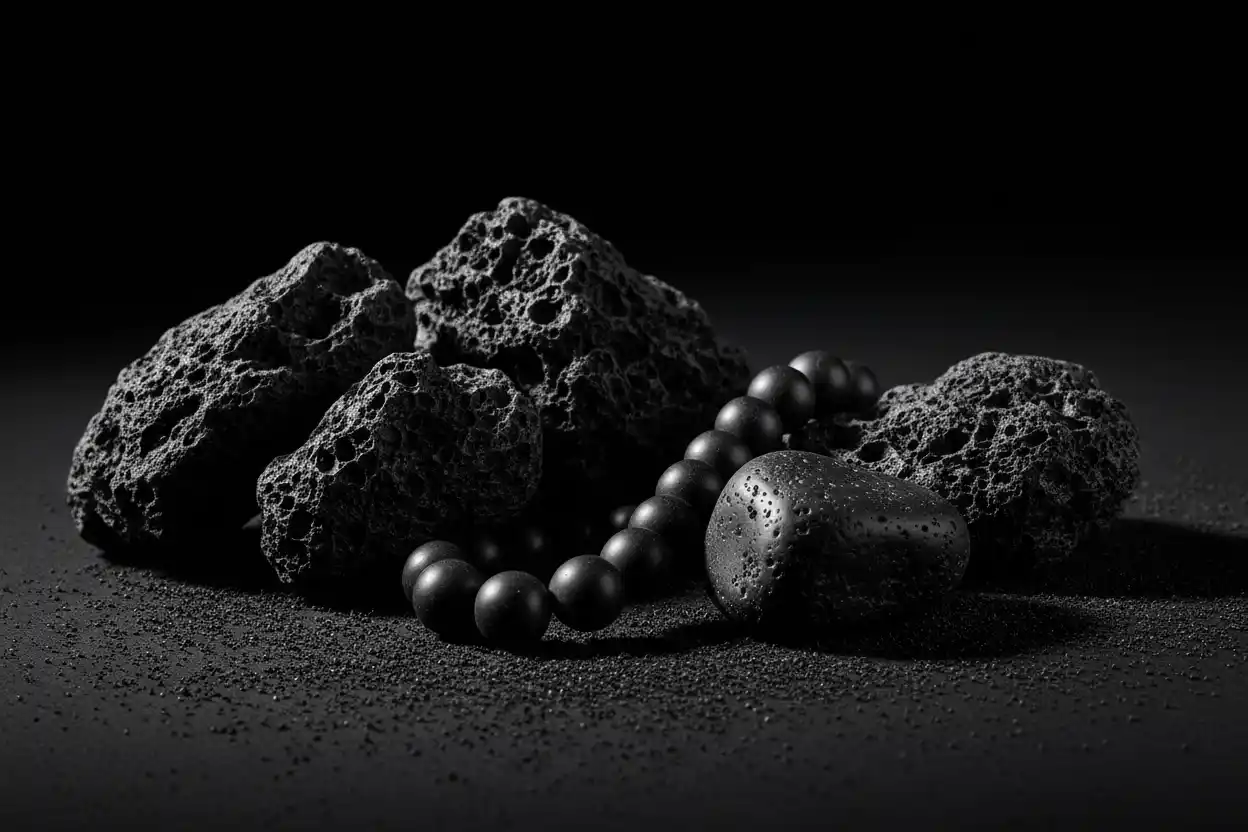
Lava Stone: Meaning, Properties & Uses
Lava stone is a broad commercial name for porous volcanic rock, most commonly vesicular basalt or basaltic scoria. Its holes formed when expanding gas bubbles became trapped as erupted lava cooled, although the exact mineral composition and durability vary between deposits and products.
Lava Stone at a Glance
| Property | Lava Stone Characteristics |
|---|---|
| Material type | Vesicular volcanic rock, usually basaltic scoria or porous basalt |
| Composition | Variable mixture of plagioclase, pyroxene, olivine, volcanic glass and iron-titanium oxides |
| Colors | Black, charcoal, gray, dark brown, reddish brown and red |
| Crystal system | None for the rock as a whole |
| Habit or texture | Vesicular, porous, fine grained, scoriaceous, rough or rounded after polishing |
| Luster | Dull in rough form; matte to softly polished in beads |
| Transparency | Opaque |
| Mohs hardness | Variable, commonly about 5–6 for compact basaltic material |
| Cleavage | No rock-wide cleavage |
| Tenacity | Brittle, with strength reduced by pores and fractures |
| Common uses | Beads, bracelets, necklaces, diffuser jewelry, landscaping, filtration media and decorative objects |
| Main care concern | Porosity, crumbling edges, dye, resin, trapped oils and silica-bearing dust during cutting |
What Is Lava Stone?
Lava stone is a trade term rather than one mineral or one formally defined rock type.
Most black porous beads sold under the name are made from basaltic scoria or vesicular basalt.
Basalt is a fine-grained volcanic rock that forms from relatively silica-poor lava. Scoria is a strongly vesicular volcanic material commonly produced during basaltic or andesitic eruptions.
The distinction is textural. A dense basalt may contain few holes, while scoria contains abundant vesicles created by expanding gas.
Commercial lava stone can also include other porous volcanic rocks, ceramic imitations, dyed material and reconstructed stone.
As a result, one chemical formula, hardness value or country of origin cannot apply to every product.
The types of gemstones guide places lava stone among ornamental rocks rather than mineral species.
How Lava Stone Forms
Magma contains dissolved gases such as water vapor, carbon dioxide and sulfur-bearing compounds.
Deep underground, high pressure keeps much of that gas dissolved.
As magma rises and pressure decreases, the gases separate from the melt and form bubbles. The process resembles gas escaping when a carbonated drink is opened, although volcanic conditions are vastly hotter and more energetic.
When lava erupts, it begins cooling rapidly.
If the outer lava hardens before every bubble escapes, empty cavities remain inside the solid rock. Geologists call these holes vesicles.
Lava with relatively few bubbles becomes dense basalt. Bubble-rich fragments can become scoria, while extremely gas-rich, silica-rich magma can produce pumice.
Flow tops, lava fountains, cinder cones and the edges of cooling flows commonly generate vesicular material suitable for commercial lava beads.
Is Lava Stone Basalt?
Many products are basaltic, but lava stone and basalt are not perfect synonyms.
Basalt describes a rock composition and fine-grained volcanic texture. Lava stone describes a commercial appearance.
Dense basalt without visible holes is still basalt but may not be sold as lava stone.
Porous scoria can be basaltic or andesitic. Therefore, not every commercial bead has identical composition.
Some sellers describe all lava beads as pure basalt, even when no geological documentation accompanies the product.
The safest wording is vesicular volcanic rock, usually basaltic scoria or porous basalt.
Mineral Composition
Basaltic lava stone commonly contains microscopic plagioclase feldspar and pyroxene.
Olivine may occur as green-to-brown grains, while magnetite, ilmenite and other iron-titanium oxides contribute to dark color.
Part of the rock may remain volcanic glass because cooling occurred too quickly for complete crystallization.
Red and brown scoria contain oxidized iron, particularly around vesicles and exposed surfaces.
Secondary minerals may later fill some holes. Calcite, zeolites, quartz and clay can crystallize inside old vesicles, producing an amygdaloidal texture.
Because every flow has different chemistry, one lava-stone bead can be denser, harder or more magnetic than another.
Why Does Lava Stone Have Holes?
The holes are molds left by gas bubbles.
Their size and abundance depend on magma viscosity, gas concentration, eruption style, cooling rate and pressure.
Small round vesicles can form when bubbles remain separate.
Larger irregular cavities develop when bubbles merge or stretch as lava moves.
Elongated vesicles may preserve the direction of flow.
Commercial beads are cut through these cavities, so every surface shows a different arrangement of pits.
The holes can make the stone lightweight, but they also reduce strength. Thin walls between neighboring vesicles can break during drilling or wear.
The cavities also trap skin oils, soap, perfume and dirt more easily than a smooth polished gemstone.
Lava Stone vs Scoria
Scoria is the most accurate geological name for many porous lava-stone products.
It is usually dark gray, black, reddish brown or red and has relatively thick walls between vesicles.
Scoria is denser than pumice and typically sinks in water.
A seller may avoid the word scoria because lava stone sounds more appealing in jewelry. Nevertheless, the two terms often refer to the same commercial material.
Not all scoria cuts well. Highly friable pieces crumble around drill holes, while compact scoria can be shaped into durable matte beads.
Lava Stone vs Pumice
Pumice is a frothy volcanic rock with exceptionally high vesicle content.
It commonly forms from silica-rich magma and can appear white, cream, pale gray or light brown.
Many pumice pieces float temporarily or permanently because their interconnected pore structure holds air.
Dark basaltic lava stone is generally denser, has thicker vesicle walls and feels stronger.
Both materials can be porous, but pumice is usually too abrasive and friable for conventional jewelry beads.
A black bead that feels exceptionally light and crumbles under a fingernail may be low-density scoria, artificial foam stone or another porous material rather than durable basalt.
Lava Stone vs Obsidian
Obsidian is volcanic glass.
It forms when silica-rich lava cools rapidly without crystallizing substantially. Most obsidian has a homogeneous glassy texture and conchoidal fracture.
Lava stone is granular or glassy-fine but contains numerous vesicles. Its surface is matte and pitted rather than smooth and mirrorlike.
Black obsidian is denser, sharper when broken and better able to take a high polish.
The types of obsidian guide covers snowflake, rainbow, sheen and mahogany varieties without classifying them as porous lava beads.
Mahogany obsidian can share reddish-brown and black colors with scoria, but its texture remains glassy rather than vesicular.
Lava Stone vs Intrusive Igneous Rocks
Lava stone forms at or near the surface.
Intrusive rocks cool underground and develop larger mineral grains.
Gabbro is the coarse-grained compositional counterpart of basalt. It contains visible feldspar and pyroxene crystals rather than the fine texture of a lava flow.
Larvikite is a feldspar-rich monzonitic intrusive rock with blue iridescence.
Kimberlite is a volatile-rich mantle-derived igneous rock and potential diamond transport system.
These rocks may all appear dark, but their formation depth, mineralogy and texture differ substantially.
Lava Stone Colors
Black and charcoal are the most common commercial colors.
Fresh basaltic glass and fine iron-bearing minerals absorb visible light and create the dark body.
Red and brown develop when iron oxidizes during eruption, cooling or later weathering.
Gray material may represent less oxidized basalt or a mixture of pale feldspar and dark minerals.
Bright blue, purple, green or pink lava beads are commonly dyed.
White lava beads may be bleached, painted, ceramic or made from naturally pale volcanic material that is not ordinary basaltic scoria.
Color should be inspected inside drill holes and broken edges. A natural body color should continue through the bead.
Where Does Lava Stone Come From?
Vesicular basalt and scoria occur in volcanic regions worldwide.
Commercial material may be sourced from Indonesia, China, Mexico, Türkiye, Italy, Iceland, the United States and other volcanic areas.
However, many bead strands have no reliable quarry or country documentation.
A country-of-manufacture label may identify where the beads were drilled rather than where the rock erupted.
Claims that every bracelet comes from Hawaii, Iceland, Mount Etna or another famous volcano should be treated cautiously.
Collecting fresh lava from active or protected volcanic sites can be illegal and dangerous. Most commercial beads come from older deposits, quarries or wholesale rock suppliers.
Exact volcanic provenance rarely affects value unless the material accompanies a documented geological or historical specimen.
How to Identify Lava Stone
Natural lava stone should show irregular vesicles that vary in size, shape and position.
The cavities continue through the interior rather than forming a repeated molded surface.
A hand lens may reveal tiny mineral grains, glassy walls and reddish oxidation around some pores.
Natural material generally feels lighter than dense basalt but heavier than plastic foam.
Resin and molded ceramic may show seam lines, repeated bubble patterns and uniform pore sizes.
Paint can collect inside the shallowest holes without penetrating broken edges.
Slag may also be vesicular. Industrial slag can contain glassy flow textures, metallic globules and unusually bright colors.
The how to identify crystals process should therefore include context and composition because porosity alone does not prove volcanic origin.
The warning signs in how to spot fake crystals help identify resin, paint and molded material.
Hardness and Durability
Lava stone has no uniform hardness.
Compact basaltic minerals commonly fall around Mohs 5–6, while olivine grains may approach 6.5–7.
Volcanic glass and altered material can behave differently.
The gemstone hardness chart should therefore be used as a general comparison rather than an exact lava-stone value.
Pores reduce toughness by leaving thin rock walls between cavities.
Drilling creates additional stress, especially when the hole intersects a large vesicle.
The rock has no single cleavage direction, but fractures can follow vesicle walls and grain boundaries.
The distinction in gemstone toughness versus hardness explains why a moderately hard bead can chip or split easily.
The gemstone cleavage guide applies to individual mineral grains rather than the rock as a whole.
Jewelry Uses
Lava stone is most commonly made into round beads.
Its low weight and dark matte surface suit bracelets, necklaces, earrings and mixed-material designs.
The porous texture creates contrast with polished metal, quartz, tiger’s eye and other smooth beads.
Cabochons are less common because large open vesicles prevent an even polish.
Lava beads can scratch softer materials when their edges remain rough. Spacers or knots help prevent direct rubbing against pearl, opal and calcite.
The rock fits within black gemstones and black crystals as an ornamental material, although it is neither a crystal nor a standardized gem species.
Gray products may also overlap visually with the gray gemstones category.
Lava Stone and Essential Oils
Porous beads can absorb a small amount of liquid.
For that reason, sellers market lava bracelets as essential-oil diffuser jewelry.
The rock does not transform or medically enhance the oil. It simply holds droplets within surface pores and releases aroma gradually as volatile compounds evaporate.
Essential oils can irritate skin, stain clothing and damage elastic cord, dye, glue or metal finishes.
Use only a very small amount and allow the bead to absorb the liquid before wearing it.
Never assume that an oil is safe because it is natural. Citrus, cinnamon, clove and several other oils can cause irritation or photosensitivity.
Children, pets, pregnancy, respiratory conditions and allergies require additional caution.
The aroma comes from the oil, not from a healing property of the volcanic rock.
Treatments and Imitations
Black dye is common because it creates a uniform matte appearance.
Wax or resin may strengthen weak surfaces and reduce crumbling.
Some beads receive paint, sealant or fragrance-compatible coating.
Reconstituted products may combine crushed volcanic rock with resin.
Ceramic and molded-resin beads can imitate the pitted texture convincingly.
Treatment does not automatically make a bead unusable, but it should affect price and care.
A sealed bead may absorb less essential oil than untreated scoria. Conversely, an unsealed highly porous bead can trap dirt and deteriorate more quickly.
The treatment categories in gemstone treatments explained provide useful disclosure language.
Lava Stone Price and Value
Lava stone is inexpensive because vesicular volcanic rock is abundant and bead production is highly scalable.
| Lava Stone Product | Broad Current Asking Range |
|---|---|
| Small loose bead or tumbled piece | Under $1–$3 |
| 15–16 inch commercial bead strand | Approximately $2–$15 |
| Simple elastic bracelet | Approximately $5–$30 |
| Bracelet combined with other stones | Approximately $15–$75 |
| Silver or designer jewelry | Approximately $30–$200+ |
| Small decorative sphere or diffuser stone | $5–$25 |
| Large natural specimen with documented locality | $20–$150+ |
The metal, design, brand and associated gemstones often account for more value than the lava stone itself.
A generic bead should not receive a rarity premium based on unverified claims about a famous volcano.
Natural irregularity, structural strength, clean drilling and honest treatment disclosure matter more than dramatic origin stories.
Buying Lava Stone
Check the drill holes and unfinished areas.
Natural texture should continue through the bead. Surface paint that exposes a pale core indicates treatment or imitation.
Beads should not crumble when handled gently. Large fractures around the drill hole can cause early breakage.
Ask whether the material is natural scoria, dyed basalt, ceramic or reconstructed stone.
A seller should also disclose whether the surface has been sealed, particularly when the product is marketed for essential oils.
The exact source may remain unknown for inexpensive strands. Honest uncertainty is preferable to an unsupported claim that the rock came from an active volcano.
Cleaning Lava Stone
Dry brushing removes ordinary dust.
For untreated beads, use brief lukewarm washing with mild soap. Rinse carefully and allow the pores to dry fully before storing or adding essential oil.
Avoid prolonged soaking because water, detergent and fragrance can remain inside connected vesicles.
The guidance in crystals that can and cannot go in water should therefore be applied cautiously.
Do not use ultrasonic cleaning. Vibration can weaken thin vesicle walls and damage elastic cord or glue, as explained in gemstones and ultrasonic cleaners.
Boiling, steam and strong solvents can affect dye, resin and reconstructed beads.
Lava Stone Meaning and Symbolism
Modern symbolism connects lava stone with transformation, endurance and rebuilding after disruption.
The association comes naturally from molten rock cooling into a solid material.
Black and dark-gray colors also inspire themes of grounded judgment, boundaries and stability.
The vesicles can symbolize experiences that leave visible marks without destroying the whole structure.
Some people use lava bracelets as reminders of resilience or significant travel to volcanic regions.
These meanings remain personal or cultural interpretations. Scientific evidence does not show that lava stone absorbs stress, balances energy or improves health.
Its geological history already provides a clear metaphor: mobile molten material released gas, cooled and became a durable record of an eruption.
Frequently Asked Questions About Lava Stone
Is lava stone a mineral?
No. It is a trade name for porous volcanic rock made from several minerals and volcanic glass.
Is lava stone the same as basalt?
Many products are vesicular basalt or basaltic scoria, but dense basalt is not always sold as lava stone.
Why does lava stone have holes?
Gas bubbles became trapped as erupted lava cooled and solidified.
Is scoria the same as pumice?
No. Scoria is generally darker and denser, while pumice is usually lighter and much more frothy.
Is lava stone the same as obsidian?
No. Obsidian is volcanic glass with a smooth homogeneous texture, while lava stone is porous and vesicular.
How hard is lava stone?
Compact basaltic material commonly falls around Mohs 5–6, but porosity and mineral composition create substantial variation.
Is lava stone durable for jewelry?
Compact beads can tolerate regular wear, although pores and drill holes create chipping and breakage risks.
Can lava stone hold essential oils?
Yes. Its surface pores can hold small amounts of liquid, but skin-safe use depends on the oil rather than the stone.
Is lava stone dyed?
Many commercial black and brightly colored beads are dyed, painted, sealed or resin treated.
Can lava stone go in water?
Brief washing is usually acceptable, but avoid prolonged soaking and allow the pores to dry fully.
Can lava stone go in an ultrasonic cleaner?
No. Vibration may damage porous rock, cord, dye or resin.
What makes lava stone valuable?
Workmanship, metal, associated gemstones, structural quality and documented geological origin matter more than the raw rock itself.
Lava stone appears in the Crystals That Start With L and Gemstones That Start With L directories, although it is scientifically a volcanic rock rather than a crystal.
Safety disclaimer: Cutting or drilling lava stone can release fine volcanic-glass and silicate dust. Use wet methods, extraction, eye protection and appropriate respiratory protection. Essential oils applied to porous beads can irritate skin or affect children, pets and people with allergies; follow qualified safety guidance for the oil rather than relying on the stone.