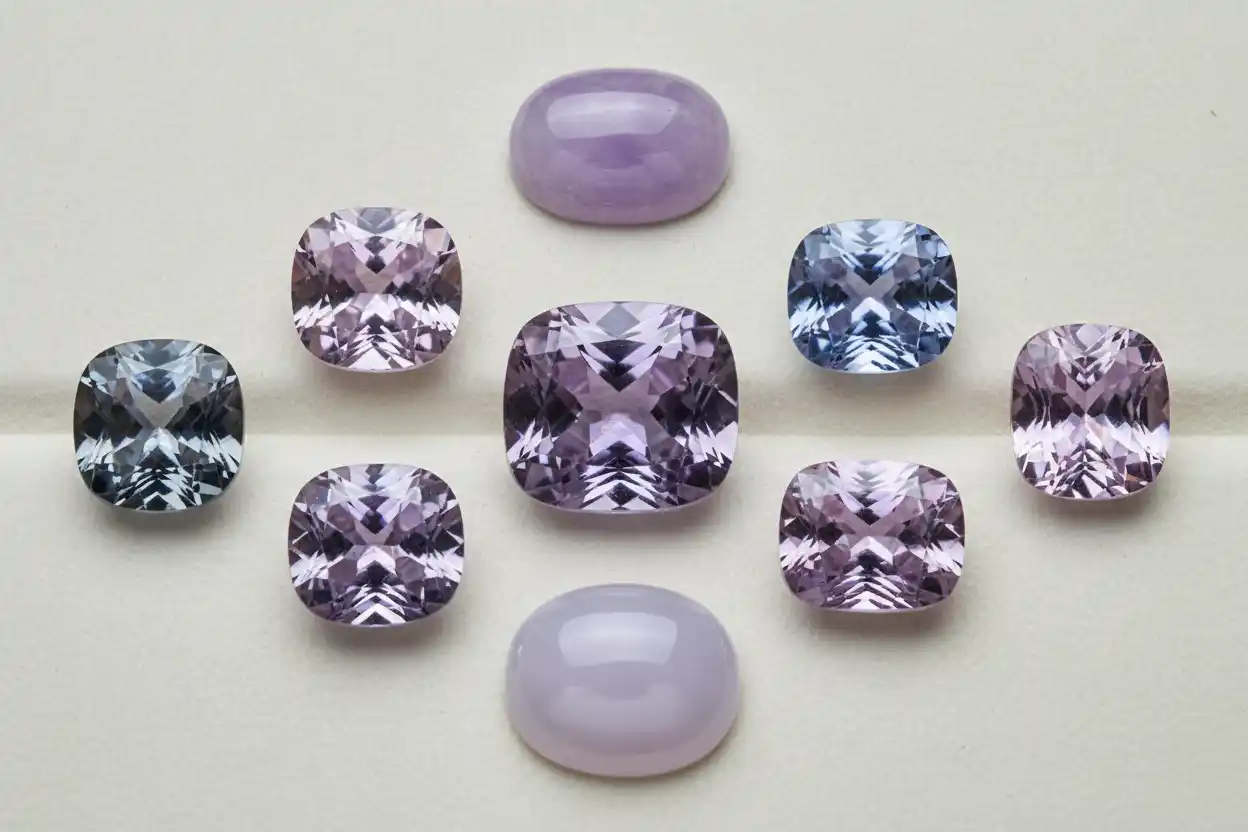
Lavender Gemstones: Names, Meanings and Jewelry Uses
Lavender gemstones range from barely tinted lilac stones to pinkish-purple, violet-gray and cool mauve gems. The color appears in several unrelated mineral families, including quartz, corundum, spinel, spodumene, cordierite, scapolite, fluorite, chalcedony and jadeite.
No single laboratory test identifies a stone as lavender because lavender is not a species. A pale-purple gem could be durable sapphire, cleavage-prone kunzite, soft fluorite, tough chalcedony or treated material whose color sits only at the surface.
The companion Lavender Crystals guide focuses on specimens, clusters and tumbled stones. This page owns the jewelry-oriented question: which gemstones naturally occur in lavender shades, how they differ and which ones suit rings, earrings, necklaces or occasional wear.
What Color Is Lavender?
Lavender is generally a light purple with a noticeable blue, pink or gray component.
Lilac often appears slightly pinker, while violet may look bluer or more saturated. Mauve commonly contains more gray or muted red. Trade descriptions overlap, and no universal gemological boundary separates them.
Lighting matters. A pale purple stone may look distinctly lavender in daylight, pink under warm incandescent light and gray under weak indoor illumination.
The broader Purple Gemstones guide includes deep violet, plum and saturated purple materials. Lavender gemstones occupy its lighter pastel range.
Lavender Gemstones Compared
| Gemstone | Mineral identity | Mohs hardness | Main durability concern | Typical lavender appearance |
|---|---|---|---|---|
| Amethyst | Quartz | 7 | Excessive heat or prolonged intense light | Lilac to pale violet |
| Sapphire | Corundum | 9 | Treatments and occasional fracture damage | Pale violetish purple |
| Spinel | Magnesium-aluminum oxide | 8 | Chips from severe impact | Bright lilac to lavender |
| Kunzite | Spodumene | 6.5–7 | Perfect cleavage and fading | Pinkish lavender |
| Iolite | Cordierite | 7–7.5 | Cleavage and strong directional color | Blue-violet to gray-lavender |
| Scapolite | Scapolite-group mineral | 5.5–6 | Cleavage and abrasion | Pale pink-purple |
| Fluorite | Calcium fluoride | 4 | Perfect cleavage and scratches | Clear lavender to violet |
| Chalcedony | Microcrystalline quartz | 6.5–7 | Dye and treatment disclosure | Translucent lilac-gray |
| Jadeite | Pyroxene-group mineral | 6.5–7 | Treatment and hidden fractures | Translucent lavender |
| Charoite | Complex silicate material | About 5–6 | Scratches and matrix weakness | Swirling lilac and violet |
| Sugilite | Cyclosilicate mineral | About 5.5–6.5 | Scratches and imitation risk | Pink-purple to lavender |
| Topaz | Aluminum fluorosilicate | 8 | Perfect cleavage and coated color | Rare natural or treated lavender |
| Tourmaline | Complex borosilicate | 7–7.5 | Heat sensitivity and fractures | Pinkish violet or lilac |
| Tanzanite | Zoisite | 6–7 | Perfect cleavage | Bluish lavender |
| Moonstone | Feldspar | 6–6.5 | Cleavage and surface wear | Gray-lavender bodycolor |
| Quartz trade material | Quartz or treated quartz | 7 | Misleading color names | Hazy pink-purple or lilac |
Lavender Amethyst
Amethyst is the most accessible natural lavender gemstone.
Its color ranges from pale lilac to deep reddish purple. Light stones are often affordable because stronger, evenly distributed purple normally attracts greater commercial demand.
Amethyst ranks 7 on the Mohs scale and has good toughness, making it suitable for earrings, pendants, bracelets and rings worn with reasonable care.
A pale stone should still have a lively cut. Weak color combined with a deep windowed pavilion can make the gem appear almost colorless.
Heat treatment can convert some amethyst to yellow, green or other colors, while laboratory-grown amethyst is widely available. Neither synthetic origin nor treatment can be established by eye alone.
Lavender amethyst commonly symbolizes calm judgment, moderation and reflection.
Lavender Sapphire
Lavender sapphire is pale purple corundum.
The Sapphire Color Meaning guide covers the wider symbolic range, while Types of Sapphire separates purple sapphire from pink, blue, yellow and other varieties.
Sapphire’s hardness of 9 and strong practical toughness make it the most durable major lavender gem for rings and engagement jewelry.
Color may range from pinkish violet to cool bluish lavender. Some stones show zoning or change appearance under different light sources.
Heat treatment is common in sapphire. Diffusion, filling, coating and laboratory growth also occur. A valuable stone represented as natural and untreated should have an appropriate independent report.
Lavender sapphire is commonly associated with loyalty, disciplined insight and reflective wisdom.
Lavender Spinel
Lavender spinel can show clear lilac, violet-gray, bluish purple or pinkish-lavender color.
Spinel ranks 8 on the Mohs scale and has no pronounced cleavage, giving it excellent jewelry potential.
Well-cut material can display strong brilliance even when the color is pale. Because spinel is singly refractive, its facet pattern may appear especially crisp.
Natural lavender spinel is less familiar than amethyst and may be confused with sapphire, synthetic spinel or glass.
Some pale colors are more affordable than vivid red, cobalt-blue or hot-pink spinel, although unusual fine stones can still command significant prices.
Its modern meanings commonly concern renewal, optimism and emotional recovery.
Kunzite
Kunzite is one of the most recognizably lavender gems because it naturally combines pink and violet.
Strong pleochroism means the apparent color depends on orientation. A good cutter positions the rough so the strongest face-up color remains visible.
Kunzite can be cut in large sizes and often has excellent transparency. However, perfect cleavage, brittleness and light sensitivity limit its everyday use.
Pendants and earrings are safer than exposed rings. The gem should not remain for long periods under intense sunlight or display lighting.
Color may be natural or enhanced by irradiation followed by heating.
Symbolically, kunzite is frequently connected with compassion, vulnerability and open communication.
Iolite
Iolite is gem-quality cordierite with strong pleochroism.
Depending on direction, one stone may show violet-blue, pale blue, gray or nearly colorless appearances. Light material can therefore look lavender from selected angles.
Iolite ranks around 7–7.5 but has cleavage, requiring reasonable impact protection.
The strongest commercial color is usually saturated violet-blue rather than pale lavender. Nevertheless, well-cut lighter gems can provide an understated alternative to amethyst.
Its directional color also makes online buying difficult. Video should show the stone rotating rather than remaining at its best angle.
Iolite is commonly associated with navigation, perspective and self-direction.
Lavender Scapolite
Scapolite occurs in yellow, colorless, pink and violet material.
Pale purple scapolite can look like kunzite, amethyst or light sapphire. Refractive index, density, optic character and spectroscopy can separate them.
Its moderate hardness and cleavage make it better for earrings and pendants than daily rings.
Some scapolite displays attractive fluorescence. That reaction is a gemological observation rather than evidence of spiritual energy.
Lavender scapolite is often associated with purpose, responsibility and changing established habits.
Purple Fluorite
Purple fluorite provides some of the clearest pastel lavender color but is among the least durable jewelry choices.
Its Mohs hardness of 4 and perfect cleavage make it vulnerable to scratches, chips and setting damage.
Fluorite works best in protected pendants, earrings, collector gems and occasional jewelry. It is unsuitable for an exposed daily ring.
Transparent material may show color zoning, bands or fluorescent reactions. Those features add interest but do not compensate for structural weakness.
Its modern symbolism commonly concerns concentration and mental order.
Lilac Chalcedony
Lilac chalcedony is translucent microcrystalline quartz with soft violet-gray or pink-purple color.
The general Chalcedony guide explains its structure and broad family.
Chalcedony’s interlocking microcrystals provide strong toughness, making it suitable for cabochons, beads, rings and carved jewelry.
Natural pastel material exists, but dye is common across commercial chalcedony. Treatment disclosure is essential when color appears unusually uniform or intense.
The subdued color is often associated with patient speech, listening and emotional composure.
Lavender Jadeite
Fine lavender jade usually refers to lavender jadeite.
The broader Jade guide explains why jadeite and nephrite are separate minerals sold under the shared word jade.
Lavender jadeite can range from pale grayish violet to richer pink-purple. Transparency, texture, color distribution and treatment strongly influence value.
Bleaching, polymer impregnation and dye can substantially improve appearance. These treatments are not reliably identified from photographs.
Jadeite has moderate hardness but excellent toughness, making it practical in cabochons, bangles and carved jewelry when structurally sound.
Symbolically, lavender jade is associated with harmony, restraint and patient decision-making.
Charoite
Charoite is an opaque ornamental material with swirling lilac, violet, white, gray and black patterns.
It is usually cut into cabochons, beads and carvings rather than transparent faceted gems.
The most attractive pieces use the flowing pattern deliberately. Large pale areas can create lavender-dominant designs, while strong fibrous texture produces a silky appearance.
Charoite is softer than quartz and requires protection from scratches and chemicals.
It is commonly associated with transformation, courage during change and emotional adaptability.
Sugilite
Sugilite can range from pale lavender and pink-purple to dark saturated violet.
Most jewelry material is opaque, although fine translucent material can be highly valued.
The market contains imitations, dyed stones and composites, so expensive pieces may justify professional identification.
Sugilite is suitable for pendants, earrings and protected cabochons. Exposed rings may show scratches over time.
Its modern symbolic themes include compassion, boundaries and emotional support.
Lavender Topaz
Topaz is naturally colorless, blue, yellow, pink, orange or brown, while confirmed natural lavender-purple material is unusual.
Some gems marketed as lavender topaz are coated colorless topaz or products sold under names such as mystic topaz. The visible color may come largely from a thin surface coating.
Topaz ranks 8 on the Mohs scale but has perfect cleavage. A hard blow can split it despite its strong scratch resistance.
Coated stones should be protected from abrasion, repolishing, ultrasonic cleaning and aggressive chemicals.
A seller should explain whether lavender color is natural, irradiated, coated or otherwise treated.
Lavender Tourmaline
Tourmaline occurs in a very broad color range.
Pale pinkish-violet and lilac stones may be described as lavender tourmaline, although the term is not a separate mineral variety.
Tourmaline ranks around 7–7.5 and is suitable for most jewelry with normal care. Fractured stones and thin elongated cuts need additional protection.
Color zoning is common and may create pink-to-lavender or violet-to-colorless transitions.
Its symbolism often concerns flexibility, creativity and emotional balance.
Tanzanite With a Lavender Appearance
Tanzanite is blue-to-violet zoisite.
Light stones or gems viewed along certain pleochroic directions can appear distinctly lavender.
Most tanzanite is heated to reduce brown or green components and emphasize blue-violet color. Treatment is accepted but should be disclosed.
The gem has cleavage and moderate hardness, so earrings and pendants are safer than everyday rings.
A pale lavender appearance should not be valued as highly as saturated blue-violet material merely because it carries the tanzanite name.
Lavender Moonstone and Feldspar
Moonstone may have a gray-lavender or pale violet bodycolor.
Its adularescence—a moving internal sheen—is separate from bodycolor. A stone can be lavender without showing a strong blue glow, or colorless while displaying blue adularescence.
Some marketed lavender moonstone is coated or loosely named feldspar. Laboratory testing may be needed when identity affects value.
Cleavage and surface wear make pendants and earrings safer than high rings.
The material is usually associated with cycles, reflection and adaptability.
Jewelry Suitability
Lavender sapphire and spinel are the strongest choices for daily rings.
Amethyst, chalcedony, jadeite, tourmaline and iolite can also perform well when the setting suits the material.
Kunzite, tanzanite, scapolite and topaz need more protection because cleavage increases breakage risk. Fluorite is best treated as collector or occasional jewelry.
The Gemstone Hardness Chart provides scratch-resistance comparisons, but toughness, cleavage and treatment must also guide design.
Treatments and Misleading Names
Lavender gems may receive heat, irradiation, diffusion, dye, coating, polymer impregnation or laboratory growth.
Treatment is not automatically negative. The concern is whether it is stable, disclosed and reflected in price.
Names such as lavender quartz, lavender moonstone and lavender topaz may be seller-defined. They should never replace the actual mineral identity.
A report from an independent laboratory is particularly useful for valuable lavender sapphire, jadeite, spinel or unusual transparent stones. The Gemstone Certification guide explains what reports can establish.
Symbolic Meaning of Lavender Gemstones
Lavender is often associated with calm, dignity, imagination, compassion and reflective spirituality.
Those meanings come from color psychology, religious and cultural color use, and modern crystal traditions. They are not universal and do not establish that every lavender gem produces the same effect.
The stone’s mineral identity remains more important for durability and buying. Someone may select sapphire for a daily ring, kunzite for an evening pendant or fluorite for a display specimen while assigning all three a similar personal color meaning.
Frequently Asked Questions
1. What is the most common lavender gemstone?
Pale amethyst is the most widely available and recognizable.
2. What is the most durable lavender gem?
Lavender sapphire is the hardest common option, followed by spinel.
3. Is lavender sapphire natural?
Natural lavender sapphire exists, but heat treatment, diffusion and laboratory-grown material are also available.
4. Is lavender spinel rare?
Natural lavender spinel occurs and may be less expensive than highly prized red or cobalt-blue spinel, although fine stones are not common in every size.
5. Is kunzite always lavender?
No. It ranges from pale pink through violetish pink and purple, with strong directional color.
6. Can lavender gemstones fade?
Kunzite is particularly vulnerable to intense light. Some amethyst, treated quartz and coated gems can also change.
7. Is lavender jade real jade?
It can be natural jadeite, but dyed and polymer-treated jade as well as non-jade substitutes are common.
8. Is lavender topaz naturally colored?
Natural purple topaz is unusual. Many lavender-colored products are coated or otherwise treated colorless topaz.
9. Which lavender gemstone is best for earrings?
Nearly all can work in earrings, including delicate fluorite, kunzite and tanzanite, because earrings receive limited impact.
10. Which lavender gemstones should not be worn daily in rings?
Fluorite, kunzite, scapolite, tanzanite and cleavage-rich topaz require more protection and controlled wear.
11. What do lavender gemstones symbolize?
Common modern associations include calm, imagination, compassion, dignity and spiritual reflection.
12. How can I verify an expensive lavender gemstone?
Request complete treatment disclosure and obtain an independent gemological report when identity, origin or enhancement materially affects value.
Lavender is one color expressed through many structures. Sapphire achieves it in hard corundum, spinel in a brilliant cubic crystal, kunzite in cleavage-prone spodumene and chalcedony in tough microcrystalline quartz. Choosing successfully means appreciating the shared color while buying according to the actual mineral.
Lavender-gemstone healing, chakra and emotional claims are cultural or personal beliefs rather than scientifically established medical effects. Gemstones should not replace medical, psychological or professional care.